Lempire Founder Interview: How to Grow Product ARR to $30 Million | Bolt Picks

The Value of Founders Doing Sales and Writing Content Themselves
When a user runs into a problem and reaches out to customer service, there's probably no better experience than having the product founder personally help fix it. When someone wants to understand a company, nothing beats reading what the founder actually wrote. In a market flooded with information and fierce competition, users and customers gravitate toward businesses — or brands — with clear, authentic stories and a human face.
Recently, the podcast 20VC interviewed Guillaume Moubeche, founder of Lempire, angel investor, and bestselling author. On the episode, he shared how he grew his product to $30 million ARR, emphasizing why founders need to master sales, how to build distinctive content from personal experience and customer stories, and the unique value of founders actively creating and distributing content. We've compiled and translated excerpts from the interview; click the "Read More" link to listen to the original podcast.
🔍 Key Takeaways
1. Founders must own sales: Sales is one of the most important skills for founders. Face rejection head-on, uncover real needs, and find your unique selling proposition.
2. UX optimization and product iteration: Track user behavior, communicate directly with customers to understand their problems, and repeatedly test and refine product design to improve activation rates.
3. Pricing strategy and market dynamics: As your product's value grows, raise prices regularly to match market trends. In economically uncertain times, focus on actual usage patterns and optimize pricing structure accordingly.
4. Founder personal brand and content creation: A founder's content builds trust. Persistently publish high-performing content to expand influence, shortening sales cycles and increasing inbound leads.
5. Multi-platform content repurposing: High-performing content can be repackaged for different platforms, with gradual optimization based on audience preferences.
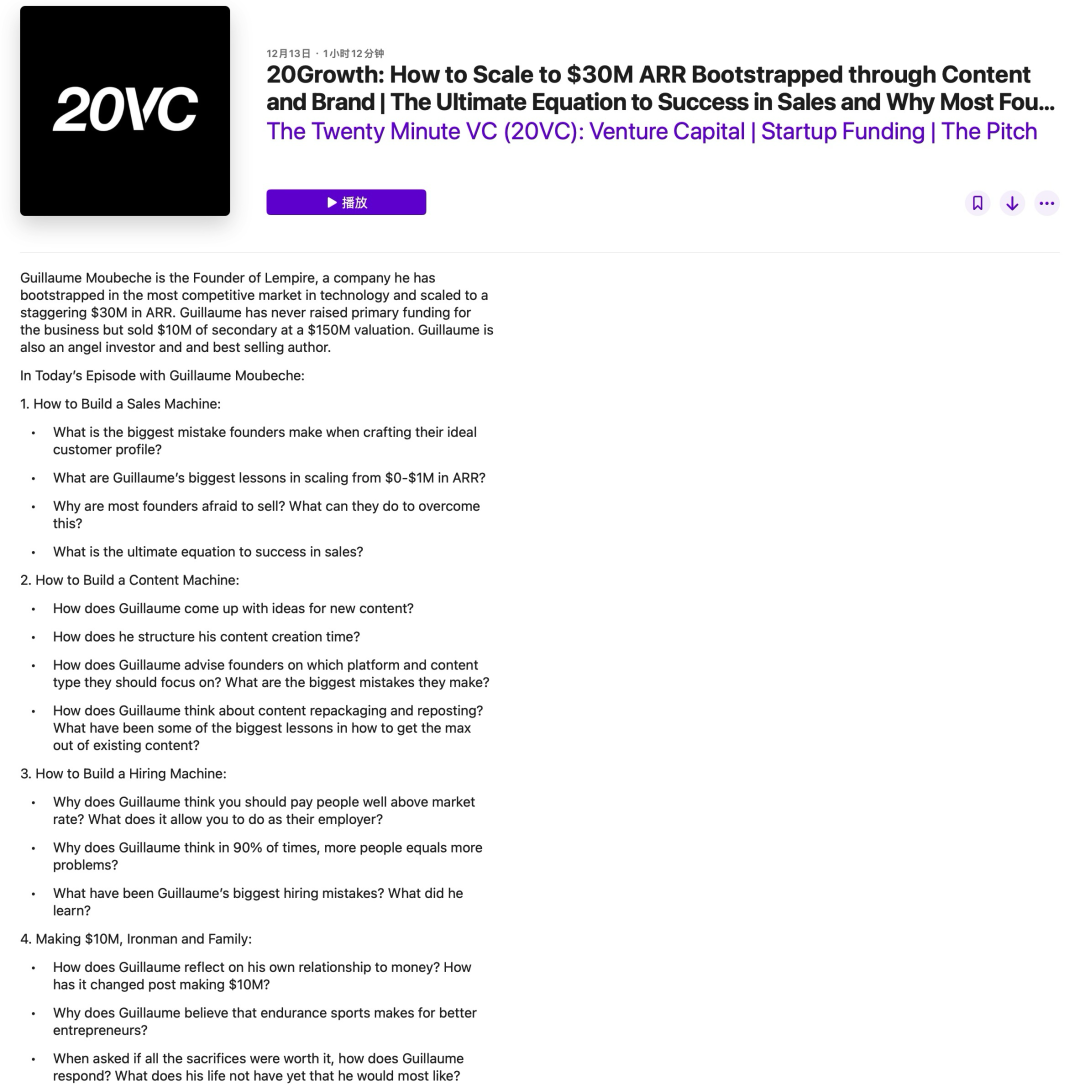
Image | Podcast Shownotes
Part.01
Why Founders Should Lead Sales
1) Harry Stebbings: In a crowded tech market, what did you do differently to raise your initial startup capital?
Guillaume Moubeche: First, we had no money. I started Lemlist (a cloud-based email marketing software) with just $1,000 and couldn't hire anyone. If I'd had money, I definitely would have hired people to do things I thought weren't worth a founder's time — but that would have been a mistake. A lot of founders are scared of sales because they think it's a job anyone can do. But in reality, sales is the most important skill a founder must master. Because everything is sales — whether it's recruiting top talent, getting your first revenue, or understanding what people are actually buying. So, with no initial funding, I spent 18 months doing almost everything: customer support, sales demos, marketing, building the website. I also wrote content, constructing an engine to acquire customers efficiently.
Because we were in a competitive market, you had to clearly define your target segment. When we first entered, we aimed at the lower end of the SMB market — mainly founders who needed to make quick decisions and were looking for innovative solutions to gain competitive advantage. To reach this market, I did sales outreach using Lemlist itself. Then, when I met these founders, they'd say: "I'm not sure cold email actually works." I'd counter: "So how did we start this conversation?" They'd say: "Through cold email." I'd reply: Exactly. That's how I closed deals. I tested different sales approaches and sales potential across different industries.
Every campaign that worked exceptionally well, I'd write about. This content was unique — it helped our users understand what worked and what didn't. Before launching Lemlist, I'd already run an agency, so I was already doing extensive sales prospecting. Back then, I was essentially "onboarding" clients by telling them: "I'll run sales outreach campaigns for you, but you have to let me use the content we create together (since it involves their campaign results)." They agreed. So I used these customer stories to build a community. From this community, I learned how to make a better product, how to improve it, and tested new features based on this feedback to see if they drove more or better results — iterating repeatedly.
2) Harry Stebbings: What's the biggest mistake you see founders make in the zero-to-one stage?
Guillaume Moubeche: I think a lot of people are afraid of prospecting, afraid of putting themselves out there, afraid of selling. So I think one of the biggest mistakes is being afraid that you can't sell, afraid the product isn't good enough. When you have to sell something that's clearly inferior to competitors, finding that unique selling proposition to make conversion easier is key.
It's like research — it requires extensive trial and error. You think people buy your product for X, Y, or Z, but the actual reason may be completely different. I think people are naturally afraid of rejection. They like hiding behind processes, behind existing product roadmaps, behind "all the things we're doing." But I believe the biggest mistake is not trying to sell. Regardless of whether your product is ready, if people aren't willing to pay, something is wrong — the pain point isn't intense enough. You should keep digging, keep talking to them, and figure out what problem you're actually solving.
Part.02
How the Right Decision Brought the Product to Life
3) Harry Stebbings: People usually look back and think, I messed up this and that. During the period when customer conversions went from zero to 250,000, what mistakes do you think you made?
Guillaume Moubeche: I was obsessed with how many visitors we had, how many conversions, how many paying customers? For us, conversion rate was essentially the metric for whether users saw value in the product. Initially, this number was terrible — around 10%.
I tried interviewing users, but it was extremely difficult because once users are unhappy with your product, they don't want to talk to you. Eventually I realized we needed to completely redesign the product. So we decided to rebuild the entire campaign creation flow from scratch. I remember it was a Friday night when I deployed the new version; I woke up Saturday morning to the community filled with outrage. The support team was overwhelmed with messages to handle. People hated the new interface, thought things were missing — the situation was brutal. That month's churn hit around 50%, unprecedented. We fixed many bugs, improved many things.
But when I looked back a month later, I still believed it was the right decision. I still think those churned users weren't using the product the way we designed it. It was harsh at the time — many people messaged me through chat saying "I want to speak to a manager." I'd tell them "I'm the CEO," and they'd assume the company was huge. A month and a half later, when I looked back at the new product, new design, and new user experience conversion rates, they'd jumped from 10% to nearly 45%. In that month with 50% churn, we barely grew because new customer acquisition basically brought us back to zero. In the following months, our growth rate was around 40%.
4) Harry Stebbings: What changes did you make that drove conversion from 10% to 40%?
Guillaume Moubeche: Originally, the system was designed so you had to create different templates, create a list, and make many different settings in different places. Only after completing all setup could you consolidate everything into one campaign. But if you hadn't created any content yet, you couldn't create a campaign. That's why people were frustrated — they couldn't understand it. The system was like an engineer's product: structurally clear, you had to build all the foundational modules first, then assemble them, test, and eventually it would be easier to operate. But in reality, people wanted you to hold their hand and tell them, "This is step one, then step two, then step three," and so on. So we completely rebuilt and simplified the campaign creation process, making it easier for users to go from A to Z. That changed everything at the time.
5) Harry Stebbings: For more founders out there — when their product activation rate is only 10%, or users are clearly dissatisfied and they're unsure whether to keep going — what advice would you give?
Guillaume Moubeche: Activation rate and churn rate are two issues I think about through different lenses. The first lens: is this a marketing and customer acquisition problem?
Typically, if I'm selling a product for sales teams but attracting marketers, they may use the product differently. Then you might think there's a reason for low activation or high churn. So first you should ask yourself: am I attracting the right customers?
If the answer is yes, and these are the customers you want to attract, then next you should ask: why is activation so low? Is the problem you're solving for them not painful enough yet? Or is the software UX poor? For this, I recommend using appropriate tools like Hotjar, Mixpanel, etc., to track all events and understand what people are doing and how they're doing it. This is most important because especially when you're an engineering-background founder, you might say: "Oh, I can find the answers myself through these tools." But that's not the best way.
For me, the best method is to call customers. If they don't answer, call again, and again, until you get answers. If someone signed up for your product but didn't like it, you have an obligation to understand why. You're the founder, you have your mission, you should have the drive. I think many people are afraid of calling, afraid of communicating, and thus can't learn the truth. They make assumptions that they would discover were wrong if they just picked up the phone for five minutes.
6) Harry Stebbings: In a competitive market, what's the biggest lesson you've learned about product pricing?
Guillaume Moubeche: Pricing is really hard. As your product evolves and delivers more value, prices should rise accordingly. This is a rule every founder should follow. I think our growth was partly helped by raising prices — it was very beneficial.
So don't always delay, waiting for the next feature release to raise prices. Raise them at least once a year.
At the same time, pay attention to market trends in your space. We're currently in an uncertain phase; economically, people have become more cautious, more rigorous about where they spend money. I think many people in the market are struggling not because their product is too expensive, but because people realize: if you're not using a tool, you shouldn't pay for it. For example, a company bought 1,500 licenses but only 15 people in the company are actually using it. The CFO will think: maybe we shouldn't keep paying so much.
So for pricing, I consider two aspects: one, if you're still delivering value, raise prices regularly; two, watch the market closely, because sometimes pricing dynamics shift and you need to adjust your pricing strategy accordingly.
Part.03
How a Founder's Personal Brand Helps Sales
7) Harry Stebbings: If a founder says, "Guillaume, I love what you're doing, but I'm just not good at that personal brand thing, that's not me" — how would you respond?
Guillaume Moubeche: Honestly, I think putting yourself out there and creating content will one hundred percent help your business, it will help you build trust. More trust means shorter sales cycles, more leads, and revenue growth as a result. As a founder, it's a great way to meet many interesting people. Actually, there are millions of businesses with great stories to tell, but you've never heard of them because they don't document anything. When these businesses reach out to you, you wonder who they are. I think content creation is the simplest way for people to understand you — it's like saying to customers: "Hey, this is what I'm doing. If you find me interesting, or after watching my videos you think I'm someone worth talking to, we can chat."
Now when I do sales outreach, or simply send intros, messages, or networking calls, my response rate is very high. This means every year I meet more smart, interesting people, which helps my personal growth tremendously and helps me become a better version of myself. So as a founder, creating content helps you become a better founder.
8) Harry Stebbings: How do you actually get content creation done? Do you have a framework around ideation, thinking process, creation, and distribution?
Guillaume Moubeche: If you want inspiration, read; if you want clarity, write. My goal is to capture ideas simply, whether through voice memos, notes, or other methods. Later, I gather all ideas together and prioritize them. I think ideas are like seeds — before growing into trees, they need time, suitable soil, and environment. For me, all ideas are seeds, but sometimes I focus more attention on one idea and spend time developing it.
My approach is: write down all ideas first, then spend time thinking about them, start writing, and draw inspiration from that. Compared to most people who focus on one task, my approach might seem a bit unconventional. For example, when I want to write a LinkedIn post, I might write 15 to 20 posts in one hour. But I don't finish one post at a time — I'll work on three or four simultaneously. A sentence I write for one post might inspire two others.
This may sound strange, but that's how my mind works. I like doing multiple things at once and switching between different tasks, so my thinking develops in parallel. I find this particularly suited for creating and writing content, because after finishing one piece, I can come back later to evaluate the idea, rather than obsessing over a single point.
9) Harry Stebbings: When you plan to publish video versions of the same content on TikTok, YouTube Shorts, and other platforms, do you first look at what works on other platforms before repurposing content? How do you think about packaging media content for different platforms?
Guillaume Moubeche: I think content repurposing is very important. When you're a content creator, it's usually because you enjoy sharing and learning that you create content. Just like you do podcasts because you enjoy learning new things.
For me, content creators are always learning new things, so they fear reusing content that performed well. But if it worked well, there must be a reason. So when certain content performs well, I rewrite the same content and publish it repeatedly. If every post is well-received, you can turn it into Reels or TikToks and see if it works there too. Step by step, you can reuse effective content and increasingly understand your audience.
But if it works on one platform, that doesn't mean it will work on every platform.
10) Harry Stebbings: Looking at your current understanding of content creation and distribution, what do you wish you'd known when you first started your company?
Guillaume Moubeche: I think one thing I wish I'd known is that content creation takes time. Because usually people want their work to blow up quickly. Everyone knows that with some time on TikTok, you'll eventually get lucky with a million-view video or something. But if you want long-term growth, you need persistence and time. When I first ran Instagram Reels, I often felt like a failure and didn't continue. Later I realized I shouldn't have quit back then. I later changed my strategy to focus on output rather than results. This is a method I like, which I call the "100-Day Rule." Essentially: output is what you can control — you can control publishing one video or one LinkedIn post every day. But you can't control results, like how many followers or views you get. So I decided to focus on output, committing to publishing content every day for 100 days no matter what. I wouldn't even look at follower counts — just do it.
When you persist for 100 days, you realize you're improving every day. This not only helps build more confidence, but you also start enjoying it. Because initially you weren't good, but now you're constantly improving. So you'll start enjoying the process, and in the long run, you'll see some results. This doesn't mean you'll immediately become a superstar, but you'll start seeing some outcomes and begin having valuable conversations.
I did something similar with my head of sales — we wrote a massive number of LinkedIn posts. I wrote roughly two months of content, which brought us excellent marketing results and step-by-step progress toward what we wanted.
📮 Further Reading



Linear Bolt Bolt is an investment initiative by Linear Capital specifically for early-stage, global-market-facing AI applications. It upholds Linear's investment philosophy, focusing on technology-driven transformative projects, and aims to help founders find the shortest path to their goals. Whether in speed of action or investment approach, Bolt's commitment is lighter, faster, and more flexible. In the first half of 2024, Bolt invested in seven AI application projects including Final Round, Xinguang, Cathoven, Xbuddy, and Midreal.