Linear Academy | What We Discussed at the "ToB Tech Enterprise Operations Management Salon"
Not long ago, Linear Capital and its portfolio company Guandata co-hosted a "ToB Tech Company Operations Management Salon" — a "homework submission" event that followed up on a Huawei BLM workshop Linear Academy had organized for portfolio companies two years prior. It was warmly received by founders across Linear's portfolio. At the event, Monica, formerly a business operations specialist at Sensors Data, drew on her practical experience since first encountering Huawei's BLM to discuss "enterprise operations management systems."
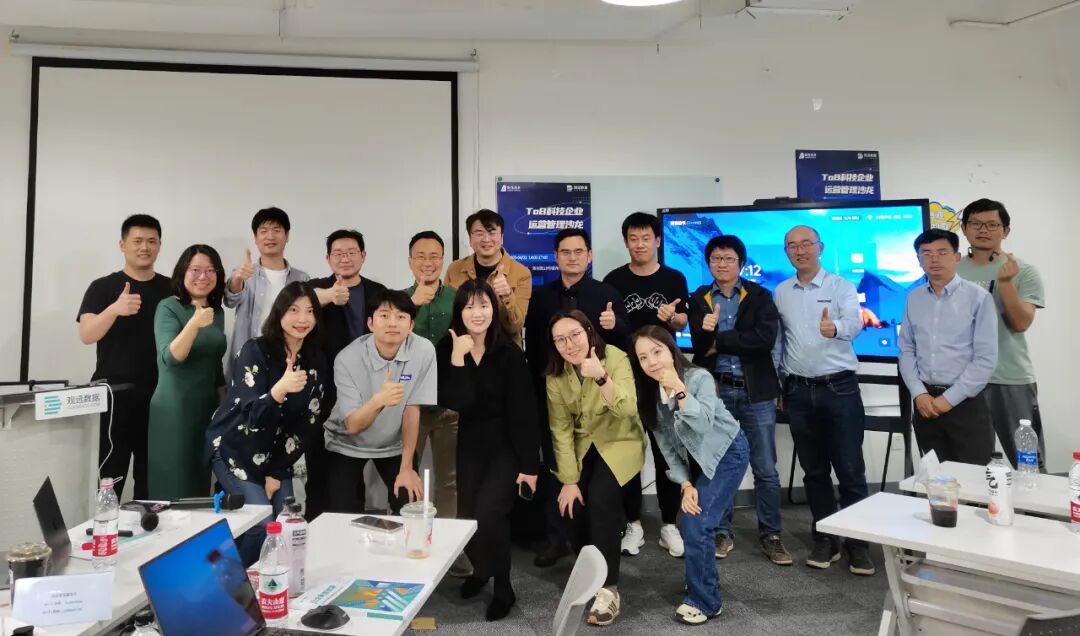
Not long ago, Linear Capital and its portfolio company Guandata co-hosted a "ToB Tech Enterprise Operations Management Salon" — a "homework submission" event following up on a Huawei BLM workshop that Linear Academy had organized for portfolio companies two years prior. It was warmly received by founders across Linear's portfolio. Monica, formerly a business operations specialist at Sensors Data, shared her reflections on BLM and her practical experience implementing it in company operations over recent years, drawing from her hands-on practice since first encountering the Huawei framework. Su Chunyuan, founder and CEO of Guandata, discussed his company's BLM implementation experience and the pitfalls they'd encountered. We've summarized portions of their presentations below.
I. What is operations management at a ToB tech company?
Operations management refers to the systematic activities that standardize how a company runs its various functions — from R&D investment through commercial output — across organization, product and technology, marketing, finance, and more. The goal is to improve operational process efficiency in a systematic way to optimize final results. Whether you're actually doing operations management comes down to three criteria:
- Holistic controllability: Balancing mature and emerging businesses in alignment with the company's long-term strategic plan.
- Measurability: Clear value recipients, clear inputs and outputs, inevitable efficiency gains — enabling proactive management intervention rather than passive reactive firefighting.
- Accumulability: Sometimes a project depends on a superstar expert. When reviewing, focus on process — ask why processes and systems didn't enable others to innovate. The aim is raising the company's average baseline, not pinning success on individuals. Anti-heroism. Build reusable, continuously optimizable organizational methods. Internalize employee capabilities as company assets.
II. What is an operations management system?
-
From strategic planning to execution: The core is verifying the chain from planning to execution to review. Strategic Plan (SP) covers strategic objectives, strategic initiatives, and organizational design. Business Plan (BP) covers business objectives, business strategies, key actions, business units, and functional departments.
-
Company-level core business processes: The core is designing clear cross-company collaboration (ideally fit on one page), so when problems arise you can see where things broke down. In practice, this often becomes designing the process for designing processes. Key processes (from Huawei's operations methodology):
- Product Development (IPD): Product planning and design, product R&D process, product go-to-market (GTM)
- End-to-End Business (LTC): Lead management, opportunity management, project delivery management, service renewal management
- Service Support (ITR): Internal service processes, customer service processes, value-added service processes
-
Functional management process support: Including compliance and risk control, legal management, IT system construction, finance, HR management, and administrative processes.
III. Operations system priorities at different company stages
-
Startup phase: The key is rapidly finding product-market fit
- Establish one unified set of books — don't let each department use different standards. A top-down evaluation system with linked tools, the earlier the better.
- Product MVP market validation, with clear pricing principles to guide later pricing iterations.
- GTM: Sales operations, marketing operations, building a leads-to-conversion pipeline.
-
Growth phase: The key is establishing standards (the best stage for building LTC). Clarifying the relationship between mature and new businesses, designing structures to manage them.
- Focus on LTC process construction for efficient collaboration.
- Every new business metric must be analyzed for its connection to the company-wide evaluation system.
- Every new business model incubation must be examined for its differences and connections to existing business processes — extending LTC rather than patching it.
-
Maturity phase: The key is strengthening predictability
- Business review meetings align core management on execution results of business strategies, with rolling strategy iteration and fiscal year outcome forecasting.
- Focus on accuracy of business unit BP/SP, judgment verification, and standardization of business processes.
- Greater emphasis on integration with IPD and ITR processes.
Guandata's BLM Practice and Iteration
What is BLM?
BLM, or Business Leadership Model, is called "业务领先模型" in Chinese. Reportedly co-developed by Harvard University and IBM, it was introduced to Huawei in 2006 through Huawei's cooperation with IBM, and subsequently became known and adopted by Chinese tech companies. It's a tool and framework for middle and senior management to connect strategy formulation and execution. It helps us see clearly where we are now, where change is happening, where we intend to go, and based on current conditions and capabilities, design a roadmap for getting there.
Guandata's experience and reflections
Guandata went through 10 quarters of practice and continuous iteration of BLM's seven-step method: gap analysis, market insight, strategic intent, innovation focus, business design, strategy decomposition, execution iteration, and organizational construction.
- 2020: Initial experimentation (self-directed learning and practice, plenty of materials available online)
- Early 2021: Framework formalization (systematic learning, Linear training)
- 2022: Strategy decomposition (targeted catch-up, external guidance)
- 2023: Business-finance integration (targeted catch-up, external learning)
Summary:
- Quarterly lightweight sessions: ~15 participants × 10-20 hours per person
- Semi-annual deep dives: ~25 participants × 30-50 hours per person
- Reflection and iteration: 2023 iteration direction — combining BLM with agile, internal-external hybrid with internal emphasis
Three value points experienced:
- Value one: In goal-setting and strategy scenarios, forming a unified framework for trade-offs, enabling higher-quality decisions
- Value two: Communication of strategy-to-execution, ensuring consistent understanding and traceability during implementation
- Value three: "Single-minded focus" — positive cycle between strategy and organization
Future iteration directions
New question 1: From strategic opportunity points to strategic control points (moats) New question 2: From BLM to building an agile organization
Additionally, the event included interesting discussions on specific scenarios such as stage-appropriate strategy formulation and methods for prioritizing customer needs.
About Linear Capital
We are hiring for our investment team, with multiple positions currently open. For details, please click here.
Linear Capital is an early-stage investment firm focused on "frontier technology + industry" — frontier technologies represented by data intelligence, digital new infrastructure, next-generation robotics, and new technology transformations in traditional sectors (such as biomedicine, materials, energy, etc.), applied across vertical industries to substantially improve industrial efficiency, empower solutions to pain points, and enable industrial upgrading. We achieve excess returns through substantial increases in industrial value. We currently manage ten funds with total AUM of approximately $2 billion.
Our investment stage focuses primarily on leading angel to Series A rounds, with typical check sizes of $3-8 million or RMB equivalent.
We have made early-stage investments in over 120 teams including Horizon Robotics, Kujiale, Sensors Data, Tezign, Rokid, Guandata, Agile Robots, and others. The combined valuation of Linear's portfolio companies is approximately $20 billion.
In the near term, Linear Capital is working to become the premier "Data Intelligence Technology Fund." In the long term, we aim to build the most influential "Frontier Technology Application Fund."