Xieyue Intelligence Closes Hundreds of Millions of Yuan in Angel+ Round, Co-Invested by Linear Capital | Linear Portfolio

Driving embodied foundation models with Duplex Reasoning.

Today, Xieyue Intelligence announced the completion of a several-hundred-million-yuan angel+ round, with participation from Linear Capital, JunShan Capital, Hongyi Capital, Hidden Hill Capital, and other institutions.
Founded in February 2026, Xieyue Intelligence is an embodied foundation model company targeting the home as its first deployment scenario. It is building a general-purpose embodied model for the real physical world, using its proprietary model to drive the rollout of general-purpose home robots.
Neil Zeng, partner at Linear Capital, said: "The real barriers for home robots are reliability and product definition. Pushing the success rate up notch by notch — in real homes, with real users, within real safety boundaries — is a capability honed in the automotive industry. Wei Chen and Xiao Zhang are one of the very few teams in China who have taken a foundation model all the way to mass-production devices and been accountable to end users. We're glad to be on this journey with Xieyue."
Recently, Xieyue Intelligence closed a several-hundred-million-yuan angel+ round. With this funding, Xieyue will continue advancing embodied foundation model training, computing and data infrastructure build-out, core team expansion, as well as home robot hardware R&D and scenario validation.
Founded in February 2026, Xieyue Intelligence is an embodied foundation model company with the home as its first deployment scenario. Xieyue is building a general-purpose embodied model for the real physical world, using its self-developed model to drive the deployment of general-purpose home robots.
Xieyue was co-founded by Wei Chen, former chief AI scientist and head of the foundation model department at Li Auto, and Xiao Zhang, former president of product lines at Li Auto. Its core team comes from globally renowned technology, AI, robotics, and smart vehicle companies, with capabilities spanning five domains: large-model algorithms, AI infrastructure, robot motion control, product management, and supply chain. It is one of the few top-tier teams in China with end-to-end experience across 10,000-GPU large-model training, digital and physical world models and agent development, and consumer product definition through mass-production delivery.
Xieyue believes the home is one of the most complex, highest-frequency, and most valuable real physical environments over the long term. Household tasks naturally combine perception, understanding, planning, manipulation, and interaction — they involve both mental and physical labor — making the home an ideal proving ground for general embodied intelligence. Xieyue believes the home is the core training ground, validation ground, and scale-deployment scenario for embodied foundation models. For the longer-term, endgame vision of robots "entering the home," Xieyue proposes an embodied foundation model driven by the Duplex Reasoning paradigm.
In the past, traditional robot systems typically followed a simplex or half-duplex process of "receive command — execute action — return result," emphasizing correct execution and task completion. But home scenarios require constantly responding to demands that are ambiguous, changing, and continuously arising. Duplex Reasoning aims to keep a "two-way channel" open between the robot and humans throughout perception and understanding, reasoning and planning, and task execution: conversational information can be interrupted and corrected at any time, and action goals can be dynamically adjusted mid-execution — ultimately creating a general-purpose home action intelligence that is interruptible, correctable, takeover-ready, and continuously evolving.
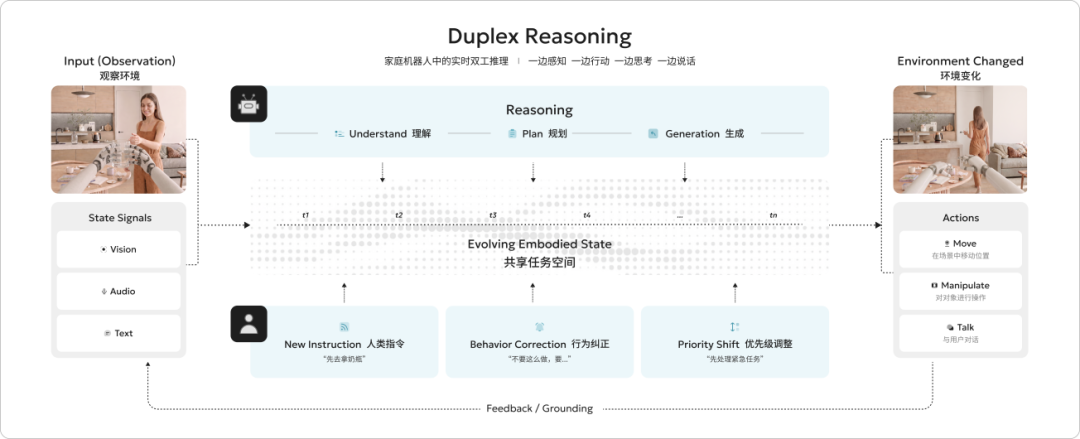
The home is not just the real physical world — it is human-centered. While executing digital skills and physical actions, Duplex Reasoning continuously receives human intervention, environmental feedback, and safety signals. It doesn't execute tasks in one direction; it keeps reasoning and adjusting through interaction, action, and feedback. Duplex Reasoning unifies interaction and action.
The Duplex Reasoning paradigm Xieyue proposes establishes a new paradigm for embodied foundation models: interaction and action should be modeled jointly across data, model architecture, and training pipelines. With VLA as the backbone, it connects with world-model prediction in a coordinated way — language compresses vision, speech, and environmental changes into transferable high-level semantics, driving cross-scenario generalization; the world model predicts the possible future outcomes of actions, providing prior constraints for long-horizon tasks. Together, both point toward one goal: improving a robot's success rate of understanding, decision-making, and action in open environments at a controllable compute cost.
Xieyue believes the core competitiveness of embodied intelligence lies not in bigger models or more data, but in high-quality data and systematic infrastructure capabilities. Among these, training infrastructure and data infrastructure are two equally important pillars — the training system determines the ceiling of model capability, and the data pipeline determines the precision of real-world deployment. The company breaks model capability down into infrastructure problems that can be accumulated over time:
First, training infrastructure: building a reusable, scalable training system around pretraining, post-training, and reinforcement learning to fully unlock the value of high-quality data;
Second, data infrastructure: building a high-standard data pipeline around signal synchronization, task design, and annotation quality — prioritizing boutique data that is highly representative and information-dense, rather than blindly stacking up data hours;
Third, establishing a closed loop covering evaluation and simulation, so that model progress can be measured continuously and objectively.
Driven by the twin wheels of training infrastructure and data infrastructure, Xieyue will explore the scaling laws of embodied intelligence at a more controllable compute cost.
Currently, Xieyue has completed an initial version of its self-developed egocentric data collection device and data platform, and is gradually building a layered data system around first-person-view data, embodiment-free data, and high-quality embodiment-related data. The company plans to complete the full pipeline — from collection, cleaning, and annotation to training — within 2026, while continuously improving signal quality, task coverage, and label validity.
On hardware, Xieyue adopts a phased strategy of "single embodiment, full-stack closed loop." By keeping the robot's form factor, sensor selection, and software-hardware interfaces consistent, it first reduces hardware variables in model R&D, then transfers validated capabilities into a consumer-facing home embodiment. At the same time, Xieyue will keep exploring home-native product forms, balancing spatial maneuverability, interaction methods, safety boundaries, and home aesthetics.
On commercialization, Xieyue will follow a pace of "validate first, then enter the home." The company plans to first validate cross-space generalization, task completion rates, and unit economics in semi-structured settings such as hotels and eldercare facilities, before gradually entering homes. High-frequency, long-horizon tasks with relatively clear evaluation criteria — such as laundry, tidying, and cleaning — will be the priority areas of exploration.
At this stage, Xieyue is developing action capability, generalization capability, and personalized evolution capability, spanning the robot embodiment, the embodied foundation model, and a self-evolving loop for the home. Xieyue is working through every factor that affects robots entering the home, building full-stack, long-term capabilities — driving the embodied foundation model with Duplex Reasoning, powering the physical-world data flywheel with a human-centric approach, building the robot safety system with a safety-first philosophy, and achieving natural integration into real home environments through a home-native dual-form embodiment.
Regarding this round of funding, Xieyue Intelligence founder Wei Chen said: "In the six months since Xieyue was founded, we've become more convinced than ever that building embodied foundation models is a hard but right thing to do. Building models, in a sense, means digging in and grinding it out — methodically building the full pipeline across compute, data, and evaluation, and laying a solid foundation.
The embodied intelligence field is far from converged today. Data collection methods vary, robot form factors differ, and the paths for combining models with hardware diverge significantly. This means there's no end-to-end open-source model that can handle the entire chain — model capability itself is the core competitiveness of an embodied intelligence company.
Xieyue insists on solving embodied problems with the large-model paradigm, and proves its value to investors through milestone results: continuously leading model performance, efficient and reliable task generalization, and a Duplex Reasoning paradigm that has already formed an iterative closed loop in home scenarios. Shovel by shovel, we will dig Xieyue's moat in home embodied intelligence deeper and wider."