Zhangyu Power Completes Another Hundreds-of-Millions Yuan Funding Round, Linear Capital Continues to Increase Investment | Linear Portfolio

Complete the buildout of its core product matrix at an extraordinary pace.

Today, Zhangyu Power announced it has closed another round of funding in the hundreds of millions of yuan. New investors in this round include well-known investment institutions and industrial capital such as Singularity Power Capital and Midea Capital, while early shareholders including Linear Capital, Xiaomi, and Panga Capital continued to increase their stakes across multiple rounds.
Zhangyu Power has chosen to center on "brain-hand integration" as its core, using coordinated hardware-software design to build a productivity loop spanning general-purpose models, general-purpose dexterous hands, and an all-modal data system, driven by an "intelligence–data–deployment" flywheel that keeps the system evolving. In just a few months since founding, Zhangyu Power has assembled its core product matrix at an extraordinary pace and has already secured a large-scale mass-production order from a leading overseas embodied AI company.
Linear Capital is an angel-round investor in Zhangyu Power and has increased its stake in subsequent rounds.
On November 24, Zhangyu Power closed another round of funding in the hundreds of millions of yuan. The proceeds will mainly go toward building a high-end manufacturing line for dexterous hands and toward embodied model R&D, further strengthening the company's investment in "brain–hand–data" Co-Design and accelerating the build-out of its "intelligence–data–deployment" self-evolving productivity flywheel.
From top-tier financial institutions to hard-tech industrial capital, from global manufacturing giants to early shareholders who have stayed on for the long haul, the continued expansion of the investor roster reflects not only the market's long-term optimism about the embodied AI sector but also strong recognition of Zhangyu Power's technical approach, team strength, and commercialization progress.
Behind the continued capital commitments is a next-generation Physical AI company accelerating the construction of its core competitiveness.

In this round, the addition of new investors such as Singularity Power Capital and Midea Capital brings Zhangyu Power dual support from financial investment and industrial resources.
Wang Jiaheng, chairman of Singularity Power Capital, said: Singularity Power Capital is firmly bullish on embodied AI as a paradigm shift that redefines the boundaries of production, and strongly endorses Zhangyu Power's forward-looking layout and relentless execution in building a "brain–hand–data" productivity loop. In just a few months since founding, Zhangyu Power has assembled a complete product matrix at an extraordinary pace and was among the first to win large-scale mass-production orders in overseas markets, fully confirming the hard-core strength of its underlying technology and its ability to commercialize. Going forward, Singularity Power Capital will continue to commit capital and industrial resources to fully empower Zhangyu Power and jointly drive the embodied AI industry to new heights.
A technical expert at Midea Capital said: This strategic entry reflects a global high-end manufacturing giant's recognition of Zhangyu Power's technological practicality and industrial-grade reliability, and is also a full affirmation of Zhangyu Power's product and technical approach.
At the same time, existing shareholders including Linear Capital, Xiaomi, and Panga Capital continuing to increase their stakes across multiple rounds also demonstrates long-term capital's firm confidence in the company's strategic direction and execution capability.
Entering the second half of 2026, the embodied AI sector is undergoing a profound industry divergence. As the early wave of hype fades, the market's evaluation criteria have shifted from mere "demo demonstrations" to broad "technical scenarios and commercial loops." Capital flows in the primary market show a pronounced Matthew effect — quality capital and industrial resources are no longer "casting a wide net" but concentrating heavily on leading companies with underlying architectural innovation capability, top-tier engineering teams, and genuine commercialization capability. At this critical watershed, Zhangyu Power, through "cognitive leadership combined with relentlessly fast execution," has forged a distinctive path as a frontrunner.

The value of embodied AI must ultimately be realized in real-world tasks.
Scenarios in the physical world vary enormously — industrial, commercial services, and even home environments all impose different demands on a robot's perception, understanding, decision-making, and manipulation capabilities. Faced with such complex and diverse scenarios, relying on a single robot body or a single model capability makes it very difficult to truly achieve a general-purpose productivity breakthrough.
Zhangyu Power's judgment is this: productivity is inherently tied to scenarios, and embodied AI scenarios are countless. Only by building an extremely general-purpose "brain-hand integration" productivity infrastructure can different scenarios be continuously unlocked in a generalizable way and true productivity be created. Based on this judgment, Zhangyu Power has insisted on extreme generality since its founding — not competing over a single robot body, nor limiting itself to a single brain model, but building an integrated productivity system around "brain–hand–data."
- Brain: Centered on a general-purpose embodied model, giving robots the ability to understand the physical world, learn tasks, and generate manipulation strategies.
- Hand: Centered on a high-degrees-of-freedom tendon-driven dexterous hand, establishing high-precision manipulation capabilities for a robot's interaction with the real physical world.
- Data: Based on an all-modal data system, continuously collecting, accumulating, and transforming real-world manipulation experience to support model training and capability iteration.
The three are not independently developed technical modules but are deeply coupled through coordinated hardware-software design (Co-Design): the model drives manipulation, manipulation generates data, and data feeds back into the model, thereby driving the entire system to keep evolving. This means what Zhangyu Power aims to build is not just a few competitive robot products but a general-purpose productivity infrastructure capable of continuous learning, deployment, and evolution.
Moving from single-point technical breakthroughs to system-level capability building is the core strategic choice that distinguishes Zhangyu Power from traditional robotics companies.

System-level innovation places demands on a team far beyond those of any single technical domain. In the embodied AI industry, model teams often face the challenges of precision hardware and real physical interaction, while hardware teams must cope with the complex requirements generated by the rapid iteration of foundation models. The capability gap between "brain" and "hand" is a key obstacle the industry must overcome to reach large-scale deployment.
Zhangyu Power's core team was built precisely around this industry challenge.
The company brings together leading talent from top global technology companies and academic institutions. Its two co-founders have deep expertise in precision robotic hardware and multimodal large models, respectively, and combine experience in 0-to-1 technical breakthroughs with large-scale commercialization practice.
Co-founder and head of hardware Guo Wenping was one of the earliest core leaders in China to complete 0-to-1 development of a tendon-driven dexterous hand. During his time at Xiaomi, he served as the No. 1 person for embodied AI hardware, directly tackling key industry challenges such as micro precision actuators, tactile perception, and hybrid force-position control of tendon-driven systems; he built a 100-person robot body R&D team from 0 to 1, creating the industry's first hundred-yuan-class robot joint and achieving mass-production delivery at the 100,000-unit level. He also led a cross-departmental team of just over ten people to complete the R&D and mass-production delivery of Xiaomi's first quadruped bionic robot within a few months, earning his team Xiaomi's 2021 million-dollar technology award. Before that, he had more than a decade of mobile phone system architecture experience, participating in the creation of several flagship phones with tens of millions of units in sales, and received Huawei's 2016 individual president's award for its phone product line.
From consumer electronics to robotics, from precision actuators to complex systems, from technical R&D to large-scale delivery, what Guo Wenping has accumulated is precisely the precision hardware R&D and mass-production capability that is extremely scarce in the embodied AI industry.
Co-founder and head of AI platform technology and products Wen Shilei is one of the few technical leaders in China with both cutting-edge multimodal large-model R&D experience and large-scale commercialization practice. He built ByteDance's Seed multimodal understanding large-model team and technical framework from 0 to 1, unified the computer vision foundation model paradigm, and was among the first to explore a unified modeling approach for image understanding and generation; he later served as head of TikTok's commercialization GenAI technology R&D, driving the large-scale deployment of technologies such as Video Gen, VLM, and Agent in real commercial scenarios. Previously, he was head of image/video technology at Baidu's vision technology department and chairman of its vision technology committee, leading his team to more than 20 international vision algorithm competition championships, publishing more than 60 papers in top conferences and journals, and twice receiving Baidu's highest million-dollar award.
From multimodal foundation model R&D to the large-scale commercial application of frontier AI technologies, Wen Shilei has the full range of experience needed to translate model capabilities into real product value.
One took multimodal large models from the lab to large-scale commercialization; the other took precision hardware from prototype to 100,000-unit delivery. When the ceiling of "brain" capability and the reliability of "hand" are brought into the same team by two co-founders, the "brain–hand–data" loop is no longer just a strategic vision but becomes the shared foundation of the organization and its technical systems.
The deep integration of the model and hardware ends also constitutes an important starting point for Zhangyu Power in building system-level competitiveness.

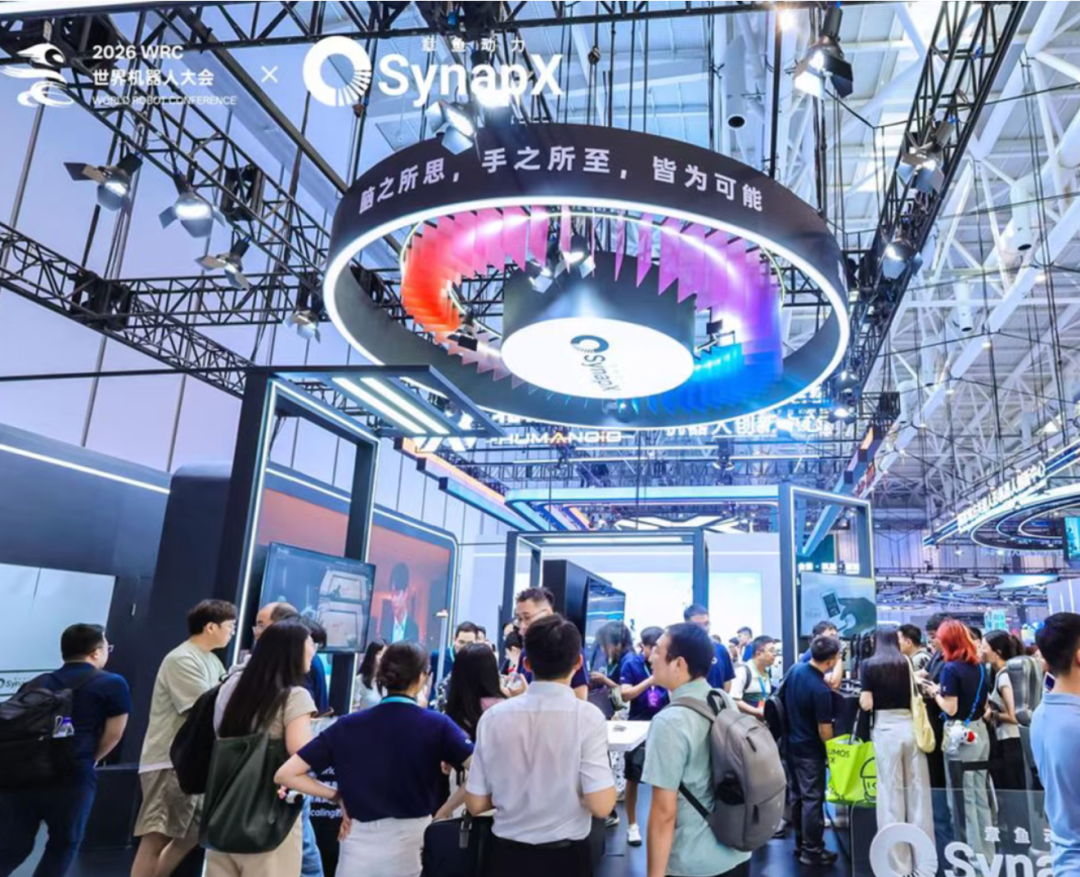
For a young company, strategic direction is only the starting point; real competitiveness comes from the ability to rapidly turn cognition into products. In just a few months since founding, Zhangyu Power assembled its core product matrix at an extraordinary pace and, at the 2026 World Robot Conference (WRC 2026), unveiled a complete productivity system built on "brain–hand–data" integrated design:
SYNWorld embodied-native world foundation model: builds general-purpose cognition, reasoning, and decision-making capabilities, providing the intelligence foundation for robots' continuous learning and execution of complex tasks;
OctoH-Hand high-degrees-of-freedom bionic dexterous hand: handles fine manipulation and interaction feedback in the physical world. Through coordinated design of models, hardware, and data, it continuously improves dexterous manipulation capability and product reliability, providing key hardware support for robots to enter more complex real-world work scenarios.
OctoSense next-generation embodied data collection solution: provides all-modal, multi-scenario data collection and feedback capabilities. It builds a multimodal data system around real manipulation processes, providing data support for model training, capability evaluation, and continuous iteration.

For physical AI infrastructure, a product launch is only the starting point. Real validation happens at the customer site: whether the system can work continuously and stably, whether the hardware meets industrial-grade reliability requirements, whether data can form feedback during deployment, and ultimately whether it can create measurable productivity value for customers.
While the industry is still generally at the stage of lab prototypes and scenario validation, Zhangyu Power has already won a large-scale mass-production order from a leading overseas embodied AI company. **This progress has brought its "brain-hand-data" integrated approach into the test of a real commercial environment, and it also places higher demands on high-end manufacturing, supply chain management, and large-scale delivery.
This round of funding will therefore focus on two interrelated directions:
On one hand, building a high-end manufacturing line for dexterous hands to further improve engineering consistency, reliability, and large-scale delivery capability; on the other hand, continuing to invest in embodied model R&D so that the data and feedback generated during deployment can be converted more efficiently into model capabilities and cross-scenario generalization.
Manufacturing and models are not two independent lines of investment but two ends of the same productivity loop. Without manufacturing and delivery, models struggle to obtain continuous real-world feedback; without model and data iteration, hardware struggles to keep expanding the boundaries of its tasks.

Physical AI is not another layer of tools but a paradigm shift that embeds digital intelligence in the physical world and reshapes how things are produced. In this transformation, real competition is not about leading in a single model or a single piece of hardware but about whether intelligence, hardware, and data can be integrated into a continuously evolving system that ultimately translates into real-world productivity.
Zhangyu Power has chosen to center on "brain-hand integration," using coordinated hardware-software design (Co-Design) to build a productivity loop spanning general-purpose models, general-purpose dexterous hands, and an all-modal data system, driven by an "intelligence–data–deployment" flywheel that keeps the system evolving.
From cognitive leadership to organizational coordination, from product matrix to commercial delivery, Zhangyu Power is turning "brain-hand integration" from a technical approach into a manufacturable, deployable, and continuously iterable physical AI productivity system. With the new round complete, Zhangyu Power will continue to work with global industry partners, customers, and developers to advance real-world deployment, making every deployment the starting point for the system's evolution and turning physical AI into true general-purpose productivity.
Let intelligence enter the physical world, and let productivity keep evolving. This is not only the work Zhangyu Power is advancing but also its long-term exploration of the next generation of physical productivity infrastructure.