The Napkin Deal That Signed Messi Over 20 Years Ago: Football's Most Successful Angel Investment | Linear Recommend

The greatest bets are made when nobody else believes.
y'x

Just moments ago, 39-year-old Lionel Messi completed his third match of this World Cup at Dallas Stadium, becoming the first player in World Cup history to score in seven consecutive games, while also extending his all-time World Cup scoring record to 19 goals.
And this immortal legend spanning a quarter century began with nothing more than an agreement scribbled on a napkin. In December 2000, Barcelona technical director Carles Rexach used a paper napkin to sign a 13-year-old Argentine boy who had been diagnosed with growth hormone deficiency. The rest is history — that napkin, written at a tennis club, became the most spectacular and purest early investment in sports history.
Most of the time, when we talk about venture capital, we look at models, data, returns, probabilities. But this investment was about something more ancient: when a genius appears before you in the humblest way possible, can you recognize him? Betting on a person — sometimes that's everything.
Today, amid the deafening roar of Dallas Stadium, Argentina played its final World Cup group stage match. Messi scored again in this game, bringing his tournament total to 6 goals, continuing to lead the golden boot race while extending his all-time World Cup scoring record to 19 goals.
This goal also made him the first player to achieve seven consecutive World Cup matches with a goal — from the 2022 Qatar World Cup final to the present, whenever he has stepped onto the World Cup pitch for Argentina, he has never left the goal untouched.
This was Argentina's third match of the tournament. In the opener against Algeria, Messi completed a hat trick in the 76th minute, tying Miroslav Klose's record of 16 World Cup goals, with Argentina winning 3-0. In the second match against Austria, he scored one goal in each half, reaching 18 goals to claim the top spot on the World Cup all-time scoring chart, as Argentina won 2-0. With another goal in the final group match, Messi has now pushed that record even further to 19.
This marks Messi's sixth World Cup with Argentina. At 39, it is widely believed that this will likely be his final World Cup appearance.
And this immortal legend spanning a quarter century began with nothing more than an agreement scribbled on a napkin — and a boy who almost never made it onto this pitch.

In 1998, 11-year-old Messi was still playing in the youth ranks of Newell's Old Boys in Rosario.
At that time he stood only 1.27 meters tall, but whenever he stepped onto the field, everyone was drawn to him.
His coach, Adrián Coria, later described him this way: "The ball seemed glued to his left foot. He surged forward at a dizzying speed, yet was completely aware of everything happening around him."
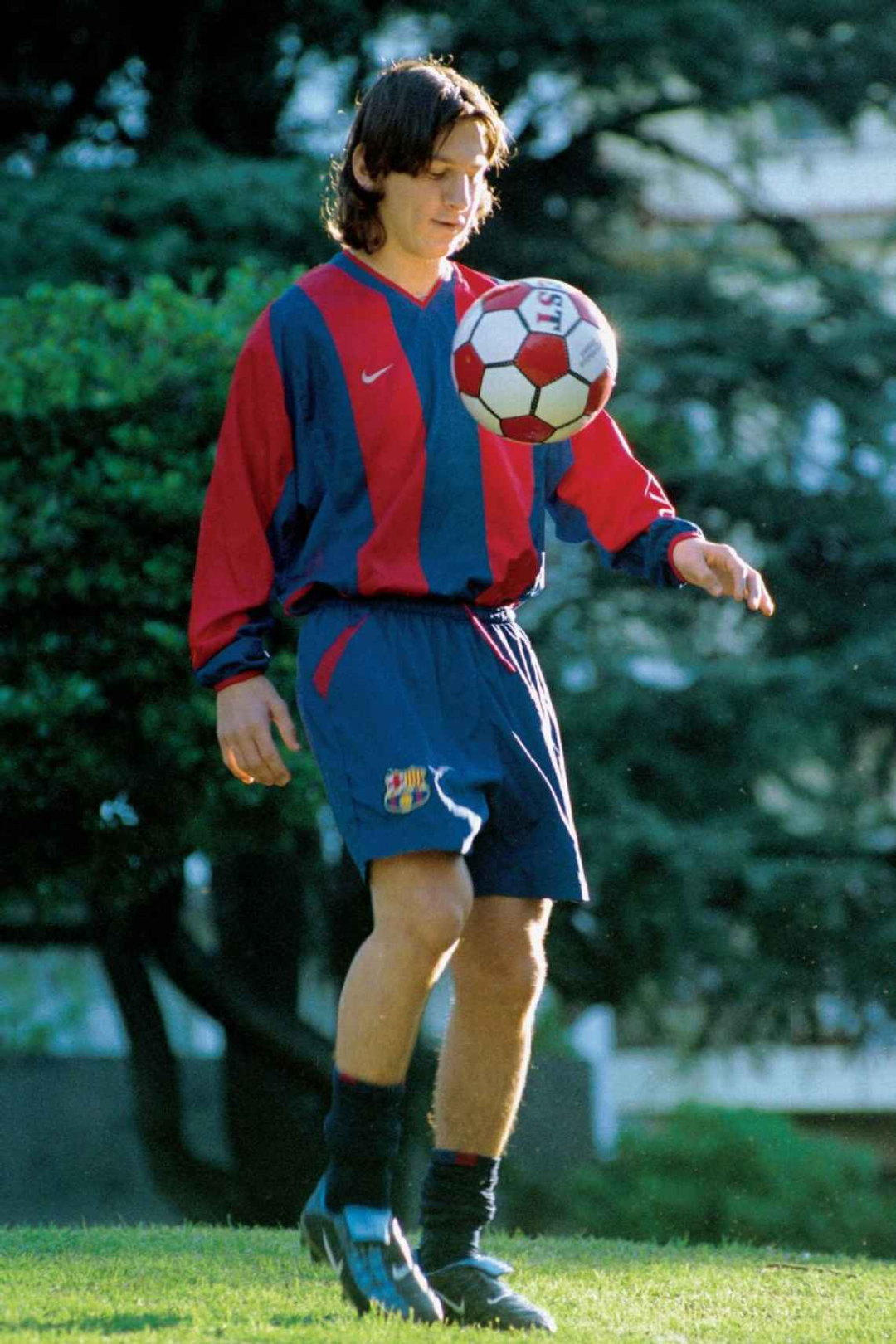
Photo from 2003, Marcelo Boeri/El Grafico/Getty Images
That same year, Messi was diagnosed with growth hormone deficiency. Without continuous treatment, his physical development would be severely affected — he might not reach 1.70 meters until age 25.
Hormone therapy required daily injections, costing nearly $1,000 per month. This exceeded the monthly income of Messi's father, who worked at a steel factory, and the family had to suspend treatment at one point due to financial strain.
For a child who dreamed of becoming a professional footballer, this was practically a death sentence.

In 1988, when Johan Cruyff took over at Barcelona, president Josep Lluís Núñez told him the club could afford any star player in the world — money was no object. But Cruyff simply asked to meet all of Barcelona's youth coaches first. In the years that followed, he single-handedly transformed La Masia academy.
Believing in and prioritizing the development of young, unproven talent became one of Barcelona's defining characteristics.
In September 2000, 13-year-old Messi crossed the Atlantic with his father to trial at Barcelona.
The man who brought Messi to the attention of technical director Carles Rexach was agent Horacio Gaggioli.
According to Rexach's recollection, they met in Montevideo, Uruguay, while he was returning to Barcelona from watching a match in Brazil. Gaggioli told him he needed to change his itinerary and go to Rosario, Argentina to see a prodigy. Rexach asked how old he was and what position he played. Upon hearing Messi was only 13, his first reaction was that there was no rush to see him.
But the passion with which Gaggioli spoke about this child changed his mind. Rexach made a decision that almost no one agreed with at the time, suggesting Gaggioli arrange for Messi and his parents to come to Barcelona so the club could spend a few weeks properly observing the boy.

After Messi arrived in Barcelona, Rexach himself was actually not present. He later recalled that he was away on business and only learned of the progress upon his return. During this period, Messi played in several youth team matches, but Rexach said, "Honestly, no one dared to make a significant investment in a child who might not grow taller."
Until one afternoon, Rexach passed by the training ground next to the Mini Estadi and saw a group of youth players in a match. He later described that moment:
"I will never forget — a lap around the field should take three or four minutes, however long a lap is, but I took fifteen minutes because I was captivated, thrilled, watching him intently, watching him control the ball, move, dribble. Without anyone telling me, I knew it was him, because he was the smallest player on the field, but I could see something different in him." "Messi was small, but he was like an alien. Facing a swarm of defenders, he could still break through effortlessly."
Rexach walked to the bench and sat down, saying to the two coaches present: "Sign him, don't hesitate. If anyone asks, say it was my decision."

Rexach's judgment was not immediately accepted by the club.
For more than three months, the Messi family never received a formal written commitment. Messi's father's patience was wearing thin. He made it clear to agent Gaggioli that if Barcelona could not provide a definitive answer soon, they would consider returning to Argentina or approaching other clubs. Both Real Madrid and Atlético Madrid were keeping tabs on signings in this age group at the time.
According to Gaggioli's recollection, the reaction inside Barcelona's youth department was that "signing Messi would be madness" — the club's finances were in terrible shape, on the verge of bankruptcy.
Opposition focused on two points: first, signing a 13-year-old from abroad would require the club to bear additional resettlement and long-term medical costs; second, the effectiveness of hormone treatment could not be 100% guaranteed given the medical knowledge at the time. "He's only 13, we don't know what will happen to him" — no one wanted to bet on such a young child.**
With incomplete information and constant opposition, Rexach insisted that this child was unlike any player they had ever seen at the club — a once-in-a-century talent.
Placing your bet on a 13-year-old at this point required tremendous courage and conviction, but Rexach understood that the cost of this investment was limited, while the cost of missing out was infinite.
It was like a gift, a once-in-a-lifetime opportunity, but also accompanied by enormous unknown risks. The greatest signings often happen when nobody believes.**

On December 14, 2000, Rexach met with Gaggioli and club transfer advisor Josep Maria Minguella at the Pompeia tennis club on Montjuïc in Barcelona. Rexach had just finished a match and had no contract documents with him.
When it came to the point where an immediate written commitment was needed, there was no blank paper on the table — they had to ask a waiter to bring a napkin.
Rexach borrowed a pen and wrote on this 16-centimeter square of paper:
"On December 14, 2000, in Barcelona, in the presence of Mr. Minguella and Mr. Gaggioli, Carles Rexach, of FC Barcelona, hereby agrees to sign the player Lionel Messi in my name and regardless of any dissenting opinions, provided that we adhere to the amounts agreed upon by both parties."
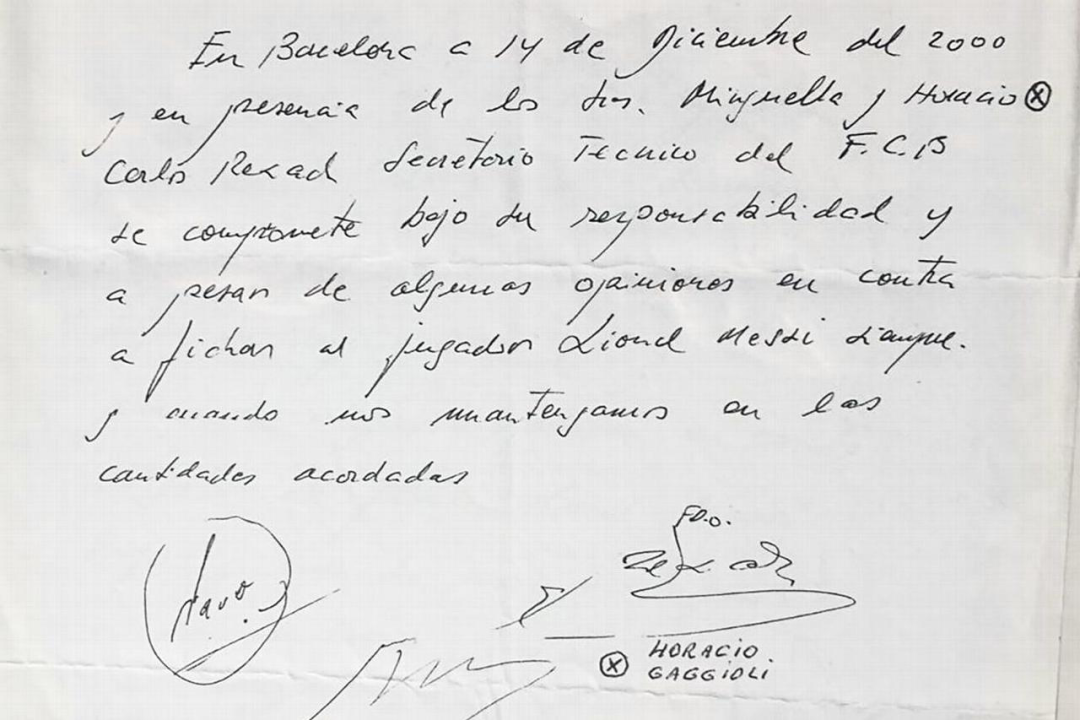
Rexach went on to do some things that never made it into any clause, paying out of his own pocket to secure club-level medical funding for Messi's hormone treatment, allowing the previously interrupted course of therapy to continue.

On November 16, 2003, at 16 years and 145 days old, Messi made his first-team debut as a substitute in a friendly against Porto.
On October 16, 2004, he came on as a substitute in a league match against Espanyol, making his official La Liga debut and becoming the youngest player in Barcelona history to appear in the Spanish top flight.
During his time at Barcelona, Messi won a total of 35 trophies, including 10 La Liga titles, 7 Copa del Rey titles, 8 Spanish Super Cups, 4 Champions League titles, 3 UEFA Super Cups, and 3 FIFA Club World Cups. His 17 years at Barcelona created unparalleled brilliance, both individually and for the club.
So when Rexach later recalled this decision, the words he used were "risk," "opportunity," and also "gift."
This napkin that brought Messi to Barcelona, that started everything, was the mythic beginning of Messi's legendary career, and also forged one of the most fruitful partnerships in football history — even sports history.
This 16-centimeter square of paper had no lawyers, no formal contract, no board approval. All it had was unwavering belief in a young person, and the courage to bet on the future.
It was probably the most spectacular early investment in football history, perhaps even in all of sports history.

Looking back at this napkin more than two decades later, you can see in it the most essential shadow of early-stage investment.
Rexach was asked many times later how he dared to sign Messi. At the moment of signing, he had no data, no reports, and virtually no support inside the club. Fifteen minutes of observation, and an inexplicable intuition — that was nearly all he had.
This way of making decisions was completely different from everyone else at the club. Barcelona's youth department looked at reports: age, height, medical data, hormone treatment projections, signing costs. On paper, Messi was below the red line on every metric. In a process-oriented club, not signing him was the only correct decision.
But Rexach was looking at something else. He was looking at fifteen minutes of an informal training match — that boy, half a head shorter than everyone around him, unflustered against a swarm of defenders, making the right decision with every touch, changing direction half a beat faster than whoever was marking him. None of this could be written into a report, but Rexach knew there were things you could only see standing on the sideline.
Betting at a stage of incomplete information and without internal consensus — you're not gambling on verified certainty, but on a judgment that the market hasn't yet priced.
Rexach later recalled that he had done some simple math: if Messi didn't make it, Barcelona would lose a small amount — a few years of academy fees for a youth player, plus a thousand dollars a month for medicine. For a Barcelona drowning in debt at the time, this wasn't even worth bringing to the board. But if Messi made it, that was an entirely new story.
In the months after signing Messi, Rexach paid for some of the family's treatment costs himself, without seeking reimbursement from the club or telling anyone. When asked about it later, he said, "You can't just watch the treatment stop."
That napkin was later framed and hung in a museum. Rexach would visit it occasionally. He once said in an interview that it was the most beautiful decision of his life.
Most of the time, when we talk about venture capital, we talk about models, data, returns, probabilities. But this investment had nothing to do with any of these things from start to finish. It was about something more ancient: when a genius appears before you in the humblest way possible, can you recognize him.
Rexach recognized him. One afternoon, fifteen minutes, a walk that took ten minutes longer than usual.
Betting on a person — sometimes, that's everything.
References:
-
The Napkin Agreement That Brought Lionel Messi to Barcelona — Bonhams;
-
Barcelona, Lionel Messi and the Napkin: Oral History of His Transfer, Arranged 20 Years Ago — ESPN;