Linear Capital's Can Zheng: The Hype Is Just a Surface — Opportunity Belongs to Teams With Conviction and Execution | Linear View

Focus on the power of obsession and execution.

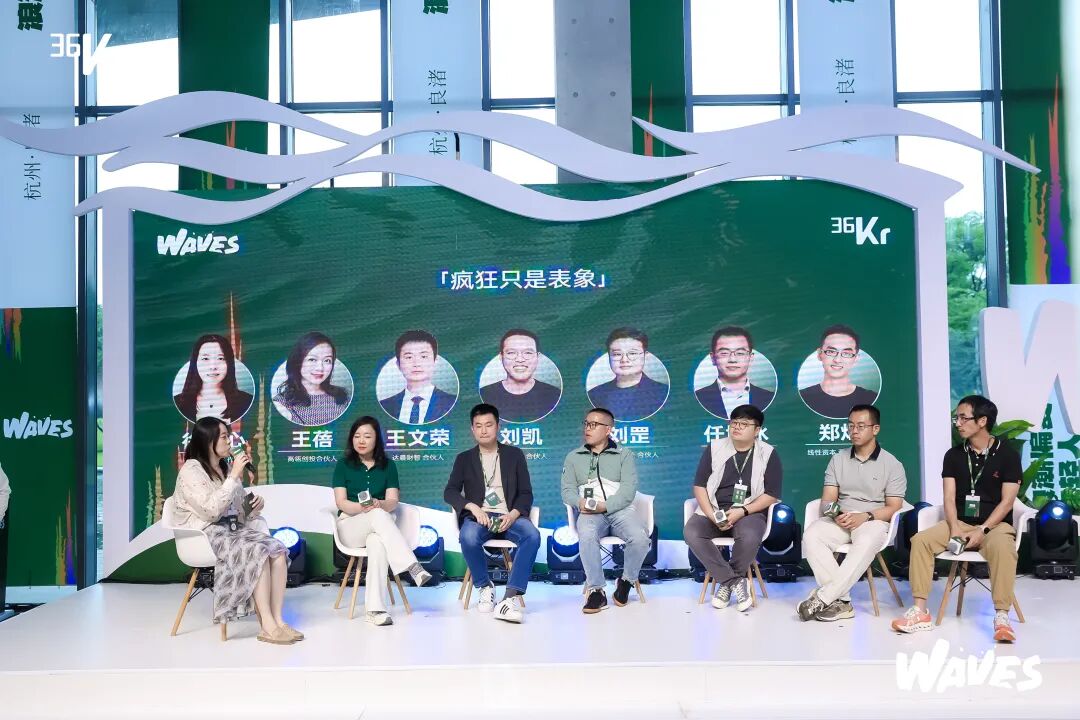
Recently, at the WAVES 2025 conference, Can Zheng, Managing Director at Linear Capital, joined veteran investors from several top-tier firms for a roundtable titled "Madness Is Only the Surface." Ahead of the event, Zheng also sat down with Waves reporter Muxin Xu for an exclusive interview, discussing how Linear Capital is thinking about AI investing amid new shifts.
A technically trained investor, Zheng graduated from the Chu Kochen Honors College at Zhejiang University with a degree in computer science, earned his master's in computer science at Shanghai Jiao Tong University, and later received his MBA from the University of Chicago. Before joining Linear Capital, he was among Morgan Stanley Technology's earliest hires in China, building post-trade platforms across Asia. In Zheng's view, in this wave of AI application frenzy, the opportunities will go to teams that combine both "obsession" and "execution."
At this year's 36Kr WAVES conference, Can Zheng joined Wang Bei, Partner at Hillhouse; Wang Wenrong, Partner at Fortune Venture Capital; Liu Kai, Partner at 5Y Capital; Liu Gang, Partner at Alpha Startups; and Ren Bobing, Executive Director at Innovation Works, for the roundtable. Ahead of that, he also spoke with Waves reporter Muxin Xu about Linear Capital's evolving thinking on AI investing.
With new projects emerging by the hour, Linear Capital has maintained its investment pace while constantly reflecting on what remains unchanged across hot and cold cycles.
We've excerpted key points from Zheng's two sessions below, and welcome more industry peers to join the discussion:
#01 Model competition will continue indefinitely. Linear never saw this as an opportunity or arena suitable for startups from day one. We want founders to choose directions that benefit from model progress, not the other way around. The moat lies in finding scenarios where you can truly scale.
#02 The projects that interest us are Agents solving specific vertical problems, because in concrete scenarios problems and outcomes are easier to define, and commercialization is more direct — even if the upside isn't as open-ended as general-purpose products. The founders we fear most are those without genuine conviction about landing in a specific scenario, who simply use AI as a buzzword to dress up their pitch decks.
#03 I'm currently focused on three directions. First, coding tools — all existing tools have limitations when working with existing codebases, so there's room for many companies to emerge here. Second, voice model-related projects — from last year to this year, voice models crossed an important threshold, producing fully human-like speech. There's a US company called Think Labs using this for phone interviews; unlike a simple survey, the voice model can follow up based on user responses. Third, AI + silver economy — we're facing serious aging, so AI needs to help address elderly care, starting with emotional companionship.
#04 Our starting check sizes this year will be larger. If last year early-stage deals were $1.5–2 million, this year they'll be $3–5 million. First, founding teams are maturing. Second, many companies are pivoting existing businesses toward AI — and these incumbents have major advantages in workflow and data over newcomers.
#05 I think AI applications are in a "pre-iPhone 6" era — there's plenty to build, but we haven't yet reached the moment when giants like Meituan or Dianping emerge. And AI is productivity, not a new channel. Essentially everything that could be done before can be redone with AI; from a commercial opportunity perspective, you can somewhat "copy homework."
#06 Our past AI application investments have been tool-centric, or rather the application companies that emerged recently have all been tools. But we've been thinking about whether there's a larger structural opportunity — not just technology, but multiplied by a user base. The answer I keep coming back to might be community. Communities differ in scale: smaller ones can increase tool stickiness; larger ones are a different concept entirely.
#07 AI applications and embodied intelligence are completely different in fundraising. For the latter, you need to prepare for "three years" without revenue, funded entirely by financing — so fundraising capability is crucial in that space. AI applications are different. I think AI applications should prove commercial viability quickly today, rather than needing to raise huge sums. They iterate fast.
#08 For us, the explosion of certain projects this year has most affected how we weight "the person" versus "the thing" in early-stage investing. We've dramatically increased our focus on the person. Everyone always looked at both, but the specific ratio differed. Today we find that the person matters more in a rapidly changing environment. Two things: obsession and execution. Both were visible in the DeepSeek and Manus cases. So we've elevated these two lenses significantly.
#09 At this stage, traditional PMF may be hard to operationalize, because everything is changing so fast. Ultimately what matters is either people love using the product, or people have to use it. I think everyone's asking "what's the most meaningful way to validate." The good thing about AI is that rapid experimentation is very accessible for founders. So in our search for PMF — finding the right form, the form people love — the cost of exploration and trial and error is much lower for them.
#10 From our perspective, valuation is highly subjective, especially at early stages. Our logic is fairly straightforward: we care more about how much the founder actually needs, how much they need to reach the next milestone or milestones, and how much buffer for error they need. Working backward from a reasonable number gives us a valuation range.
#11 For the next long period — five years, ten years, even longer — AI is the biggest force driving economic and productivity growth. For a trend of this magnitude, it's never too early or too late to start a company; it's certainly not crowded yet. But entrepreneurship is genuinely hard. Whether at the start or in the middle, there will be brutally difficult periods. Think this through before deciding.
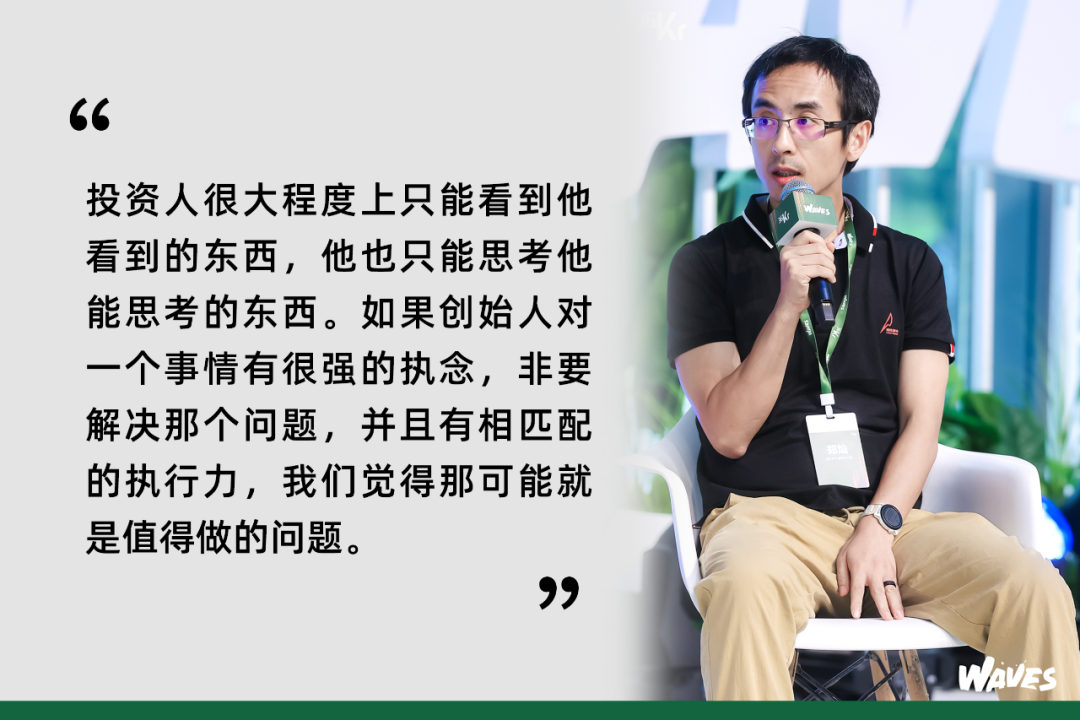
#12 On specific directions: while we've mentioned areas we care about, investors can largely only see what they see and think what they think. If a founder has strong conviction about solving a particular problem, and the execution to match, that's a problem worth solving. Looking back, when Insta360 was just starting, few could imagine it growing into what it is today — that's the power of obsession and execution.