The Last Mile Delivery's Ultimate Answer May Be a Pack of Robot Dogs from Switzerland | Linear Voice

A robot needs to deliver added value to the customer.

As competition in embodied robotics heats up, commercialization is becoming the ultimate test for startups. This August, Swiss company RIVR signed Europe's largest food delivery platform Just Eat Takeaway, while also adding Swiss Post and online supermarket Migros to its client roster — pushing into grocery delivery and steadily increasing real-world deployments of its robotic dogs.
Recently, Cyzone interviewed RIVR founder Marko Bjelonic and Gus Leung, head of China supply chain project management. In their view, technology in robotics is relatively level globally; what matters more is who lands first and truly creates user value.
Linear Capital led RIVR's earliest round. The company has also secured investment from top financial and strategic investors including HSG, Amazon's Jeff Bezos, and Agile Robots.
"Wheels on legs — that design didn't exist back then," Marko Bjelonic said.
Marko was referring to seven years ago, when as a PhD student at ETH Zurich he developed a "wheel-leg" (wheeled-quadruped) robot that combined flat-ground speed with complex terrain traversal. More notably, he was the first person globally to apply artificial neural networks to wheeled-quadruped robots.
Marko is from the former Yugoslavia, born in 1990. After the civil war broke out, he and his parents relocated to Germany. Trained in mechanical engineering with a PhD from ETH, Marko and four co-founders established RIVR in Switzerland in 2023 (originally Swiss-Mile). The core team emerged from the ETH Zurich Robotic Systems Lab, focused on wheeled-quadruped robots.
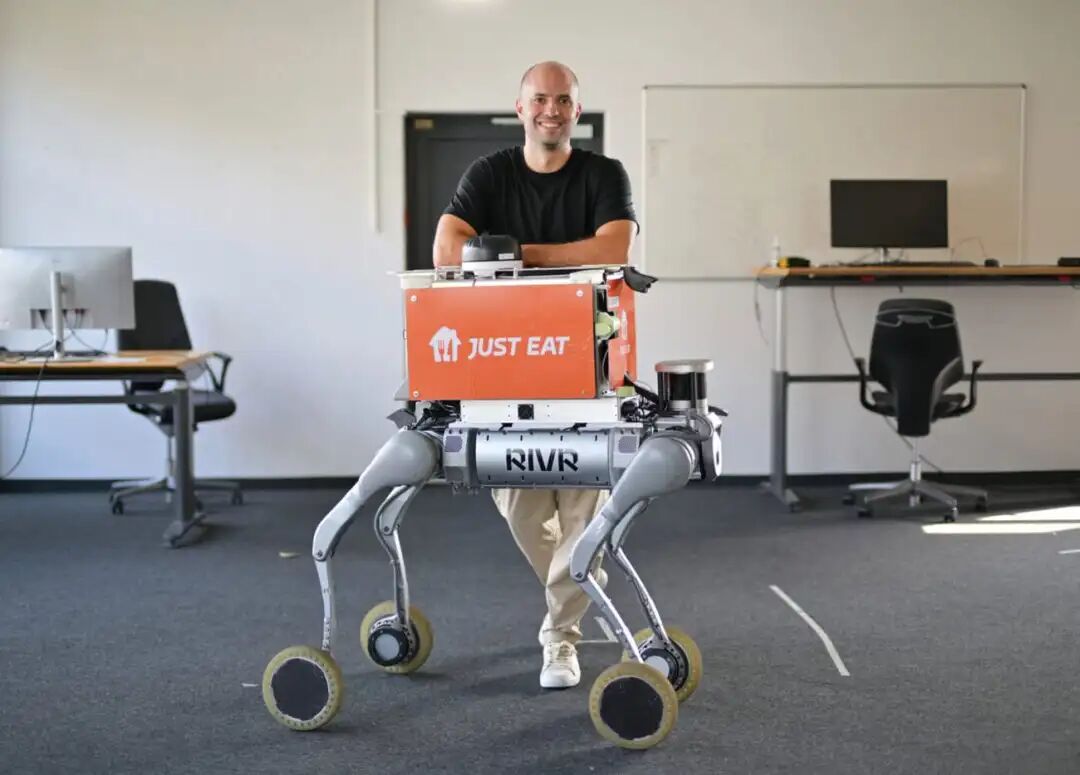
RIVR founder Marko
Marko is aggressive on technology but pragmatic on operations. While most robotics companies were making demos and posting dancing videos, RIVR had already achieved commercialization.
In 2024, Marko identified a sufficiently vertical, competitive scenario for the company: focusing on "last mile" delivery for packages and food.
Operations started in Europe and America. RIVR currently runs primarily in Zurich, Leeds in the UK, Austin and Boston in the US, partnering with logistics and delivery leaders like UK courier Evri, US logistics firm Veho, and Europe's largest food delivery platform Just Eat Takeaway for door-to-door service. Marko estimates delivery volume will reach tens of thousands of items by year-end.
Marko repeatedly emphasizes that technology isn't the core competitive advantage — creating value for users is. "Break out of the general-purpose robot box." This is also why RIVR attracted Bezos, Linear Capital, HSG, and other notable VCs.
This year, part of Marko's focus shifted to China, where he aims to build a complete supply chain like the EV industry — a task only possible there.

Marko is the archetypal robotics founder — every credential and experience tied to mechanical engineering. "Strong academic and technical background," as Gus Leung put it.
Marko earned his master's at TU Darmstadt in Germany. During his ETH PhD, he joined Professor Marco Hutter's group — the premier source of wheeled-quadruped robot research — at the ETH Robotic Systems Lab, among its first doctoral students. After graduating, he continued postdoctoral research on wheeled-quadruped robots at ETH.
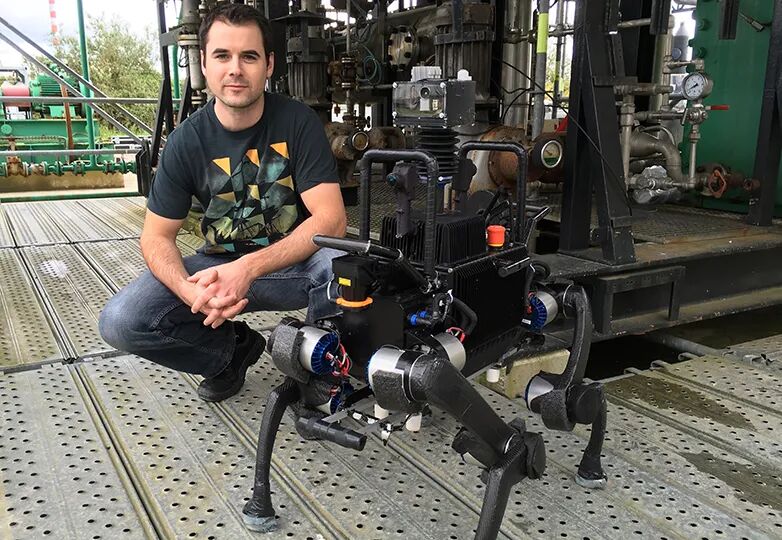 Professor Marco Hutter
During his master's, Marko designed a hexapod robot called "Weaver" and published multiple papers on legged robot control that later became reference documents for several domestic robotics companies.
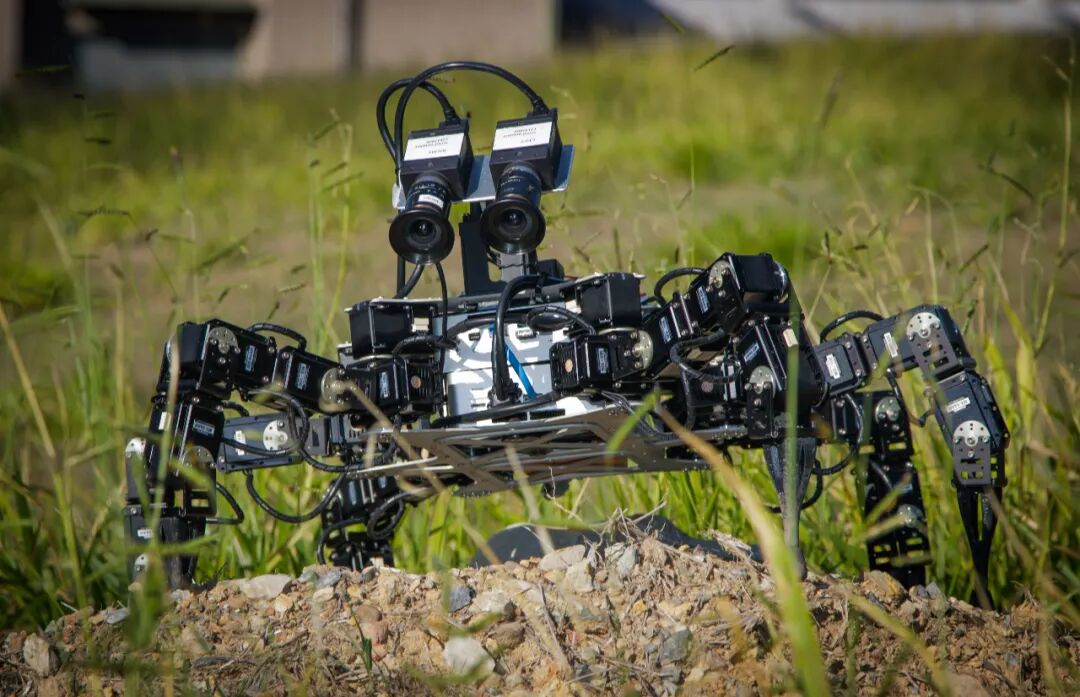
Weaver
Reportedly, on the computer of a prominent Chinese AI robotics CTO, there's a folder containing Marko's papers for company study and research.
He later moved to wheeled-quadruped robots because he found "legged robots too boring — slow, can't go anywhere, very inefficient." Bionic robots shouldn't be the only form, "Humans don't need to replicate nature exactly; we can design robot forms better suited to specific applications."
Before 2021, Marko focused primarily on robotics research, participating in projects at Mercedes-AMG (Daimler subsidiary), Fraunhofer LBF (German institute specializing in mechanical systems research), and CSIRO (Australia's Commonwealth Scientific and Industrial Research Organisation, focused on autonomous robot development).
He briefly tried company management. From 2020-2021, Marko took over his father's construction business, managing it for a year before selling. According to Marko, his father founded this company when Marko was 14, which indirectly influenced his later career choice and his dream of becoming an engineer.
NVIDIA CEO Jensen Huang personally showcased Marko's embodied intelligence product in his 2022 GTC keynote. Marko's reaction: "We can do robots."
With this prelude, Marko — freshly PhD-graduated in 2023 — co-founded the company with four partners: Swiss-Mile, later renamed RIVR, focused on wheeled-quadruped robots using proprietary technology combining physical AI with artificial neural networks to build robots that "work" and "improve efficiency."
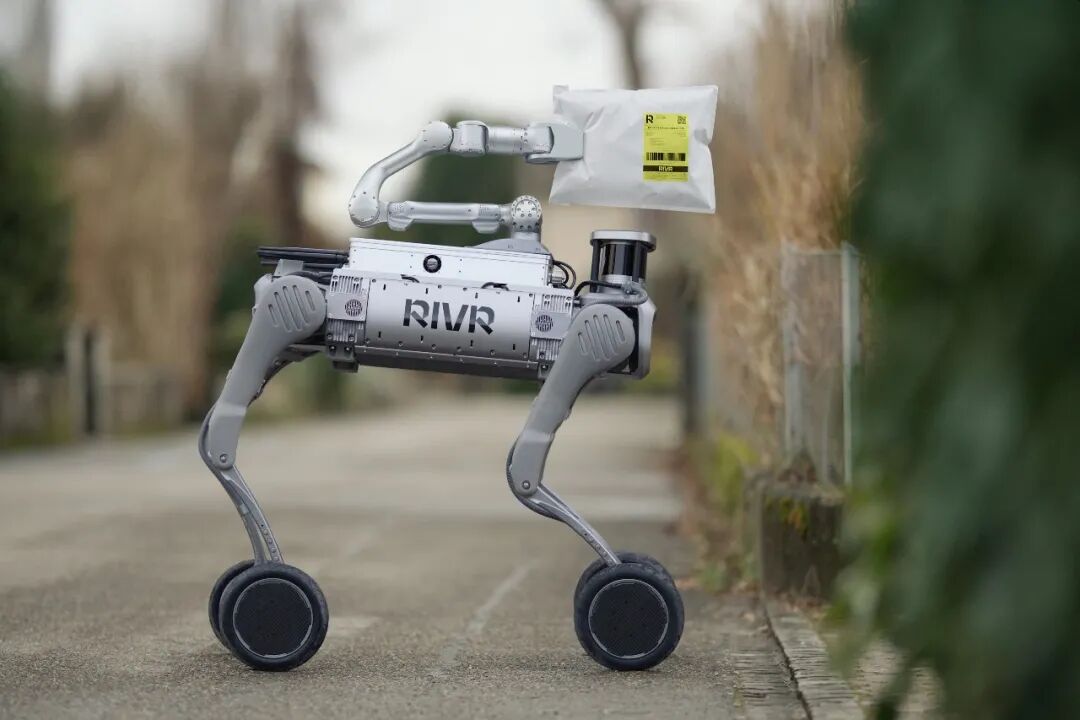
Legged robots can do deep learning and are intelligent enough, but not sufficiently flexible and autonomous. RIVR's robotic dogs, built on physical AI with reinforced training of artificial neural networks, possess environmental perception, obstacle avoidance, navigation, and autonomous decision-making/planning capabilities. Meanwhile, the "legs + wheels" design enables both fast flat-ground travel and traversal of stairs, curbs, potholes, and other rough or complex terrain.
"The team wants to build an AI-native product, not something plus AI (attaching AI capabilities to an existing product)," Gus Leung said. "The core difference is that AI is essentially the interesting soul; what shell you put that soul in is critical."

RIVR's entry point is "last mile delivery" — getting goods to the door, focusing on express delivery and food delivery.
Marko considered industrial and security applications, but data generated in those scenarios lacked meaningful reference value. In factories, for instance, robots essentially repeat the same motion.
Globally, almost every robotics company first thinks of industrial and security applications.
In a media interview, Xing Wang of Unitree said customers buying Unitree robotic dogs mainly have three use cases: pure consumers buying for fun or simple educational programming; education and research institutions for scientific study; and industry applications like power grid inspection at power plants and chemical facilities. Unitree's R&D focus shifted to humanoid robots starting two years ago.
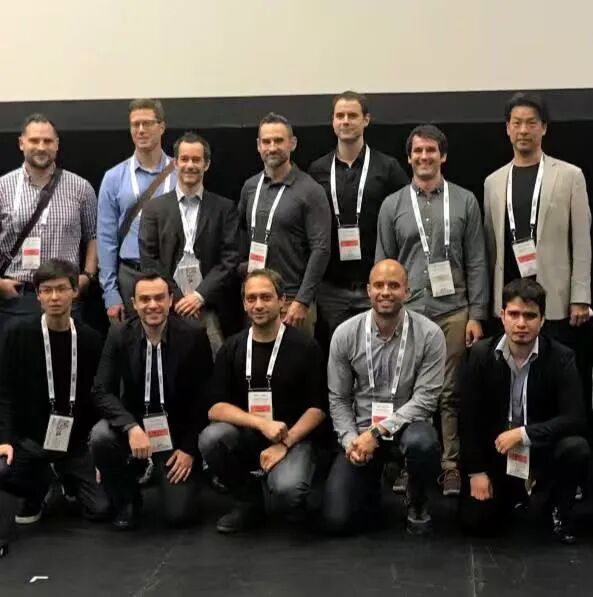
At a Canadian robotic dog workshop丨Xing Wang at far left, Marko second from right
"Robots need to get out there, interact with the messy, complex real world — dynamic data is what matters," Marko said. Scenario-accumulated data ultimately feeds back into reinforcing the robotic dogs' training.
Marko first targeted the US and European markets, approaching top logistics carriers and delivery companies with heavy labor costs. For specific living scenarios, he chose upscale villa neighborhoods as pilot sites.
"The math is straightforward — labor costs for delivery are high in Europe and America, order density isn't sufficient, and even saving $0.60 per order creates immediate, visible cost reduction and efficiency gains," Gus Leung said. Villa neighborhoods were chosen because routes are far simpler than high-rises, with less complex scenarios.
Specifically, one robotic dog can deliver 60-100 packages daily, or complete roughly 20 food delivery orders. Marko estimates delivery volume will reach tens of thousands by year-end. On speed and duration: one robotic dog operates 5-6 hours daily, can travel up to 30 kilometers, moves at more than twice walking speed with a top speed of 15 km/h. Maximum payload is 60 kg, with food delivery compartments holding up to 40L.
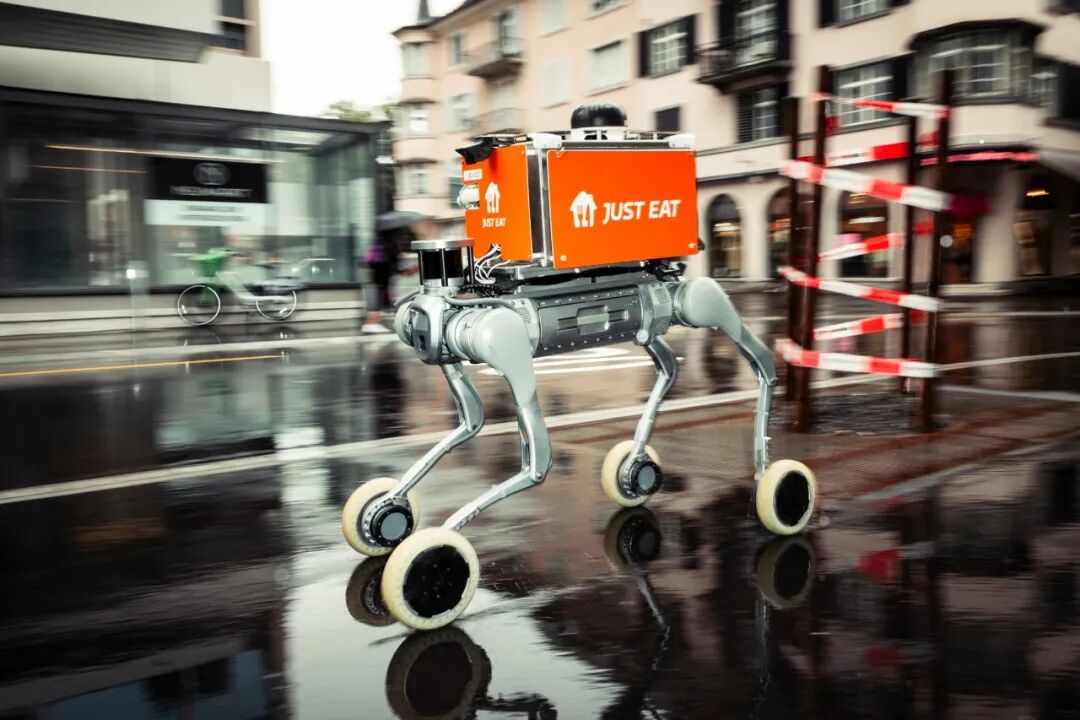
Compared to unmanned delivery vehicles and humanoid robots, RIVR's hybrid-chassis robotic dogs are more flexible — adapting to different environments, from stairs, ramps, and uneven sidewalks to residential front steps and porches, switching movement modes fluidly, particularly suited for door-to-door delivery.
In RIVR delivery footage reviewed by Cyzone, several interesting moments stood out: a robotic dog whose compartment had been drawn with a smiley face in chalk by children still accurately delivered a package to the designated floor; it detoured around a napping stray cat; and at one intersection it paused for nearly 30 seconds to wait for students crossing the street.
The team made several detail adjustments. According to Gus Leung, to adapt to dim lighting, the team added lights to the robotic dog's body and made the wheels fluorescent; an extra remote control was added to allow safety operators to request passerby assistance if minor malfunctions occur on the road; due to unstable US networks, the team switched to dual IoT SIM dual standby to ensure transmission timeliness and accuracy.
On hardware design, RIVR's robotic dogs make trade-offs around scenarios — not necessarily using the most advanced components for everything, but rather matching to requirements. "Advancement is more about integration, like building electric vehicles — integration keeps getting better over time," Gus Leung said, believing technical advancement accounts for only 50%, with the other half being the company's business model.
This August, RIVR signed Europe's largest food delivery platform Just Eat Takeaway, while also adding Swiss Post and online supermarket Migros, pushing into grocery delivery. The company's robotic dog deployments continue increasing.

Switzerland is a country of only 8 million people, so from day one Marko planned for rapid internationalization. When the company had just 15 people, Marko already established offices in the US and Shanghai.
Europe and America handle commercialization; supply chain must be built in China. "To become a real robotics company, you have to replicate the kind of complete industrial chain that the EV industry has." He's particularly focused on integrating talent from the automotive supply chain.
Gus Leung joined this year and currently oversees supply chain construction. With 10 years in the EV industry, he witnessed China's new energy vehicle boom. He was among NIO's first 100 employees, joining in 2015. He later followed NIO co-founders into entrepreneurship, helping establish Qichen Motors.
Cars and robots share the same foundation — both are bodies and entry points. Moving up the stack requires environmental perception, environmental understanding, task understanding, task decomposition, reasoning, planning, execution, and ultimately control — very long chains with substantial supply chain commonality.
RIVR's China supply chain construction also centers on the mobility sector. In supplier outreach, Gus Leung's overall impression is: "Everyone's betting on the next Tesla."
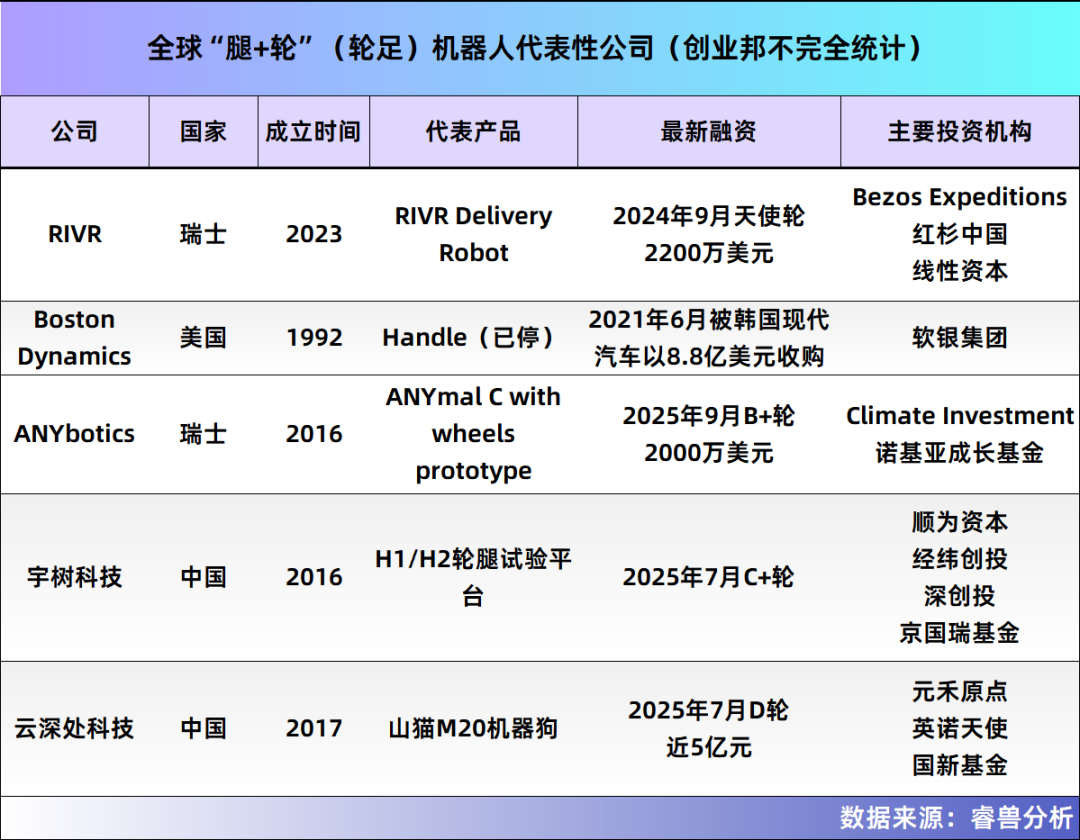
This is also why Gus Leung joined RIVR — he strongly approves of the company's business model, especially with China being a relatively independent operation. Building something from 0 to 1 again excites him.
RIVR has completed two funding rounds totaling $26 million. Investors include Bezos Expeditions, HSG, Linear Capital, and Agile Robots. Linear Capital led the seed round and continued to double down in the angel round. After last year's angel round, the company reached a $100 million valuation.
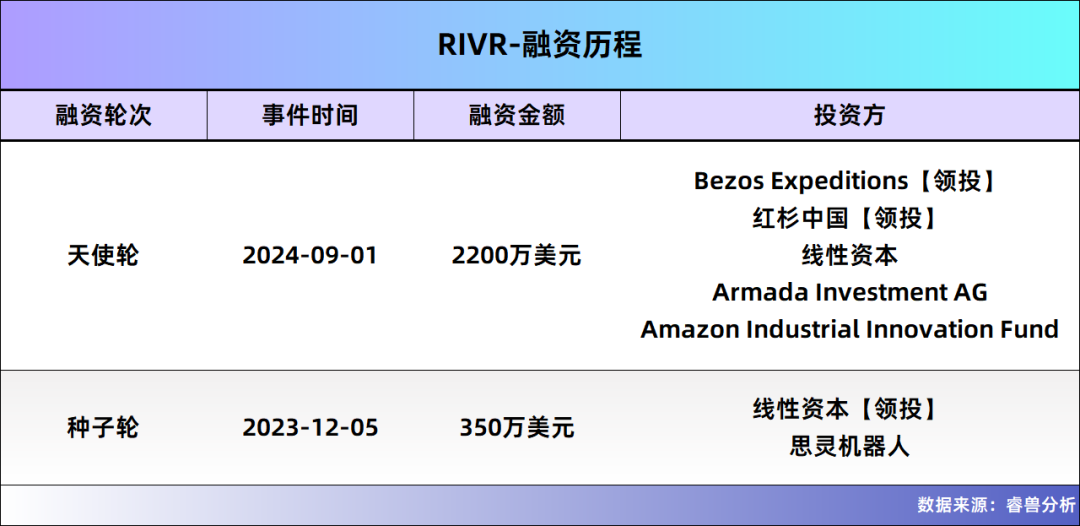
Investor logic: the team's professional background, company technology and algorithms hold promise to become leading forces in the next wave of AI-physical world integration, while as a European company, it has major advantages in global commercial deployment.
RIVR's team has developed a multi-functional AI framework independent of robot hardware that can become the "brain" for all robots. For example, RIVR can now train a new neural network for different robot hardware in just one week.
For Harry Wang, founder and CEO of Linear Capital, beyond extreme technology, what most excites him is RIVR's international vision and customer-centric philosophy from day one. "Whether it can commercialize is the key metric testing team strength."
This is also why Bezos invested in RIVR: "Robots must deliver added value to customers."
One interesting detail: Marko said when he received Bezos's email, he thought it was spam. He ended up talking with Bezos for an hour instead of the planned half-hour. After the call, Bezos led RIVR's angel round.
Uncertainties and areas for improvement remain. Gus Leung feels future products could be designed softer and cuter; they could move beyond villa neighborhoods into more complex high-rise buildings. Currently every robot is monitored in real-time by RIVR's operations center, and there's still a long road to full unmanned operation.
In Marko's vision, RIVR's models should permeate daily life to accomplish more work. The company plans to expand to more than ten cities in North America and Europe next year, deploying thousands of robots. In China, RIVR has more stories to tell — such as partnering with leading autonomous driving companies to collaborate on last-mile delivery.
"In robotics, global technology is relatively level, like autonomous driving. What matters more is who lands first and truly creates user value," Gus Leung said.