A Conversation with Linkloud's Ning Gao: What Do Successful Chinese Companies Going Global Agree On — and Disagree On? | 100 Questions on AI Applications

2024: Some Observations and Takeaways on Going Global
"100 Questions on AI Applications" is an interview series by Linear Capital focused on the development and trends of AI applications. We invite AI application entrepreneurs — founders from our portfolio or friends of Linear Capital — to share their startup stories, personal observations, and reflections on the industry. Through these conversations, we explore current topics and progress in AI applications, hoping to offer useful perspectives for others interested in the space.
For this edition, we invited Ning Gao, founder of the overseas expansion community Linkloud, to share his experiences building a go-global community over the past two years, his observations from working with entrepreneurs who aimed for global markets from day one, and his takeaways from notable overseas success stories.
1. Linear Capital: Please briefly introduce yourself and Linkloud's business, particularly what you focused on in 2024.
Ning Gao: I'm Ning Gao, co-founder of Linkloud. Our work includes hosting community events for entrepreneurs expanding overseas, growth-focused workshops, pioneer study tours, and consulting services for market entry.
Looking back at my 2024, the main activities were:
- Taking over 50 overseas entrepreneurs and founders on trips to the US and Japan to observe shifts in their thinking and actions, as well as evolving local AI application trends.
- Expanding our growth workshop for Linkloud member companies by adding social marketing and PMF modules to the existing SEO curriculum, inviting two Silicon Valley-based AI entrepreneurs with proven track records to share their insights.
- Hosting our first salon in Japan, where I felt the enthusiasm among Chinese founders in Tokyo around AI and globalization.
2. Linear Capital: What do the companies that "go out" with you look like?
Ning Gao: The entrepreneurs who join us roughly fall into two categories. The first I call "entrepreneurs" — their companies have typically reached Series C or beyond, or are already public. They generally see globalization as a critical strategy and evaluate multiple markets simultaneously (with the US and Japan being relatively more important). They need to select 1-2 markets for concentrated investment, so they require deep understanding of local ecosystems: competitors, customer pain points, SWOT analysis, and so on, before handing off to dedicated teams.
The second category is startup founders, mostly from companies founded in the last 1-2 years. They target global markets from day one and already have basic familiarity with markets outside China. During their overseas research, they need to understand how companies at their same stage (mostly pre-Series A) handle localization and growth in those markets.
3. Linear Capital: Adding social marketing and PMF to your SEO workshop — what industry developments or shifts in founder needs does this reflect?
Ning Gao: On the marketing side, we've observed two trends.
First, this wave of AI has spawned numerous new content channels — short video, Twitter, newsletters, podcasts, and more. Over the past 1-2 years, we've often seen AI products "blow up" overnight. With more channels to choose from and greater difficulty in matching the right product to the right channel, startups with limited resources face the challenge of finding the most cost-effective way to identify what works for them. Second, in social marketing, sometimes finding just 1-2 channels is sufficient, and founders absolutely must be personally attuned to this. They need to develop their own intuition for these channels because founders are best positioned to quickly identify what fits their product. Moreover, being conscious of content channels facilitates direct dialogue with users, which helps iterate the product. That's why in this AI wave, many overseas founders run their own accounts to create content — we hope to pass these shifts on to more entrepreneurs.
On PMF: no company finds PMF easily. Some have found it, and while their methods may not be replicable, their frameworks for thinking about it are highly worth sharing.
4. Linear Capital: If you had to simply summarize, from Linkloud's founding to now, what development process have you observed for AI applications going overseas, what were the important inflection points or milestone events along the way, and which directions were founders experimenting with in 2023 that became consensus by 2024? Similarly, which directions or strategies being tried in 2024 do you think will become consensus in 2025? Or which will be disproven?
Ning Gao: Let me list out the key inflection points we observed and summarized for 2023 and 2024.
1) 2023
The beginning: In the second half of 2022 through year-end, a wave of AIGC products emerged (particularly in image generation), with Midjourney as a standout example proving the global potential of such products, which galvanized entrepreneurs to take globalization seriously.
Entrepreneurs who directly embraced globalization reaped first-mover advantages. Typical examples now widely known include Heygen, Opus, Monica, and Talkie. By late 2023, some of these companies' results became visible, and seeing was believing — more and more young founders decided to go global from day one.
The overseas expansion market began paying attention to countries like Japan and South Korea. Speak and Gamma gained traction in Korea; Notta and others achieved milestone breakthroughs in Japan. Sakana.ai was founded in July 2023. Other markets with strong payment willingness and rapid ChatGPT penetration also gradually drew attention.
2) In 2023, we saw three directions that gradually became consensus by 2024
- Multimodal tools: Starting from video, images, audio, editing, captions, and so on. In 2024, the number of such products and companies rose dramatically.
- General efficiency tools: Point solutions that improve work efficiency for creators, marketing, and operations — information processing, marketing and promotion efficiency — combined with multimodal capabilities, these also multiplied.
- AI hardware: With Plaud as a representative, plus education and toy categories. This year's CES saw numerous related hardware products, reflecting this trend.
3) 2024
- SaaS+AI going global. Companies with established domestic foundations actively prepared for and explored overseas markets, visiting many countries for on-the-ground assessment of implementation plans and results. Many growth-stage and public company founders joined us in the US and Japan, while also actively visiting other places themselves.
- Japan gained more attention from overseas entrepreneurs. The market entry of companies like Notta, Plaud, Dify, and PingCAP, plus OpenAI's decision to open a Japan office, were all signals.
- PMF was generally defined by revenue and organic growth. From what we know — names withheld — companies surpassing $1 million ARR began actively building SEO and organic growth systems and talent. Linkloud participated in many such processes, witnessing their growth.
4) In 2025, we believe all three of the above will become the strongest consensus.
5. Linear Capital: A recent Linkloud article quoted Silicon Valley investor Sarah Guo's observation that AI applications are undervalued. Simply comparing the past 1-2 years, what differences do you see between China and the US in AI application entrepreneurship — in terms of where projects cluster, product maturity, market acceptance (or speed to PMF)? Based on these differences, what lessons can Chinese founders draw?
Ning Gao:
1) In the US market, there's already consensus that entrepreneurs gravitate more toward B2B, the overall market ecosystem is healthier, and the trend of deconstructing monolithic software toward vertical integration is very pronounced. Enterprises generally have stronger digital awareness, cloud services are more widespread, and in this ecosystem, startups can generate revenue faster and more easily. However, having revenue doesn't mean a startup has truly found PMF — the flip side of a strong ecosystem is intense competition.
-
SaaS-era efficiency tools are being rebuilt: meeting tools, editing tools, sound and scoring, Office suites, coding, and more — all seeing new batches of startups emerge.
-
Whether SLG or PLG, the founder-led growth trend was very pronounced last year. Founders are active on social media and across channels/events, facing users, customers, and building brands directly. This has pros and cons, and also means there's still plenty of noise.
4) Lessons for Chinese founders:
- Choose directions where results are relatively easier to see or that you already know (you don't have to pick blue-ocean markets). Just get in, and make gradual adjustments. On one hand you practice; on the other you accumulate product experience. The key is to enter.
- Don't worry about serving unglamorous markets. Someone in the industry once noted that products that grew late in the mobile internet era all seemed rather unremarkable or outside the mainstream. But choosing a niche market is almost the default entry path for most products from tools to SaaS, and AI is no exception.
- Rather than fixating on one product's success or failure, try building several products simultaneously, running multiple experiments. Development barriers are lower now; AI changes very quickly. Using engineering talent for rapid execution and iteration is a startup's greatest weapon.
6. Linear Capital: The advantages of startups may be obvious to many, but in practice people still can't pull them off. Having worked with so many startup founders, what do you think holds people back?
Ning Gao: My sense is that people first need a mindset shift. When building products for China, the tendency was to make things as perfect as possible before users would like or pay for them. Overseas isn't like that — a simple plugin can easily attract users who will pay if they find it useful.
Right now, startups have two practical advantages. First, building an AI product is much faster than before, and with some operational skills, cold starting is relatively doable. Second, there are already many AI products, and they generally charge (often in the $10-20 range). So the cost of testing the waters is lower. Startups can use these advantages for rapid validation. We've seen many good startups do this kind of quick validation, rather than requiring rigorous justification or resource approval for every step like large companies.
On the other hand, try multiple products. Rapid validation, accumulate experience. For tool-type products, rather than building one product with 5-6 features, build 5-6 separate products each with a single point function. Each attempt accumulates a new user base. With this portfolio approach, you build and improve operational skills; you can also push your best-performing or most desired product to more precise audiences, adjacent模糊 audiences, or even users in neighboring countries, making conversion easier. Third, for companies going overseas, this approach lets you explore different country markets and see feedback from different national users to judge whether particular markets need localization. I've seen cases where overseas companies first build an English version, create a tool matrix, attract English-speaking users from other countries, compare conversion across countries/regions, and then localize. This is how startups effectively leverage their flexibility.
7. Linear Capital: In the offline events and overseas study tours you organized in 2024, what questions from entrepreneurs left the deepest impression, and how have they changed compared to before? What do you think these concerns reflect?
Ning Gao:
- Greater attention to markets beyond Europe and America, such as Japan, the Middle East, and South America. This was the biggest difference from the year before.
- Focus on how to achieve organic growth and how to attract senior growth talent. This shows that after accumulating some development and growth experience, people have advanced their understanding of overseas playbooks — from tactics to strategy and holistic thinking.
- Cold start remains an eternal topic, as does finding PMF with limited data, limited budget, and limited talent. There's strong appetite to learn how benchmark overseas products found PMF, with patience and persistence.
8. Linear Capital: In previous talks, you've shared about the US and Japan markets, mentioning that "America is good, but emerging markets still offer红利." Could you highlight which markets you observed this year that deserve Chinese founders' attention, which products might suit them, and why?
Ning Gao:
- PLG products that plan to launch the product first rather than establish a local team before developing — these are suited to testing in English-speaking countries. If you're not facing a completely blue-ocean market and have some comparable benchmarks, I'd more recommend developed markets like the US as the best place to practice and get positive feedback.
- SaaS products with solution-oriented needs that want to leapfrog by adding AI — look at neighboring countries like Japan. These markets are very worth exploring from the perspectives of service capability, local talent access, and investment cost. You're welcome to reach out to Linkloud.
- Products with distinctive advantages in specific directions, such as e-commerce SaaS or video creator tools — consider markets where these industries are well-developed. South America, for instance, has very active e-commerce and influencer economies; Brazil could be a good market.
- Return to first principles and do some market research and selection first. Choosing based on your own strengths matters most. Whatever you choose, get some positive feedback quickly and accumulate understanding and familiarity with the market and users.
9. Linear Capital: Doing some market research first — how do you define "understood"? Are there quantifiable metrics?
Ning Gao: My feeling is that most products aren't entirely novel; there are usually overseas benchmarks, or products with similar point solutions or features. Entrepreneurs often mistakenly equate understanding the benchmark product with understanding users or the market.
I think you need to go one level deeper beyond the product itself: Why do its users like this product, or what got them to start using it. A trap founders easily fall into is treating their own subjective judgment as fact. This is especially pronounced among first-time founders. If I had to suggest hard metrics: for user research, talk to at least 20-50 core users of the benchmark product; on the company side, talk to some employees — most won't build an identical product anyway; third, talk to people who did cold-start growth for similar products, so you better understand how to approach similar user groups with your own product.
10. Linear Capital: Among the early-stage startups you've seen doing well with AI applications overseas, what common characteristics do the founders, products, teams, and working styles share? What can broader AI application entrepreneurs learn from them? Or what pitfalls have some founders fallen into that others should carefully consider?
Ning Gao:
1) Figure out clearer user profiles and needs as you go — users are also choosing you. Two examples:
- Gamma initially set out to build better visual expression. After accumulating users to a certain point, they narrowed focus to people with professional needs around presentations — they didn't want to open a blank template, and when doing layouts they wanted one-click generation of formatted, content-filled basic frameworks. Through iteration they gradually identified user needs and a clear user profile.
- Heygen started with digital humans, leaning toward enterprise clients. Later they saw that enterprises doing short-video marketing also needed KOLs for video promotion, so they created digital humans to produce similar videos for clients with that need.
2) Founders must be hands-on — what Silicon Valley recently discussed heatedly as "founder mode." Founders can ask themselves: Do I participate in user research? Have I been involved in marketing content creation? Do I personally post on LinkedIn?
- Taking Gamma again: early on, the founder invested enormous time and energy doing marketing himself. In my conversations with him, I found that not only did he write all LinkedIn articles himself, but he planned them out clearly in advance. For users of presentation tools, LinkedIn is definitely a platform they browse regularly. I've seen some founders post rather randomly or irregularly, but the Gamma founder's deliberate approach — especially for a product where content is a long-term investment — is worth learning from.
3) Communicate value, not features. For example, how do you do onboarding well, how do you convert registrations, how do you achieve the fastest possible "aha" moment?
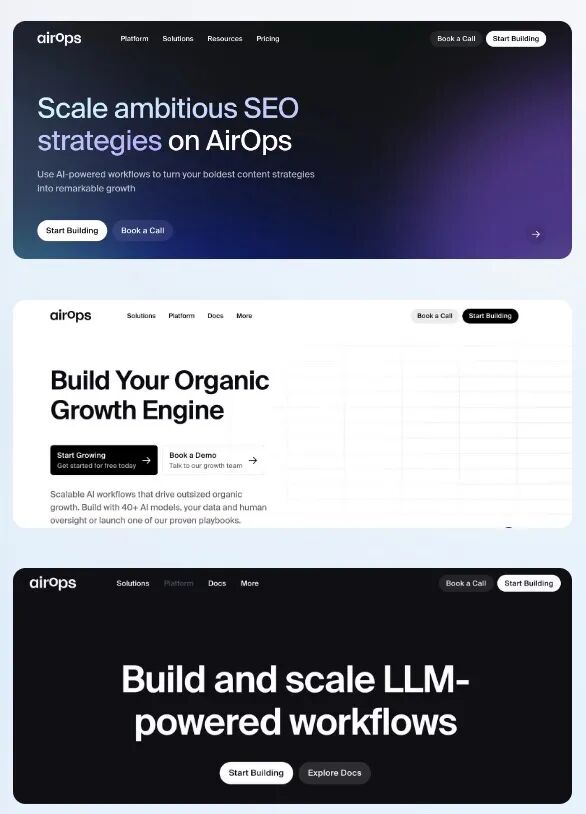
- Here's an example: three iterations by AirOps. For most Chinese companies going overseas, the third option — "Build and scale LLM-powered workflows" — might seem like the obvious big value proposition. The second seems okay; the first feels too small. But in fact, the first had the highest paid conversion rate, because the latter two talked about features, not value. They adjusted later, but this vividly illustrates that users/customers need to immediately understand what value you provide.
4) Focus on specific country markets, especially with limited resources — you absolutely cannot expect to bloom everywhere. I'd suggest entrepreneurs pay more attention to South America and Japan. In South America, the AI products people encounter may not update as frequently as what US market users see, but when they find a good product, they stick with it. Japan cares a lot about认同感. In Europe, the UK and France stand out as places where more and more people are willing to try AI products.
5) Be ready to pivot at any time, subtract before you add, and be rigorously data-driven.
11. Linear Capital: What can entrepreneurs preparing to go from 0 to 1 start doing right now, and what should they constantly remind themselves to stay calm and avoid?
Ning Gao:
- Don't hold out for a grand reveal — let users define the product.
- Start accumulating users from the moment you conceive the product, not after it's designed.
- Start user research when you have design mockups; founders often don't actually understand users.
- Don't choose blue-ocean markets for practice — red oceans are more meaningful.
- Product and growth are equally important in the early stage; founders must be hands-on. Don't fantasize about a silver bullet or handing everything off to a growth lead.
- Go to the market physically. If you're committed to global markets from day one, it's not just for users — it's also for hiring.
12. Linear Capital: What information platforms or channels do you personally use to keep up with overseas venture capital and startup dynamics? Any high-quality sources you'd recommend?
Ning Gao:
- This year, mainly newsletters from trusted investors: ed.sim, Boldstart Ventures, Jamin Ball's SaaS weekly, and AI-related podcasts like Latent Space, No Priors, BG2, Generative Now.
- For growth and product content, I'd recommend Lenny's Podcast, First Round Capital, 20VC, and Growthunhinged.
📮 Further Reading



Linear Bolt Bolt is Linear Capital's dedicated investment program for early-stage AI applications targeting global markets. It upholds Linear's investment philosophy, focusing on technology-driven transformative projects, and aims to help founders find the shortest path to their goals. Whether in speed of action or investment approach, Bolt's commitment is lighter, faster, and more flexible. In 2024, Bolt invested in 11 AI application projects including Final Round, Xinguang, Cathoven, Xbuddy, and Midreal.