"Ludens AI" Closes Two Rounds Worth Tens of Millions of RMB, With Linear Capital Leading the Angel Round | Linear Portfolio

A former DJI engineer founded a companion robot startup.

Today, companion robot company Ludens AI announced it has completed two funding rounds totaling tens of millions of RMB. The angel round was led by Linear Capital, with participation from Clear Water Bay Investment; the angel+ round saw co-investment from Japan's PKSHA Algorithm Fund and Clear Water Bay Investment.
Ludens AI founder Lijun Xue is a former Tesla and DJI engineer who later joined the founding team at FITURE, where he led the development of its AI systems. The company's compact robot COCOMO and desktop companion robot INU are slated to launch on crowdfunding platforms this year, marking its official entry into overseas markets.
Zeren Bai, Senior Director at Linear Capital, noted that the Ludens team demonstrates exceptionally nuanced insight into user needs, creating differentiated products with emotional value centered on home scenarios. "With outstanding product capabilities, on-device AI implementation experience, and deep understanding of overseas markets, we are optimistic about their future in the AI companion hardware space," he said.
At a time when companion robots are growing increasingly homogeneous, what kind of product can actually capture people's attention?
At CES 2026 earlier this year, a compact robot named COCOMO, dressed in an orange jumpsuit, unexpectedly became a frequent subject of foreign media cameras.
Its slightly "alien" extraterrestrial-pet quality, body temperature of 37°C close to human warmth, and innovative modular design that allowed it to be held or to follow autonomously, drew numerous attendees to stop and try it out at the booth.
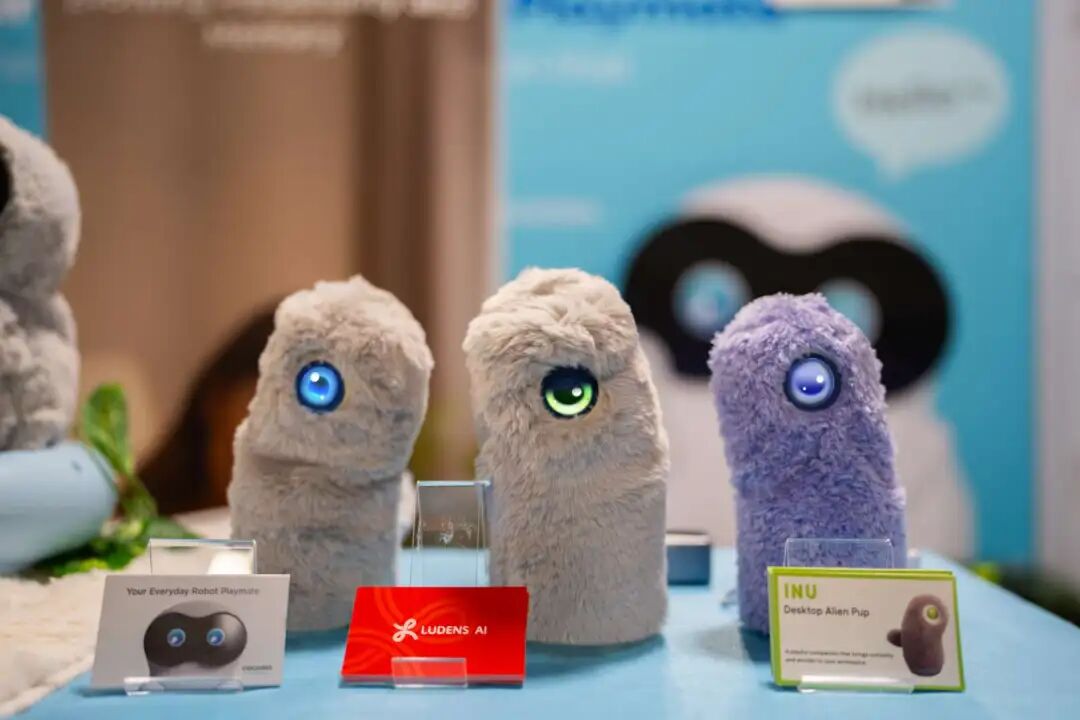
On the same booth, the team also showcased another, more lightweight desktop companion robot called INU. Positioned as a "desktop alien puppy," INU responds through tail wagging and body twisting — a smaller, more stationary desk companion designed for work environments.
Both products come from companion robot company Ludens AI.
Ludens AI's founder Lijun Xue is a former Tesla and DJI engineer who later joined FITURE's founding team to build out its AI systems. "But robots have always been my passion," Xue said in an interview.
To date, Ludens AI has completed two funding rounds: the angel round led by Linear Capital with Clear Water Bay Investment as co-investor, and the angel+ round co-invested by Japan's PKSHA Algorithm Fund and Clear Water Bay Investment, with both rounds totaling tens of millions of RMB.
At CES, many visitors experienced firsthand through COCOMO and INU the shift of robots from "functional" to "relational." As one foreign media outlet put it in its coverage, "It's not an AI assistant trying to complete tasks, but a robot companion that builds emotional connection through temperature, movement, and non-verbal expression."
For the home companion robot category, Ludens AI hasn't pursued feature stacking, but instead attempted to reframe demand starting from "space" — the home isn't a uniform scenario, but a space composed of different locations with varying attention densities. Therefore, robots shouldn't be a single product, but rather form a product matrix that can cover different spatial nodes.
Under this logic, COCOMO and INU have distinct, complementary roles.
COCOMO is positioned as an "everyday robot playmate," an autonomous mobile entity designed for open family spaces. It features 10 degrees of freedom and a 200-degree wide-angle field of view, capable of roaming through spaces, following users, and maintaining a degree of "presence behavior" even without direct interaction.
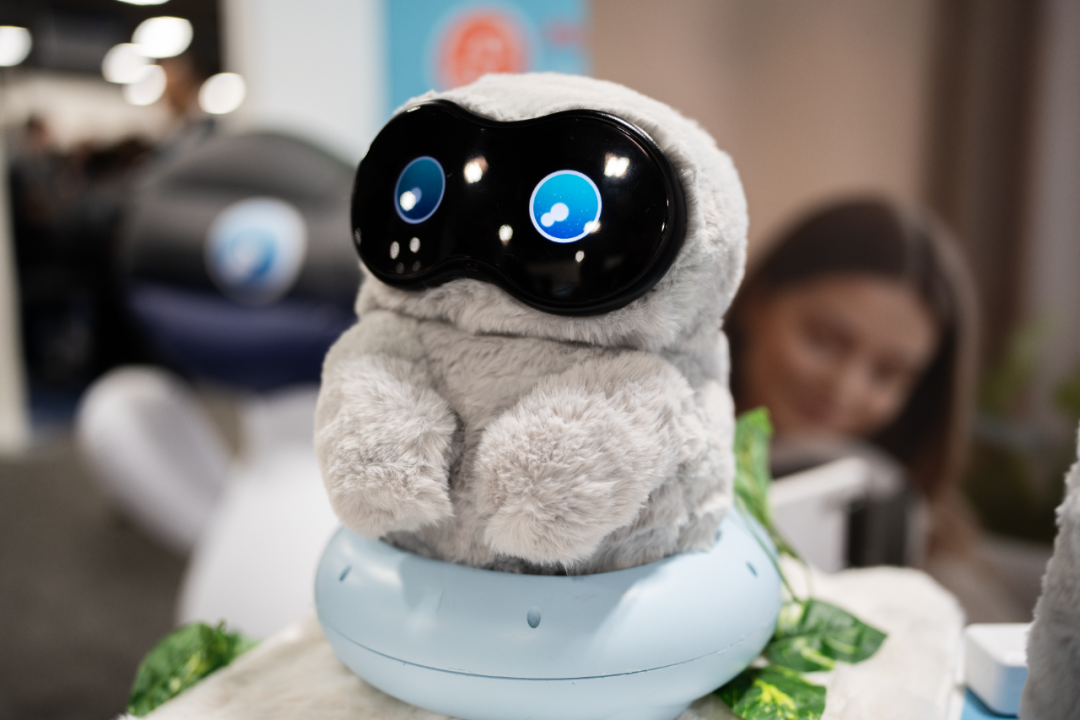
"We don't want the robot to be a tool loaded with many functions, but rather a living, breathing entity," Xue explained. "For example, COCOMO has its own life — it walks around the space on its own, observing the world. Its interactions aren't completely human-centric."
By contrast, INU is deliberately designed for the fixed scenario of a desktop. It won't actively enter every corner of a user's life, but instead provides just-right light companionship during work, study, and similar scenarios — present, but not intrusive.
In terms of interaction, Ludens AI similarly follows a "heavy on companionship, light on functionality" logic.
COCOMO doesn't speak human language. It possesses its own AI language system, expressing emotions through hums and movements rather than through explicit semantic communication.
"Many companion robots today are essentially just Chatbots in a different form. When a robot directly says 'I love you' to you, there's actually a strong sense of dissonance," Xue believes. "But when you suddenly realize one day that a particular sound it makes means 'I love you,' that moment of emotion is 'discovered' — this touching instant makes the connection between human and robot more real, more profound. That's the interaction philosophy behind our product design."
Ludens AI hopes people can gradually build deeper connections with the robot through long-term use — a philosophy also reflected in the exterior design.
Whether it's COCOMO's "extraterrestrial pet" quality or INU's unfamiliar single-eye form, neither opts for traditional "neotenic" or humanoid approaches, instead emphasizing an expression with greater aesthetic endurance.
"A robot is first and foremost an object that exists long-term in a user's living space. Its aesthetic endurance is, in some ways, more important than functionality," Xue noted. "INU's design is a kind of 'strange cute' — it doesn't please you at first glance, but sustains your interest over time without quick aesthetic fatigue."
Beyond the products themselves, what supports all of this is a complete technical system built by Ludens AI.
Unlike much AI hardware that relies heavily on cloud models, Ludens AI has chosen to deploy complex perception and decision-making capabilities on-device. This not only ensures real-time responsiveness in interactions, but also fundamentally addresses privacy concerns — the robot can complete the vast majority of emotional interactions without an internet connection.
On the specific technical architecture, the team has built an entire multimodal capability system centered on "non-verbal emotional interaction."
At the sound level, through phoneme-level emotional voice generation, the robot can convey nuanced emotions through hums and rhythmic variations rather than relying on concrete semantics; at the cognition level, through multimodal memory mechanisms, interaction fragments, preference understanding, and behavioral patterns between human and robot can be integrated, allowing the robot to remember the relationship and gradually develop a relatively stable "multimodal personality"; at the tactile level, through multi-layer composite material structures, the robot's shell maintains a temperature range close to human body temperature and dynamically changes with high-frequency contact, thereby physically dissolving the "coldness" of traditional machines.
More fundamentally, there is Klara OS, an edge-native AI system for companion robots developed in-house by Ludens AI. This system enables unified on-device scheduling of perception, cognition, and behavior generation, allowing the robot to achieve real-time understanding of multimodal information including environment, sound, and movement under low-latency conditions.
It is precisely based on this system capability that INU, a product that originally sprang from inspiration, was able to evolve rapidly from prototype to demonstration-ready in just two weeks. Going forward, Ludens AI will continue to launch robots in more form factors based on the Klara OS capability platform.
According to sources, COCOMO and INU are planned for launch on crowdfunding platforms this year, officially entering overseas markets.
At a time when companion robots suffer from severe homogenization, what Ludens AI truly seeks to answer isn't what robots can do, but what kind of relationship they can establish with people. From on-device AI to a self-developed operating system, from non-verbal emotional interaction to a multi-scenario product matrix — the endpoint of this technical system isn't functionality, but enabling robots to truly become present members of living spaces. Whether it can genuinely become a member of the family remains to be tested by time, but compared to "toyified" companion devices, this represents a further attempt to bring robots into real living environments.