Wire News | Targeting Pain Points in New Energy Vehicle Charging, State Grid Shunneng Pioneers the MPS Solution
At the end of July, Gotion Shunneng announced a multimillion-yuan angel round from Linear Capital and HSG, aiming to apply new-energy vehicle technology to build safe, efficient MPS (Mobile Power Supply) products. The following interview with the company offers a detailed breakdown of what MPS is, its advantages and prospects, and Gotion Shunneng's roadmap — recommended reading.
Linear Capital
In late July, Guangshun Energy announced it had secured a multimillion-yuan angel round from Linear Capital and HSG Seed Fund. The company is dedicated to using new energy vehicle manufacturing technology to build safe, efficient MPS (Mobile Power Supply) products. The following article, based on an interview with Guangshun Energy, explains and analyzes MPS in detail — its advantages, prospects, and the company's development plans. Recommended reading.
In recent years, China's new energy vehicle industry has experienced explosive growth, and the related energy replenishment problems have become increasingly prominent: difficult charging pile deployment, users struggling to find stations, poor charging experiences, relatively high failure rates of charging piles, and high idle rates in remote areas, among others.
The reality is that China's current vehicle-to-pile ratio stands at just 3:1. As new energy vehicle ownership continues to climb, the energy replenishment contradiction will undoubtedly intensify. Some analyses point out that if we calculate based on 80 million vehicles in operation, achieving a 1:1 vehicle-to-pile target would require expanding the entire power distribution network by an additional 2 billion kVA, corresponding to infrastructure investment on the order of tens of trillions of yuan — the cost is staggering.
To keep pace with new energy vehicle development, the National Energy Administration and the National Development and Reform Commission have stated in relevant guidance documents this year that we must adapt to user-side demands across different scenarios and develop advanced technological solutions. These should not be limited to charging and battery swapping; energy storage approaches that reduce the need for capacity expansion investments should also be encouraged.
Faced with the pain points of new energy vehicle energy replenishment and the problem of infrastructure failing to keep up with rapid product development, Guangshun Energy (Shanghai) Energy Technology Co., Ltd. (hereinafter referred to as "Guangshun Energy") has seized the opportunity to pioneer the definition of MPS (Mobility Power Supply) mobile energy solutions.
What is MPS?
Guangshun Energy was formally registered in Shanghai this February. Its founder, Deng Xiaoguang, has over ten years of experience in the new energy vehicle industry, having worked at Siemens VDO, SAIC New Energy, Neta Auto, and Qingtao Solid-State Battery. He was also one of the drafters of the current national charging standards.
As the saying goes, "when Heaven is about to confer a great responsibility, it will first exercise his mind with suffering." Shortly after its founding, Guangshun Energy faced the massive Shanghai COVID-19 outbreak. Yet it still secured tens of millions of yuan in angel funding during this period, with participation from top international investment institutions. This reflects the market's high recognition of the MPS mobile energy track that the company is pursuing.
According to Deng Xiaoguang, founder and CEO of Guangshun Energy, unlike fixed charging pile deployments, the MPS solution features autonomous driving capabilities, enabling "piles that find people" and providing users with seamless charging services through automatic plug insertion and removal. At the same time, the solution incorporates distributed energy storage functionality that breaks down large systems into smaller units, decoupling user demand from the power grid and enabling orderly charging on the user side of the energy network architecture.
After innovatively defining the MPS mobile energy solution, Guangshun Energy created the DHForce brand for operations. Users can enjoy intelligent charging services by placing orders through the DHForce app.
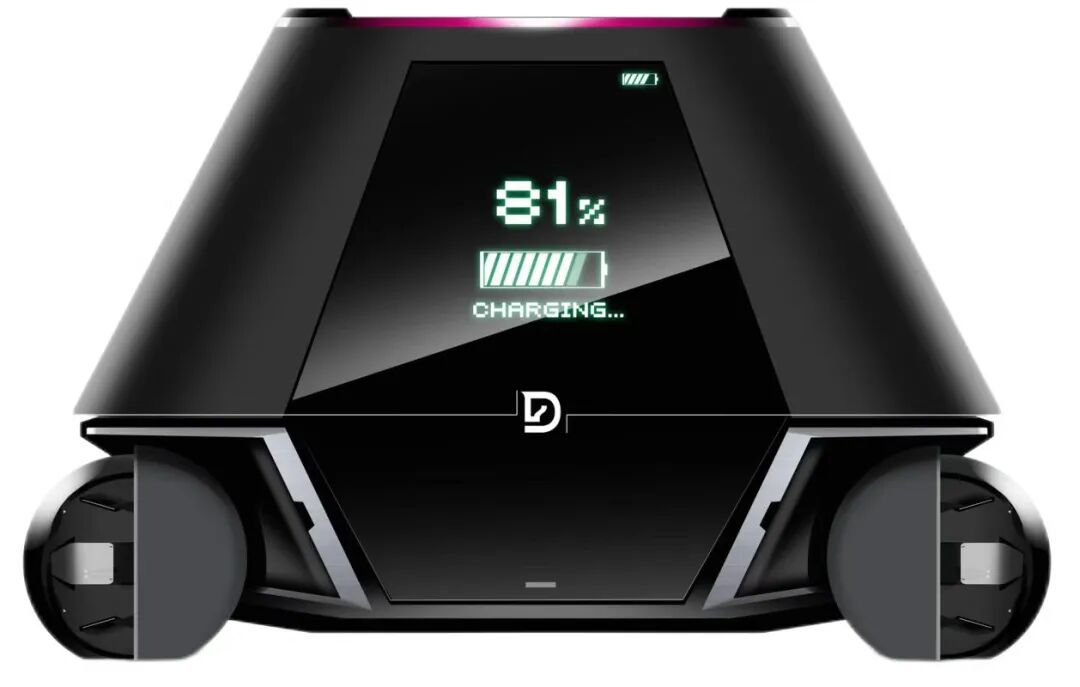
G60 Xiaohei; Image source: Guangshun Energy
In terms of product planning, MPS will launch two products: the G60 Xiaohei and the G90 Dabai. Xiaohei focuses on mobile energy replenishment for passenger vehicles, while Dabai G90 carries more battery capacity and can supply energy to construction machinery and commercial vehicles with high electricity consumption.
As one of the angel round investors in Guangshun Energy, HSG partner Yang Zhaoguo told Gasgoo: "Under the wave of the new energy electrification era, we see expectations of more than tenfold growth over ten years, and massive flexible demand on the electricity consumption side of new power systems. Guangshun Energy has advanced the fresh definition of MPS mobile energy, bringing us an entirely new solution that combines comfortable technological experience with efficient energy supply. Mr. Deng and his team have deep accumulation in new energy vehicles and upstream and downstream industry chains, along with a spirit of continuous pioneering and enterprising development, providing the most efficient and convenient services for users across various scenarios."
What are MPS's advantages?
In fact, as an energy replenishment method beyond fixed charging piles, the industry has previously explored mobile energy replenishment in various ways. Relevant automakers and power battery manufacturers have successively introduced mobile energy replenishment vehicles, mobile energy storage vehicles, mobile charging robots, and other solutions. What differentiated competitive advantages does the MPS mobile energy solution that Guangshun Energy has launched have over previous products?
On this point, Deng Xiaoguang emphasized that compared to mobile energy replenishment vehicles already on the market, MPS represents an entirely new product form — a convenient, high-tech, and safe energy source. There is currently no comparable product on the market.
As mentioned above, MPS's convenience lies in providing users with seamless charging services through automatic plug insertion and removal. Additionally, regarding the charging speed that users generally care about, MPS takes high-power charging capability as its core design goal. Its products adopt industry-leading 4C fast-charging battery cells, capable of replenishing 150 kilometers of range in under 10 minutes. The constant temperature management system can support more than 6,000 cycles.
The high-tech element comes from Guangshun Energy's self-developed RxTech technology platform. This platform provides strong technological attribute support for MPS products, specifically including: RxPower energy source, RxPilot intelligent driving, RxEP intelligent power, RxMech seamless technology, RxDomain domain control cloud, RxEPT key battery technology and management systems, and other aspects.
Safety is reflected in the fact that the MPS mobile energy solution has certain technical thresholds, requiring automotive-grade battery technology and battery integration development capabilities. At the same time, since MPS provides energy output in relatively densely populated areas, battery safety is particularly crucial. Guangshun Energy's founding team has mass production experience with more than 500,000 new energy vehicles, accumulating rich practical experience in power batteries, core three-electric systems, and charging/swapping standards.
Furthermore, unlike traditional mobile energy replenishment vehicles, MPS can serve as distributed mobile energy storage facilities, providing peak shaving and valley filling, frequency regulation, peak regulation, and orderly charging for the power grid, with bidirectional regulation capabilities. "Drawing on our team's years of accumulated experience in new energy vehicle products, MPS products will deliver smoother performance and better service experiences in seamless charging, system safety, and intelligent power driving platforms," Deng Xiaoguang said.
In terms of business model, given that most mobile energy replenishment services previously launched by companies have faced profitability difficulties, Guangshun Energy has innovatively identified three market values and social values of the MPS solution.
First is defined market value, namely the convenience revenue from providing users with unmanned mobile energy services with seamless plug insertion and removal. Second is social value as part of the energy network: faced with the enormous investment required for infrastructure capacity expansion and network expansion, and the rigid electricity demands of scattered users, MPS breaks down into smaller units to become a supporting point on the capillaries of the new energy network. Third is revenue from the transformation of big data resources: in the process of providing services, MPS actually connects upstream energy supply with downstream user demand. Relying on a technologically intelligent electrification platform, MPS can learn user habits and help the power grid with orderly regulation.
What are MPS's prospects?
Regarding the future market application prospects of MPS products, Deng Xiaoguang used this set of data to illustrate: when new energy vehicle ownership reaches 80 million, annual electricity consumption will amount to more than 568 billion yuan (not including other electrified products and distributed energy storage electrification demands). Additional forecasts indicate that by 2030, China's new energy vehicle ownership will exceed 100 million, and by 2040 it may surpass 200 million.
The track ahead for Guangshun Energy is undoubtedly broad. For now, its most important task is to ensure the implementation of MPS products in actual use and achieve effective connection with the energy network.
Regarding product implementation, Deng Xiaoguang candidly stated that while the pandemic has adjusted the product launch timeline somewhat, Guangshun Energy is working hard to make up for lost progress. "At present, MPS products have completed virtual design and are advancing to the sample prototyping stage. They are expected to be unveiled by the end of this year, with pilot and demonstration operations in select core application scenarios at that time."
About Linear Capital
We are hiring talent to join our investment team. Multiple positions are currently open. For details, please click here.
Linear Capital is a professional investment institution focused on "Data Intelligence" and "Frontier Technology."
Linear Capital currently manages ten funds with total assets under management of approximately US$2 billion.
We focus primarily on early-stage projects in "Data Application," "Data Infrastructure," and "Frontier Technology" application areas. Our investment stage focuses mainly on leading angel to Series A rounds, with typical investment amounts of US$3-8 million or equivalent RMB per project.
To date, we have invested in over 120 early-stage entrepreneurial teams including Horizon Robotics (US$3B), Tongdun (>$1B), Kujiale (>$1B), Sensors Data, Tezign, Rokid, Guandata, and Agile Robots. The combined valuation of Linear's portfolio companies is approximately US$20 billion.
In the near term, Linear Capital is working to become the best "Data Intelligence Technology Fund," and in the long term, gradually build itself into the most influential "Frontier Technology Application Fund."