What the Phenomenal Success of NotebookLM Means for AI Application Startups | A Bolt Perspective

A New Paradigm for AI Application Innovation

NotebookLM is an AI-powered content research tool developed by Google Labs. Not long ago, it launched the Audio Overviews feature, which generates roughly ten-minute two-person conversational podcasts based on content users upload. This feature's extreme flexibility with input formats and solid audio production quality catapulted NotebookLM into the spotlight — earning shoutouts from AI heavyweights like Sam Altman and Andrej Karpathy and sparking considerable discussion across Silicon Valley. As someone who listens to podcasts almost daily, I was genuinely struck by how cleverly designed this use case was when I first learned about and tried NotebookLM's Audio Overviews.
Recently, NotebookLM's product lead Raiza Martin sat down with prominent blogger Lenny Rachitsky to discuss the product's evolution, the thinking behind it, and how the team collaborates internally. Drawing from that podcast conversation and my own understanding of the product, I believe NotebookLM's popularity actually sketches out an interesting paradigm for AI application innovation today — one with plenty of lessons for AI app entrepreneurs.

Image | NotebookLM homepage
Leaner Organizational Structure
When people discuss NotebookLM today, the product itself is only part of the story. Another major factor is that it comes from Google — a textbook big company. But look closer and you'll find the NotebookLM team started with just three people. After two years of development, it still hasn't exceeded ten people. This is a classic startup organizational structure, smaller even than many actual startups. It's also representative of what we're seeing across AI-native application teams today, particularly the strong ones. The reasons are twofold: first, AI-native teams should themselves be AI-empowered; second, extreme agility in the early stages allows faster adaptation to the rapidly shifting AI market and ecosystem. So in most cases, if you're building an AI application startup today and planning to assemble a team of more than fifteen people from day one, you need to seriously reassess your team's efficiency.
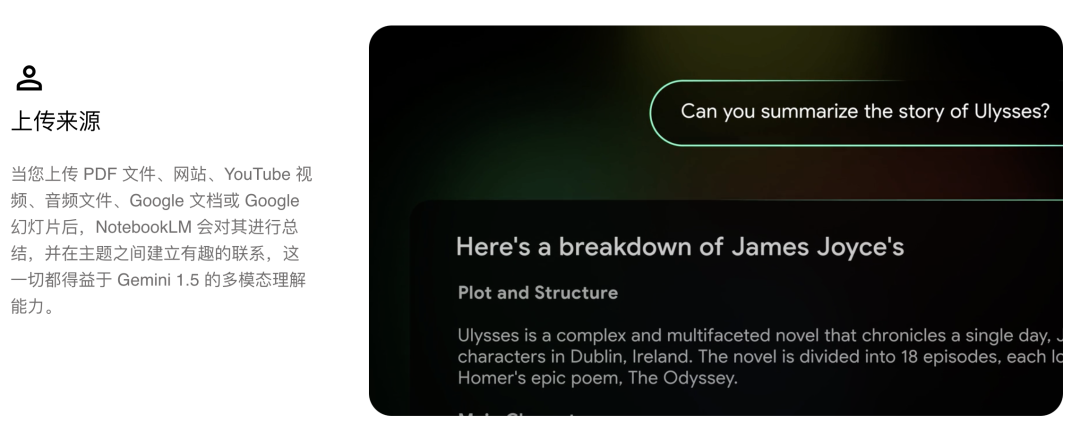
Image | NotebookLM feature introduction
Don't Chase the Perfect Launch
Raiza expressed this view — she means shipping a basic functional version quickly, then iterating and improving based on user feedback, letting users and time help you build product moats. But I think there's another crucial point for startups: in the early product stage, don't spend too much time selecting models or fine-tuning model capabilities. On one hand, today's model capabilities are already sufficient for many consumer-facing use cases. Once you find a usable foundation model, you should quickly build your MVP and seek TPF (Technology-Problem-Fit). The Gemini model that powers NotebookLM isn't the most powerful foundation model available today, yet that didn't stop NotebookLM from becoming a breakout product (though we shouldn't overlook possible底层调节 the Google Labs team may have done on the model side).
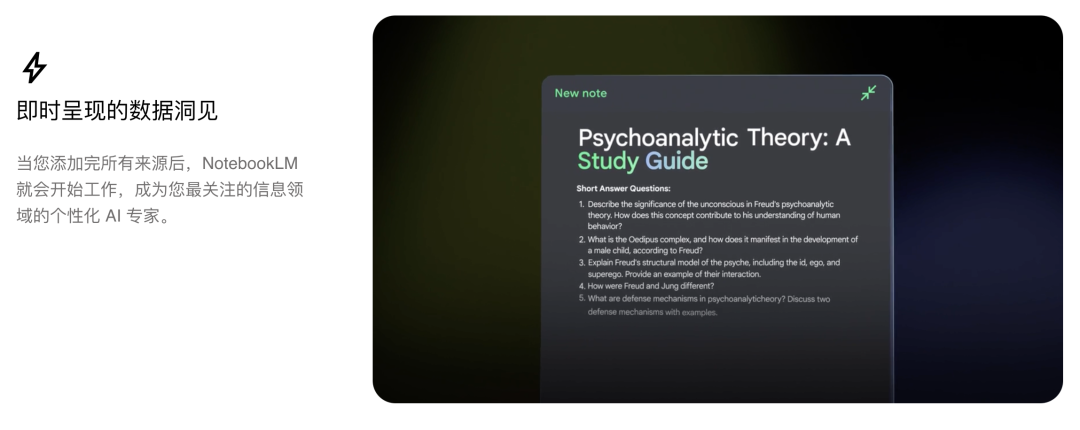
Image | NotebookLM feature introduction
Target Underestimated Scenarios
NotebookLM's breakout success is largely thanks to Audio Overviews — a relatively niche podcast use case. Setting aside whether podcasting seems niche (it's actually not that niche, just smaller compared to mainstream content platforms), podcasts are an excellent format for passive content consumption. Traditional podcast content is typically systematically organized and produced by people with editorial capabilities, crystallizing intellectual labor value. Additionally, hearing is the most natural channel for humans to receive linguistic information. NotebookLM leverages AI to handle the complex information processing pipeline, then delivers content through conversational audio — the most natural and efficient format — transforming a content interaction experience that the market had undervalued into something that genuinely delights users. This clever scenario selection is well worth pondering for today's AI application entrepreneurs. Perhaps the next interesting AI use case is one that nobody is paying attention to yet.
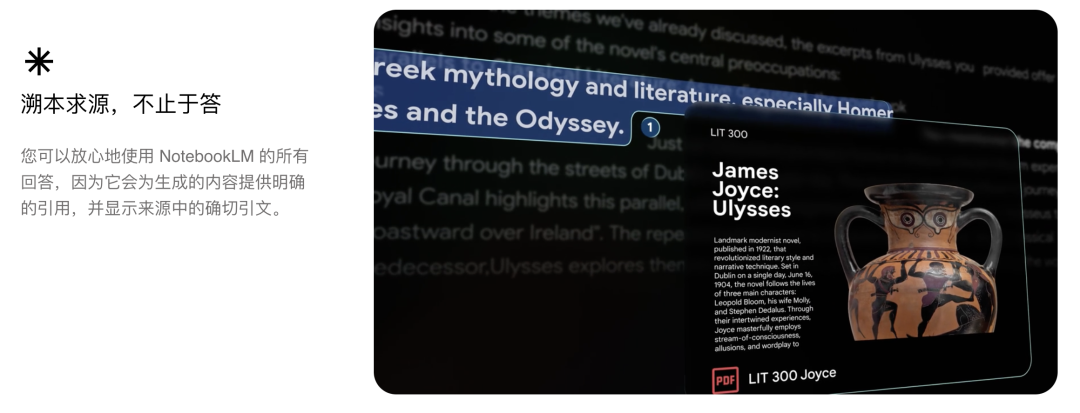
Image | NotebookLM feature introduction
User Insight Is Core
From a user needs perspective, NotebookLM strikes an excellent balance between active and passive content interaction. User agency manifests in two ways: first, users provide content that's valuable to them (after users upload "source documents," interactions are bounded within that information); second, users can choose their preferred content consumption format. Passivity shows up in users not needing to do cumbersome content processing — instead, AI handles the information refinement and outputs content in the desired format, such as a concise two-person podcast. In fact, there were AI audio products before this, but none achieved NotebookLM's breadth of user reach. I believe a critical reason is that earlier explorers failed to strike the balance described above, instead relying on AI to dump information without considering the user's rightful agency. Of course, this balancing act severely tests product managers' understanding of their users. Raiza mentioned that the NotebookLM team spent extensive time observing user behavior and genuinely spending time with users to think about how to make their product more user-aligned. This reflects the clever thinking and attention to detail rooted in user insight — something that's easily overlooked in today's AI applications but often proves to be the key differentiator.

Image | NotebookLM feature introduction
NotebookLM's Shortcomings
It must be emphasized that NotebookLM is still in the early stages of product refinement. Even the breakout Audio Overviews feature only recently added a "customize" option to provide additional instructions for audio output. I believe the podcast functionality alone has substantial room for user experience upgrades and could even become a standalone product.
Second, we haven't yet seen an effective data flywheel form within NotebookLM. Without valuable user interaction data and the resulting product experience improvements, mere scenario innovation and feature showmanship may face significant homogenization competition over time — especially given that similar open-source projects already exist.
That said, NotebookLM's emergence brought fresh energy to AI application innovation in the second half of 2024. The product goal Raiza's team described — modality-agnostic content transformation guided by user needs — is also quite intriguing and points toward the future direction of content interaction. Linear Bolt took notice of and has been tracking opportunities in AI applications around content interaction, creation, and distribution from early on. We believe NotebookLM's appearance will inspire more brilliant minds to explore further in this space.
Further Reading

Linear Bolt Bolt is an investment initiative established by Linear Capital specifically for early-stage, global-market-facing AI applications. It upholds Linear's investment philosophy and principles, focusing on projects where technology-driven transformation creates change, with the goal of helping founders find the shortest path to their objectives. Whether in speed of action or investment approach, Bolt's commitment is to be lighter, faster, and more flexible. In the first half of 2024, Bolt invested in seven AI application projects including Final Round, Xin Guang, Cathoven, Xbuddy, and Midreal.