From OpenAI Intern to Perplexity Founder: What I Learned Building a Startup to "Challenge Google" | Bolt Picks

The so-called "building the next generation of information interaction experiences"

Recently, Perplexity co-founder and CEO Aravind Srinivas sat down for a YC interview to share his founding story, what it feels like to compete with Google, and his vision for the future of search. We've translated and curated excerpts from the conversation; the full video is available via the "read more" link. (Note: interviewer David Lieb is a YC partner.)
🔍 Key Takeaways
1. Betting on AI evolution instead of following trends: Early pivot from reinforcement learning to unsupervised learning, seizing the GPT breakthrough window, replacing traditional indexing with direct webpage parsing via large models — an "anti-consensus" strategy that achieved a qualitative leap in search experience.
2. Cold-start validation: A three-person team built the first demo in one month, scraping public social data to generate structured results, validating the "AI Q&A + cited sources" model's user value while sidestepping commercial data negotiation traps.
3. From tool to conversation partner: After accidentally going viral due to an AI misjudging whether a public figure was alive or dead, the follow-up question feature deepened engagement — doubling queries per session and revealing that "participation > absolute accuracy" is the real user need.
4. The anti-giant playbook: Exploiting Google's entrapment in ad revenue and Microsoft's lack of consumer DNA, insisting on a clean Q&A experience, building a hybrid system with open-source models to maintain low-cost, rapid iteration capability.
5. Balancing pure experience with commercial viability: When extending from information queries to transactional actions, solving the "answer → purchase" chain becomes critical. An "AI orchestrator" coordinates multi-model collaboration, letting users complete complex tasks seamlessly.
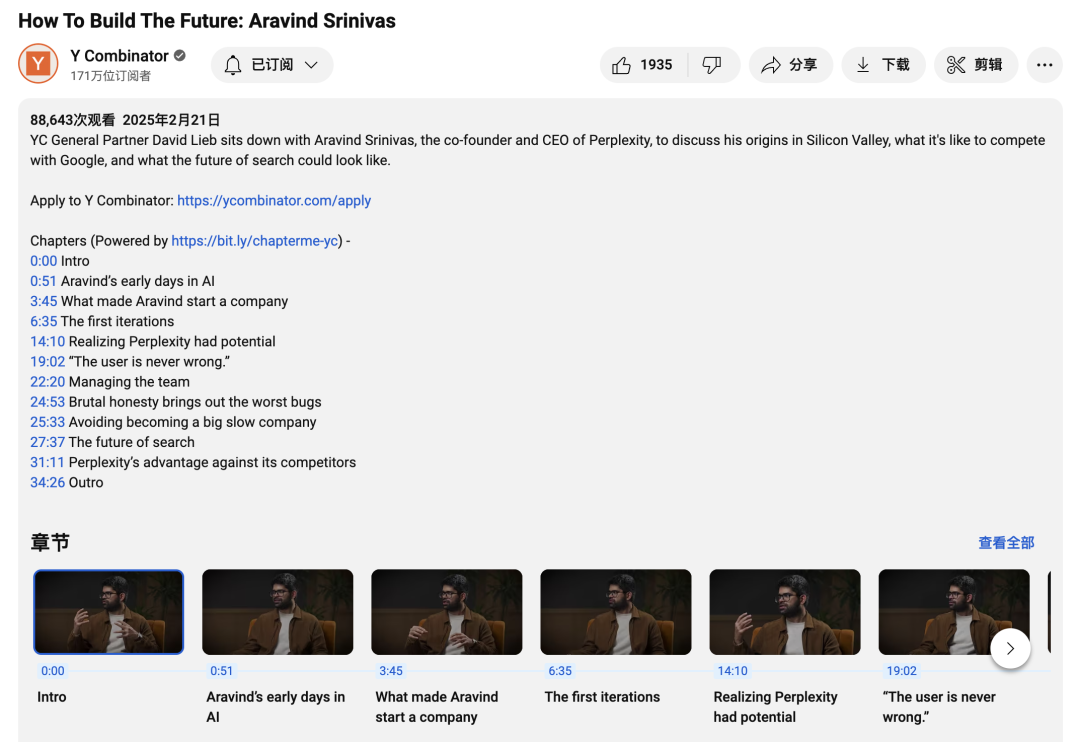 Figure | Interview Show Notes
Part.01
From Initial Concept to Perplexity's First Version
1) David Lieb: How did you get into AI?
Aravind Srinivas: I've always been deeply interested in AI and deep learning — that's what brought me from India to the US. What truly changed my trajectory was my internship at OpenAI. Researcher Ilya Sutskever gave me incredibly stimulating feedback. The first time I spoke with him, I pitched some ideas I found interesting. Five minutes in, he said: "This research is useless." I felt crushed at the time, but I gradually got used to this direct, brutally honest style, even when it stung. He then drew two circles: a large one for "unsupervised learning" containing "reinforcement learning," and a smaller one for "AGI." He said: "This is AGI. Nothing else matters." This was when they were building what would become GPT-1, before it even had that name. Back at Berkeley, I realized my reinforcement learning work had been going with the crowd. I shared this with my professor and decided to focus on unsupervised learning and generative models.
Later, during my Google internship, I happened to read In The Plex, which mentioned how many grad students like me had become industry leaders. It filled me with ambition — I wanted to build a company combining deep research with solid product development. I spent a lot of time thinking about this and discussed it with Ilya Sutskever. He noted that only two domains might allow simultaneous AI research and product development: search and autonomous driving. Both generate massive data that feeds back to optimize AI models, creating a flywheel effect. As AI improves, the product gets better; as the product improves, it drives further AI advances. This virtuous cycle keeps the company growing until AI can automatically solve the problems the product originally targeted.
2) David Lieb: What made you leave a good job at OpenAI to start your own company? How did you find your co-founders?
Aravind Srinivas: I came across a blog post by former YC partner Daniel Gross about building the next Google — how search could be optimized with suffixes to filter results, even improving Google's existing ranking. More complex operations were possible too, like categorizing search results. He mentioned that large language models could automatically identify these suffixes. This clicked for me: generative AI might enable a more efficient way to build search engines.
DeepMind had built an Android environment to develop a mobile prototype where an agent controlled phone apps. I was fascinated by this too. At the time, I discussed these ideas with my co-founder and CTO Dennis, a visiting student in my lab. We explored building agents to control Android environments, bouncing around many concepts without landing on any specific company or product. We'd often think: "Why do this? Google will definitely build it." If you want to make a better Google Docs, Google will eventually add those features. For them, it's just an add-on. And precisely because these aren't core to Google and other giants, companies like Notion can get funded and find room to grow.
The real reason we ultimately built Perplexity actually only became clear after launch — we hadn't foreseen it. Perhaps ignorance was a kind of luck. In building Perplexity, we realized AI-generated content could disrupt traditional search. If people stop clicking links, the ad-based business model collapses. There are many nuances here, but this core insight crystallized only after we shipped. Once I recognized it, I knew we'd found our direction. This insight laid the foundation for our next two years.
3) David Lieb: Can you talk about your early experimental versions?
Aravind Srinivas: I'd expressed my vision of challenging Google to our investors, who advised us to take it slow.
As a startup initially targeting enterprise users, we needed business data. PitchBook and CrunchBase had extensive commercial data; I tried multiple approaches to partner with them for a demo that would convince investors. They rejected us. So we pivoted to Twitter. Elon Musk wasn't CEO yet, and Twitter allowed academic access. We built a database from Twitter data and organized it into tables.
We used OpenAI's Codex model to process this data — GPT-3.5 hadn't launched yet. We wrote templates; the model extracted information and generated SQL queries based on them. We also built a callback mechanism: if errors occurred, the system auto-corrected and continued querying the database to retrieve records. It worked remarkably well, enabling conversation, querying, and chart plotting through a chat interface. This was our first real product. Though only three people built it, we completed it in just one month. We showed it to many people; the response was overwhelmingly positive.
Why? First, this functionality had never existed before — users couldn't search Twitter this way. Second, it let users discover fascinating information. It was essentially social search: who someone followed, which tweets they liked or disliked, who they'd unfollowed, and other details.
Part.02
From Twitter Search to Perplexity
4) David Lieb: After launching Twitter search, how did you transition to what people now know as Perplexity?
Aravind Srinivas: After launching Twitter search, we tried extending similar functionality to other data sources — LinkedIn, for instance, letting developers filter information by specific criteria. But the technical challenges remained substantial.
I saw a tweet from Paul Graham (YC co-founder) noting that problem-solving typically starts with a complex problem and ends with a relatively simple, general, scalable solution. Two approaches exist: first, building indexes for each domain and converting data into specific formats (like SQL) for LLMs to read; second, keeping data unstructured and relying on LLMs to do most of the work during reasoning and querying rather than at the indexing stage. Clearly, if the future trends toward the second approach, models will keep getting smarter. This way is more generalizable, and its advantages grow as model capabilities improve.
Simultaneously, this gave us an opening to challenge traditional search engines like Google. We decided to try building a more general, flexible solution. In fact, we built a prototype of this idea in just one weekend. At the time, John Shulman's team had released WebGPT, and OpenAI had developed TruthBot — users could ask it questions, and it would search the web and return sourced answers. But it was inefficient, using the 175B-parameter GPT-3 model with very slow execution. We tried a simplified exploration approach that was much faster. We decided to extract only the top few links from search API returns, using only cached summary snippets. This way, users didn't need to scroll or click through pages. All links were fed directly into the prompt; the model output answers with academic-style sourced summaries.
5) David Lieb: So you were essentially betting that models would become good enough to eventually make all this complexity irrelevant?
Aravind Srinivas: Yes, though timing mattered more. A year earlier, when John and his team tried, models performed terribly. Betting on models then would have completely failed. Only when models' instruction-following capabilities improved did this approach start working, solving the core user experience problem: latency.
Even so, our first released version still took about seven seconds, since we hadn't conceived of "streaming answers" yet — we had to wait for the full answer generation before returning it. We also couldn't control response length, sometimes producing extremely verbose answers. So we hard-coded prompts to constrain length, requiring concise responses within five sentences or 80 words.
Part.03
Perplexity's Launch and Early Success
6) David Lieb: After launching Perplexity, when did you realize "we got something right"?
Aravind Srinivas: While drafting the launch tweet, I knew people might mock it, expecting errors. The first major attention came when a prominent academic searched her own name, and the system returned a biography written in past tense. She was furious, tweeting: "I'm alive, how could this happen?" The model had actually confused her with a deceased namesake. This sparked widespread discussion: even with reliable sources, can we fully trust the answers?
Then we noticed more and more people searching their own names. Similar phenomena have occurred across all consumer products. I once spoke with Mike Krieger (Instagram co-founder), who noted that despite users being able to click their profile picture to return to their page, they still loved typing their username directly into the search box. It's become a fascinating human habit. So many began searching their Twitter handles or social media accounts. The model would synthesize their social behavior and profiles, even combining childhood anecdotes or job postings, generating interesting summaries to share. At this point, I sensed what we were building had significant potential.
But I wasn't fully convinced yet. Later, we launched the follow-up question feature. This new capability doubled user engagement time and caused questions to grow exponentially. That's when I started believing this product might really have legs. We shouldn't give up, and we didn't need to pivot to enterprise after all.
7) David Lieb: When did the thought "we might actually have a chance to compete with Google" emerge? How did it happen?
Aravind Srinivas: Honestly, I never seriously considered actually competing with Google, because I knew Google could hardly launch something like our product on their homepage. For example, Google struggles to determine whether a query is purely informational. Moreover, Google's search page is already crowded — answer boxes, knowledge panels, ads, social views. The difference between Google and Perplexity is like fast food versus healthy food: entirely different experiences, even for informational queries.
Initially, I was more worried about Microsoft, since they were about to release Bing Chat. We were in talks with investors like NEA, nearly reaching investment terms. One day, over coffee, I heard Microsoft was about to launch Bing Chat, with some screenshots leaked. Our planned 30-day due diligence got extended to 45 days. Another investor who'd made a verbal agreement asked my thoughts on Bing Chat. I told my co-founders that Microsoft's progress might force us to adjust, perhaps even pivot or sell. But instead of asking us to change direction, my investors encouraged us to keep going. That was incredibly motivating.
Then Google published an article signed by Sundar announcing Bard (Gemini's predecessor), with only product screenshots. We realized competition would be fierce. But we also knew Microsoft has always struggled with consumer products — this deep-rooted issue won't be solved overnight. I didn't think Microsoft would seize the opportunity; they'd face numerous internal problems and challenges. This leaves massive market space for other competitors.
Perplexity's Future Vision
8) David Lieb: Your recent versions seem more verticalized, like shopping. Where do you want Perplexity to be in a few years?
Aravind Srinivas: If you search "which sweater should I buy," Perplexity gives you a high-quality answer. But where do you ultimately purchase? Probably still Google. Where does the commercial value accrue? Google earns ad fees in this process; we get nothing. Even if we launch a pro paid version, some company might use cheaper models to offer a free version, diverting our revenue.
Our challenge: we want users to complete one-stop operations on Perplexity, from asking to buying. But many users feel that if, when querying "what watch does Bezos wear," we provide an answer alongside a "buy" button — what we see as one-stop service, users see as advertising. It's not actually advertising, but users assume we're showing this because advertisers paid us.
Thus, tension exists between monetization and early users: early users hate ads and pursue pure experiences, while the mass market needs products that comprehensively help solve their problems. This appears across many scenarios — checking game scores, accessing website or API documentation links. Perplexity might provide more accurate data, but users don't care about these technical details. You need to build systems incorporating small models, knowledge graphs, LLM streaming responses, multi-step reasoning — but users don't care about the underlying tech. AI should intelligently choose which model to use; we call this a "router" or "orchestrator."
This will be the most challenging part. Whoever successfully builds such a system serving a billion users, providing an integrated experience that both understands users and helps them complete tasks, will become the next Google. Though this goal seems extremely challenging, I think Google is currently closest to achieving it. Next-generation systems are clearly achievable; with ten to twenty years of persistence, we can ultimately solve these challenges.
9) David Lieb: Over the next decade, what companies will compete with you? Where do you think your advantages lie?
Aravind Srinivas: Our greatest strengths are our obsessive dedication to serving users and excellent product taste. These actually require deep domain expertise. Among the companies you mentioned, Google is a company with product taste and global distribution channels, but it's facing some predicaments. Google is fundamentally a search company, yet also an advertising company — search's core purpose is serving ad revenue. Approximately $200 billion in quarterly search revenue remains Google's primary income source. Though YouTube and cloud computing contribute revenue, their profit margins are far below search.
10) David Lieb: Will stock price become their obstacle?
Aravind Srinivas: Exactly. Wall Street closely watches search revenue; any decline triggers overreactions. In a world where users directly converse with AI and AI agents execute tasks, search revenue naturally gets impacted. This doesn't mean Google won't act — they're actively developing Gemini and other new apps. But integrating these technologies into core Google services with billions of users is no easy feat.
11) David Lieb: Do you think new business models and monetization methods must be developed to win this competition?
Aravind Srinivas: We'll face many new challenges ahead — shopping, travel, and more. You need to decide which merchants to choose? How to handle bookings and cancellations? Who's the "middleman"? Who decides which hotel or airline ticket users book? Google made major advances in PageRank, MapReduce, visual deep learning, and BERT transformer models. But they also did much "boring" work — launching Google Finance, Google Shopping, Google Flights. I think Perplexity has an advantage over OpenAI and Anthropic in solving these problems because beyond reasoning and model technology, we deeply care about user and product experience — it's our core DNA. We're intimately familiar with these technologies, able to flexibly use open-source models for fine-tuning, post-training, and evaluation. We won't devote all company resources to building data centers or manufacturing chips, nor merely to breaking programming records or solving the hardest math problems. Our goal is building the next-generation information interaction experience, firmly believing this holds tremendous value.
Linear Bolt Bolt is Linear Capital's dedicated investment program for early-stage, global-market-facing AI applications. It upholds Linear's investment philosophy, focusing on technology-driven transformation, aiming to help founders find the shortest path to their goals. Whether in action speed or investment approach, Bolt's commitment is lighter, faster, more flexible. In 2024, Bolt has invested in 11 AI application projects including Final Round, Xinguang, Cathoven, Xbuddy, and Midreal.