Everyone's Scrambling to Become the "Palantir of China," But He Says There's More Than One Path | Linear Voice

The real moat for decision-intelligence platforms actually lies outside AI.

Every wave of technology, when it runs deep enough, circles back to a simple question: who does it create value for, and what value does it create? Over the past two years, Palantir's stock has risen nearly tenfold at its peak, and "decision intelligence" has become the new narrative in capital markets.
But what enterprises actually need may not be a smarter model — it's AI that can read data, understand the business, and enter real decision-making. As a veteran entrepreneur in this space, Chase Su, founder of Guandata, believes this path won't be a simple copy of Palantir, but will grow out of concrete scenarios one by one.
Linear Capital was the lead investor in Guandata's angel round, and has added to its position in multiple subsequent rounds.
As U.S. decision intelligence company Palantir's market cap once broke through $400 billion, the "decision intelligence platform" concept was thoroughly ignited, and Hong Kong stocks saw a surge of IPOs centered on the "AI + data" theme. A batch of companies scrambled to claim the title of "China's Palantir."
Beyond the hype, a more direct question remains: the vast majority of large models and agents still can't break into true enterprise-grade applications.
The answer doesn't lie in the models themselves. The real barriers to enterprise AI are only two — first, whether you can make enterprise data ingestion, cleaning, and governance trustworthy, reliable, and observable; second, whether you have deep enough industry scenario know-how. And these are precisely what general-purpose large models cannot provide.
Recently, Guandata officially launched DecideX, an AI-native decision intelligence platform that connects data analytics, business context, and agent action into a closed loop, integrating all three to help enterprises build an AI-era operating decision brain.
In the past, Guandata served the most numerous and most "intense" industries and enterprises in China, with over a thousand well-known clients, including many Global 500 companies. Now AI is redefining how enterprises operate — data analytics is no longer the endpoint, but the starting point for decision intelligence. Guandata also formally launched its globalization strategy earlier this year, with its first moves into Indonesia, Hong Kong, and Europe, with more regions to follow.
"If we had to pick a benchmark for Guandata, the answer is unquestionably Palantir." But Guandata founder and CEO Chase Su also believes: Palantir's path may not hold in China — China will take a lighter, more agile route — more enterprises will gradually evolve from their existing data analytics platforms into AI operating decision brains. And this is precisely the direction the Guandata team is pushing forward.
On capital and going public, Su is no longer evasive. In his view, the launch of DecideX opens an entirely new category. In the coming 1–3 years, Guandata will accelerate product innovation and customer deployment on one hand, while actively embracing capital markets on the other.
Recently, Chase Su of Guandata sat down with IPO Zaozhidao for an interview. The conversation follows.

Q: How would you briefly introduce this new product launch?
Chase Su: Actually Guandata was a bit of an "oddball" from day one in 2016 — we were already thinking about how AI could surpass BI, even disrupt BI. In 2017, we released our AI + BI product matrix. In 2020, our 5A AI practice, from Agile to Actionable, earned us World Economic Forum Technology Pioneer honors.
In the past we were built on a machine learning tech stack. With the rapid evolution of large models and agent technology, over the past year and a half we've agentified all our original BI products, which has received excellent feedback from existing customers.
More importantly, DecideX, which we're launching this time, is an entirely new AI-native product line, defined as a platform for defining, orchestrating, running, and continuously evolving enterprise decision intelligence agents — helping enterprises move AI from answering questions to truly participating in decisions. We believe what enterprises truly need to build is not just a smarter large model, but a capability system that can continuously accumulate business context, understand enterprise operating logic, and support AI's ongoing participation in decision-making.
Q: Which capabilities from your years as an "AI + BI" vendor can be carried over to this decision intelligence platform?
Chase Su: The true, core capabilities of a decision intelligence platform actually lie in two dimensions beyond AI — first, enterprise-grade data analytics capabilities, including how to ingest, clean, define, and ensure reliability across all aspects; second, accumulated industry scenario know-how. Whoever understands decision-making in this domain more deeply will be more valuable in the agent era. And Guandata happens to have built very solid foundations in both dimensions.
On one hand, we've been co-creating solutions with customers from day one. Our philosophy has always been to get business teams using it, not just IT — our shared goal with IT is to get business teams using it. So to this day, our accumulation in retail, consumer, and manufacturing scenarios is very deep. For example, among the top ten tea drink brands we serve seven; among the top ten restaurant chains we serve five; among the top ten beauty brands we serve eight; among the top ten consumer goods, daily necessities, and food & beverage Fortune 500 companies we serve five; and in manufacturing, we've served over 100 listed companies or segment champions. So over these years, by focusing on leading customers, we've accumulated substantial depth across scenarios.
On the other hand, in enterprise-grade data analytics capabilities, we also serve a leading financial institution with up to 80,000 active users — basically one of the largest, if not the largest, enterprise analytics applications domestically and even globally. We also serve Mixue Ice Cream & Tea, a brand with 50,000 stores. Our stable, high-performance data processing capabilities for cases like this are at the industry's forefront.
So the deepest moat for an AI-era decision intelligence platform is actually the iceberg below the waterline, and it requires time to accumulate.
That said, AI itself is also quite important. We've invested continuously in AI over our 9+ years, and have been actively embracing large models for the past two-plus years. One proof point: we collaborated with Unilever on a series of supply chain agents. And earlier this year, we helped Unilever's Hefei FTC logistics center get selected into the World Economic Forum's Global Lighthouse Network with its "factory-to-consumer" supply chain model, becoming Asia's first supply chain resilience lighthouse. Our AI capabilities have already landed in real business scenarios and become a global benchmark.

Q: With this new wave of AI, will market competition become more intense?
Chase Su: From another angle, I believe the overall market opportunity is expanding by multiples. Whether traditional BI or AI + BI, there's still a lot of value that hasn't been released, which is why we're proposing the decision intelligence platform today — the core reason is that the value we can create for enterprises today is 1–2 orders of magnitude greater than before. People are increasingly recognizing that the value created by decisions is different from the value created by data, and also better understand the importance of actual deployment.
Simply put, along the AI thread, moving from past data platforms to true decision platforms itself expands the addressable market by 1–2 orders of magnitude. Of course, this won't happen in one year — it's probably a 5-year, 10-year journey. So over the past year-plus we've been validating new value together with some of our previous leading customers, and I believe the opportunity here is enormous.
Q: When decision intelligence platforms come up, the most prominent company people think of is obviously Palantir. What do you think it takes to become a true "China's Palantir"?
Chase Su: First, we consider Palantir a very great company. To some extent we're benchmarking against and learning from them, though in some areas we're actually doing a bit better.
From another angle, the "China's Palantir" path will be quite differentiated — it will definitely be a lightweight, scenario-driven approach to landing decision intelligence. Palantir is very high-end; its engagements are measured in hundreds of millions, representing massive organizational transformation and restructuring. But China's overall commercial soil doesn't support adjustments of that magnitude. Chinese enterprises tend to be pragmatic, practical, and agile, plus the domestic environment is so "intense" and changes so fast — if a Palantir-style project takes a year, that clearly won't work here.
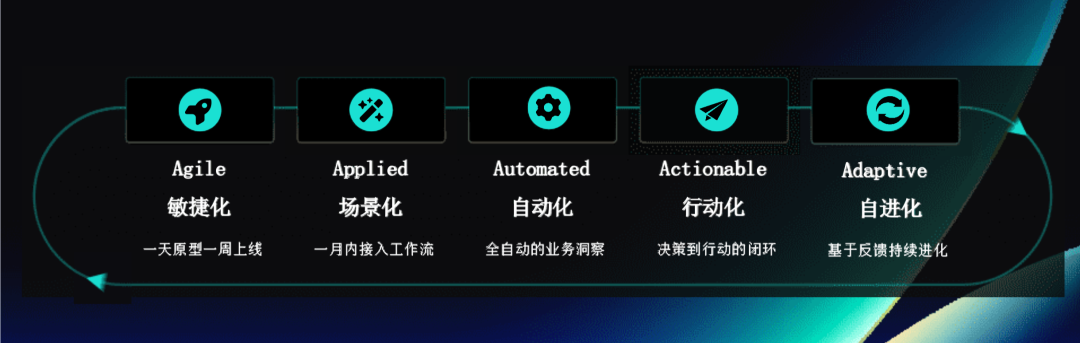
So I think for the vast majority of Chinese enterprises, a more agile approach starting from scenarios with lightweight deployment is the realistic path. We've also upgraded our decision intelligence 5A path — covering Agile, Applied, Automated, Actionable, and Adaptive stages, corresponding respectively to rapid scenario value validation, entering business workflows, and then forming complete capabilities for automation, actionability, and continuous evolution.
One more point: we strongly endorse Palantir's FDE (Forward Deployed Engineer) concept, which we've been practicing on AI projects for many years. Over the past year, our AI FDE teams have gone into factories and warehouses, stores and outlets, e-commerce livestream rooms — working alongside customers to share business results and accumulate product capabilities.
But as I just mentioned, we're also much lighter than Palantir on this front, again starting from scenarios. In every scenario across consumer, retail, and manufacturing, we have FDEs who understand the industry most deeply and can execute on the ground. Some of these FDEs understand business, some understand AI. Our newly launched DecideX is essentially designed to help enterprises quickly and agilely build their first scenario closed loop, with the final step being self-evolution.

Q: Guandata launched its globalization strategy this year. What's the thinking behind this?
Chase Su: In recent years many customers have actually "taken us out" with them, such as ANTA Group, Mixue Ice Cream & Tea, and Genki Forest. By this year, we felt it was time to proactively expand our own globalization strategy.
Indonesia, Hong Kong, and Europe are the first regions in our globalization push — in Indonesia, TOMORO, the country's second-largest coffee chain, has partnered with us; in Hong Kong, Wellcome, one of Hong Kong's largest supermarket chains, and Kin Wah Group, one of Hong Kong's largest fresh food retailers, are successively establishing partnerships with us; and in Europe, we also have some Fortune 500 consumer goods clients.
Going global is a natural next step for us — Guandata's globalization strategy for the next 5 to 10 years is already fairly clear. We have so many leading customers in consumer, retail, and manufacturing domestically, and they're among the most advanced globally. So after our products gain initial validation in China, they naturally radiate outward globally. Just like this new product launch, it will also gradually expand to global customers.
Q: Why now? Isn't it a bit late?
Chase Su: We've been monitoring the global market continuously over the past year or two, but we wanted to "build internal strength" first. After all, globalization is a long-cycle battlefield — it won't be decided overnight. Meanwhile, while our products were already capable of English localization, deployment and service mechanisms differ by country and region, so as we followed customers outward, we were also assessing which countries and regions were more suitable for our layout.
Another factor relates to our products — our new AI-native products can launch globally from day one, creating greater value and bringing some of our innovations to global customers in the shortest time possible.
To some extent, our globalization path may be similar to SAP back in the day — SAP was a German company, and Germany had the world's most advanced industrial manufacturing capabilities. Because SAP's concepts and practices were globally leading, its gradual outward extension made it a global enterprise application software giant.
Today, in the consumer, retail, and manufacturing domains where Guandata is deeply rooted, China leads the world. I believe the decision intelligence market also holds the opportunity to birth a global giant.
Q: Do you have any short-term targets for international business?
Chase Su: In the short term we haven't set explicit KPIs. What's most important is the recognition from benchmark customers and benchmark partners in several countries and regions. Once these benchmark customers and partners are proven out, we hope to achieve scale in international business within the next two to three years. This scaling refers both to customer volume scaling within these three countries and regions, and to geographic coverage scaling — we plan to start exploring and entering additional countries and regions in the second half of this year.
If I had to name one metric, we hope international business can generate at least nine-figure RMB revenue in three years, but right now validating the 0-to-1 business model and proving out local benchmark customers and partners is more critical — this is a long-term strategy.

Q: Guandata will hit its tenth anniversary this September, and you've given yourselves a new positioning. How do you evaluate what has changed and what hasn't over these 9-plus years?
Chase Su: Nine years ago, the group chat name we founders created was called Beyond BI. Our original intention was to surpass BI, so we proposed "AI + BI" from the start. Today, combined with technological development, we've become an AI-native decision intelligence platform — the essence is still helping enterprises build decision brains. This original intention and vision haven't changed; only the product form has evolved somewhat, and the delivery method (AI FDE) has evolved somewhat.
In Guandata's values, what matters most is always creating real value for customers. What we care about most isn't creating a hammer, but rather the hole behind the hammer, the painting that hangs above that hole, and the owner behind that painting — what goals they want to achieve, like relieving stress, or cultivating their temperament. This is essentially Job to be Done, a classic theory that runs through Guandata's entire entrepreneurial journey. We constantly remind ourselves of this, and strive to hold to it.
In other words, even if we forget about AI, forget about technology, forget about much of what we say externally — how to solve the pain points of enterprises in consumer, retail, manufacturing and other industries remains the origin point of all our innovation.
All in all, there have been some changes over this decade, but I think what's more important is what has never changed — customer value as the first principle.
Q: At this tenth anniversary milestone, do you have any grander vision? More practically, for example, IPO.
Chase Su: Capital markets are beginning to recognize AI + Data enterprises, giving them high valuations, even somewhat overheated ones. In my view, this may be short-term heat fluctuation, but looking 3 years out, this may precisely be the beginning. As massive capital flows into AI large model infrastructure, the most important battlefield in the next 3 years will definitely be the AI application layer, and decision intelligence will necessarily play a core role. Understanding this, for us, means focusing on ourselves and truly achieving pragmatic leadership.
Over these years, on one hand we've steadily provided customers with advanced products; on the other hand, we've always maintained an open attitude toward capital and going public. Our investors are all top-tier domestic and international institutions that understand technology innovation best. In the coming 1–3 years we'll continue actively embracing capital, thereby serving a broader market. Frankly, over the past two years we ourselves have been in an AI transformation period, conducting a series of reconstructions across product, technology, and organization. The official release of the AI decision intelligence platform is a brand new milestone for us. We're stepping on the gas, accelerating product innovation and market expansion, and will also actively and openly embrace capital markets and social resources.
Moreover, tokenmaxxing is being noticed by more and more people today, but Guandata's North Star has always been how much value we can create for customers, not how many tokens we burn. I believe that in the next 1–3 years, the significance of valuemaxxing will be amplified even further.
If we must name a benchmark, from a more accessible angle, our benchmark is Palantir — the most well-known but also much-misunderstood company in the decision intelligence space. Of course, our long-term goal isn't to become China's Palantir, but to become Guandata that global enterprises trust in the future.
Why do I say this? As mentioned earlier, while our direction is similar to Palantir's — building operating decision brains for enterprises in the AI era — we believe Chinese enterprises' landing path will be dramatically different: lighter, more agile, evolving more from existing data analytics platforms and data assets. We probably won't serve a small number of ultra-large-scale custom projects like Palantir does, but we'll enter stores and outlets, factories and warehouses, e-commerce livestream rooms, and operating meetings across consumer and manufacturing industries, starting from real business scenarios one by one, and step by step build these enterprises' most important operating decision brains for the AI era.
Interview source: IPO Zaozhidao