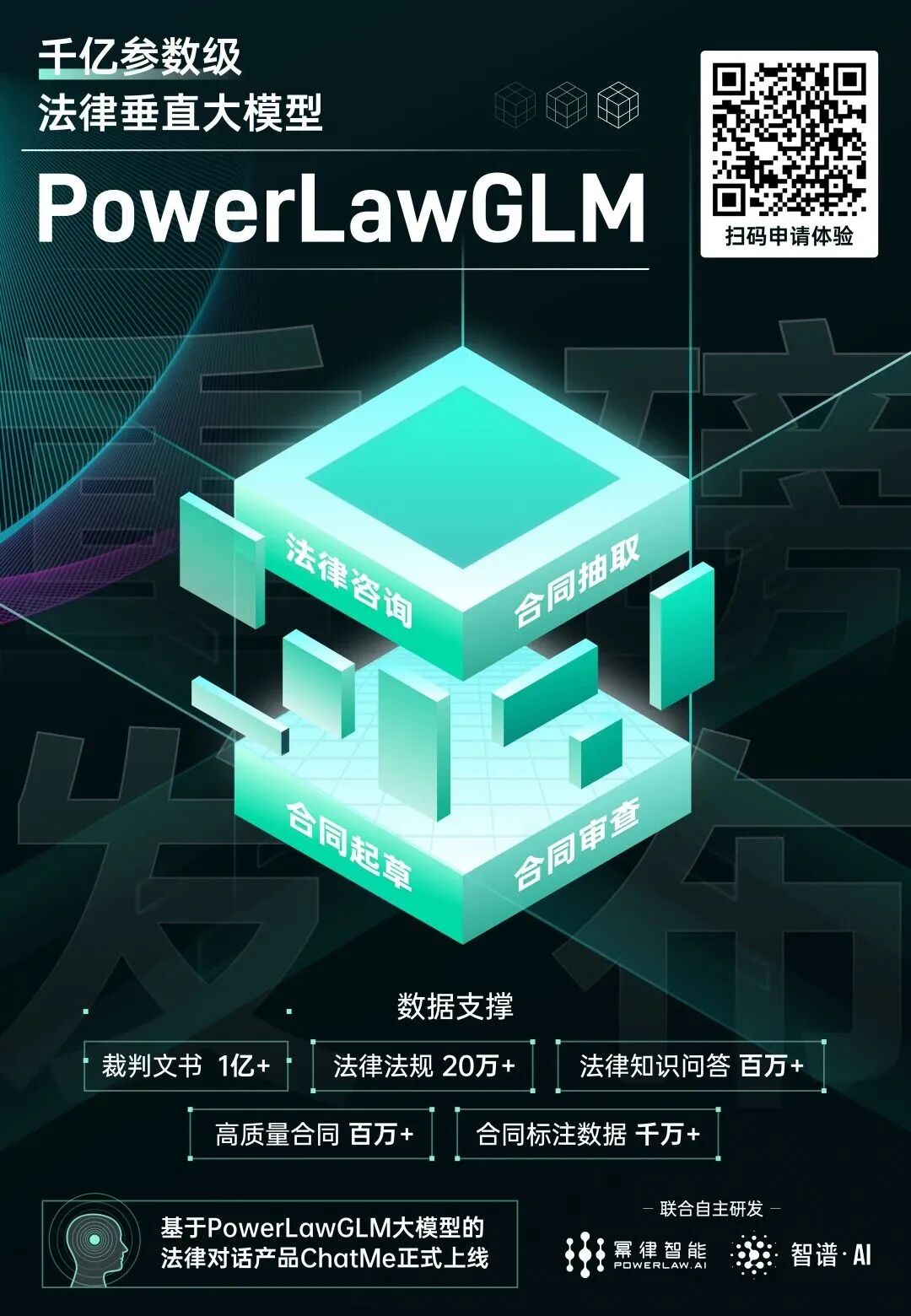
Linear Capital portfolio company PowerLaw AI releases legal vertical large model PowerLawGLM

2023 was undeniably the "year of large language models." According to a UBS report, just two months after its launch, ChatGPT had already surpassed 100 million monthly active users, making it the fastest-growing consumer application in history.
2023 was undeniably the "Year of Foundation Models." According to a UBS report, ChatGPT hit 100 million monthly active users just two months after launch, making it the fastest-growing consumer application in history.
In this red-hot foundation model race, Chinese-language models have been rolling out one after another. Compared to the "big and comprehensive" approach of general-purpose models, MeFlow (幂律) and Zhipu AI are jointly releasing PowerLawGLM, a legal vertical model built on a Chinese-language trillion-parameter foundation model. Focused squarely on the legal domain, it offers distinct advantages for Chinese legal scenarios, with rich legal knowledge and sophisticated understanding of legal language.
01
The Birth of a "Legal Vertical Model"
General-purpose foundation models boast powerful language understanding and generation capabilities. But due to gaps in specialized knowledge and data, applying them directly to legal practice often yields serious problems — incorrect legal knowledge, inaccurate citations, mismatches between legal systems, and more. Recall the U.S. lawyer who used ChatGPT to draft a court brief, only to have all six cited cases turn out to be fabrications. This "AI hallucination" phenomenon is hardly rare in legal settings, and it underscores how general-purpose models struggle to guarantee factual accuracy and correctness at a professional legal level.
Since its founding in 2017, MeFlow has been deeply rooted in the legal + AI space, offering intelligent contract products to enterprises while contributing to Tsinghua University's NLP Lab on legal models like OpenCLaP and LawFormer. Zhipu AI, a leading general-purpose model provider, has made legal applications a key priority in its model roadmap. Through a strategic partnership, the two companies are collaborating deeply on legal foundation models to accelerate real-world deployment and commercialization in the legal industry.
In early 2023, the two firms formed a joint project team to develop a legal foundation model. After trillion-parameter base model incremental training, supervised fine-tuning for dialogue, and application-layer engineering optimization, they launched PowerLawGLM — a legal vertical model built on a Chinese-language trillion-parameter foundation model.
02
Building PowerLawGLM
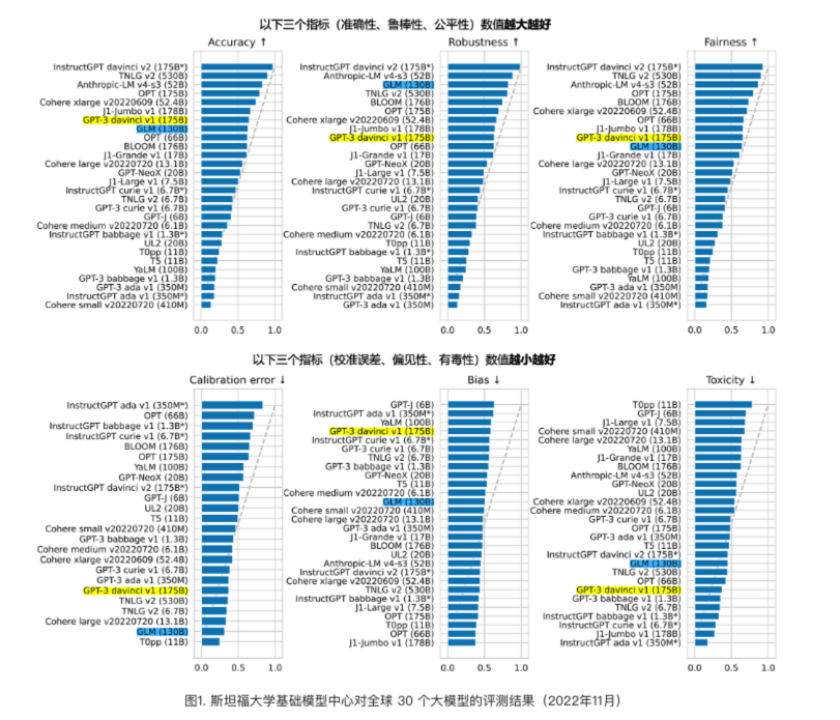
PowerLawGLM was co-developed on top of ChatGLM 130B, Zhipu AI's best-performing general-purpose trillion-parameter dialogue model. In Stanford University's Center for Research on Foundation Models evaluation of 30 global models in November 2022, GLM-130B was the only Asian model to place in the top 10.
Step one in training a legal vertical model — Base layer: Read vast amounts of legal text.
The fundamental reason general-purpose models falter in legal applications is that their base models haven't been trained on large volumes of high-quality legal text. Starting from the GLM 130B base model, the team conducted multiple rounds of data cleaning and incremental training on high-quality legal corpora — court judgments, statutes and regulations, legal Q&A, and more — producing the legal base model LawGLM 130B.
Step two — Dialogue layer: Align with legal conversation scenarios and develop legal dialogue capabilities.
While LawGLM 130B had text generation capabilities, it lacked legal dialogue skills. The team used nearly a million pairs of high-quality legal Q&A data to fine-tune the model, producing the PowerLawGLM beta. At this stage, it had acquired end-to-end generative dialogue capabilities for legal scenarios along with distinctive response patterns.
Step three — Application layer: Ensure output quality and reliability.
Legal Q&A has unique characteristics — it demands high accuracy and explainability. Having the model generate answers end-to-end introduces numerous problems: citing obsolete laws, fabricating statutes and cases, reasoning differently from how legal professionals would. So MeFlow designed a suite of general and scenario-specific engineering optimizations to improve grounding in valid legal sources and accuracy of statutory citations, ultimately boosting the professionalism and reliability of legal answers.
Through this three-layer architecture — base, dialogue, and application — the model's capabilities for understanding, reasoning, and generating legal text were substantially enhanced:
1
Understanding: Comprehending complex legal texts including statutes, case law, contracts, and other legal documents.
2
Reasoning: Inferring underlying issues from legal texts, proposing possible solutions, or predicting legal consequences.
3
Generation: Answering legal questions, providing consultation, and even assisting in drafting legal documents. It can engage in legal dialogue to help users grasp complex legal matters.
03
PowerLawGLM in Practice
To benchmark PowerLawGLM against general-purpose models, MeFlow's legal team collected the top 100 most frequently asked legal questions online and conducted manual evaluation across different models. From a legal professional's perspective, they compared performance against typical general-purpose models like ChatGPT across several dimensions: accuracy in identifying the core issue, comprehensiveness and accuracy of information analysis, operational feasibility of answers, degree of legal professionalism, and presence, accuracy, and comprehensiveness of legal basis. The final results showed that PowerLawGLM provided the best answer for nearly 70% of the 100 questions, with significant differences in operational feasibility and legal professionalism.
Below are sample responses from ChatGPT and PowerLawGLM:
- On a specific legal consultation:

ChatGPT's response on dowry questions

PowerLawGLM's response to the same question
On this legal question, ChatGPT failed to directly address whether one could request return of dowry payments and didn't analyze the issue from a legal perspective or provide relevant legal basis. PowerLawGLM, by contrast, gave a clear answer with analysis and cited relevant legal basis.
- On drafting a sales contract:
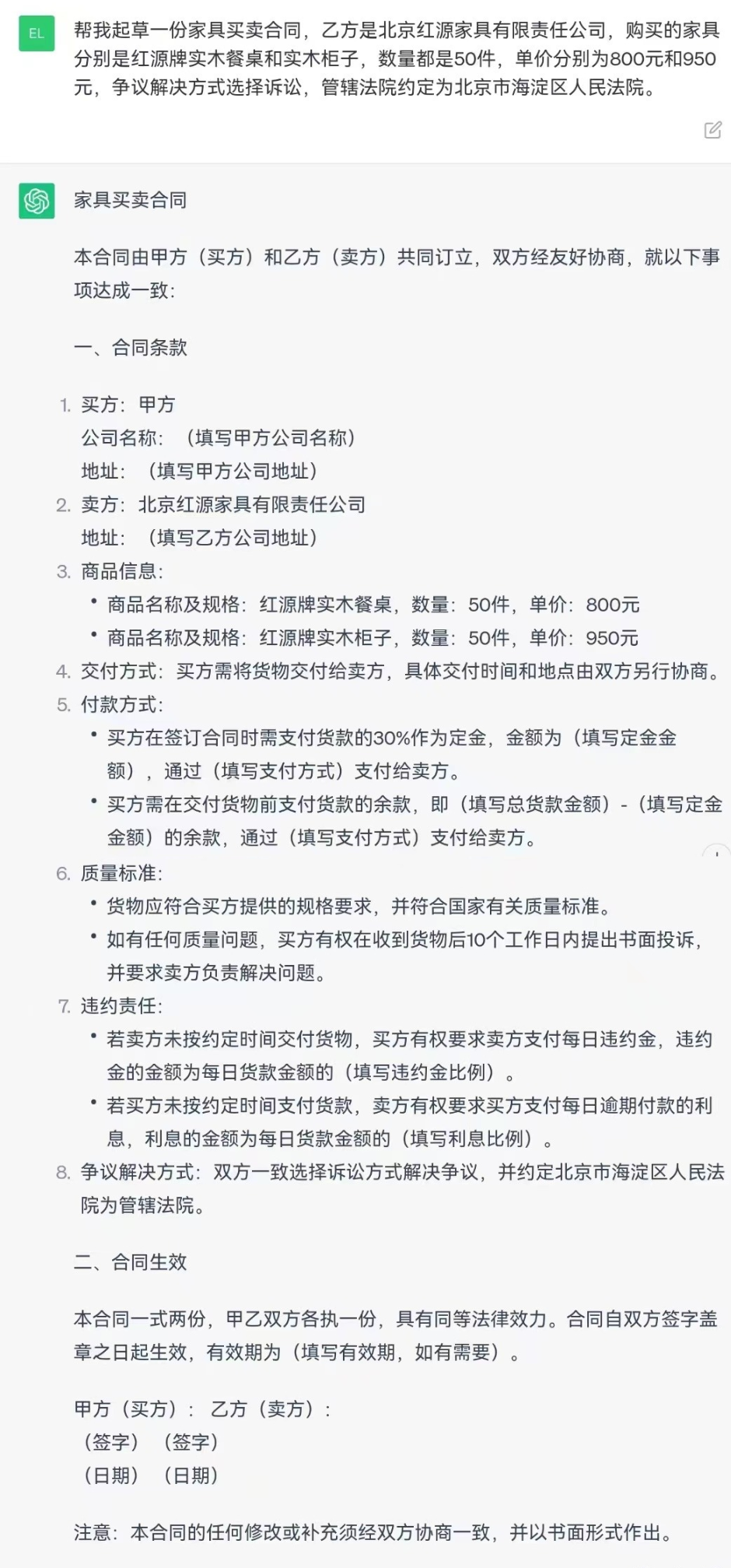
ChatGPT's contract drafting response (scroll to view full text)
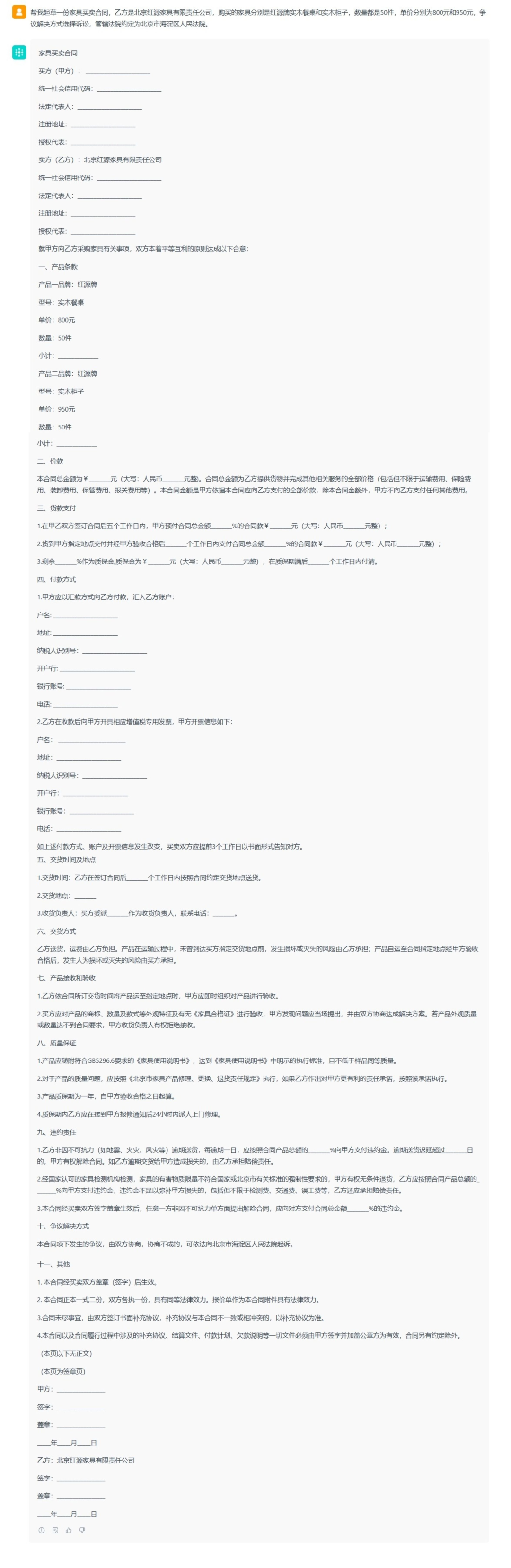
PowerLawGLM's contract drafting response (scroll to view full text)
As shown, ChatGPT's drafted contract was relatively simplistic, with formatting and clause language falling notably short of a genuinely usable contract. It frequently cited obsolete laws, omitted clauses, and left information incomplete. PowerLawGLM, meanwhile, accurately incorporated the parties, subject matter, unit price, and jurisdiction specified in the user's query into the contract body, with dramatically better clause completeness and professionalism.
04
ChatMe: Conversational Product Based on PowerLawGLM
Officially Launched
Leveraging PowerLawGLM's capabilities, MeFlow has built the legal dialogue product ChatMe, now officially live. The first batch opens 50 beta slots — scan the QR code at the end of this article to register.
ChatMe features and capabilities:
1
Contract consultation: Rich contract knowledge data enables answers to questions like "What are lease term limits?"
2
Contract drafting: Tailored to Chinese contract drafting scenarios, with template-based drafting, clause assembly, and end-to-end generation options for higher-quality output.
3
Contract information extraction: Identifies and extracts key information like party details and total contract value.
4
Contract review: Flags risk points in contract clauses with relevant recommendations.
5
General legal consultation: Professional legal advice backed by valid legal basis.
Going forward, MeFlow will continue focusing on advancing its legal vertical model technology and practical applications, deeply integrating legal model capabilities into its intelligent contract management product MeFlow and intelligent contract review product MeCheck. MeFlow will also open API access to enterprise clients, enabling companies to rapidly embed legal model capabilities into existing workflows and systems for significant efficiency gains.
MeFlow will keep iterating and improving the model, with targeted optimizations for evolving legal knowledge and applications, further enhancing PowerLawGLM's capacity for continuous improvement.