Carbon capture inorganic binder materials developer "Tanda New Materials" raises tens of millions of yuan in Pre-A round, with Linear Capital as sole investor
36Kr Carbon has learned that Tanda (Shenzhen) New Materials Technology Co., Ltd. recently completed a Pre-A funding round of tens of millions of RMB. The round was led by Linear Capital, with 2060 Advisory serving as exclusive financial advisor. The proceeds will be used for core business operations, business expansion, working capital, and new projects.
36Kr Carbon has learned that Tanda (Shenzhen) New Materials Technology Co., Ltd. recently completed a Pre-A funding round worth tens of millions of RMB. The round was led by Linear Capital, with 2060 Advisory serving as the exclusive financial advisor. The funds will be used for core business operations, business expansion, working capital, and new projects.
Founded in 2021, Tanda New Materials is a developer of non-cement-based, carbon-utilizing inorganic binding materials. The company is dedicated to developing carbon dioxide utilization technologies, offering CO2-utilizing material products with clear emissions-reduction accounting and strong economic returns. Its main product is a powdered active material containing high amorphous silicon and high hydration reactivity that can replace cement, using steel and mining industries as upstream raw material sources, thereby reducing energy consumption and carbon emissions associated with construction projects.
The Tanda New Materials team has deep overseas research experience. CEO Yingtian Yu told 36Kr Carbon that the company's core technical team graduated from renowned international institutions including UCLA and has extensive experience in carbon-utilizing building material R&D. Team members previously won a $7.5 million award at the NRG COSIA Carbon XPRIZE, a global CCUS competition.
Tanda New Materials' product advantages lie in its combination of economic viability, environmental benefits, and high performance. CEO Yingtian Yu explained that the company's products cost less than traditional cement, reduce product carbon emissions through comprehensive solid waste utilization and CO2 utilization, and offer more flexible material design than conventional cement, enabling coverage of more specialized application scenarios.
 Emissions reduction coefficient approaching 100%, with clear price advantage
The cement industry is a major carbon emitter and one of the key sectors for achieving carbon neutrality goals. Traditional cement production requires a "two grindings, one burning" process: raw materials are ground once, sent to high-temperature environments for calcination, then ground again. The entire production process not only consumes enormous energy but also emits substantial CO2. As carbon reduction demands in the cement industry grow increasingly urgent, the application scenarios and market demand for new non-cement-based materials continue to expand.
Compared to traditional cement production, Tanda New Materials' approach uses low-hydration-reactivity industrial solid waste such as coal-based solid waste as raw materials, introduces CO2 as a modification material, and adds the company's self-developed activator to produce powdered active materials containing high amorphous silicon dioxide and high hydration reactivity through a series of activation and excitation processes. Under Tanda New Materials' product solution, every 10 kg of CO2 can produce 1 square meter of carbon-sequestering concrete pavement bricks.
What makes this technical path distinctive is its use of interatomic tension within the materials themselves to promote chemical bond breaking and hydration/hydrolysis processes, stimulating the materials' inherent hydration capacity to enhance product hydration reactivity. Specifically, when the materials encounter water, chemical bonds break rapidly; during solidification, ions re-bond, and in this process, CO2 can regulate the ratio of metal ions to give the material better chemical properties.
Notably, Tanda New Materials' product manufacturing can be completed at ambient temperature and pressure, without heating or pressurization, avoiding carbon emissions from coal burning and electricity use. From a full lifecycle perspective, Tanda New Materials' products only generate small amounts of carbon emissions during transportation. Compared to traditional cement, the company's product solution achieves an emissions reduction coefficient of 95%-100%.
Low cost and economic viability are major advantages for Tanda New Materials. CEO Yingtian Yu told 36Kr Carbon that the company's raw materials mainly come from industrially emitted CO2 flue gas and industrial solid waste like fly ash, both of which can be obtained at no additional cost. At the same time, because the production reaction requires no high temperature or pressure, coal and electricity costs are substantially reduced. Additionally, Tanda New Materials' self-developed solid waste activator has obtained patent protection and can replace traditional high-cost strong alkali or strong acid activators, further reducing overall product costs.
Yu noted that Tanda New Materials can reduce total product costs to 40%-50% of traditional cement, giving it a clear price advantage. In terms of customer orders, the company has already signed contracts with clients including Henan Energy Group.
 Multi-scenario product applications, multi-regional project deployment
Thanks to its excellent performance, Tanda New Materials' products can meet diverse application scenario demands.
In the construction materials sector, the products can replace traditional cement, covering conventional electromechanical, road, bridge, and building construction scenarios. In non-construction sectors, the products can meet surface environmental restoration needs. Additionally, in scenarios with surface anti-seepage requirements such as riverbanks and coastlines, the products can satisfy practical needs for river filling, sea filling, and dam construction.
Yu explained that because the proportions and contents of silicon, aluminum, sodium, iron, and other elements vary across industrial solid waste from different regions, and because CO2 purity differs by source, Tanda New Materials can produce products meeting different performance requirements by adjusting and optimizing various parameters in its technical process.
36Kr Carbon learned that in terms of production capacity and ongoing R&D capability, Tanda New Materials' production lines can meet differentiated product manufacturing needs across various application scenarios with only minor adjustments. Going forward, the company will continuously adjust production plans according to market demand and carry out corresponding small-scale product iterations and large-scale R&D.
Yu revealed that Tanda New Materials' first large-scale domestic production project — a solid waste comprehensive utilization facility supporting a chemical project under Henan Energy — is planned to commence production between late this year and early next year, with annual output in the hundreds of thousands of tons.
Investor perspective:
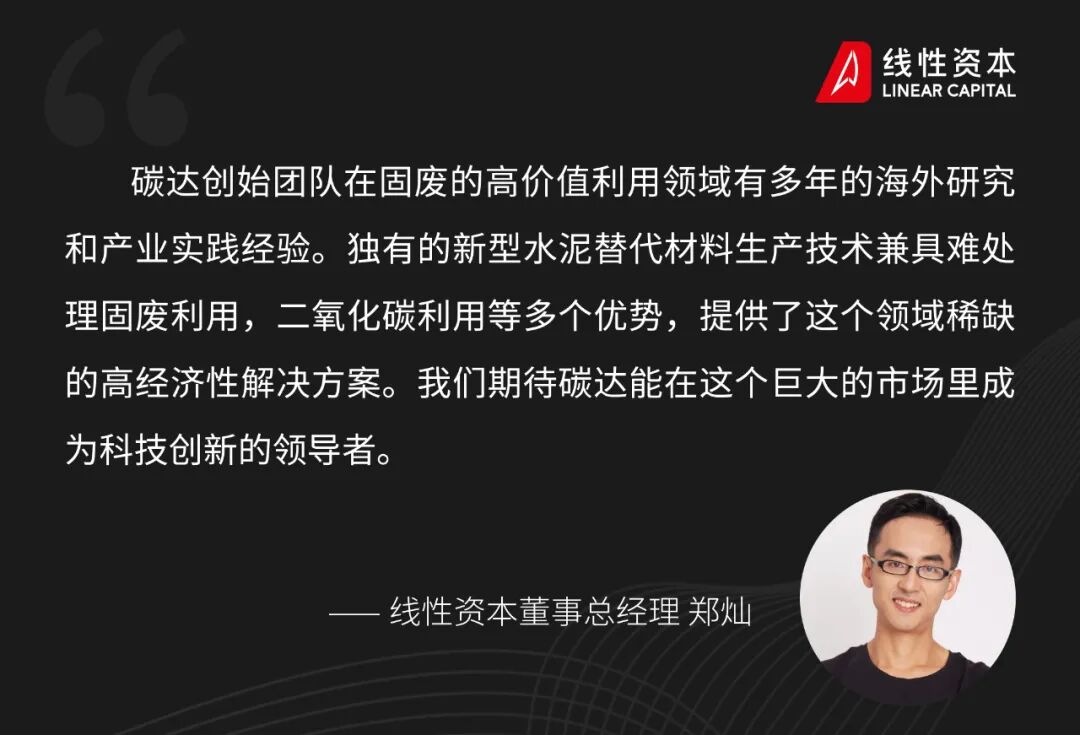
Can Zheng, Director at Linear Capital: The Tanda founding team has years of overseas research and industry practice in the high-value utilization of solid waste. Their unique new cement replacement material production technology combines multiple advantages including difficult-to-process solid waste utilization and CO2 utilization, providing a rare, highly economical solution in this space. We look forward to Tanda becoming a leader in technological innovation in this massive market.
| Header image source: Visual China