Linear Capital Leads Pre-A Round in CloudNat Technology, Follows On in Series A with Pro-Rata Allocation | Linear News

Dedicated to driving agile digital transformation for enterprises.
Recently, cloud-native RPA vendor Yunna Technology closed its Series A round, with Sky9 Capital and Haochen Capital as new investors, and existing investor Linear Capital making an additional investment beyond its pro-rata rights. Yuanhe Capital served as the exclusive financial advisor. The proceeds will be used for product R&D, market expansion, and other initiatives.
RPA is a technology that uses software to automate business processes according to specified rules and workflows, either augmenting or replacing manual work.
As China's economy shifts from extensive growth to refined operations, rising labor costs have made RPA an effective tool for companies to break through productivity bottlenecks. According to RPA China research, approximately 76.1% of surveyed enterprises plan to expand RPA adoption and gradually increase technology investment, with China's RPA market expected to reach 8.18 billion yuan by 2024.
Looking at the evolution of China's RPA market, it can be divided into two eras: • Era 1.0, entering the market through project-based customization, providing clients with "tailor-made" products and services; • Era 2.0, entering the market through general-purpose products, with vendors aspiring to standardized product capabilities and improved product efficiency, rather than service-oriented approaches.
The former revolves around CIO decision-making, with long implementation cycles, high costs, and no guarantee of precisely or rapidly responding to business needs; the latter provides tools rather than solutions, with long learning curves and limited "friendliness" to business departments.
Founded in 2020, Yunna Technology aims to balance the trade-offs of both approaches with "scenario-based modular products" and usher in RPA's Era 3.0.
01

From Digital Workers
to "Agile Systems"
Before explaining what "scenario-based modular products" means, we need to redefine the value of RPA.
Current RPA practitioners largely position its value as "digital workers" — replacing human labor to improve operational efficiency. But Yu Bao, founder & CEO of Yunna Technology, believes that in the long run, RPA's value lies in driving the construction of "agile systems."
In an environment of highly unstable information and market conditions, enterprises urgently need an information system that meets rapidly changing market demands: one driven by market and business needs, capable of directly and quickly solving existing problems within established processes and frameworks; and as problems and conditions evolve, able to flexibly and nimbly reconstruct workflows.
RPA is inherently cross-system and cross-departmental, making it well-suited for long-tail and fragmented needs like system integration and data migration. Combined with APIs, low-code development platforms, and BI, it will become standard equipment for agile systems.
From market demand, we can distill three keywords for building agile systems: rapid efficiency, business-driven, flexible iteration.
Yunna Technology's ambition is to disrupt the "cost and efficiency" equation of digitalization, achieving rapid and efficient project implementation through scenario-based products; and to redefine "ease of use" for business-facing applications, enabling business personnel to autonomously reconstruct system workflows in response to market changes through sufficiently accessible, loosely coupled modular products and an iPaaS platform.
02
Disrupting
Cost and Efficiency
Built on cloud-native architecture and focused on the broad circulation industry, Yunna Technology abstracts frequently occurring events into independently deployable robot modules that users can deploy out of the box. This is the "scenario-based modular product," with the following characteristics:
Cloud-Native
Yunna Technology's RPA product is the first in China based on cloud-native architecture, a decision driven by multiple considerations around cost and efficiency:
- On cost: clients need not procure dedicated hardware servers or bear operations and maintenance costs, saving on both hardware and personnel expenses;
- On efficiency: elastic computing power prevents performance bottlenecks, while a clean environment avoids interference from local antivirus software on robot execution, significantly improving operational efficiency.
In the future, software will be built for the cloud. Yunna Technology firmly believes the cloud transition is irreversible, and delivering the ultimate in convenient experience remains its long-term pursuit.
Loosely Coupled
Yunna Technology offers multiple product forms, including four layers: RaaS (robot as a service), SaaS, PaaS, and IaaS — fundamentally different from the traditional RPA "three-piece suite." Users need not purchase the full product set; they can freely combine modules across these four layers to obtain their desired solution. They might purchase Yunna's PaaS product and "DIY" robots through drag-and-drop workflow design; or directly buy a single scenario-specific RPA robot.
This flexible deployment enables higher cost-performance solutions:
Previously, clients seeking to solve a single scenario still had to procure the RPA "three-piece suite," costing hundreds of thousands of yuan; with loosely coupled products, RPA robots solving individual scenarios can be independently deployed, requiring only 20,000–30,000 yuan annually — dramatically lowering the decision threshold.
Service Productization
Beyond providing RPA robots that directly solve individual scenarios, Yunna Technology also offers comprehensive solutions for industries or business departments called "Industry Workbenches," delivered as out-of-the-box SaaS, dedicated to improving overall industry efficiency.
• Industry Deep-Dive: Yunna Technology has chosen to focus on the broad circulation industry, entering the market through supply chains to solve enterprise problems across the supply chain. This vertical strategy keeps it focused and specialized, aiming to accumulate and extract generalized industry capabilities from serving diverse individual clients.
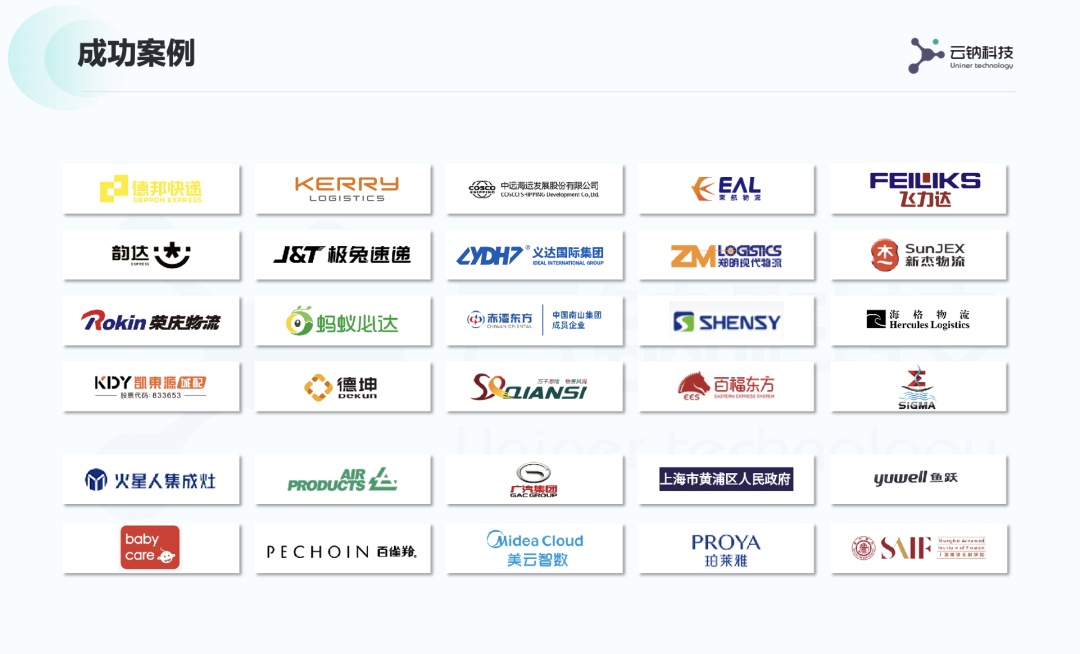
Currently, after more than six months of commercialization, Yunna Technology has earned the trust of 200+ industry-leading clients, maintaining steady growth even during this year's pandemic period. Meanwhile, serving these benchmark clients has further deepened Yunna Technology's understanding and knowledge of the broad circulation industry.
• Out-of-the-Box: Drawing on its experience serving hundreds of leading enterprises, Yunna Technology has accumulated an extensive library of automation scenarios, covering hundreds of use cases.
Now, targeting specific niche scenarios, it distills, combines, and synthesizes these "scenario robots" into complete "out-of-the-box" solutions, covering cross-border trade, e-commerce, finance, and many other scenarios. By standardizing and productizing services, enterprises can rapidly deploy SaaS applications suited to different niche scenarios, achieving cost reduction and efficiency gains.
03
Redefining
Ease of Use
Whether it's "scenario robots" designed to solve specific problems, or "Industry Workbenches" covering complete solutions for niche scenarios, Yunna Technology has made them all "out-of-the-box."
But this only achieves the "rapid implementation" of agile digital transformation. True agility means being able to respond to market changes in a timely manner — which requires products and systems that are sufficiently accessible and flexible.
How should we understand ease of use for business personnel? Perhaps start by defining what a product for business personnel should be.
Traditional RPA products consist of three core components: • An editor, providing RPA design tools for developers, whether zero-code or based on specific programming languages; • A runtime platform, providing management capabilities for RPA configuration, deployment, execution, and monitoring; • Robots, the actual workers executing automation according to preset workflows.
Project-led enterprises deliver pre-programmed robots to clients, where business personnel neither need nor can use the editor to develop "robots" — clearly not meeting the "flexibility" requirement. Product-led enterprises aim to provide zero-code or low-code editors, enabling business personnel to orchestrate autonomously.
But is "zero-code" truly accessible?
However accessible, a low-code editor remains grounded in "programming thinking", carrying significant learning barriers and costs for business personnel. Building a robot to solve a specific problem requires not only familiarity with the product's various commands, mastery of programming basics like loops, conditionals, and waits, but also the ability to map out workflows. When scenarios become diverse and complex, business personnel struggle to quickly comprehend, structure, and implement workflows.
Yunna Technology believes that what business personnel can understand is not "commands," but "standardized operating procedures" — one level of abstraction above commands — finer-grained than "scenario robots," yet coarser-grained than "commands."
A product for business personnel should be an iPaaS platform built on RPA+API that breaks free from "programming thinking" entirely and is grounded in "business scenarios." In the future, the iPaaS platform will become the core capability embedded within industry-standard SaaS applications, allowing business personnel to directly modify corresponding "standardized operating procedures" in response to changing business needs, recombining them into "agile applications" for new requirements.
How does RPA's Era 3.0 begin? How to balance between project customization and general-purpose products?
Yunna Technology's answer: Faced with complex business scenarios, achieve balance between customization and standardization through industry-standardized solutions, making the leap to product and service standardization; and once we have exhausted "standardized operating procedures," enable business personnel to conveniently and freely develop agile applications matching their needs through a PaaS platform, allowing complex requirements to receive nimble responses.