In Conversation with RIVR's Marko: From Refugee Streets to Amazon, Life Has No Safe Zone
From a land without a country, to a trillion-dollar river.
"Between the Lines" is a deep-dive video podcast produced by Linear Capital. The guest for episode three is Marko Bjelonic, 36-year-old founder of RIVR.
Marko was born in Yugoslavia and fled to Germany with his family as a war refugee. Yet he kept pushing himself toward bigger worlds: attending the best schools, joining the most elite ETH lab, then building his own company.
Three years ago, Linear Capital traveled to Europe in search of the most cutting-edge innovation, and was fortunate to meet Marko and his team, becoming the company's earliest investor. This March, RIVR was acquired by Amazon, and Marko and his team officially joined the company. We hope this unusual story of someone who keeps embracing uncertainty can give you some strength.
Most people fear uncertainty. But Marko, founder of RIVR, has always actively walked toward it.
In 1990, Marko was born in Yugoslavia. When war broke out, he fled to Germany with his parents. At age ten, he took to the streets to demonstrate for his family's right to stay. Later, he kept pushing himself toward bigger worlds: attending the best schools, joining the most elite labs — the ETH Robotics Systems Lab where he worked is widely recognized as the world's leading source of wheeled-legged robotics research. But every time he reached a new environment, he felt he was back at the "bottom," so he'd start over and push to catch up.
During his PhD, reinforcement learning made a breakthrough. Within days, he overturned five years of accumulated research and pivoted to an entirely new direction. In 2023, Marko founded RIVR in Switzerland, targeting last-mile logistics and pushing machines into the real world where they had previously struggled to reach, becoming one of the earliest companies to commercially build "wheeled-legged robots with brains."
Three years ago, Linear Capital traveled to Zurich to explore the most cutting-edge innovation at ETH, and was fortunate to meet Marko and his team, writing the first check for this Swiss company. Later, we accompanied the team as they learned about China, connected with supply chains, and expanded into the United States market. In March 2025, RIVR was acquired by Amazon, and Marko and his team officially joined the company. This is the closing chapter of RIVR as a startup, and the opening of a new chapter for this team.
From refugee streets to ETH to Amazon — how far can a person's obsession take them? How does Marko define risk, and how does he define success? What are the characteristics of building a company across China, Europe, and the United States?
This written excerpt is approximately 13,000 words. The video experience is even better ↓

When Uncertainty Becomes Part of Life
▍Harry Wang: Your life story really draws me in. How did those childhood experiences shape you, and how did they influence your later path?
▍Marko: I was born in 1990 in Banja Luka, Yugoslavia. Before I turned one, war came. Before that, grievances in this country had been building for years. There was a football match against Belgrade — basically Croats versus Serbs — and the entire stadium erupted into fighting. The civil war ignited from there.
When war broke out, my parents were farmers, and they decided to leave. Of the entire extended family in our area, only our family made this decision. My father had an uncle who had gone to Germany many years earlier, so we went to join him.
But life in Germany was just as hard. We were asylum seekers; every week we had to renew our status. There was always a long line outside the office, with two people at the window. My mother would observe — who's in a good mood today, willing to approve you, who's having a bad day and won't. When we got close, she'd already know. If something felt off, she'd step out and get back in line.
▍Harry Wang: That's very "data-driven."
▍Marko: Back then, police could show up at your door anytime and tell you to get out of the country. They specifically came in the middle of the night, while you were asleep, giving you no time to prepare, nowhere to run. I only understood later that my parents slept with their hearts in their throats every night, lying down and just praying no one would knock on the door that evening.
▍Harry Wang: What did this experience mean for your later growth?
▍Marko: For me, that was just "normal." I was born into turmoil; I didn't know life could be any other way. My parents were always working; I basically raised myself.
I started helping my parents figure out how to stay in Germany very early on. We went out collecting signatures. I'd hold the materials and stop passersby, asking one by one if they could please sign so our family could stay. We collected roughly ten thousand signatures in total, then sent them to politicians, trying to apply pressure — look, society wants us to stay, what right do you have to deport us?
We even organized a demonstration once. I was ten, built a stage, stood on it and spoke to the crowd below. Crying and begging people to help us. These experiences made me someone who today, when alone, is in a very good state — very independent, very resilient, able to get through almost anything entirely on my own.
▍Harry Wang: Extreme uncertainty was part of your life from an early age.
▍Marko: What is entrepreneurship? It's being immersed in complete uncertainty all the time, constantly betting. But honestly, compared to those days, the risks and uncertainty in entrepreneurship are nothing. Whatever happens, it doesn't matter. Of course there's still responsibility, but ultimately, you're moving toward a goal, and uncertainty is just part of the game.
▍Harry Wang: This explains something we've always observed about you: **You have an extremely steady core. Most people don't, because in most people's lives, stability is arranged for them.
▍Marko: I'm the exact opposite. A stable environment actually makes me deeply uncomfortable. I keep "self-destructing" my own life just to introduce some uncertainty, to keep it from being too settled.
Manifesting Dreams, Manifesting the Future
▍Harry Wang: I remember you said you were the only person on that refugee street to go to college. Why was it you who took this path?
▍Marko: I only truly understood this trait about myself last year: no matter what environment you throw me into, I always feel like I'm at the bottom. So I work harder than everyone around me. Actually, nobody on the refugee street went to college, yet I still felt like I was at the bottom. Later, my life saw one turning point after another. Whenever I felt I was starting to stand out, surpassing everyone around me, I knew it was time to change environments.
Germany has three types of schools. Based on my elementary school grades, I should have gone to Gymnasium (the highest tier of secondary school). But the teachers told my parents: this child should go to Hauptschule (the lowest tier) because he's a foreigner. My mother told the teachers: No, my son will go to the best one.
That turning point was so important for me. In the new environment, I was suddenly sitting with native-born local kids. In my eyes, they lived practically perfect lives, and once again I was at the bottom.
Looking back, I wasn't actually at the bottom — that was just my feeling. But this drive to "push hard" followed me through university, PhD, entrepreneurship, and now to Amazon. Facing those big figures, I again feel like I'm at the bottom, and have to push hard to "escape."
I'm very much like my mother. No matter what situation we encounter, we can always find something positive in it. What happens to you, you can see as bad or as good — it's your choice.
▍Harry Wang: This was actually one of the important reasons we liked you from the very first meeting. Optimism isn't always something people say out loud — you can see it, in a person's eyes, in how they speak and act.
▍Marko: They call this "manifesting." It took me quite a while to understand what "manifesting your dreams" really means. You have to truly believe, and adjust your feelings to the state of "as if it's already achieved."
I thought I was already pretty good at manifesting, but after listening to Jensen Huang's interview, I realized there are levels to this. Jensen Huang doesn't just manifest for himself — he manifests his vision of the future to all his employees; and beyond that, he manifests for the entire ecosystem. He hosts GTC, invites all suppliers and partners, and talks about the future as he sees it. He makes all the suppliers believe him. By the time he actually reaches that point ten years later, the entire ecosystem has already prepared his dream for him.
▍Harry Wang: I remember someone saying something similar: A good employee does today's work well, while a good leader makes you see a future that "should be." Another example is Elon Musk — he's especially skilled at selling tomorrow as today.

Halfway Around the World to Make a Professor Know Me
▍Harry Wang: From a refugee childhood, you made your way step by step into university. I heard you chose engineering because you randomly flipped open a book about "what people good at math and physics can do." Is that true?
▍Marko: True. In German gymnasium, you graduate around nineteen or twenty. Before graduation, you have to figure out what to do with your life. The German government gives every graduate a book listing all the majors you can study. I knew I was good at math and physics, so I only looked at those pages, flipped to "engineering," and thought this seemed interesting. But I had no idea what engineering actually was at the time.
▍Harry Wang: Later you emailed Professor Siegwart three times, and he didn't respond once. So you simply flew to Brisbane, Australia, stayed for a year just to get a referral. What was all that circling the globe for?
▍Marko: When I was doing my undergraduate at TU Darmstadt in Germany, a student said the best engineering school in Europe, even the world, was ETH Zurich. I heard this and blurted out: Oh, then I should do my PhD there. Everyone laughed at me at the time. But that seed slowly sprouted in my mind. I thought, if it's the best school, why can't I go?
Later I went to Norway for a year of study, where I met a Russian professor who introduced me to robotics. I became completely obsessed with "how to control a robot."
I searched online for ETH, specifically "ETH robotics," and found Roland Siegwart. He had all kinds of TED talks. Around 2013 or 2014, they already had legged robots. At that time, basically only ETH and Boston Dynamics had them anywhere in the world.
I emailed him saying I wanted to do a PhD there. I sent three emails, all of which disappeared into the void. But I didn't just wait around. I went through his lab's website and discovered they had a collaboration with a lab in Brisbane. I thought: why don't I go work there for a year, prove myself with actual results, and then ask them to introduce me to Roland?
▍Harry Wang: So you took the long way around to get that referral. But you never considered just driving to Zurich to corner him? It's only three hours.
▍Marko: But think about it — going to Australia for a year is way more trouble than a three-hour drive. For me, being rejected was nothing new. And I could understand his position too. I had nothing. Even if I met him, what could I say? "I studied engineering in Germany"? There are tens of thousands of engineering students in Germany, anyone could say that. Why should he believe I was qualified for his lab? If I could go to Australia and bust my ass for a year, getting people there to vouch for me — that gave me a much better shot than charging in cold.
Becoming a "Nobody" Once Again
▍Harry Wang: Later Siegwart referred you to Professor Marco Hutter. I've met him several times — he's very young, ambitious, brilliant, and full of energy. The first time you meet him, it's hard to see him as a professor — he's more like a young PhD student, but with massive achievements already. You became one of his earliest PhD students. Were you excited? Scared?
▍Marko: Actually I wrote to Siegwart first, with that referral from Brisbane. I said: "I want to work on legged robots." Siegwart said: I'm currently advising postdocs in this area, and one of them is about to become a professor. Then he introduced me to Marco Hutter.
I knew almost every researcher on that team: Péter Fankhauser, Christian Gehring, Jemin Hwangbo, and Marco Hutter. I'd read all their papers. In my eyes, every single one of them was a legend. I remember my first video call with Marco Hutter — I was incredibly nervous. Fortunately, he decided to give me a chance.
▍Harry Wang: He's a very decisive professor. Makes decisions and judgments very fast.
▍Marko: He told me something once, I don't know if he was joking — he said he judges people by how fast they walk. He looks at whether they have a sense of urgency. To young PhD students, he'd say: You're young, you should walk fast.
When I first joined the lab, I once again felt like a nobody. But at the same time, I was incredibly proud just to be standing there.
▍Harry Wang: But you knew you'd climb up, at least into the top tier, right?
▍Marko: I never had a "summit charge" mentality. I just felt overwhelmed, and then worked as hard as I possibly could. Precisely because of that feeling of being awestruck, I compensated with effort. I kept telling myself: Okay, if someone is smarter than me, I'll put in double the effort. Saturdays, Sundays — I was always in the lab.**
Fall in Love with the Problem, Not the Tool
▍Harry Wang: During your PhD, your team was among the first in the world to put neural networks into real legged robots. You said it destroyed five years of your work overnight. How did you come to try neural networks?
▍Marko: At the time, almost everyone was working on traditional optimization problems. Only Jemin Hwangbo, another PhD student on our team, was working on reinforcement learning alone. He had his breakthrough moment near the end of his PhD — the reinforcement learning approach actually worked. I remember my first reaction was to deny it verbally, but inside I was absolutely stunned. It only took me a few days to process it, and then I threw myself into it completely.
From then on, I went all in on this new technology. We often say, for the general public, accepting change is too hard. AI is changing the world, and it's normal for people to be afraid of it. This has nothing to do with AI itself — it's about "change." When change comes, people don't like it. You might think, surely robotics PhDs should be the most receptive to change? But even there, the distribution of reactions is the same as the general public. To this day, some people are still stuck in place. Only the new generation immediately throws itself at new things.
▍Harry Wang: Because they have no historical baggage. But you turned around in just a few days. What drove you to embrace the new?
▍Marko: I think the key question is: what did you actually fall in love with. When I interview people, I ask this kind of question. If someone comes in saying "I love reinforcement learning, I want to build the world's best reinforcement learning algorithm" — that's a red flag for me.
Reinforcement learning is just a tool. What you should fall in love with is the problem. Maybe in five years we won't be doing reinforcement learning anymore, we'll be doing something nobody can imagine. When that time comes, you should pick up the better new tool, the more suitable hammer.
This world changes too fast. There's AI news every day, you wake up and the world is different. At times like this, only anchoring yourself to something constant brings coherence. If your goal keeps changing, you'll be drowned out by the noise.
The same applies to building a company. What you should fall in love with is the customer's problem. For example, we chose delivery. When it comes to delivery, customers always want faster, cheaper, more convenient — the method doesn't matter, it's irrelevant. In fifty years, people will still want these same things. Grab onto what doesn't change, and you have an anchor for life. No matter how the underlying tools shift, you can accept it calmly.
Find a New Obsession, Solve the Hardest Problems
▍Harry Wang: During those PhD years, was there any particularly difficult moment where you almost quit for industry? This is very common in the United States. If you want to be a good boss, you should probably drop out of your PhD first.
▍Marko: Actually, of all the people who've come to intern at RIVR, I've advised them to drop out. As long as they're truly excellent, I say: drop out, come here. We don't care about that master's diploma. If you're good enough, no one will look at your degree for your next job. Now that we've been acquired, these interns all have experience at a company with a successful exit. That looks far better on a resume than a master's degree.
▍Harry Wang: True. But the European mindset doesn't encourage this.
▍Marko: Very much not. The biggest challenge I faced starting a company in Europe was changing this mindset. It can be done, it just requires enormous effort.
▍Harry Wang: Do you think what a person obsesses over is innate, or can it be cultivated along the path of study and entrepreneurship?
▍Marko: The older you get, the more you understand yourself, and the clearer you become on what you're obsessed with. Before my PhD, my entire reason for working so hard was to give my parents a better life. But during my PhD, my mother passed away, and my father could no longer work. My brother and I returned to Germany, sold my father's company for some money, and got everything settled so my father could live without worries. But suddenly, my obsession anchor was gone.
I had to keep searching. Later my obsession became: using reinforcement learning to actually do useful things with robots. This idea took shape in my mind and grew bigger and bigger. Today, it has become: I want to deploy a million robots in the United States. But I'm certain that in five years my goal will be even bigger.
You can see the same pattern with Elon Musk. Twenty years ago he wasn't saying he wanted to colonize Mars. He built up his vision piece by piece, year after year. You can see it clearly in him.
▍Harry Wang: One thing I'm sure of — this person will never obsess over simple things. He likes things that are hard, big, extreme.
▍Marko: And I think choosing the hard thing is the right call. Because whether you choose a simple problem or a hard one, you spend the same amount of time, you endure the same pressure.
▍Harry Wang: So why not put that pressure to use? Make your life more memorable.

From Swiss-Mile to RIVR
▍Harry Wang: RIVR was founded by you and three other PhD students, plus Professor Marco Hutter — a purely academic team. It was originally called Swiss-Mile. Why that name? What made the four of you decide to build this company together?
▍Marko: The other three were Alexander Reske, Giorgio Valsecchi, and Lorenz Wellhausen. Marco Hutter was an advisor from day one. When I finished my PhD, I told him I'd only do a postdoc on one condition: give me the freedom to work toward starting a company.
Our name came about like this. One Sunday, I had a research grant application due and was sitting there stuck because I needed to name the project. Then I came up with Swiss-Mile. Mile, because this robot had both wheels and legs, and could cover very long distances. As for Swiss, well, if the name had "Swiss" in it, the chances of getting funding from Swiss institutions were higher.**
Later I worked in this direction, and Alex, Giorgio, and Lorenz joined one by one. We all have completely different personalities, but the division of labor happened almost naturally. The kind of power struggles you see at other startups — that never happened with us. Alex became COO, practically my right-hand man. Everything we're not good at doing, he handles: dealing with lawyers and tedious paperwork, how to set up companies overseas, and so on.
▍Harry Wang: I can already picture Alex in a suit, a handsome lawyer type.
▍Marko: We joke about this all the time. During the Amazon acquisition negotiations, there were 30 Amazon lawyers sitting in the Zoom, and Alex was up against all 30 alone. We took a screenshot right then. One against thirty.
▍Harry Wang: Last year you renamed the company to RIVR. Why?
▍Marko: Actually we never liked that name. This time we thought it through seriously, and even worked with a professional advertising agency. First, "Swiss" had to go, because for a global company, you can't have "Swiss" in the name. The "Swiss" label is a great brand for watches, but we're doing last-mile delivery. I don't want people to think we're expensive.
The new name RIVR hides the Roman numeral IV inside it — that stands for us four founders, and the four legs of our first robot. R is for Robotics. Flip it upside down and you can read AI. More importantly, we wanted a name that could grow with the company. RIVR is a river. Rivers give life to things. You could say, we're giving life to robots. Rivers historically carried things; our robots are the new transportation system for cities. Whatever we're doing ten years from now, we can still build a story around "river" today.
Linear Capital Is a Little Bit Crazy
▍Harry Wang: When did we first meet?
▍Marko: Probably June or July 2023, maybe even earlier. I remember that at the event, someone told me I was going on stage five minutes before I actually went up. So I just went up. You came straight to me afterward. You said, "We'll follow up with you." You said it politely — probably to save face for everyone, since there were other founders pitching in the room.
▍Harry Wang: All founders deserve respect, but we only have so much money and energy. We can only bet on the one project that really "clicks." I was quite satisfied that time — we'd only known each other for 15 minutes, and I'd heard some very technical stuff. But more importantly... I joke that maybe your bald head helped that day too, haha.
You know, based on experience in China at the time, a professor coming out to start a company was a pretty strong "likely to fail" signal. Most of the time they get too deep into research and don't think about customers or the real world.
▍Marko: Actually for me, that's a red flag too. If I were an investor, I wouldn't be sure if someone with a purely academic background is really the right fit. People who go straight from undergrad to masters to PhD to founding something — that's okay. But if someone then spends another ten years in academia, doing postdocs, becoming a professor, they probably won't make it.
▍Harry Wang: You understand our concerns. But today, in China's startup world, in physical AI and embodied intelligence, a senior professor plus one or two students — you wouldn't believe how high the valuation can get pumped in the first round.
▍Marko: It's the same in the US. I can't judge China's situation, but in the US there are definitely some physical AI companies that are basically just using a professor to raise money and gain credibility. But to me, that's not a company. That's just a research lab.
▍Harry Wang: What did you think of us? What was your impression?
▍Marko: I thought Linear Capital was a little bit crazy. I asked someone who'd introduced us: what's Linear Capital like? He said it's one of the most well-known VC firms in China — basically did my due diligence for me. Then we had many phone calls and slowly got to know each other.
▍Harry Wang: Has that assessment changed by now?
▍Marko: No. And one thing I particularly appreciate: besides money, you give so much more. Like that three-week China trip — you took us to meet people across industries, to understand the supply chain. Most American VCs, even the top-tier ones, basically just give you their name. The name is often enough, but a young founder needs someone to show them the way.
▍Harry Wang: As you said, we try to put ourselves in a very humble position. We can't think "money given, story over." We have to work harder, step by step, to grow together with founders. I remember another thing — we figured out how to get Sequoia to invest a bit more. Where we could help was making the whole pie bigger.
You've met plenty of European VCs, Chinese VCs, and later focused on American VCs. You've dealt with all three. How would you compare them?
▍Marko: European venture capital is generally one beat slower. What Europeans expect for a seed round is equivalent to a Series A in China or the US. The way they evaluate a seed investment is: what's your value proposition? What's the market? Show me your comparable companies.
Chinese and American investors always look at the team first. So when you kept drilling into us during due diligence, I was particularly surprised, because at that time other investors were constantly asking about customers, about the market.
I'd prepared a stomach full of customer and market stuff, but you asked all about technology and about each of us as individuals. Later I learned that Chinese and American VCs are aligned on this "people first" approach.
The difference between China and the US is hardware versus software. Pure software is less attractive to Chinese investors, but very attractive to American investors; hardware is the opposite — American investors are generally less interested, Chinese investors love it.
An Email from Jeff Bezos
▍Harry Wang: Speaking of investment, you told me you received an email from Jeff Bezos. Can you talk about that?
▍Marko: This actually starts with Song Yan. After you invested, Song Yan came to Zurich to see us. We founders had prepared to talk business with him, but we were all stunned — he came to "sell" an idea: you need to raise more money right now.
But we'd just raised money! In Europe the accustomed rhythm is: get the money, heads down for a year, build the next phase of stuff, then take that to raise the next round. But the China and US mindset is: you're always fundraising, never stopping. He also said, you need to go raise money in the US.
You gave me two contacts in Silicon Valley. I went to the US for three weeks with just those two contacts.
▍Harry Wang: Ah, really? You should have told me earlier, I could have given you more. I thought you had your own channels.
▍Marko: Then one day, I wanted to go for a walk by the ocean. I parked my car and was walking down when I checked my email, and saw that someone had sent my materials to Jeff, saying Jeff wanted to chat. I immediately wanted to reply to schedule a time, but there was no signal there. I turned around and ran back up the hill, sweating profusely. Because I knew investors look at how quickly you reply to emails. I told myself, I have to reply as soon as possible.
▍Harry Wang: So Jeff specifically picks people who reply fast?
▍Marko: Not necessarily Jeff's habit specifically, but American investors generally care about this. At least that's what I thought at the time. I wanted him to see that even on a Sunday, I reply instantly. Then we scheduled that Zoom call.
▍Harry Wang: Was there any part of that conversation that left a particularly deep impression? This is someone who built Amazon's massive commercial empire from nothing.
▍Marko: I was surprised by how much he knew about reinforcement learning. He went deep into details, even talking about simulators. I showed him a few videos of our robots working, and he said he'd never seen anything like it. We talked about application scenarios, and he said: I understand, this is like when I started Amazon selling books first — it's just an entry point, then you expand. Another thing that surprised me was how kind he was. He could have torn me apart at any moment, shown he knew vastly more than me, but he didn't.
▍Harry Wang: Looking back, why do you think he invested?
▍Marko: I was surprised at the time, but I understand now. He was looking for "people with a sense of mission." We'd talked about "obsession" before, and I think he saw my obsession with what I'm doing. That was the key to his decision.
▍Harry Wang: We saw it too. That sense of mission, that obsession — it can take you very far. In any case, this is a very good investment for us. We think you can do something even bigger.
▍Marko: This is just the beginning.
Swiss Brain, Chinese Body, US Market
▍Harry Wang: Your entrepreneurial formula is very clear: Swiss brain, Chinese supply chain, US market, plus global capital. Why did you choose Unitree for the first hardware, and keep software in Switzerland? Why not use ANYbotics from the same lab, or other European supply chains?
▍Marko: When we were still doing our PhDs, we used ANYbotics hardware. But when we wanted to start a company, they had issues with that and weren't very willing to cooperate. That basically forced us to think about alternatives earlier. I also contacted Boston Dynamics — they weren't interested.
Unitree hadn't built the brand recognition it has today. But I knew Xingxing Wang quite early. That year at ICRA in Canada, I organized a legged robotics workshop and invited Xingxing to speak — he was the only non-Westerner invited.
▍Harry Wang: Why invite him?
▍Marko: Because I wanted diversity. Unitree probably had about ten people at the time. We even took a group photo — in the picture is the first robot they built. Later I went to China and spent a week at Unitree's office.
At that time they were just designing a wheeled-legged robot, and didn't even have a controller yet. We went in, and within one week got the controller running for the first time. Meaning, before Unitree had its own controller, the "brain" of that robot was ours running on their hardware. From then on, our cooperation deepened. To this day, every time I go to Hangzhou, I visit Unitree and meet with Xingxing.
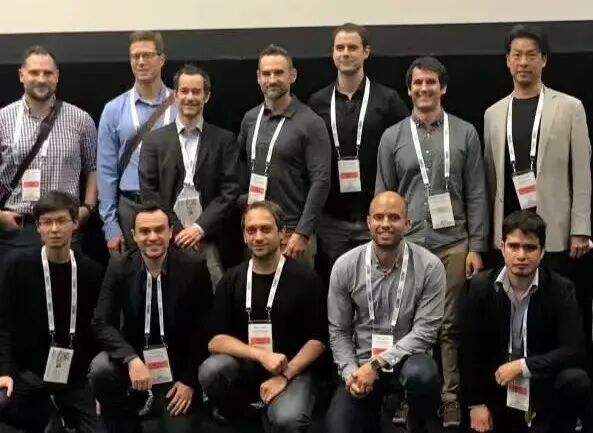
Far left: Xingxing Wang; second from right: Marko
▍Harry Wang: From the early days to today, you're probably one of the very few, maybe the only foreigner who truly understands this company. How do you evaluate Unitree's growth trajectory?
▍Marko: Unitree is very interesting. I personally think they're aiming for DJI's position. Drive hardware costs down to DJI's level. At first no one believed this could work. From what I understand, they're extremely vertically integrated on hardware, building many components from scratch rather than buying off-the-shelf. That's how they've done it.
However, whether there's a "DJI-style" market for this category of robots remains to be proven. DJI's real core market isn't FPV drone racing — it's using drones to capture photos and video from insane angles. That's why most people buy drones. The big question for legged robots is, what's their "photos and video"? What's the must-have use case? I don't think anyone has found it yet.
▍Harry Wang: From another angle, you could say something bigger hasn't appeared yet.
▍Marko: Right. What Unitree needs to do is find the first scenario that makes you think "it's worth using this every day."
▍Harry Wang: Back to the supply chain question. Did you consider European or US supply chains at the time? Why did you ultimately choose China's?
▍Marko: The first thing I did after you invested was book a trip to China. I spent three weeks here, traveling all over the country. Meeting potential customers on one side, potential suppliers on the other, getting a look at all different types of companies across the value chain.
I wanted a complete picture — how does China actually work? How does it operate down to the local government level? To build my own judgment. To this day, there's still too much misunderstanding on the European side. Every time I hear someone talking nonsense over there, I give the same advice: go see for yourself, go spend some time there.
▍Harry Wang: I see it as a victory of the ecosystem. The entire ecosystem, built up over so many years, has achieved extreme efficiency, and that brings competitiveness.
Different Cultures Just Mean Different Ways of Living
▍Harry Wang: You wanted to build your own supply chain, manufacture your own hardware. You set up a Shanghai office, then went to Hangzhou, spent about two years back and forth all told. What satisfied you, and what disappointed you?
▍Marko: The thing I'm most grateful for in recent years is that through my work, I've been able to spend time in the United States, Europe, and China simultaneously — observing all of it firsthand. No culture is superior to another; they're just different ways of living.
Europeans are especially good at focusing on value propositions when building companies, because from day one they're forced to figure out how to find customers, how to work backward from outcomes to create value. The focus is extremely high, because there's so little capital available — you have to be very smart about using what little money you have to generate revenue.
What Europe lacks is the spirit of adventure. People fear failure; they don't treat it as a form of learning. That's exactly what's holding Europe back from becoming stronger today. Americans are the complete opposite — they dare to think big, and their culture even admires failure. In Europe, if you fail at a startup, people will talk behind your back; in America, that's called courage. Now in China, you can do that too.
▍Harry Wang: Like they say, failure is fertilizer. Just don't die completely — the company can die, but you shouldn't lose your ambition.
▍Marko: Right, you have to keep going. But Americans lack something too — humility. That's their blind spot. Chinese people are humble, hardworking, always thinking in terms of scale, and masters at driving down costs.
But there's one thing I think Chinese people lack: they're too focused on competition, and sometimes forget to think about the customer, forget to ask "What new value can I create?" Look at all these robot companies popping up now — every single one is competing with Unitree, all with similar value propositions, identical. But they should be thinking: could there be a different value proposition?
▍Harry Wang: Yes, that's a blind spot, I completely agree. In our culture, sometimes there's a lack of creative thinking — you see a path that works, they've raised a lot of funding, gotten government attention, industry favor... then following that path must be right.
We'll analyze it: they can do it, so can we. So we just do it, without thinking about how we could do it differently. Unitree is a good company, but if this is a building, it's only the first floor. You have to think about the second floor, the third floor — not build a bunch of duplicate first floors.
▍Marko: Exactly. There's another aspect too: some technology companies are always fixated on "what jobs do humans do." But with technology, we can actually provide entirely new solutions that humans can't achieve.
▍Harry Wang: Right, not just cheaper, but a thousand times what humans can do, or even things certain people fundamentally can't do. That requires the ability to think outside the box. That's precisely something our culture is a bit lacking in. But I have hope for China's younger generation — they're different.
▍Marko: And exchange helps too. At RIVR, because we're exposed to all three cultures, as CEO I actively try to take the best from each world. I encourage people to fail; I get them to think like Chinese people about how to reduce costs at massive scale; and also like Europeans to focus on the customer. Put all of that together, and you can create something unique.
There's one more thing that really struck me. When I talked with the Shanghai team, every single time they would ask me about competitors: How are they doing? Are we ahead? What are they up to? I was genuinely shocked, because no American or European has ever asked me that question — never, not once in my entire career. I'd actually have to bring it up myself before they'd even think about competitors.
In Chinese culture, people are constantly thinking about the competition. Of course that creates some pressure too. So I told them: we focus on customers, not competitors.
Don't Fixate on Today's Ceiling
▍Harry Wang: Now we're seeing that the new generation of Chinese entrepreneurs is incredibly driven, more creative than my generation. They're capable, execution-oriented, learn fast from mistakes, very open. Aren't you worried about competition from this new generation of Chinese entrepreneurs?
▍Marko: In my day-to-day work, I really don't think much about competitors. I'm too immersed in my own world. For the next few years, I'm thinking about my customers, about how to get things to their doorstep. I'm betting everything on that. When I see something happening outside my domain that I can learn from, that can improve my customer experience — I take it and use it.
▍Harry Wang: That's also Amazon's principle: focus on customer value.
▍Marko: One reason the two sides could come together is cultural fit.
▍Harry Wang: But competition will come eventually. Though sometimes, competition actually forces you to become a better company.
▍Marko: What we're doing today, almost no one else is doing. If you write out the unit economics, one algorithm is: how much does human delivery cost per order, I'm cheaper than that, and the difference is my profit — think this way, and you're finished in the future.
Cost shouldn't be calculated starting from the price of human labor; it should be calculated from the bottom up. What's the cheapest service I can build? Then make that number the team's target. Because the price of human labor will keep dropping with competition. If you stare too hard at today's ceiling, tomorrow you'll be too expensive.
▍Harry Wang: Right, you're setting a global, long-term optimization goal, not fixating on today's status quo.
▍Marko: So costs in the unit economics model must always be calculated from the bottom up.
▍Harry Wang: Back to the product. What can this wheeled-legged robot actually do? Does it still need a person on-site when it's working?
▍Marko: In China everyone lives in high-rises, while sixty to seventy percent of Americans live in single-family homes. American houses have porches — first a few steps, then a platform, then the door.
If you want to replicate what humans do, you have to deliver packages to the door, set them down, and go to the next house — all unattended. But you have to get over those steps — that's why the robot needs legs. But everything before the door is flat ground; walking the whole way would be too inefficient. So wheels and legs have to combine: legs handle the last hundred yards, wheels handle the last mile.
Autonomous cars pre-map cities, but in our scenario, mapping every customer's doorstep isn't realistic. So the robot has to find the front door on its own with no prior knowledge, no pre-built map. That's why we use reinforcement learning and self-supervised learning.
▍Harry Wang: Can it do this with absolutely no one nearby now?
▍Marko: Yes. But we still have remote assist personnel. When the robot gets stuck, it requests help — via 4G, 5G, operated remotely by someone sitting in a lower labor-cost country. But this is also training signal, our natural way of solving long-tail scenarios. Every time it gets stuck, it means the AI isn't good enough yet. Record that operation, add it to the dataset. That's the path from 80% to 90% to 99.9%.
▍Harry Wang: When do you think you'll reach 99.9%?
▍Marko: 2028.

Three Reasons for the Acquisition Decision
▍Harry Wang: On March 19, 2026, you announced the Amazon acquisition, and Amazon bought Kiva on March 19, 2012 — same day as you, exactly 14 years apart. Pure coincidence? Or did Amazon deliberately pick the date?
▍Marko: Not deliberate. When you said "14 years," I thought you just meant 14 years apart — I didn't realize even the dates matched, that's crazy.
▍Harry Wang: I think the universe made that choice, not you, and not Amazon.
▍Marko: As much as I want to be an engineer and figure out everything in life with logic, the more I experience, the more I accept this: many things simply don't follow logic.
▍Harry Wang: Exactly. If you only follow logic, you end up with the most illogical result. There's a Chinese saying: zhi si di er hou sheng — you have to be prepared to die to earn the qualification to survive. Otherwise, life will torture you by every means possible. What was the specific moment that made you decide to sell the company to Amazon?
▍Marko: I saw several things. First, we could continue fulfilling our mission. Amazon wasn't just trying to acquire talent — I could still realize my mission within it, and that's what drives me to pour all my energy into this.
Second, cultural similarity — Amazon's leadership principles fit very well with ours.
Third, they already have over a million robots in their warehouses; by robot count, they're one of the largest companies in the world. We have so much to learn, can avoid the pitfalls they've already hit — our learning curve would be incredibly steep.
Those were the main three things. Of course, there are always business aspects, but I can't talk much about that. These three things were equally important to me as money. Money is a byproduct, a natural result of focusing on the mission. Because of that, I felt grounded, confident this was the right choice. Of course, risk is always there — you never know what happens next. Making this kind of decision is like marriage — you have to consider the practical aspects of the marriage.
▍Harry Wang: So you're not the type to decide to get married at first sight?
▍Marko: At 18, I would fall in love at first sight, might marry someone the same day. But now, I analyze from many angles.
Transforming Amazon, the Future of Physical AI
▍Marko: I've always had a strong belief: RIVR can completely transform Amazon. I believe the future Amazon is a physical AI company. I have a great opportunity to take on more responsibility within Amazon, to lead in this direction. But if this isn't the right choice for Amazon, then at some point we may have to part ways — because I have to continue fulfilling my mission.
▍Harry Wang: Some things were written in the book of your life before your life even began. You just didn't know it at the time. Like the Kiva story. Now you've become part of this giant, Amazon. Against the backdrop of Amazon, what can you do that you couldn't as an independent company?
▍Marko: The most direct thing is: our robots can scale so much faster. Because we are our own customer, operations are run by Amazon, the entire value chain is ours. From the moment someone opens the website and places an order — first mile, middle mile, last mile, warehouses, infrastructure — we can change all of it. When we were running our own startup, we were just one link at the very end of the value chain, and that interface wasn't ideal. Now you're looking at the whole board; things are so much simpler.
▍Harry Wang: Make every link robotic, natively robot-first. As long as Amazon's mission and your mission are fully aligned, you'll definitely scale faster.
▍Marko: That risk always exists. But ultimately, this is my responsibility — if I can realize the future of physical AI as quickly as possible, Amazon has no reason to think otherwise. But if all I offer is promises without numbers, then it gets hard.
▍Harry Wang: I think it's even more than numbers. If you can bring Amazon a better version of vision and mission, great numbers will naturally follow as a byproduct. Don't you think?
▍Marko: You need both.
▍Harry Wang: What do you want Amazon RIVR to become? You've said you want to completely transform Amazon's logistics, and even go beyond that.
▍Marko: Revolutionizing Amazon means injecting a "physical AI first" mindset and repositioning Amazon as a physical AI company. Google acquired DeepMind, and today we have Gemini. The most unique thing Google brought to Gemini was reach — the ability to touch users. It has the full value chain: training, its own models, data centers, its own chips, and access to users through G Suite and Gmail that no one else has.
On our side, we have something almost parallel: application scenarios. For robotics and physical AI, the hardest thing is finding a truly scalable application scenario — we have one, and it's very clear. Scale will unlock robotic intelligence for you, and that intelligence will let you do other things. That's my goal: go beyond delivery, use it as a slingshot to propel me toward the next wave of robotic intelligence.
Seize the Day
▍Harry Wang: A year or two ago, we were sitting outside a Hyatt having drinks with some other Linear portfolio founders, and I taught you something that night. Not about robotics, not about fundraising. Do you remember what it was?
▍Marko: That night in Abu Dhabi, I remember it one hundred percent. You taught me something very special.
▍Harry Wang: A poem. Its author is one of China's most celebrated poets. The line goes: "When life goes well, seize every joy — don't let your golden cup face the moon in vain."
▍Marko: I still remember the tone. I actually tried so hard to learn it, but I failed so many times. Every time I meet Chinese people, I recite this poem, and they all look at me blankly: what are you saying? Then I pull up the voice message you sent me on WeChat and play it for them.
▍Harry Wang: Did I ever tell you that when doing business with Chinese people, pulling off something like this makes things go much more smoothly?
▍Marko: I've actually done it several times, with suppliers.
▍Harry Wang: That's life. This poem is thirteen hundred years old, written by a poet who never had stable employment in his life but exited as a legend. When fate smiles upon you, celebrate it fiercely.
Last question — what does success look like in your eyes? What does it mean to you to live a meaningful life?
▍Marko: A lot of the time, people become successful through external validation — others telling you, you're amazing, you accomplished this and that. But the real first step is detaching yourself from "needing others' approval," still affirming yourself without those voices. That's also the first step toward inner peace.
▍Harry Wang: Do your own thing, bear the risks you choose.
▍Marko: When it comes to success, everyone has to find their own definition. The hard part is, don't tie success to external validation.
▍Harry Wang: Find your role, find your mission. As we wrap up, I've prepared a special gift for you. It's a simple thing, but what I wrote on it comes from the heart.
To Marko Bjelonic: From the earliest days, we have been honored to support RIVR and watch it grow into something larger than itself. But a company's period is only a person's comma. May we meet again in life's later chapters, to drink together freely. In comfortable moments, always stay alert.
▍Marko: That's beautiful. Thank you.
Due to space constraints, this article covers approximately half of the day's interview.