Linear Capital Portfolio Company Rokid Founder Misa Zhu Interview: The AI Glasses Battleground Is Only in China

The Springtime of an 11-Year-Old Company
"Spring for an 11-Year-Old Company"
By Muxin Xu
Edited by Jing Liu

Suits pour into the office building — local government officials, channel distributors, livestreamers. The man they all want to see, Rokid founder Misa Zhu, is debugging glasses at his workstation. A month earlier, he had used this same pair to demonstrate displaying his speech notes directly on the lenses, a stunt that went viral. That day, Zhu also mentioned a detail: one evening not long before, Feng Ji of Game Science, Xingxing Wang of Unitree, Wenfeng Liang of DeepSeek, Bicheng Han of BrainCo, and several other founders had come over to his place for dinner. Afterward, these Hangzhou founders — all white-hot lately — signed their names on the same blackboard, which now sits in Zhu's meeting room. Rokid has become one of the most sought-after companies in Hangzhou's Dream Town.
But this isn't a new company. At eleven years old, Rokid has spent its life building consumer AR glasses and serving energy, industrial, and cultural heritage (to B) markets. In 2014, Zhu left Alibaba to found Rokid, backed by Yuanjing Capital, Linear Capital, Fosun, and other top-tier investors, reaching unicorn valuation. Zhu's office matches the man — deeply geeky. His workstation sits in a corner of a grid-layout office, ringed by a moat of first-generation Apple computers and vintage keyboards. In interviews he always brings up Steve Jobs — a reference point more common among the previous generation of founders.
Last week, Anyong Waves sat down with Zhu at Rokid's office. That same day, news broke that another AR glasses company backed by Alibaba — Qidian Linjin — had fallen into operational trouble by late 2024, its founder hit with spending restrictions, its business now unable to function normally.
Zhu was surprised to hear this: "Why collapse right before dawn? Rokid finally got the industry hot. They just needed to grit their teeth a little longer."
The day felt like a microcosm of AR's decade-plus history — bubbles, troughs, some crowned with flowers, others not making it to the finish line.
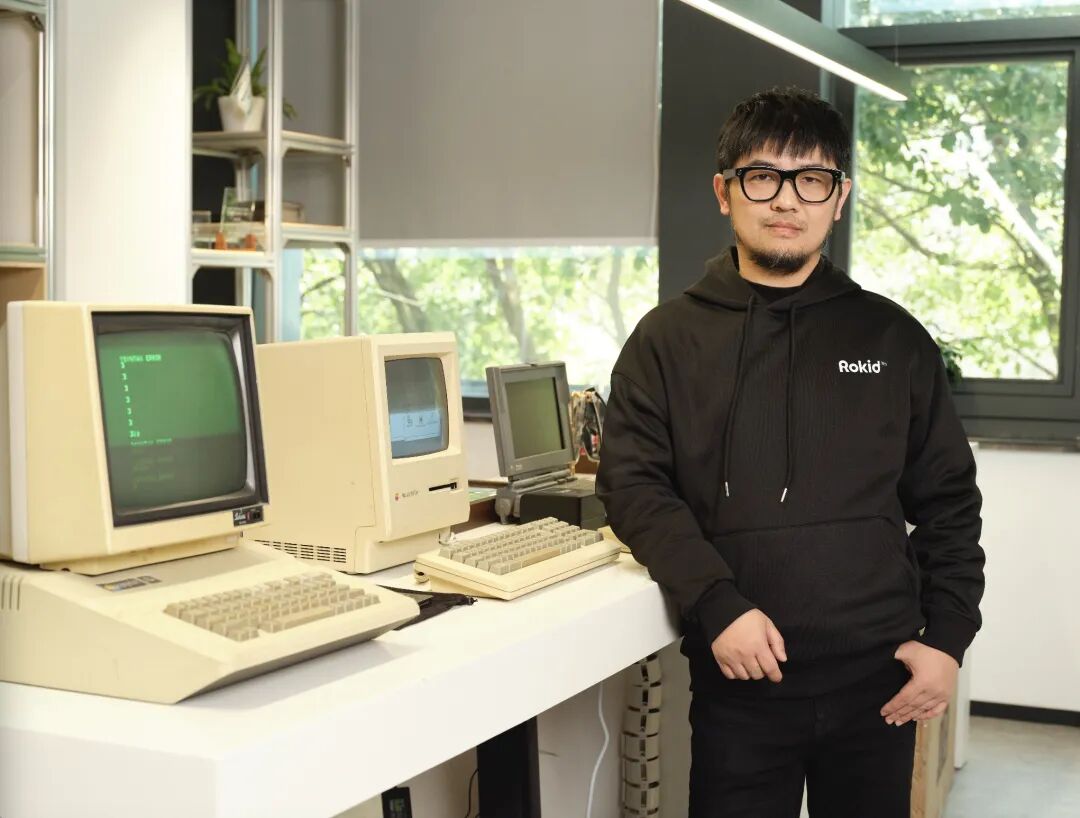
Below is Anyong Waves' conversation with Zhu (Misa):
Part 1
AR or AI
"Anyong": What did you talk about at that "legendary" dinner?
Misa: It was February 15th. The next day Liang was heading to the private enterprise symposium, so he wanted to chat with us about technical topics.
"Anyong": Hangzhou's "N Little Dragons" all come from different fields. What do you actually discuss?
Misa: It's all the same — technology is universal. Didn't I also get Black Myth: Wukong running on my AR Lite glasses?
"Anyong": Rokid's previous products were all AR glasses, but what went viral was AI glasses. Do you think the latter represents the real technical direction?
Misa: There's an impossible triangle in this industry: display capability, battery life, and computing power. These two product types each occupy two corners, but the endgame is a complete triangle. You'll notice AI and AR glasses are actually converging — AR needs to get lighter, AI needs better display. They'll eventually become one thing.
"Anyong": What obstacles stand in the way?
Misa: Fusion is possible in five years; until then, it's about trade-offs. AI technology has matured first, AR hardware still needs work, so I'm putting 70% of my energy into spatial computing and software, 30% into grinding AR technology with the industry.
"Anyong": You currently have both AR and AI glasses product lines. Which do users actually buy into?
Misa: AI glasses orders are currently 10x AR's — and that's with F-codes restricting purchases. Without limits, it'd probably be 20-30x.
"Anyong": But IDC data shows overseas market share leaders are mostly on the AR route.
Misa: I basically ignore that. Pure AR glasses aren't mass-market products, not a real need. They can be a nice small business, a toy. AI glasses are a completely different tier of track.
"Anyong": How do AI glasses avoid being seen as toys and become actual needs?
Misa: Anything you can't wear all day isn't a real need. Meta-Rayban's experiments these past few years, plus AI capabilities — I believe within a few years AI glasses will become essential. The key to PMF is that your product definition can't be too far off. You need to make users pull out their wallets decisively, not convince them to. For example, Rokid's hot right now because of the teleprompter, but most people won't pay for a teleprompter. That's a viral moment, not a selling point. The selling point is AI, is need, is making you want to keep wearing them even when they're dead.
Part 2
To B or To C
"Anyong": Is this speech-reading glasses your first AI glasses?
Misa: First to C. In 2020 we made a pure to B monocular AI glasses, but costs were too high for consumer. Still, consumer glasses contain a lot of tech — waveguides, micro-displays — that came from industrial and cultural heritage experiments. B to C makes sense in an early industry. Apple did education and publishing early on too.
"Anyong": What was the decisive inflection point for B to C?
Misa: First, AI. AR and optical tech kept developing, but AI pulled the final trigger. Second, our experience doing AR museum guides. Cultural heritage was the crucial bridge from B to C — many people undervalue this space.
"Anyong": What feedback did museum users give you?
Misa: There's always been debate about whether smart glasses need displays. We stuck with displays because of how accepting museum users were of head-worn AR. And users gave specific feedback: lose the cable, add prescription lenses, etc. Companies that haven't gone through B to C will find copying Rayban the easier path.
"Anyong": What's your current revenue split between to B and to C?
Misa: C-side revenue scale is definitely higher, but to B has better margins. We have huge B-side influence. Cultural heritage is roughly 100 million RMB annually, our ecosystem partners do tens of millions, several million people visit museums yearly, and Rokid is the only player in this track.
"Anyong": But they might not recognize it as a Rokid product.
Misa: Doesn't matter. Brand-building shouldn't be like pressing a thumbtack into users' heads. I'd rather users suddenly realize "oh, this is that glasses I wore at the museum."
"Anyong": You're among AR companies with relatively heavy state investment, including Hefei and Wuhan, and you work closely with local governments — also because of cultural heritage?
Misa: To B business is the bridge to government engagement. However remote a local government might seem, they always have culture and tourism, always have museums.
Part 3
60 Points or 90 Points
"Anyong": We're now defined as being on the eve of the "hundred glasses war," with many new competitors emerging — big tech like Xiaomi and Baidu, plus "outsiders" like moody and Sharge. Which type worries you?
Misa: It's a land-grab phase; competition isn't the main story. Even when big companies enter, they're working in a snail shell — even if they go all-in, their per-unit-area investment ratio is similar to startups', so no need to worry too much.
"Anyong": As you said before, we're in a phase where "big companies are generating buzz but their product strength hasn't caught up to requirements" — a rare time window for you and other startups.
Misa: Right, about two years.
"Anyong": What's most important in these two years?
Misa: Competition has six dimensions. Product, innovation, ecosystem — we're already ahead. Brand, channels, supply chain — big companies have advantages. We've unexpectedly completed the brand part, so we're mainly working channels now, and need to solidify supply chain going forward. This is total war; no weak links allowed.
"Anyong": But Xiaomi went from zero to one in auto manufacturing in four years. If Lei Jun really pushes AI glasses, would Xiaomi be an opponent you'd guard against?
Misa: He'll succeed. But AI glasses market capacity will exceed phones, because they're more personalized. We just need to stay at the table.
"Anyong": What will Rokid's competitive strength be?
Misa: At core we're a software, operating system company. Jobs spent his whole life telling people Apple was a software company, but because the hardware was so outstanding, it kept getting overlooked. Why so many Apple fanatics? Hardware differences across phones are already minor; in the end users can't leave Apple's software and ecosystem. AR glasses' most criticized aspects — battery life, unstable Bluetooth — have nothing to do with hardware. My first startup, Mammoth Tech, was also an OS. A company's DNA doesn't change.
"Anyong": If you're doing systems, Google's Android XR would also be your opponent.
Misa: I agree — in the future our biggest opponent might be Google. But no need to worry now; Google is still a second-tier player. The biggest AR glasses market is China. Whoever masters the China market will truly win.
"Anyong": Why China?
Misa: Simple — I'll give you one number. The US has roughly 400 million people, only 7.9% with myopia. China has 1.4 billion people, and high school graduates have roughly 80% myopia rates.
"Anyong": Yet many AR brands are making overseas moves. Why?
Misa: Avoiding domestic competition — strategically correct. Early stage isn't the time for internal competition. Everyone grinding each other to death on a narrow battlefield just lets big companies come in and harvest everything at the end.
"Anyong": Rokid's buzz is so hot now — if many consumers come because of the name, then find the glasses experience doesn't meet expectations, what happens?
Misa: This is what we worry about most. A comfortable startup rhythm is releasing a 70-point product and saying let's polish together. But Rokid doesn't have that luxury anymore. By June we must deliver an 85-95 point product. If we can't, the traffic will definitely backfire.
"Anyong": The engineering unit we just experienced — how many points?
Misa: 60.
"Anyong": How do you get to 90 in three months?
Misa: My definition of 90 is: I toss you the glasses, no engineer standing by telling you how to operate them. Like when everyone first saw the original iPhone's "slide to unlock" — you naturally slid your finger across the screen. Our biggest challenge now is how users learn the AI assistant wake word. The simplest way is subtitles saying "please say 'Leqi'" — but that's too mediocre. A user's first 10 operations with the product form their core impression. What we need to crack has nothing to do with AI or hardware.
"Anyong": Sounds like a product manager capability.
Misa: It's definitely a product moment now.
Part 4
Idealism or Groundedness
"Anyong": When you decided to start Rokid in 2014, were you inspired by Google Glass?
Misa: At the time I believed I could make something better than Google Glass. I posted on Moments saying I'd self-fund it — looking back, truly ignorant and fearless. I put in over 10 million RMB myself, far from enough.
"Anyong": But Google Glass was later proven a failure.
Misa: Google Glass's problem was being too early. Of course Google itself may never have intended it as a mass product — just letting a good idea sprout, whether it grows into a big tree, doesn't matter. Vision Pro has a typical problem: it has too many capabilities, like Zhang Wuji's internal martial arts, ultimately becoming a powerful, expensive, heavy, gorgeous monster. It's an interesting contrast — you need to handle your own overflowing capabilities. Elon Musk did it. Liang did it too; his quantitative trading capabilities overflowed, which made DeepSeek possible.
"Anyong": Rokid's two best-selling products historically, Lite and Max — you rejected both. Why?
Misa: At the time I only wanted to make what Rokid Glasses is today — a mass-market, essential AI glasses product. I didn't want to waste time on AR. But later facts proved the team's decision was correct. These weren't my ideal products, but they were important products for a startup.
"Anyong": As CEO of a startup in an early-stage industry, do you ever feel you're too idealistic?
Misa: This may relate to me not really having had a job. I work from big to small — if I decide AI is the future, I set the goal and work backward. I've observed people with jobs: they plan the future from existing resources, like what I can deliver today, what I can deliver in six months. Innovative companies probably need a CEO like me.
"Anyong": Rokid is 11 years old now. What was the hardest moment?
Misa: Rokid has never fought a fully prepared war in ten years, because the whole industry was immature. But Jobs said, always choose spring technology. If you choose autumn or winter tech, you'll find you can prepare everything thoroughly, but you'll be very lacking in imagination.
"Anyong": Are you mainly responsible for technology now, or commercialization?
Misa: I'm responsible for product.
About Linear Capital
Linear Capital is an early-stage investment institution focused on "frontier technology + industry," namely frontier technologies represented by data intelligence, digital new infrastructure, next-generation robotics technology, and new technology transformations in traditional fields (such as biomedicine, materials, energy, etc.), applied across vertical industries to greatly improve industrial efficiency, empower them to solve pain points, complete industrial upgrading, and achieve excess returns on commercial value through substantial increases in industrial value. Currently managing ten funds with total assets under management of approximately $2 billion.
Our investment stage focuses on leading angel to Series A rounds, with individual investments ranging from $1 million to $10 million (or RMB equivalent).
To date, we have made early investments in over 120 entrepreneurial teams including Horizon Robotics, Kujiale, Sensors Data, Tezign, Rokid, Guandata, Agile Robots, and others. The combined valuation of Linear's portfolio companies is approximately $20 billion.
In the near term, Linear Capital is striving to become the best "Data Intelligence Technology Fund," and in the long term, gradually build itself into the most influential "Frontier Technology Application Fund."