The Toughest SaaS Market and Its Hottest Winner: How Sensors Data Built a Product with Nearly 100% Renewal Rate at a Billion-Dollar Valuation

](https://mp.weixin.qq.com/mp/appmsgalbum?__biz=MzU5MTY4NDQwNA==&action=getalbum&album_id=2230864849192976388#wechat_redirect)

An executive at a company that has purchased Sensors Data's products told Wan Gong Research Institute, "Sensors Data is the hope of China's to B product companies."
Given the bleak economic environment, that assessment seems like high praise.
Although the data analytics track that Sensors Data belongs to remains a capital favorite. According to Data Yuan's statistics, in the first eight months of 2022, investment and financing cases in data analytics were the most numerous, accounting for more than 25%, followed by data security and healthcare big data. And as the biggest winner in the data analytics track, Sensors Data not only achieved significant revenue growth this year but also secured $200 million in Series D funding — the largest round in this track. This round attracted well-known institutions including Tiger Global, Carlyle, and HSG. HSG has been along for the ride since Series A, participating in five consecutive rounds.
But in the face of overall economic decline and the dire state of Chinese SaaS, can Sensors Data still bear this hope?
Sensors Data is a big data analytics and marketing technology services company. It started from user behavior analytics. Its founder and CEO, Wenfeng Sang, graduated from Zhejiang University. During college, his dream was to build software as powerful as Windows. In his junior year, he made this dream his graduate school direction, hoping to follow an operating systems professor to delve deeper into OS research. But after starting graduate school, the professor told him he wasn't doing operating systems research — he was working on grid computing. Grid computing and cloud computing are both forms of distributed computing, with operational similarities. This laid a solid foundation for Wenfeng Sang's later entrepreneurship in big data.
In 2007, Sang graduated and joined Baidu. During his eight years there, he worked on distributed computing research and later cloud computing, rising from a junior R&D engineer to technical manager. He participated in building Baidu's user log big data platform from scratch.
In 2011, the "big data" concept was proposed. Enterprises across industries increasingly valued big data, and market demand for big data services grew. In 2015, Sang resigned and co-founded Sensors Data with several former Baidu colleagues.
From 2015 to today, over seven years, Sensors Data grew from an 11-person team to 1,200 employees, serving 2,000+ clients including leading enterprises like Bank of Communications, BOC International, Lalamove, Pacific Insurance, and Chunyu Doctor.
According to market forecasts, this company's sales grow significantly every year. And according to Wan Gong Research Institute's understanding, Sensors Data's performance this year is at a level that would make any SaaS company envious.
In the era of data dividends, competition is exceptionally fierce. In 2015, when Sensors Data was founded, there were no shortage of competitors launched the same year. Yet seven years later, Sensors Data is not only a standout in user behavior analytics but even a benchmark for the entire data analytics market. Is Sensors Data really the hope of China's to B product companies? What did they do right? What characteristics do they possess that peers lack?
Wan Gong's MarTech research team sent an interview invitation to Wenfeng Sang with these questions. In a Tuesday afternoon conversation, he walked us through Sensors Data's journey.

Sensors Data Founder and CEO Wenfeng Sang
01 The Start: The Ultimate Single Product
Whether a newly established brand can make a name for itself depends on whether it can create a hit product in the 0-to-1 stage. As the saying goes, "a single product wins the kingdom, multiple products keep it." Sang also understands this rule of breaking through. Therefore, at the start of his venture, Sang was very clear about his 0-to-1 goal: to build the ultimate single product.
This single product was a user behavior analytics tool — the field Sang had wanted to work on and persisted in researching since graduating and joining Baidu.
Before that, let's first understand what user behavior analytics is.
User Behavior Analytics (UBA) refers to technical service providers legally obtaining basic data on website or APP traffic, then statistically analyzing all interaction behavior data that users generate on the product. This includes time of use, duration, number of pages viewed, time spent on page, page view completion rate, and usage paths. It helps enterprises discover which product features users use most frequently and their true behavioral habits, gain insight into their real needs, adjust marketing direction, and make enterprise marketing more precise and effective, thereby improving revenue. Enterprises can also use this to build user tag profiles, predict consumption habits, and push products users are interested in to achieve precision marketing.
You can also simply understand it as: user behavior analytics uses data to reflect user behavior, helping enterprises "face-to-face" observe users. Its functions are search recommendation and precision marketing.
User behavior data analytics serves as a key element in tracking user behavior, refining customer profiles, assisting precision marketing, and building real-time recommendation scenarios. It can greatly help enterprises extract data value, connect seemingly unrelated data points, and use data analytics for precision marketing.
User behavior analytics may seem relatively simple to describe, but truly good implementations in the industry are actually rare. This is because user behavior analytics is not just a technology but also an analytical method, extremely dependent on the granularity of analytical models, which often requires deep industry knowledge. Moreover, user behavior analytics places great emphasis on data accuracy, timeliness, and comprehensiveness of data collection. Any issue in any link will lead to crude analytical results.
Therefore, to do user behavior data analytics well, two parts of work are needed:
First, data collection. Common data collection methods include data tracking (divided into manual tracking and automatic tracking) and third-party statistical tools. Data tracking involves placing tracking points on websites, APPs, and other marketing touchpoints. When users pass these tracking points, related operations are recorded to collect user behavior data. Third-party statistical tools generally connect via SDK.
Second, establishing data analytics models (such as funnel models, behavior path models, user segmentation models, etc.) and analytical methods to discover user habits and product needs, optimize products, and refine operations.
For example, if a brand wants to improve user conversion rates, analysts will first sort out requirements based on the brand's industry characteristics and confirm data application scenarios. Then analysts will implement tracking to collect required user data, model and analyze the collected data, tag and segment users, and finally match personalized recommendation strategies based on analysis results and user conditions to achieve improved conversion rates.
Sensors Analytics is Sensors Data's first product, a privately deployable user behavior analytics platform — the ultimate single product Sang hoped to build. The Sensors Data story begins here.
Sensors Analytics currently supports both private deployment and SaaS, using a subscription pricing model — private deployment + standard product + subscription pricing. This model was innovative in the To B market at the time, and not easy to pull off. Not many vendors were willing to do this.
Why?
The answer to this question may also indirectly prove how "ultimate" Sensors Data's single product is.
First is Sensors Analytics's private deployment. Everyone knows the benefits of private deployment. Private deployment means that after purchasing the software, users also need to deploy servers and databases. All data is stored on the user's own servers, or through agreement between user and vendor, source code is given to the user, granting more secondary development rights.
However, for vendors, private deployment is not something you casually do. It means dedicating staff to serve the enterprise, unless the client pays particularly well — who would argue with money. For enterprises, private deployment often requires far more human and financial resources than SaaS. But even though SaaS is more cost-effective, private deployment remains the best/ultimate choice. When it comes to data analytics, core data security concerns cannot be ignored.
After in-depth communication with some enterprises that have purchased Sensors Data products, Wan Gong Research Institute found that they all said Sensors Data's private deployment pricing is absolutely extremely cost-effective compared to other vendors in the industry. According to our understanding, leading companies in the industry charge fixed fees of several hundred thousand yuan annually for private deployment, but Sensors Data's price is far below this average.
High cost performance isn't easy. Think about it — how can a product's price be low?
Standardization is an unavoidable hard requirement.
When private deployment processes and service processes are standardized, service costs can be greatly reduced and efficiency improved, making controllable private deployment costs possible. This means Sensors Data must first have standardized product capabilities that are solid, and second, all supporting services (including implementation staff SOPs) must be standardized to achieve this.
Some enterprises that have been "hurt" by private deployment told us, "There are too many scams in the industry. Many vendors sell services and customization under the banner of products, or the value doesn't match the price. Sensors Data is very conscientious." According to Sensors Data, currently 70% of clients have chosen private deployment solutions.
Conversely, if private deployment costs are too high, it actually suggests the vendor may lack experience in private deployment, hasn't specifically researched and iterated for the private deployment model, and naturally costs are high.
Second is subscription pricing. Sang said whether annual fees can be continuously collected depends on whether the software product can continuously deliver value to clients, and whether the software vendor can continuously provide software implementation services.
The implication: Sensors Data can provide continuous updates and upgrades for clients' privately deployed software products.
Due to deployment prices and resource investment reasons mentioned earlier, annual fee models for private deployment are not common. Renewal is the unsolved problem of the SaaS industry — if you can charge once, why trouble yourself? From the service lists provided by Sensors Data clients, in their private deployment, Sensors Data also provides varying degrees of training support services for enterprise business departments to support project implementation. And project implementation doesn't mean the end. Sang said this doesn't mean users can use the product well — subsequent operational services are needed.
It's said that when Sensors Data was first founded, they internally wrote a 300,000-word help document, but clients still couldn't use the product. Help documents are typical Silicon Valley culture, but domestic data culture or the professionalization level of many company employees often renders help documents useless. Software vendors need to do more.
In our conversation, Sang also lamented that in China's current digital transformation, some enterprises' biggest pain point is they don't know how to do it themselves and need technical institutions to provide one-stop services. Sensors Data realized early on that they couldn't just make products — they had to do services.
 Source: Unsplash
Sang told us that around Sensors Data's second year, they already had roles like customer success, technical support, analysts, and consultants, and reworked Sensors Data's delivery process. He said, "We need to proactively do services." More surprisingly, Sang said Sensors Data standardized the specific division of labor and steps for every link in the customer service process, including solution design, launch testing, and training delivery.
For a startup, adding positions before establishing a foothold in the market is rather risky. And serving clients and customer success are usually not the primary concerns for technical founders in the early stages of entrepreneurship — these are typically later decisions.
But Sang said, "If clients can't use it well, the product's value is zero." From Sensors Data's perspective, failing to meet client needs is more dangerous.
In a 2020 interview, Sang revealed a small story. When Sensors Data had just been founded for a month and a half, they began pushing the 0.1 version demo product to seed clients. During trial use, clients felt the product's analytical flexibility was very strong, but they felt it lacked a data overview function. Sang was focused solely on deep analysis at the time and felt data overview was an outdated function, not planning to provide it. Since clients had the need, the newly founded Sensors Data stopped development on all other features and focused solely on this one data overview function.
Though they haven't invented mind-reading, Sensors Data tries to help clients understand their users to the greatest extent.
Currently, in Sensors Data's 1,200-person team, R&D personnel account for 40%, with 300-400 people working in service-related roles. It's said that at one point, the service team even accounted for half of the entire team. People in the industry have more or less heard the rumor that "Sensors Data has many salespeople." We can confirm this here: there are indeed many salespeople, but these "salespeople" differ from what we understand as salespeople only concerned with transactions. They lean more toward customer service personnel — frontline staff dedicated to meeting client needs.
Service, standardized service, is also Sensors Data's ultimate single product.
Sang revealed that as Sensors Data's medium and large clients have grown, Sensors Data has increased investment in services. Over the past year, Sensors Data has brought in senior talent from companies like SAP, Adobe, and Deloitte, with the goal of building Sensors Data's large client management capabilities.
02 Expansion: Closed-Loop Capability
The ultimate single product was Sensors Data's "0-to-1" stage. As for the "1-to-100" stage, Sang said Sensors Data benchmarks against Adobe Experience Cloud.
Adobe Experience Cloud is a digital marketing solution suite containing Adobe Marketing Cloud, Adobe Advertising Cloud, and Adobe Analytics Cloud. It helps B2C and B2B enterprises address needs from data insights to content management to marketing workflow, solving large-scale personalized user experiences. As of March 2022, Adobe's Experience Cloud platform operated at a scale covering over 24 trillion segmentation evaluations daily.
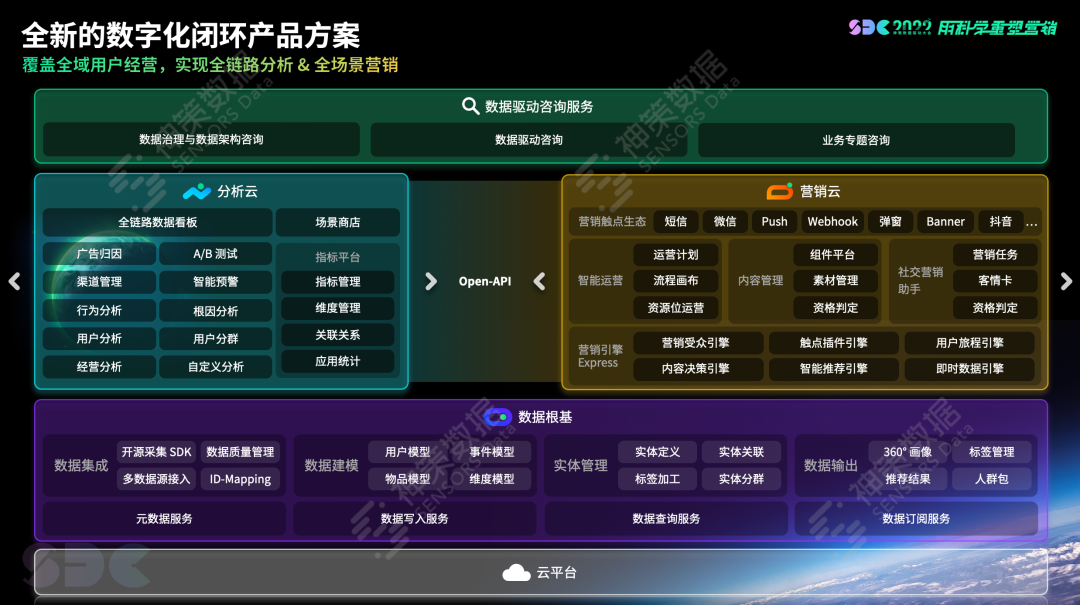
Whether Sensors Data, having passed the "0-to-1" stage, harbors similar ambitions, we don't know. But looking at Sensors Data's current product system "two clouds, one platform" (Analytics Cloud, Marketing Cloud, Data Foundation Platform) — Sensors Data can provide clients with a comprehensive digital marketing suite centered on data insights:
Data Foundation Platform: Mainly functions for real-time collection, governance, storage, query, accumulation, and display of data. Based on the Data Foundation Platform, Analytics Cloud and Marketing Cloud can connect and complement each other. This synergy enables rich possibilities for user activation. This also lays the foundation for data-based activation.
Analytics Cloud: Contains user behavior analytics, user profile analytics, business data analytics, BI visualization reports, and A/B testing. It helps clients perceive business changes and user needs through data in every scenario, providing support for marketing decisions.
Marketing Cloud: A digital marketing platform covering public and private domains, online and offline, for all scenarios. Contains functions like omni-channel user reach, marketing automation, omni-domain tags, content management, and intelligent recommendations.
 Source: Sensors Data
Sensors Data's current product matrix
From Data Foundation Platform to Analytics Cloud to Marketing Cloud, a piece of data can transform from an initial number into various decision-supporting results — a perfect data closed loop. This also encompasses important elements of what enterprise digital marketing needs to accomplish.
However, as mentioned earlier, domestic enterprises currently don't fully possess data capabilities. If Sensors Data is to reach Adobe Experience Cloud's level of data analytics volume, or if enterprises are to achieve true personalized marketing, clearly this cannot be accomplished by the technology vendor having capabilities alone.
To this, Sang's answer is: "1-to-100" revolves around "how to bring value to clients." He told Wan Gong Research Institute that the key at this stage is to provide clients with "closed-loop capability."
Data needs not only "landing" as mentioned earlier, but from obtaining data to analyzing data to truly impacting marketing, Sensors Data wants to help enterprises complete this chain's closed loop. However, just as every industry and every company has its own marketing logic, to achieve "closed loop," this requires Sensors Data to not only understand clients but also help clients understand users.
On this point, Sensors Data has done two things.
1. SDAF Data Closed Loop
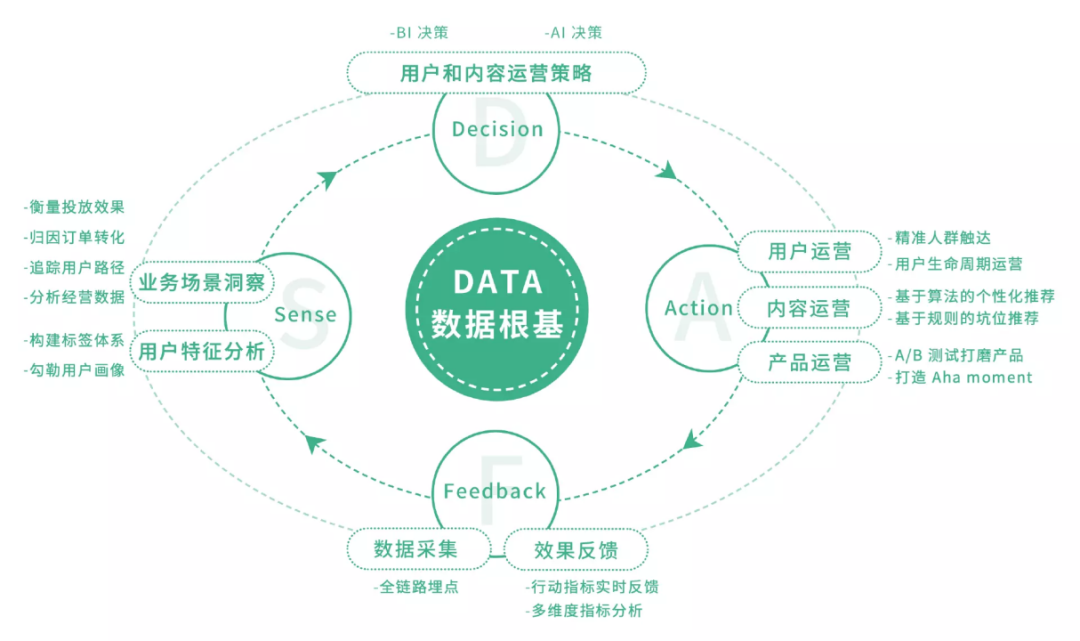
Sang abstracted a data closed-loop methodology "SDAF" from the underlying operational logic of enterprises:
SDAF represents four stages. The first stage is Sense: based on data analytics, identify key business metrics.
The second stage is Decision: for improving key metrics, formulate product optimization plans.
The third stage is Action: A/B testing helps implement product optimization plans.
The fourth stage is Feedback: comprehensive, real-time collection of data, timely feedback on results. With Feedback, a new Sense is formed, creating a closed loop.
 Source: Sensors Data
Sensors Data's data closed-loop methodology "SDAF"
Taking Sensors Data's cooperation with Carl Zeiss as an example:
In the Sense stage, after helping the client complete data tracking and other actions, Carl Zeiss used Sensors Data's funnel analysis and other multi-dimensional data analytics models to discover that new users had low conversion rates in feature experience and content reading, with homepage bounce rate exceeding 50%.
In the Decision stage, based on user behavior analytics revealing current user preferences and behavioral habits, combined with insights from the Sense stage about homepage bounce rate, a homepage redesign plan was determined.
In the Action stage, to ensure the optimized version could truly improve user conversion, Carl Zeiss used Sensors Data's A/B testing to determine the optimal design version.
The Feedback stage involved selecting the final solution based on the above data feedback and continuously tracking user experience feedback.
According to the "SDAF" logic, you should better understand Sensors Data's product matrix. Sang told us that if you only produce a series of data metrics without corresponding actions, it has no meaning. "SDAF" is essentially following a map — thinking about data closed loops based on business processes, first mapping out business processes, then abstracting key problem links, which can help clarify client needs. Under this framework, enterprises can also clearly understand what data-driven operations require, what can be achieved, and more clearly see the effects of data-driven closed loops.
Everything is to achieve data empowerment of business.
2. Journey Canvas
In an article by Wan Gong Research Institute Director Bo Mei, "Why We All Need to Catch Up on MA" (click the blue text to review), he mentioned that "journey design and data insight are at the core of marketing cloud, but to achieve refined operations, two capabilities are key: first, user insight capability — truly understanding user needs and establishing clear business cognition; second, dynamic execution capability — through system deployment, ensuring your business practices better serve users." The "journey design" mentioned refers to the journey canvas.
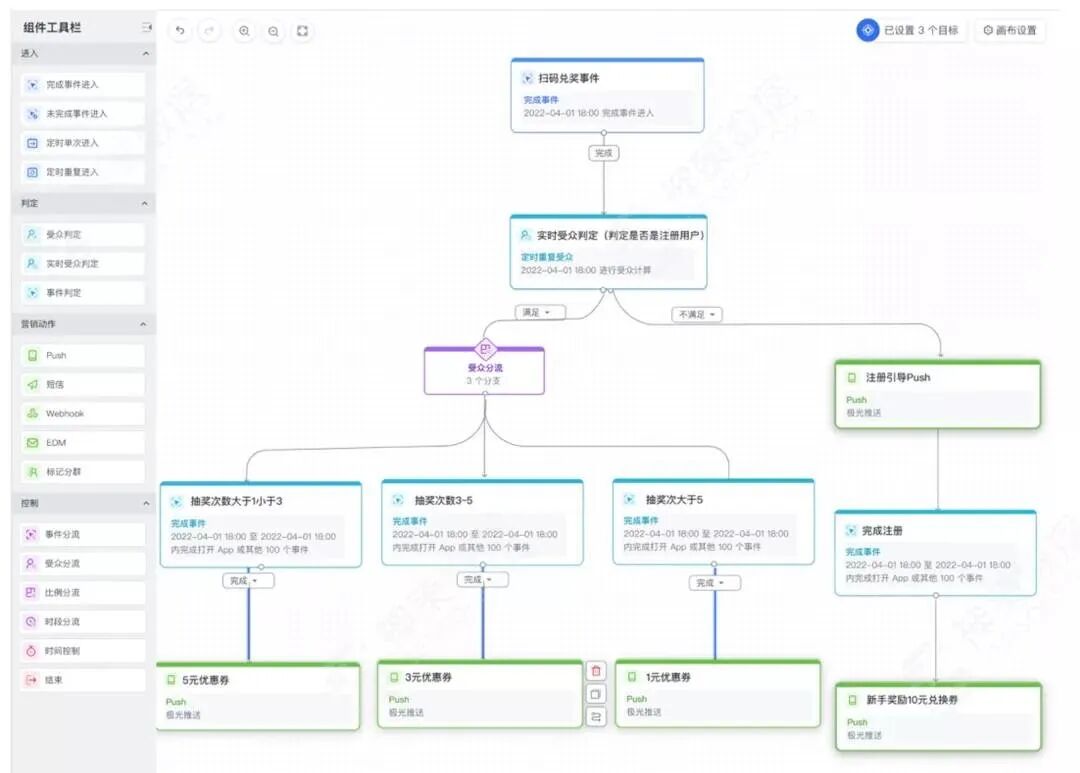
The journey canvas is an advanced way to orchestrate automated outreach activities, a typical capability of Marketing Automation (MA). It helps enterprises create complex workflows while achieving refined operations for different audiences, or proactively reaching out at appropriate times when users visit websites. It can be as granular as automatically reaching out to remind users at specific points in the behavioral journey for different groups at different lifecycle stages, to achieve user cultivation, promote conversion, and other goals.
The journey canvas is a core function of Sensors Data's Marketing Cloud for deploying journey design, and Sensors Data is among the earlier technology institutions in China to implement journey canvas.
According to Sang, currently 30% of Sensors Data clients use Marketing Cloud-related products (100% use Analytics Cloud products), but he couldn't tell us how many journey canvases Sensors Data has built, since canvases are configured for different operational scenarios. A single client may establish over 200 journey canvases. Sensors Data needs to continuously help enterprises explore and uncover hidden marketing scenario needs.
 Source: Sensors Data
Sensors Data's journey canvas
As for how to operate, enterprises can set up canvases according to marketing scenario needs. What they need to do is build marketing workflows using the component modules provided by Sensors Data's journey canvas. For example:
At 0:00 on June 18 (component module: time condition), promptly send a reminder to pay the balance (component module: marketing action) to customers who paid deposits during the pre-sale period (component module: target setting).
When consumers receive the balance payment reminder, this was actually set up a week or even longer in advance. As long as consumers meet the conditions, they will receive the brand's reminder.
Take a certain securities company as another example. The securities company wanted to send SMS outreach to potential clients who hadn't yet opened accounts, recommending wealth management products to guide them to open accounts. For those who completed their first investment within one week of opening an account, or hadn't invested but showed trading interest, or showed no trading interest, different workflow triggers would be activated respectively. For example, for those with trading interest, recommend novice wealth management products to attract them to make their first trade through high yields. If they still haven't purchased after a week, recommend free investment tools, coupons, etc.
Sensors Data's public materials summarize the data closed loop: Sensors Data provides a digital closed-loop solution covering omni-domain user operations, full-link analysis, and all-scenario marketing. Through omni-domain data collection, access, and unification, as well as full-link analysis and audience insight, it helps enterprises achieve digital dual closed loops: on one hand, building a closed loop based on data analytics and multi-channel ad placement through effect attribution; on the other hand, building a closed loop based on data analytics and all-scenario personalized private domain outreach through the SDAF closed loop.
The so-called "closed loop" isn't any complex logic. The point here is simply:
Data shouldn't just be about data workflows. Being an "enterprise solution" is where data should ultimately go.
Conclusion
Sensors Data is similar to many SaaS enterprises, or rather, most technology vendors follow similar development paths — founder with technical background, experienced entrepreneurial difficulties, product adjustments... But Sensors Data wins by being a bit more sincere, a bit more genuine. For example, more standard process formulation. For example, relatively affordable private deployment. For example, more salespeople (who are actually all doing customer service work).
From a user behavior analytics tool to today's digital marketing solution, Sensors Data has continuously disrupted industry and market conventional approaches and perceptions, and continuously adjusted its strategy with its unique market insights. The market's first impression of Sensors Data wasn't wrong — we just may need to look at what Sensors Data conveys through its product and experience. Earning recognition from capital markets and 2,000 enterprises, plus a near 100% renewal rate, can't be based solely on strong product capabilities.
Although Sang repeatedly emphasizes that Sensors Data is a To B software company, what Sensors Data provides clients goes beyond software. Its attitude toward clients and understanding of business operational logic are both key to what makes Sensors Data what it is today.
Returning to that opening statement — "Sensors Data is the hope of China's to B product companies" — it now seems like a relatively understated assessment. Sensors Data's decade of behind-the-scenes work has indeed been quite arduous.
Sensors Data's legendary story remains unfinished. The disruption continues.
MarTechTOP100