What's New in Suno V4, and the Future of AI Music | Bolt Take

After all, who wouldn't want to become the next Spotify?

Since its founding, Suno has stood out in the AI music generation space with a star-powered founding team, models that keep wowing users, viral product distribution, and substantial funding — all reflecting strong user and market interest in AI-powered music. But it had been a while since we'd heard any major developments in the space. Last week, Suno released V4, and music generated with this updated version has been drawing significant attention and discussion in overseas media. We've tested the V4 product ourselves, and here's our take on what's new and where AI music might be headed.
Part.01
Core Updates in V4
Suno's V4 update delivers exactly what it promised: Better Audio, Better Lyrics, Better Song Structures. In short, it lets users generate higher-quality, better-sounding, longer music (up to 4 minutes). Here's how:
1. Remaster: Users can take tracks generated in previous versions and regenerate them, preserving the original lyrics and melody while upgrading the audio quality. This isn't traditional audio upsampling or EQ adjustment — it's the V4 model regenerating the audio from scratch based on the original.
2. A leap in audio quality: Comparing V4 and V3.5 outputs, the improvements are palpable. Vocals are noticeably clearer and more natural, instruments are more distinct, and there's evolution in orchestration, chord progressions, and harmonies, with greater separation between layers. In V3.5, you could still tell the vocals were AI-generated — there was an unstable, mechanical quality, some muddiness in the diction. With V4, it's genuinely hard to tell (at least in English; Chinese still gives it away). So on output quality alone, this release represents genuine, significant progress.
3. ReMi lyrics assistant: An AI-powered lyric writing tool. In Custom mode, users can collaborate with ReMi to generate more creative, musically coherent lyrics. Our experience: you describe what you want to write about, and ReMi handles generating lyrics you'll be happy with.
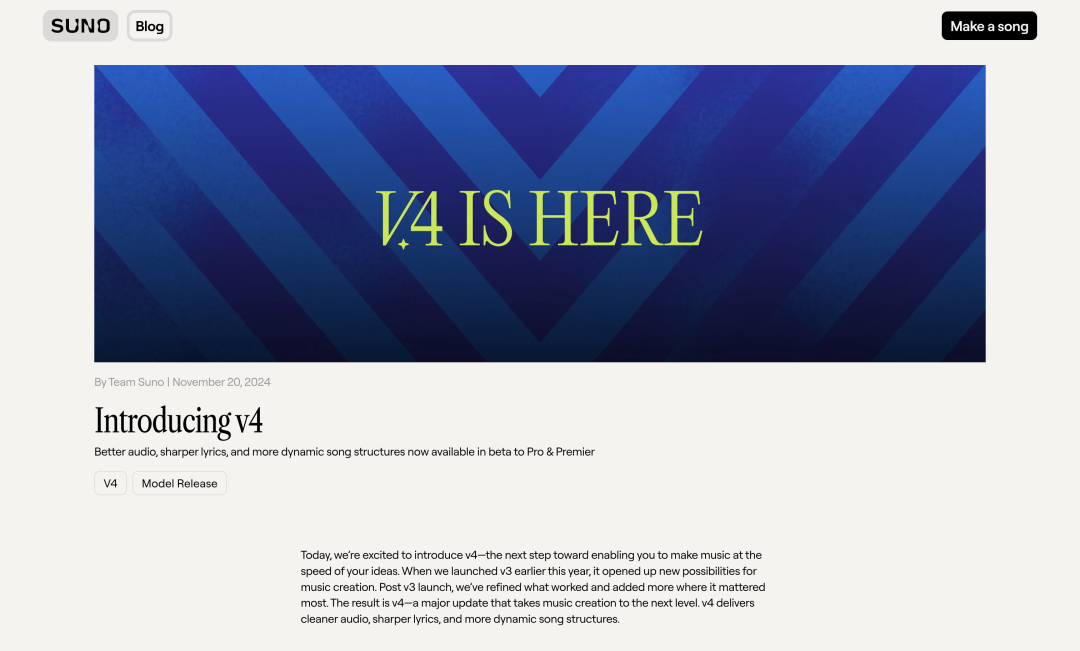
Image | Suno V4 update overview
Part.02
Other Fun Features
Suno has been rolling out and refining playful approaches to music creation. Over the past six months, they've released a number of interesting features, some of which have been strengthened by the V4 update:
1. Cover: Users can upload or record audio and generate a cover version in one click, with support for various musical styles. The viral trend of turning non-musical recordings (like tapping sounds) into songs was powered by this feature.
2. Persona — style reuse: This lets you establish a "persona" for a song, allowing you to reuse core elements like vocals and style across different tracks while maintaining consistency in those elements. In a sense, this makes AI-generated album releases viable.
3. Suno Scenes — multimodal generation: Users upload photos or videos, and the system generates a 30-second music clip based on the content. Setting aside output quality, this feature has accelerated Suno's spread on short-video platforms and social media.
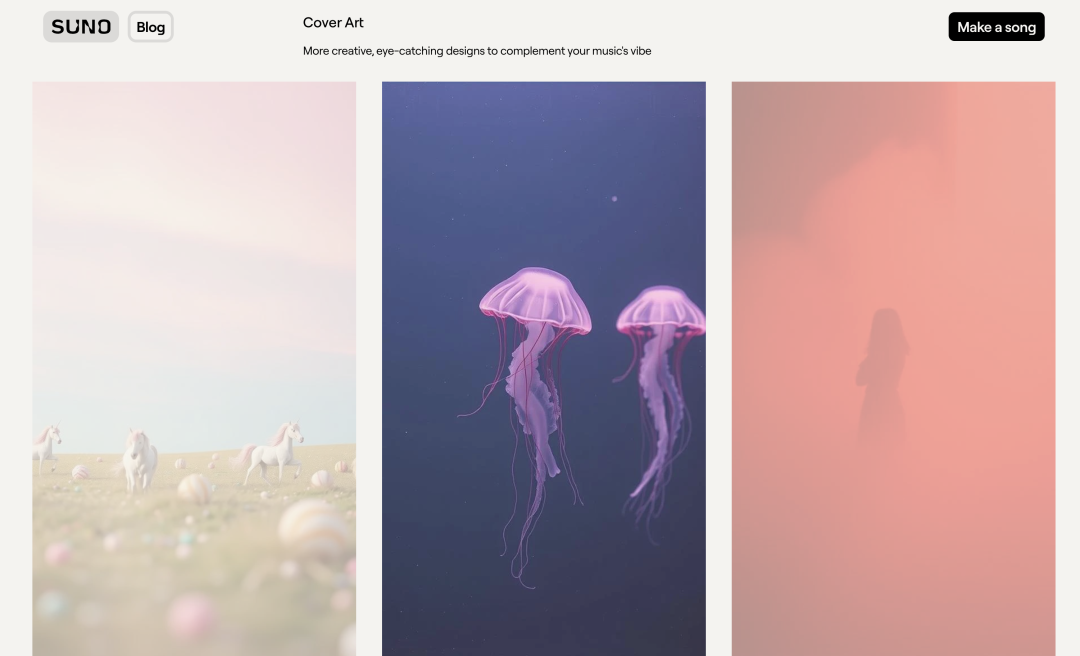
Image | Suno V4 update overview
Part.03
The Future and Possibilities of AI Music
1. Copyright pressure persists in the near term: High-quality music generation models depend on high-quality audio training data. Globally, we're talking roughly tens of millions of tracks, a substantial portion of which are under copyright. Since June this year, both Suno and Udio have been embroiled in lawsuits from the major record labels, with no resolution yet. It's undeniable that copyright concerns have, to some degree, slowed productization and commercialization for entrepreneurs in this space. But we believe that once new technology demonstrates its value as a productive force, it will find ways to keep developing. This bargaining process will also catalyze new regulatory frameworks and mechanisms for distributing value.
2. Deskilling through AI tools: Music creation is highly specialized, and a major barrier is "skill" — everything from making an instrument produce sound to systematic music theory study to professional recording and mixing workflows. Each step filters out potential creators; each area has its dedicated professionals who've spent years honing their craft. The biggest shift AI brings is letting users who previously could only score a zero produce passable work through natural language alone — bridging the skill gap. That's a massive productivity gain. But whether that's enough on its own? Suno's explorations suggest perhaps not. There's still a gap between extreme ease-of-use and precise, high-quality output, and there's an inherent trade-off between them. Deskilling may give rise to new skill demands, likely not pure prompt engineering but rather built on new interaction paradigms or even new musical contexts. This is surely what Suno and other AI music startups care about most.
3. Native AI music creators: A rough estimate suggests AI music generation tools could improve content production efficiency by two orders of magnitude. And as model quality and tooling continue advancing, the quality of music creation will rise too. In this process, we're likely to see (and already are seeing) the emergence of native AI music creators — a population that will certainly be much larger than traditional music professionals. Because these future creators are essentially today's music enthusiasts, people like you and me. How to serve this group — whether through content creation tools, distribution platforms, or perhaps an entirely new content format (Short Video Plus?) to absorb this incremental supply — is a question worth pondering for all players.
4. New forms of intelligent instruments: The global musical instrument market is roughly $40 billion. Most customers sustaining this massive market are enduring the pain of learning an instrument (or have already given up). We buy instruments to play music, to experience the emotional value of creating and performing. What's blocking people is that same "skill" barrier. If new hardware incorporating AI can solve this, it could be a fascinating direction to explore.
Suno V4's release may signal that AI-generated music has entered an entirely new phase. Ordinary users can now create not just songs that sound relatively complete, but genuinely professional-grade musical works. This change doesn't just shrink the distance from idea to finished product — it further blurs the line between professional musicians and casual enthusiasts, giving everyone the chance to express their musical ideas through simple operations. And behind this transformation may lie enormous commercial opportunity. After all, who wouldn't want to become the next Spotify?
📮 Further Reading
Linear Bolt Bolt is Linear Capital's dedicated investment program for early-stage, globally oriented AI applications. It carries forward Linear's investment philosophy, focusing on projects where technology drives transformative change, and aims to help founders find the shortest path to their goals — whether in speed of execution or investment approach, Bolt's commitment is to be lighter, faster, and more flexible. In the first half of 2024, Bolt invested in seven AI application projects including Final Round, Xin Guang, Cathoven, Xbuddy, and Midreal.