Suno Founder Interview: At Least for Music, Scaling Law Isn't a Panacea | Bolt Picks

Challenges and the Future of AI Music
Is the Scaling Law slowing down? Even approaching its limit? Mikey Shulman, co-founder and CEO of AI music creation tool Suno, addressed this in an interview: "Music is fundamentally different from text. You can't simply assume that in AI's development trajectory, audio is just text running a few years behind, and that Scaling Law will solve everything. Music is an extremely subjective domain. Training good music models and building good products requires many other skills beyond just scale."
In this conversation with the podcast 20VC, Mikey Shulman also discussed why he draws parallels between music and gaming, how Suno and the music industry can coexist and develop together, and more. We've compiled and translated selected portions of the interview; you can click the "read more" link to listen to the original podcast.
🔍 Key Takeaways
1. Suno's Evolution: Suno began as an enterprise AI audio tool before pivoting to focus on music creation, with an emphasis on using AI to drive interactive and creative musical experiences.
2. Technical Challenges: Music generation operates on different logic than text generation. Scaling up models isn't the only path to solutions. AI models must remain relatively small and incorporate other techniques to ensure generated music aligns with user tastes.
3. Interactive Experience: Mikey Shulman wants music creation to become as interactive as video games, attracting more users through an engaging creative process rather than treating music merely as background listening.
4. Copyright and Litigation: Suno faces lawsuits over using copyrighted works for training, but Mikey views this as standard industry practice. He emphasizes that the music industry should collaborate to build a broader future rather than fight one another.
5. AI Training on AI: Suno is exploring the possibility of training AI on specific artists' content to help artists and fans create more personalized and interactive music experiences.
6. Future Business Models: New models could enable more direct artist-fan interaction, such as purchasing rights and creating model branches, redefining how artists earn revenue.
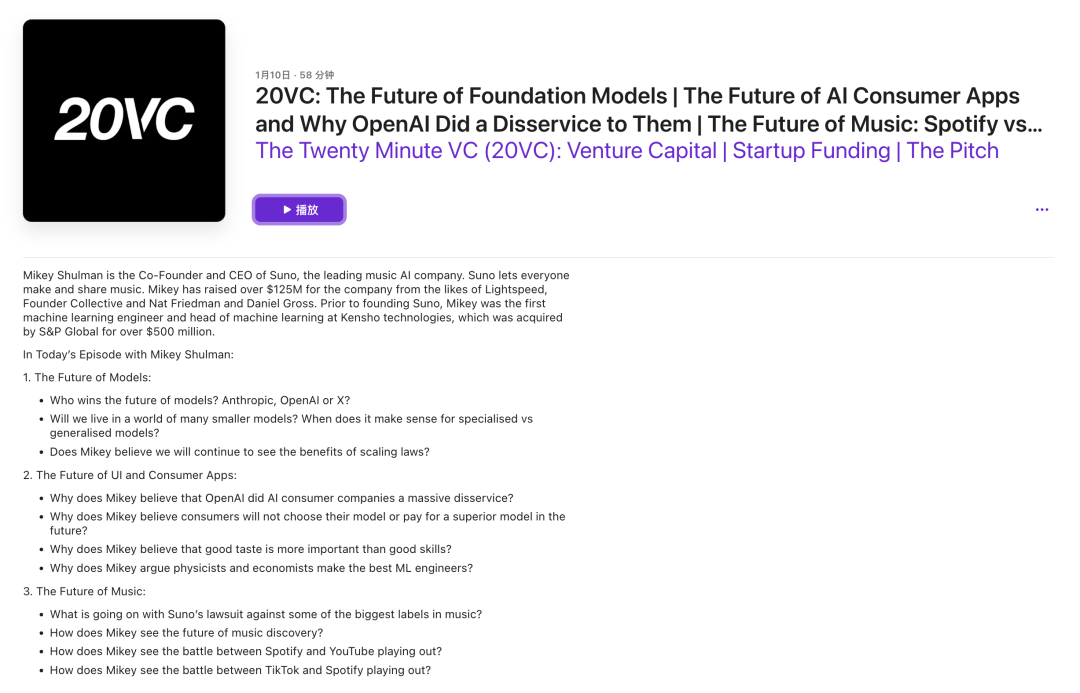 Image | Podcast Shownotes
Part.01
Exploring AI in Music
1) Harry Stebbings: I heard Suno started as an enterprise AI audio tool and has since shifted to a music creation tool. Can you share what drove this transition?
Mikey Shulman: I wouldn't call it a "pivot." Our team actually comes from an NLP background, and we had long recognized that audio technology lagged far behind text. Initially, we believed generating high-quality audio content would be extremely difficult, so we thought our first product would be about understanding and exploring its uses. When GPT-2 first came out, people weren't using it to generate interesting text — they were mostly using it as a tool to understand text. We assumed we'd stay in that phase for several years before mastering and scaling these technologies.
But we found that progress exceeded expectations. The ability to generate content advanced much faster than we anticipated. So we quickly abandoned our original plan and shifted toward more creative and interactive music creation tools.
2) Harry Stebbings: Do you think Scaling Law will continue to hold?
Mikey Shulman: Music operates on completely different logic from text. Many people might simply analogize from what OpenAI and Anthropic have done in text, assuming audio is just a few years behind and that Scaling Law will solve everything. But music is profoundly subjective. Scale isn't the only path to solutions. In audio, models need to stay relatively small and must employ other techniques to ensure generated content has "aesthetic" quality.
3) Harry Stebbings: You've said that in the future, music should be more like video games. That's an interesting analogy — can you elaborate?
Mikey Shulman: Video games are highly interactive and engaging. Single-player is fun; multiplayer is even more fun. From this perspective, I want music to be interactive and engaging like video games, getting people more focused on creating music. This way, we can attract more people to participate in music creation.
If we can achieve this — making music creation both interactive and captivating — people will pay for it like they do for video games. To me, the future of music shouldn't be just auditory enjoyment; it should be an experience with participation and interactivity.
Part.02
Challenges in Music
4) Harry Stebbings: How do you get AI models to align with human taste? After all, taste is highly subjective.
Mikey Shulman: This is indeed a major challenge, but we can continuously adjust through extensive data collection and A/B testing. Right now, the technological path forward isn't entirely clear, but there will likely be more personalized elements in the future. Currently, we use approaches similar to RLHF (Reinforcement Learning from Human Feedback) in ChatGPT, aiming to adjust models based on human feedback to match user preferences. However, whether this path works for music models remains uncertain. We don't fully know whether techniques used to align LLMs with complex human aesthetics can be directly applied to music creation models.
5) Harry Stebbings: Do you think large model companies will move into the application layer? For example, would OpenAI enter customer service or music creation?
Mikey Shulman: They'll try, but music is relatively unlikely; customer service is more probable. I'd love to build a massive company too, but general intelligence and customer service are much larger markets than music. If everything can be automated, the future of customer service could far exceed what companies like Zendesk and BPO (Business Process Outsourcing) service providers currently offer. As for music, the future will definitely become clearer; OpenAI's team just may not realize it yet. This isn't just about aesthetics — it's product competition. Ultimately, what gets people to choose products like Suno? It's that it's a better product, not just because it has a bigger, stronger model behind it. We focus on giving users a delightful music creation experience, simple and direct. So chat interfaces aren't the only way to achieve this goal.
6) Harry Stebbings: In June 2024, the RIAA sued you for using copyrighted works to train your models. What's your take on this lawsuit?
Mikey Shulman: We knew there were some copyrighted works in our training data. But this isn't illegal — it's standard industry practice. Nearly every AI company does this. In a sense, this lawsuit isn't surprising. Most AI companies encounter training data copyright issues; the music industry itself has plenty of litigation. Honestly, it's a bit frustrating because I believe music's future should be broader and brighter. We can grow alongside the existing industry rather than fighting it, which risks making the entire industry smaller.
Speaking of lawyers, I have a bit of a gripe: I once read an economics paper from the 1980s exploring why some countries develop while others stagnate. One conclusion was that a country's ratio of engineers to lawyers directly affects economic growth. More engineers, faster growth; more lawyers, slower growth. While exaggerated, this reminds us that if we could collaborate with some of the litigants before lawsuits, working together to build a bigger, better musical future, everyone would be happier. The music industry currently has a "the pie is only so big, let's divide it" mentality, with everyone fighting over limited wealth, leading to unfair distribution. If we could grow the pie together, everything would become much easier.
7) Harry Stebbings: How do you think litigation conflicts between emerging AI companies and traditional enterprises will be resolved? Through settlements funded by VC money, or through equity allocations giving big companies a stake?
Mikey Shulman: The traditional Silicon Valley mentality is "I'm going to disrupt your existing industry, and there's nothing you can do about it." Big companies typically respond with "I'm going to sue you until you disappear." Obviously, neither approach is right. At Suno, every one of us deeply loves music and has tremendous respect for this industry. This culture is fantastic and keeps us from having that "must disrupt the existing industry" mentality. We prefer to work hand-in-hand with existing industry players, focusing together on building a bigger, brighter future.
Part.03
The Future of Collaborative Music
8) Harry Stebbings: In your ideal world, what should the future of music look like?
Mikey Shulman: I want music to involve more people and create more diverse musical experiences. This means we're not satisfied with making current music creation 10% faster or easier. To change how a billion people listen to music globally, you have to create unique experiences for a billion people.
This first requires making music creation enjoyable for everyone — which is completely different from the status quo. Today, creating music isn't easy. It takes enormous time and practice; you have to be very good at some instrument or production software. I think most people don't actually enjoy most of the time they spend on music creation.
9) Harry Stebbings: Regarding training on copyrighted music — you now have a massive music library. When can you start using Suno's own music for training? When can AI train on AI?
Mikey Shulman: This is an extremely complex question. The key is how to use this data without biasing the model. Large companies face similar challenges and are actively seeking solutions. Like many problems, having these big companies solve complex technical difficulties lets us focus on our competitive advantages — which is actually good for us. So I hope this problem gets solved by others, not by us.
10) Harry Stebbings: Why can't AI music and traditional music exist as separate worlds? Why doesn't Spotify just merge directly with Suno, offering both experiences in one app?
Mikey Shulman: From a user experience perspective, it's very inconvenient if users need to go to two different places to find content. If you can't find certain music on Spotify and have to go to another app, that's not a good experience. If music splits into two separate worlds, ordinary consumers may get confused. Moreover, I don't want music to be purely a consumption experience — creating and sharing music should itself be an enjoyable experience. Creation and listening shouldn't be separated. Combining these elements makes them far more valuable than the sum of their parts.
11) Harry Stebbings: Is there a way to create personalized models for different creators? For example, if Ariana Grande wanted to collaborate with you, giving you exclusive access to her content, you could train a model on her material and quickly create all future Ariana Grande songs.
Mikey Shulman: The answer is yes, and I'd absolutely love to do this. In reality, given her contract terms, she probably couldn't do this — it's somewhat complicated. She doesn't own the copyrights to all her music, but she does own her name and likeness. I want to enter a world where she can own a model that creates her music. Our design philosophy at Suno is: if you're creating music with her name, we'll remind you — this isn't original music; this isn't how future music works, this is imitating someone. Suno focuses on original music, not imitation.
But if Ariana Grande herself uses this tool, that isn't imitation — it's creating her own musical style. This is an incredibly powerful tool that can help her create music, help her songwriters better understand her style, and even let her give this tool to her fans if she wants, so they can create something based on it. This would be an extremely compelling interaction, more valuable than doing an AMA (Ask Me Anything) with fans, and more engaging for fan participation.
12) Harry Stebbings: So if I ask Suno to create songs in a specific artist's style, would that artist get a cut?
Mikey Shulman: Something people may not realize: our current product is about users enjoying the process of creating music and being willing to pay for that. This is different from traditionally listening to music. I think music's future lies in rethinking business models. The current streaming royalty model has limitations — everyone is fighting over that limited pie, and artists don't actually earn much. I want to find new business models that more closely tie to users' enjoyment experiences and directly link to artists' income, especially when people genuinely want to interact with artists.
13) Harry Stebbings: What would these new business models look like?
Mikey Shulman: For example, suppose you discover a creator you really love. You could directly purchase their rights on the platform, even own a branch of their music model. If they agree and you're willing to pay, you could create music in their style. We once held a remix contest with legendary producer Timbaland and received massive numbers of entries. For me, being able to rearrange my musical idol's work is the ultimate way to interact with them. It's cooler than meeting them backstage at a concert. And the existing streaming royalty model doesn't properly capture the value of this kind of interaction.
📮 Further Reading
Linear Bolt Bolt is an investment initiative established by Linear Capital specifically for early-stage, global-market-facing AI applications. It upholds Linear's investment philosophy, focusing on projects driven by technological transformation, with a mission to help founders find the shortest path to their goals. Whether in operational speed or investment approach, Bolt's commitment is lighter, faster, and more flexible. In 2024, Bolt has already invested in 11 AI application projects including Final Round, Xin Guang, Cathoven, Xbuddy, and Midreal.