UiPath Founder Interview: Agents vs. RPA | Bolt Recs

"Building an agent isn't hard. The hard part is making it run reliably thousands of times over, and function properly as part of an enterprise workflow."

Ask anyone to predict where AI is headed in 2025, and "agents" will come up fast. Plenty of people are also curious about how agents relate to RPA (robotic process automation). Daniel Dines, founder and CEO of UiPath, recently weighed in on the 20VC podcast. UiPath was founded in 2005 with no outside funding and just $500,000 in annual revenue. After finding product-market fit, it raised capital from Sequoia Capital, Accel, and Kleiner Perkins, went public in April 2021, and now commands a market cap north of $7 billion — making it a household name in RPA.
In the interview, Dines stressed that building AI products is about utility, not chasing technical breakthroughs for their own sake. He explained how UiPath is merging RPA with AI agents to streamline both low-skill and high-skill automation, and argued that reliable workflows plus human oversight will be the keys to enterprise AI adoption. We've selected and translated excerpts from the conversation. You can listen to the full episode via the "read more" link at the bottom.
🔍 Key Takeaways
1. Product-first strategy: The key to AI success is building genuinely useful products, not merely advancing the underlying technology.
2. From RPA to agents: UiPath is transitioning from traditional RPA toward agentic automation through agent orchestration and modern tech frameworks.
3. Agent technology in practice: Agents can automate both rules-based and non-rules-based processes, deeply integrated with enterprise workflows.
4. Generative AI's enterprise value: Generative AI will break through in rules validation and enterprise applications, laying groundwork for future automation.
5. Multi-technology convergence: AI's future depends on combining multiple models and technologies to serve diverse enterprise and individual needs.
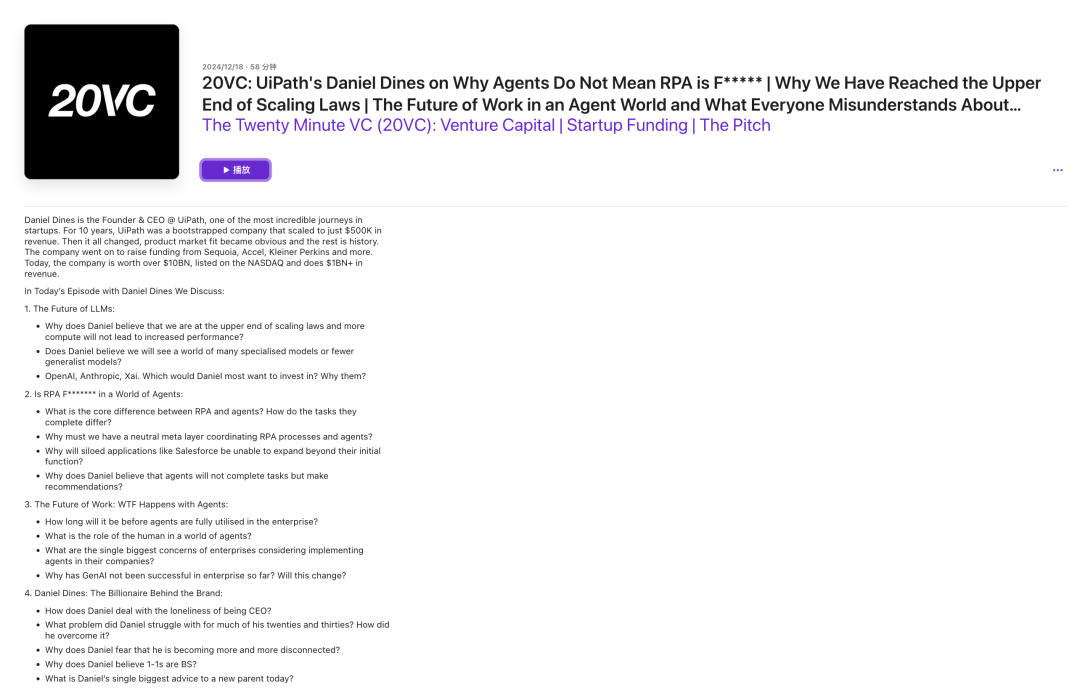
Image: Podcast shownotes
Part.01
The Evolution of AI Systems
1) Harry Stebbings: Can you explain why "product matters more than innovation" in this current AI cycle?
Daniel Dines: Lately I've been thinking about where we fit in the AI narrative and what real value we can deliver. For the past two years, we spent enormous time optimizing LLMs and building products around them, which brought some success.
Certain standout products have deeply influenced me — Cursor AI, for instance. It's built on multiple LLMs. That reminded me of UiPath's early days, when we also used AI for development. We leveraged an open-source computer vision library called OpenCV, which could identify and locate small images within larger ones. We used it for automation: when a user needed to click a button, we'd capture that button's image, then at runtime call a function to locate its coordinates and execute the click.
Looking back, UiPath created an intuitive experience: just record your on-screen actions and generate corresponding instructions. When users clicked buttons, all relevant data got captured and stored. If someone typed into an edit box, we'd record the box's image and label so we could pinpoint it precisely at runtime.
From the user's perspective, the process was dead simple. In 2013, I demoed this to several Blue Prism experts. By comparison, achieving the same thing on Blue Prism took two days with mediocre results. With our product, the entire flow took three to five minutes and ran perfectly. When I asked for their thoughts, there was dead silence — they couldn't believe it. That became our market entry point; many customers chose us because of it. From there we gradually expanded our product capabilities until we reached our current scale.
2) Harry Stebbings: Do you see a future with multiple specialized large models for different domains, or will it consolidate like cloud computing today, dominated by one or two giants like AWS, Azure, and Google Cloud?
Daniel Dines: I don't think large models will consolidate under a few giants the way cloud computing did. I'm more inclined to believe multiple large models will coexist. Even looking at the human brain, you see a similar pattern. We have general cognitive models, but for specific tasks, specialized models clearly outperform general ones. Take something as simple as picking up a cup to drink — that's a specialized model we've trained since childhood, far more efficient than relying on a general-purpose model.
There will indeed be frontier models leading the way, but there will also be numerous specialized models for specific tasks. These specialized models are more likely to be built on open-source foundations rather than closed frontier models.
3) Harry Stebbings: You mentioned Cursor succeeded through a product-first strategy rather than pure technological advancement. How has this philosophy shaped UiPath's future direction?
Daniel Dines: The impact has been profound. We've made major internal adjustments, fundamentally rethinking how we build software. Incremental improvements and simply adding AI on top isn't enough. Cursor is completely AI-first, built from scratch. We need to learn from that approach. So our current AI product strategy for agents is starting from zero.
To do this, we've abandoned certain traditional RPA technologies and shifted to entirely new frameworks, rebuilding from the ground up. Because we want to create a completely AI-centric, fresh experience for users.
4) Harry Stebbings: Specifically, what RPA technologies have you moved away from?
Daniel Dines: For example, we used to rely on something akin to the Windows Workflow engine, which we optimized over many years. Now we've switched to more modern technology and are building on that foundation.
Honestly, I resisted this change for a long time. UiPath's engineers debated countless times whether to introduce a new workflow engine. Ultimately, AI convinced me to make the leap — adopting a new workflow engine purpose-built for "agent orchestration" (coordinating and managing different types of agents to automate complex enterprise processes and tasks). This kind of engine excels at efficiently connecting agents, human users, other robots, specialized models, and APIs or other entry points.
Part.02
Integrating Agents with Enterprise Workflows
5) Harry Stebbings: Many people are skeptical about how RPA can be compatible with future agent orchestration and enterprise agent usage. Why do you think that skepticism is misplaced?
Daniel Dines: It's because few people truly understand RPA's core use cases and why agents can't simply replace them.
RPA's core value is automating complex, rules-based tasks across multiple enterprise systems. These tasks often involve numerous steps — sometimes 100 to 200. The crucial point is that every step follows explicit rules, with structured input data. These rules actually encode institutional knowledge — special handling for certain VAT numbers, for instance. This rules-based automation is highly reliable; as long as the underlying systems don't change, it runs stably.
Agent technology is different. In automation scenarios, LLMs are better suited for tasks involving unstructured data. For enterprise knowledge that can't be fully expressed as rules, agents can simulate user actions and reduce manual input, but they can't fully replace rules-based automation. Because agents are fundamentally about autonomous task completion, while rules-based automation depends on clear logical rules — they're complementary, not substitutive.
6) Harry Stebbings: If we simply distinguish between rules-based and non-rules-based, does that mean customers need to buy solutions from different vendors? Why not just focus on the non-rules-based part? Or why can't non-rules-based solutions cover rules-based scenarios?
Daniel Dines: That's precisely why we've entered the AI agent space. These two parts typically coexist within the same business process. In lengthy processes like order-to-cash or procure-to-pay, there are both clearly defined rules-based segments and uncertain segments. So integrating both into a unified technical framework makes complete sense.
That's also why agent orchestration is so critical. We have the capability to connect all parts of a process while automating these steps. To use an analogy — but they can all collaborate on the same platform. Just as enterprises don't create completely independent working methods for different employees, technology should also pursue unity and integration.
7) Harry Stebbings: Do you want UiPath to become a platform that manages both low-skill and high-skill tasks?
Daniel Dines: We're already a platform for managing low-skill tasks, and we're now expanding into high-skill task management. But merely having the ability to automate a single task isn't enough. You need to automate thousands of tasks simultaneously, with capabilities for management, delivery, deployment, monitoring, data analytics, and access control — who can run agents or access specific applications, for example. We've already built these capabilities into the UiPath platform, and one of our core differentiators is the efficient coordination of robot operations.
8) Harry Stebbings: But can you really pull this off? After all, your previous design was rules-based, and now you're entering a non-rules-based, fuzzy domain.
Daniel Dines: It's not an entirely different domain. What RPA and agents have in common is that both mimic human operations. Non-rules-based processes are more challenging because they're more fragile — you must build in extensive exception handling and retry capabilities. For instance, website loading times can fluctuate, so you need sufficient technical reliability to handle these variations.
We've accumulated rich experience in robotic automation, and we're now applying that to agents. Building an agent isn't hard; the hard part is making it run reliably thousands of times and function properly as part of an enterprise workflow. Otherwise, enterprises won't use it for autonomous tasks in production.
Our customers consistently tell us they'd rather have a workflow task fail than become too "intelligent," because their risk tolerance for task failure is extremely low. This mindset also determines how agents are deployed: agents primarily provide recommendations rather than take direct action. Typically the flow is: the agent makes a suggestion, a human user validates it, then triggers the next action. It's a gradual, step-by-step model.
Part.03
The State and Future of Generative AI
9) Harry Stebbings: Why has generative AI failed in enterprises in recent years, and why will it succeed in the coming years?
Daniel Dines: Generative AI failed in the past because its output was unpredictable. It will succeed in the future because we're embedding it within agent workflows, constraining its unpredictability through rules, and introducing "human-in-the-loop" validation to ensure reliability. This is fundamentally different from traditional chatbots.
In the new model, enterprise workflows drive the entire process. For example, a customer emails a mortgage application, which triggers a workflow that calls an agent to process it. The agent generates a recommendation and pushes it to my inbox; I can validate it and choose "approve" or "reject," triggering the next step — perhaps calling a robot to complete loan approval in the banking system.
This model is essentially enterprise-workflow-driven, fundamentally distinct from traditional chatbots, which lack the guidance of rules and validation steps.
10) Harry Stebbings: With the proliferation of agent-building tools and various technologies, does this mean UiPath can enter new markets? You currently serve enterprise customers — could you expand to the small business market in the future?
Daniel Dines: I'm not sure about that. The key point is that building agents requires highly specialized skills. While technically feasible, making agents truly effective demands experienced professionals. Currently, writing prompts is even harder than writing scripts. Script behavior is predictable — you just implement requirements based on logic and algorithms — whereas tiny variations in prompts can produce completely different results.
We're investing substantial resources and effort to help automation developers write better prompts, such as providing prompt suggestions and assisting with evaluation set construction. Testing whether a script works as expected is relatively straightforward; testing prompts is far more complex because differences in input data can lead to massive output deviations.
11) Harry Stebbings: Sam Altman predicts we'll witness AGI in 2025. Though that's not guaranteed — what do you think?
Daniel Dines: My definition of AGI differs from theirs. For enterprises, the AGI standard is having an LLM with capabilities equivalent to a human with roughly 120 IQ, but with high predictability — not showing 180 IQ on complex math tasks while dropping to 60 on others. This consistency is the key to AGI.
If this is achieved, the entire employment market and industry will undergo profound transformation. But to reach that point, I believe major new technical breakthroughs are needed. Current LLMs haven't demonstrated the reasoning capabilities I expect. At their core, they're still stochastic engines (algorithms or systems that process random variables or probability problems).
Why do I say this? On certain tasks, I'm far inferior to LLMs, but in other respects, I'm clearly superior. LLMs make logical errors I'd never make, yet can solve math problems completely beyond me. This indicates their intelligence is fundamentally different from human intelligence — a type of intelligence not yet suited for business environments where reliability is paramount.
📮 Further Reading



Linear Bolt
Bolt is Linear Capital's dedicated investment program for early-stage, global-market-facing AI applications. It upholds Linear's investment philosophy, focusing on projects where technology-driven transformation is taking place, with the goal of helping founders find the shortest path to their objectives. Whether in speed of action or investment approach, Bolt's commitment is lighter, faster, and more flexible. In the first half of 2024, Bolt invested in seven AI application projects including Final Round, Xinguang, Cathoven, Xbuddy, and Midreal.