From Big Tech to VC: Nine Deals in Year One, with First Investment in Aikenong丨Core Investors
Self-taught calculus in middle school, holds a bachelor's degree in engineering from Tongji University and a master's degree in science from Columbia University, champion of the IBM Intelligent Business Analytics Competition, and previously worked at Tencent Cloud and Smart Industries Group.

By Zeren Huang
Edited by Suyun Shi
He taught himself calculus in middle school, earned an engineering bachelor's from Tongji University and a master's in science from Columbia University, won the IBM Watson Build Challenge, and joined Tencent's Cloud & Smart Industries Group (CSIG).
For the first 26 years of his life, Baizeren had accomplished all this through sheer intellect and hard work. Yet something still felt missing. In middle school, he had discovered Hunan Science & Technology Press's First Principles series — dozens of books spanning computer science, mathematics, physics, astronomy, and more. They ignited a lasting passion for technology.
As China's internet boom took hold, with apps like WeChat, Alipay, and DiDi transforming daily life, "technology changes life" evolved from slogan to lived reality. This transformation left Baizeren both exhilarated and restless.
He marveled at technology's immense power, yet kept asking himself: "What does it mean to truly dive into the tech wave and help drive that change? How do I go from being a user of technological transformation to an actual participant?"
In 2019, he left Tencent, departed familiar Shenzhen, and joined Linear Capital as a tech investor — his answer to himself.
Four years into Linear, Baizeren rebuilt his career from scratch. He led investments in notable projects including Boxiaoxiao, Aicron, Woshi Technology, Lingdata Intelligence, and White Rhino. He rose from analyst to vice president of investments, at his peak deploying capital into nine projects in a single year.
Baizeren believes that unlike big tech companies, where business needs drive decisions, investors can take a more panoramic view, return to technology's origins, think through innovative applications from first principles, and help companies translate tech into real-world impact. "This is closer to my original intention of embracing the tech wave."
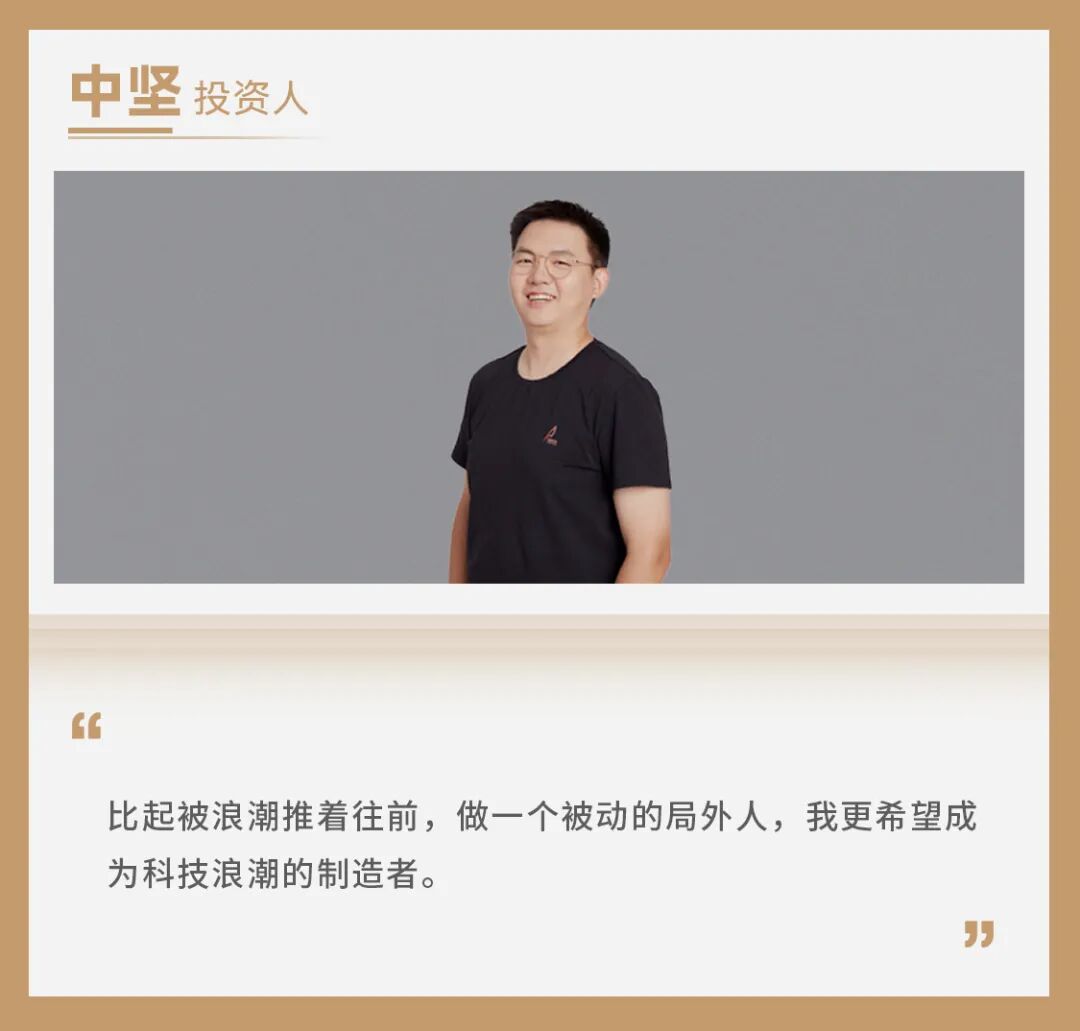
"Rather than being pushed forward by the tide as a passive outsider, I want to be someone who helps create the wave."

Leaving Big Tech, Standing at the Crest
Xiaofanzhuo: What was your role at Tencent CSIG (Cloud & Smart Industries Group)?
Baizeren: I joined Tencent in 2017. Back then it wasn't even called CSIG — it was SNG (Social Network Group). The major 2018 reorganization shifted Tencent's strategic direction from consumer internet to industrial internet, which gave me excellent opportunities to grow. I worked across numerous verticals, providing algorithms.
For e-commerce scenarios, I was originally responsible for data science and algorithm-related work. This was the early stage of AI-industry integration, where algorithm-focused engineers and researchers had to take on more front-end and back-end business responsibilities. The demands on one's comprehensive capabilities were high, and I grew quickly.
Xiaofanzhuo: Constantly encountering new application directions — is that good or bad for a technologist?
Baizeren: Fundamentally it's good, though it raises the question of active versus passive — whether you're exploring actively or responding passively to a large company's business needs.
I've been curious about frontier technology since childhood. In middle school, I read Hunan Science & Technology Press's First Principles series — dozens of books covering computer science, mathematics, physics, astronomy, and more. In college, I watched apps like WeChat, Alipay, and DiDi genuinely transform our lives. From the perspective of agency, being part of that was incredibly exciting.
But on the other hand, in a big company you inevitably serve corporate business needs, and the scope of work is quite broad. So I was always trying to find the balance between depth and breadth.
Xiaofanzhuo: Doing investing at a firm with Linear's strong technical DNA seems like it would satisfy what you're looking for.
Baizeren: Before joining Linear, I actually knew very little about VC or finance in general.
A headhunter friend reached out asking if I was interested in VC. At first I even misheard it as CV (computer vision). But after deeper conversation, I realized that being a tech industry VC investor doesn't mean leaving technology behind — if anything, it let me "enter the tech wave and participate in the tech revolution."
On one hand, my perspective shifted. Instead of heads-down writing code and algorithms based on business requirements, I could return to technology's source and think through innovative applications from the bottom up. On the other hand, my technical DNA didn't disappear — I still encounter cutting-edge technology every day, so to this day I read large volumes of papers to help evaluate projects.
After researching the VC landscape, I learned that Linear was very technology-driven, so I proactively sent them an email and quickly heard back.
Xiaofanzhuo: How does being a VC investor differ from being a big tech programmer?
Baizeren: The key difference is that investors can actively choose which technology directions to explore, whom to talk to, whom to meet. For the right people, I can provide concrete help through investment or resource connections. I see this as a more proactive approach, and one that better fits my personality.
Of course, I had to give up things that conventionally matter to people — leaving familiar Shenzhen for Shanghai, starting my career from zero in VC.
Xiaofanzhuo: Was Linear your first match right away?
Baizeren: It sounds a bit mystical, but Linear was indeed the first firm I interviewed with. I think fundamentally it was a matter of "compatible temperaments."
Linear's founder Harry Wang was the second Chinese engineer at Facebook headquarters — his technical DNA speaks for itself. He established Linear's focus on technology research and technology investment early on, which aligned perfectly with my intention to embrace the tech wave.
Linear's style is also very pragmatic. I still remember my first interview. Carrying stereotypes about finance, I wore a formal suit. It was a sweltering Shenzhen summer, and during the interview I noticed Harry and other Linear colleagues were all in shorts and t-shirts — I was the one who stood out.
This was quite a shock. Venture capital isn't as distant and unattainable as legend suggests. The practitioners are living, breathing ordinary people with a similar faith in technology, doing work they all believe in.

Nine Deals in One Year: Being the "Victorious Buddha"
Xiaofanzhuo: From the outside, Linear can seem a bit "Buddhist" — few events, little PR.
Baizeren: I'd say we're more like the Victorious Fighting Buddha. Outsiders may see us rarely at events or in interviews and think we're "Buddhist," but that doesn't mean we're passive about work. When tech investment was moving fast in recent years, our pace was intense. Even last year under difficult conditions, Linear still invested in 18 new projects. So we say we're actually quite "juan" [intensely competitive] about investing.
Of course, our "juan" is effective juan. When our managing director Songyan Huang was promoted to partner last month, Harry evaluated him as someone who, regardless of position, charges to the front lines, leads by example in high-quality, results-driven juan, and inspires the team to juan together. Actually, everyone on the team is like this.
Xiaofanzhuo: As an investing novice, how did you keep pace with such a "juan" leader early in your career?
Baizeren: Songyan was the first leader I worked with at Linear, and his style influenced me greatly. I always joke that "I only became this juan because I followed Songyan." Linear originally stipulated that new hires generally needed six months before independently handling projects, but after just three months working with Songyan, he had me leading projects myself.
Coming from a technical background, I wasn't yet familiar with investment negotiations, but I completed the identity transition quickly. It was actually a natural process, since being able to stand on your own is the most basic requirement for a qualified investor. Of course, before pulling the trigger I'd still feel nervous. Though the boss said he was willing to "pay tuition" for young investors early on, a bad investment would still significantly impact one's future career trajectory.
On the other hand, "juan" is generally seen as negative, but our joking use of it really means self-driven, taking responsibility for work and outcomes.
Xiaofanzhuo: But mistakes are hard to completely avoid for primary market investors.
Baizeren: That's true, but I haven't had any companies go bankrupt so far. Beyond the technology itself, our firm's project screening most emphasizes judgment of people.
My technical background actually left me lacking experience dealing with people. The most obvious example: at Tencent I barely traveled for work; at Linear I was practically on the road every week meeting people.
Judgment of people comes from this massive accumulation of experience. Only by meeting all kinds of people can you know who's reliable, who has chemistry with Linear, who's worth investing in, and who's worth long-term partnership after investment. It's like building algorithms — only by collecting sufficient data can you improve the model.
Once I established my own people-judgment model, investing became more efficient. At my peak, I invested in nine projects in one year.
Xiaofanzhuo: Linear is known for its rigorous style, but nine projects in a year — how do you ensure accuracy?
Baizeren: Linear has strict project evaluation criteria, which we internally abbreviate as "the 4 Rs" — right problem, right people, right time, right return. Only when all these criteria are met can a project advance to investment committee review.
So my nine projects in a year absolutely weren't about rushing to hit quotas or lowering quality. At that point in time, all nine projects met the "4 Rs" and deserved investment. The fact that these companies have all performed well post-investment proves this out.
Xiaofanzhuo: Early-stage projects are fiercely competitive. How did you access so many quality deals, and how did you win them?
Baizeren: Accessing quality projects isn't difficult — Linear's brand carries some weight in tech entrepreneur circles. I believe what VCs ultimately compete on isn't deal access, but judgment and the ability to actually win good deals.
Take Linear portfolio company Lingdata Intelligence as an example. They use digital and intelligent methods to make manufacturing production management more refined and higher-quality. Founder Wenwei Guo was a former executive at Honeywell, a Fortune 500 industrial company. At the angel round, everyone was fighting to get in. Linear wasn't the highest bidder on valuation, yet we still successfully invested.
Xiaofanzhuo: What was Linear's key to winning over entrepreneurs like Lingdata Intelligence?
Baizeren: I believe the key is "expertise plus ecosystem."
First, because our investment team all has technical backgrounds, we can discuss technical directions and details deeply with tech entrepreneurs. The most common feedback we hear from founders is, "You guys really understand technology."
Beyond understanding technology, we also spend significant time understanding how technology genuinely creates value in real-world scenarios. For companies like Lingdata that apply technology to industry, their customers are highly vertical sectors like manufacturing — factories.
Similarly, for many projects we visit numerous factories for on-the-ground research to understand industry needs, from chemical plants and auto parts factories to paper mills, fertilizer plants, even grain drying facilities. Back then I'd get excited seeing factory chimneys smoking in the distance. This extensive research makes our term sheets highly professional, giving founders strong confidence because they can feel that we truly understand and believe in what they're building.
Second, Linear has an ecosystem concept where many portfolio companies can become partners. For example, we actively engage with Fortune 500 companies like Honeywell and Starbucks to facilitate partnerships for our portfolio companies. For founders from pure technical backgrounds, finding suitable commercial application scenarios isn't easy. Linear can recommend appropriate portfolio companies for collaboration or as customers through early conversations.

Targeting Computation-Driven Next-Generation Applications
Xiaofanzhuo: Linear invests in technology — but what technology, fundamentally?
Baizeren: The broad logic is that if technology can create leverage in an industry, driving tenfold or even hundredfold efficiency gains, there must be enormous commercial opportunity. Linear will consistently invest in and support companies that deliver such efficiency improvements.
Additionally, our term sheets include requirements for portfolio companies' social responsibility as they grow. This "technology for good" value resonates with many portfolio companies because, at their core, they're also people with technological ideals.
Xiaofanzhuo: How do you accurately assess whether an early-stage project's technology can truly deliver massive efficiency gains for an industry?
Baizeren: Take my first lead investment, Aicron, as an example. They primarily use AI combined with mechanistic crop growth models to provide scientific planting recommendations for actual production. Before investing in Aicron, I knew essentially nothing about agriculture.
But I saw that Aicron's "smart planting decision" tools delivered a leap in planting efficiency. Traditionally, farmers managing land through smallholder economics could handle a few dozen mu at most. Through Aicron's digital planting technology, farmers can understand every detail — weather, seeds, pests and disease, water and fertilizer — and one person can manage thousands of mu. This clearly creates substantial commercial value.
On the other hand, Aicron founder and CEO Jianming Guo holds a PhD from China Agricultural University, previously served as VP at China National Seed and Monsanto China, and has focused on smart agriculture for over 20 years — among the most senior people in China applying frontier technology to agriculture. We believed in Dr. Guo's 20-plus years of frontline industry experience. Of course, Aicron was also Linear's longest pre-investment evaluation in our history. Starting in January 2020, we spent the better part of a year on thorough due diligence before deciding to become long-term partners with Aicron.
Xiaofanzhuo: Agricultural tech wasn't hot in early 2020. As an early entrant, what work did Linear primarily do?
Baizeren: We mainly spent extensive time deeply understanding application scenarios and needs.
We traveled to farmland in Hebei and Xinjiang, talking directly with farmers, agricultural input distributors, and agricultural input groups. We examined what value Aicron's digital planting technology empowerment could actually deliver for them. Additionally, we had extensive technical discussions with Aicron's CTO about how mechanistic models in this field could effectively combine with AI — so industry, users, and technology were all covered.
Early-stage investment involves an important process: you need to talk with people from many different circles to develop a global perspective.
Xiaofanzhuo: Four years into Linear, what's your personal investment thesis?
Baizeren: I define what I invest in as computation-driven next-generation applications. Aicron is computational biology, Woshi Technology is computational chemistry, Boxiaoxiao is computational graphics, and the AGI (artificial general intelligence) space I'm currently focused on is large model computation.
Xiaofanzhuo: Your current focus on AGI investing is something of a return to your roots.
Baizeren: Yes, my original work at Tencent involved combining computer vision, natural language processing, big data, and machine learning with industry applications. Looking at AGI now is a natural progression.
Xiaofanzhuo: With your dual DNA as algorithm programmer and tech investor, what do you see differently in this AGI wave?
Baizeren: From a technology development perspective, the stunning effects demonstrated by AIGC today weren't achieved overnight — they resulted from considerable evolution. Since the emergence of deep learning, image generation progressed through major model innovations including CNN, VAE, GNN, and CLIP to reach today's Diffusion models. Text generation similarly developed step by step through RNN, LSTM, and Transformer to GPT models. These two fields didn't develop separately but evolved together through mutual learning, which is why we're seeing major breakthroughs in both simultaneously today.
There remain opportunities for node innovation in AI today. On one hand, there are cross-task multimodal innovation opportunities within AI itself, moving toward AGI. On the other hand, there are cross-disciplinary innovation opportunities combining AI with other fields, similar to previous "AI plus industry" but today becoming "AI times industry" opportunities. Linear has consistently focused on both types of innovation in the AI space.
From the application perspective, I believe we'll see a more flourishing, diverse landscape. The underlying logic is that today's AI-driven massive experience upgrade means that at least at the HMI level, all applications are worth rebuilding. This creates enormous value reshaping opportunities, evolving from "AI plus industry" to "AI times industry." Application innovation under such massive historical opportunity demands extremely high talent density — teams must keep pace with rapidly evolving external technology while having deep cognition and understanding of the scenario problems they're solving. So I believe this is a great era for product-oriented technical talent.