From High-Quality Growth vs. Hypergrowth: Thoughts on Marketing, Fundraising, and Hiring | Bolt Recs
"Growth comes from people discovering that our product is better than everything else on the market."

On the latest episode of 20VC, host Harry Stebbings interviews Karri Saarinen, co-founder and CEO of Linear, the project management tool. Linear has raised funding from venture firms including Sequoia Capital and Accel. Before founding Linear, Karri was Principal Designer at Airbnb and founding designer at Coinbase.
We've extracted and translated some broadly applicable startup lessons from this episode. You can click the "read more" link to listen to the full podcast. Given the length of the interview, we've organized the content into key takeaways first, followed by a Q&A section.
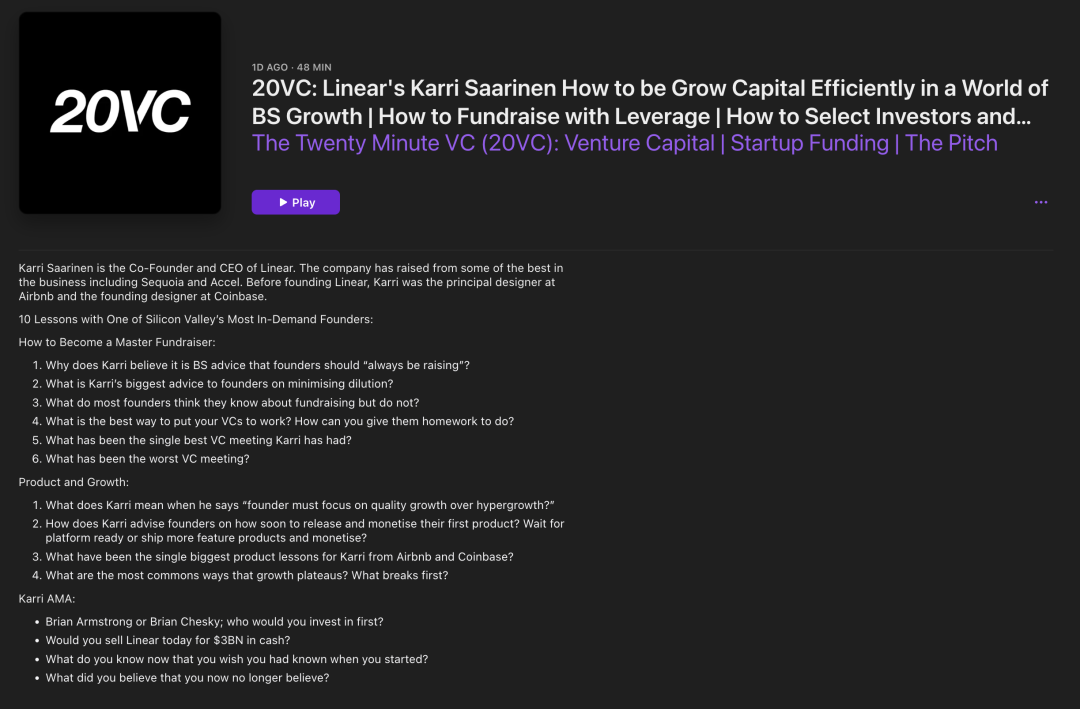
Image: Podcast shownotes
📝 Summary
1. High-quality growth vs. hypergrowth: Saarinen believes high-quality growth is built on something genuinely effective within the company, not artificially stimulated, making it more sustainable. Many companies pour money into growth to generate impressive numbers, but this is often unsustainable.
2. Product and market strategy: Startups should begin with a focused angle or niche market, serving a small group's needs, then expand gradually. Successful products need to find a small group of people who truly care and are willing to pay.
3. Team building: Early employees have outsized influence on company culture, so it's better to leave positions unfilled than hire poorly. Saarinen believes small teams produce the best results, emphasizing a lean-and-sharp philosophy.
4. Enterprise market strategy: When Linear moved into the enterprise market, product, marketing, and sales all had to advance together. Saarinen notes that enterprise customers need a good product experience, plus marketing and sales support.
5. The meaning of fundraising: Raising capital helps signal positive momentum to the market and can also boost company valuation.
6. Investor relationships: When engaging with investors, focus on fit — finding those who understand your values and way of working.
7. Hiring strategy: Saarinen likes asking candidates "what are you most proud of?" to gauge their attitude and passion. In hiring, look for craftsmanship and a willingness to exceed expectations.
8. The CEO role: Being CEO is a challenging role requiring constant adaptation, balancing present and future demands. There's always more you could be doing — this restlessness is inherent to the role.
🎙️ Interview Excerpts
1. 20VC: Before we started recording, we talked about the difference between high-quality growth and hypergrowth. What do you mean by high-quality growth? How is it different from hypergrowth?
Karri Saarinen: By high-quality growth, I mean growth that's more sustainable. It means growth based on something real and effective inside the company, not artificially stimulated. It's like going to the gym — not like taking steroids. (People probably shouldn't take steroids, though maybe sometimes they need to, but it's not sustainable.) The same logic applies to startups. There's a culture of rapid growth and rapid expansion, trying to hack growth through various tricks. But to me, some of these artificially stimulated growth methods are dangerous.
Some companies spend heavily on growth. They may get nice-looking numbers, but often expenses exceed revenue. Eventually this model can't sustain itself and requires continuous fundraising. For us, high-quality growth means we barely spend on marketing and advertising. For the first three years, we didn't even have sales. What we want to see is growth coming from people discovering that our product is better than others on the market, and choosing to buy it. That's real growth to me.
2. 20VC: Founders listening might say, okay, I get it. But I need to raise my next round. If my growth rate is 2x, while some companies are growing 4, 5, 6x — and AI startups might be completely different — then this quality growth you're describing seems like a luxury. Many founders would say they need hypergrowth because that's the only path to their next round. What do you think?
Karri Saarinen: I think you're right that you do need growth to raise funding. But there's another option: suppose you don't need to raise, or you only raise one round, then focus on making the business actually work and truly making money without spending too much. Then you're no longer beholden to these metrics, because you don't need to fundraise. You can choose to raise, but you don't have to. Of course this also depends on your position in a rapidly changing market — how quickly you want to reach the next stage, and so on. I advise founders to think clearly about what game they're playing, what market they're entering, what needs to be done, and what the rules are. At our company, we knew from the start that there wouldn't be quick wins in our space. Basically every company uses some kind of solution, and the game has been played for 20 years. Not much has changed in the past 20 years, and I don't think much will change in the next 5-10 years, unless we make it happen. So in our case, we don't need to be the fastest — we need to focus on delivering the best product. The cost of trying to grow too fast, or what gets sacrificed, is quality and focus.
3. 20VC: I find it very interesting that you mentioned making money from customers. Your company had revenue in year one and was profitable in year two. How do you think about quickly shipping monetizable features/products versus founders who say, it's fine not to make money now, I'm building a platform, but clearly can't platform-ize within 24 months?
Karri Saarinen: I've always believed startups should start from a more focused angle or a niche they can quickly penetrate, serving a small group's needs first. Even if you have platform ambitions, you can still attract people into the platform through simple features, serve them, and build the platform together with them. So I don't see this as a black-and-white choice between platform or feature/product. There's always a way to focus on what you're doing, serve a specific group, build an excellent product for them, and expand from there.
4. 20VC: I know some companies fail to find product-market fit because founders get nervous before launch. They expand their target customer base too broadly, so the product resonates with no one. They can't find 1,000 true fans — nobody cares about the product. As you said, find those 1,000 people who truly care, are willing to pay, and love it, then expand from there. Your company was profitable in year two. Why didn't you spend more money on customer acquisition and hire more people? Customer acquisition costs are high, but retention is good — people love your product. If you spent more, you could get more customers, and expanding the team could achieve that faster.
Karri Saarinen: Same answer — our strategy is to build the best tool, and we believe reaching that goal rests on several principles. One is that teams should be smaller and more focused. Looking back at my career, I've always felt that small teams tend to produce the best results. Typically, when you assemble a truly capable team of maybe just 3-5 people, what they do can quickly have major impact inside the company.
So we try to find the best people rather than expand team size. Hiring obviously increases costs and dilutes culture. You spend more time managing, and you have to train people. Generally, our team size doubles each year. One reason we became profitable is that our revenue grew faster than our team expanded.
As for marketing spend or other expenses, I want to see growth even without paid distribution. Second, our product wasn't for everyone from day one. Returning to the focus on finding first customers — our first customers were small startups who chose our product not from seeing ads, but from hearing about it from friends or other founders. I believe word-of-mouth and building connections with these founders matters far more than spending on advertising.
5. 20VC: Do you wish you had entered the enterprise market earlier?
Karri Saarinen: Not really. I think first comes product, then marketing, then sales. To reach the next market segment, all three need to advance together to some degree. When selling to enterprises, you obviously need a sales team to figure out how to handle enterprise accounts, how to communicate with people there, how to influence them. Next, marketing has to be in place — people need to know about you. Otherwise they won't engage in the sales process because they've never heard of you and don't understand what your product is or why it's better. Finally, the product has to be ready too. If they buy it, it actually has to work. We started getting some enterprise customers about a year ago, shortly before our Series B.
Now, a year later, we convert customers every month. We've made some progress, but we need to keep refining this year — improving the product, getting more customers to see where the product can be better. Then in our sales conversations, we'll know what improvements marketing and sales need. I think founders need to continuously level up all three functions. You can't just jump in and hope for the best.
6. 20VC: You mentioned your Series B. I'm curious — since you're profitable, why raise? Why dilute?
Karri Saarinen: I'm still thinking about this, and I keep discussing it with people. Do we need to raise again?
I think first, it's useful to update the company's valuation at the right time. Our Series B was about three years after our Series A. What bothered me was when interviewing candidates, saying we're a Series A company, but they perceived us as actually a Series B company based on revenue and other metrics. This creates issues with employee equity value — for example, when we tell candidates we can't give them 1% like a Series A company would, because we're actually quite far from our Series A. In solving this kind of problem, company valuation, or raising to increase valuation, is useful. Of course you can achieve this other ways too — fundraising isn't the only path.
At the same time, I think there's also a signal to customers. You're no longer a Series A company. If you're a Series B company, it sounds more serious, because there are many seed or Series A companies out there, but not many Series B companies.
7. 20VC: What's the most successful meeting you've ever had with an investor?
Karri Saarinen: For me, the most successful meetings are with people who already knew us and were willing to go deep. In the fundraising process, I don't like making it too long or talking to too many people. When we see a good opportunity or need to raise, I usually make a list of people I know or have heard of.
8. 20VC: How long is this list?
Karri Saarinen: The list could be longer, but usually when I start the fundraising process, there are maybe five people I want to reach out to. Some might be our previous individual investors, some well-known VCs, and some specific individuals I've heard of.
9. 20VC: Many people say founders should always be fundraising, constantly building new relationships between rounds. What do you think?
Karri Saarinen: I don't think you necessarily need to always be fundraising, but as a founder or CEO, you should always be thinking about the next round — or what circumstances would make fundraising go smoothly, or ideally, what you want to get from it, what kind of people you want to bring in?
Fundraising requires timing judgment. For example, when business momentum is strong, you maintain better negotiating power. So I think it's actually a continuous cycle — you need to think about it from time to time, not necessarily every day, but every month or quarter: when's the next round? What should I prepare? Though I meet investors even when not fundraising, it's usually casual conversation, getting to know them. So when I do start a fundraising process, there's already some relationship foundation, and subsequent meetings can go deeper.
10. 20VC: When we chatted before, you mentioned putting VCs to work, giving them homework. What do you mean?
Karri Saarinen: I create a separate Google Doc for each investor, saying this is a memo prepared for them. At the end of each memo, I list some questions I hope they'll take time to think about and write answers to, which we can then discuss.
For me, this is somewhat like simulating working with them. The answers themselves may not be the most important thing — what matters is that I can see their thinking style and approach. For example, whether they're more strategically minded, whether they think from an operator's perspective, and so on. But more important is whether I like their style. For instance, I don't like overly benchmarking against other companies' playbooks, templating the business. I feel if you do that, you're not really considering the situation and challenges we face. Investors vary greatly. Ultimately, when we discuss fundraising, what matters more is my feeling: do we have chemistry? This doesn't mean we need to think the same way, but is our communication or thinking effective? Do they understand our values or our way of working? So I'm looking for a fit, and this fit can take different forms.
11. 20VC: When hiring, are there questions that work across functions? For example, I always ask people about their relationship with their siblings — it's usually the exact opposite of how they see themselves.
Karri Saarinen: I like asking people what they're truly proud of. First, I think it proves they care about something and can articulate why they care. Then, I think it's not just what specifically they did, but how they talk about it. People who truly care about their work always want to exceed expectations, or want to do better.
The answers from people passionate about their work, or who want to do good work, usually sound like the project was their child. They start glowing, become emotionally full, or show more detail. People who don't care as much about their work tend to give flatter, more factual answers, like: "I did this, it worked well, the impact was significant," and so on.
So for me, this is an interesting observation point. Do they want to do better? Can they exceed expectations or standards in this job or role? Can they propose better solutions? Do they have the drive to do it? In this question, I look for that sense of craftsmanship.
12. 20VC: What's the biggest hiring mistake you've made?
Karri Saarinen: We've only let go of a few people. Not many have left the company in the past five years. When something unpleasant or regrettable happens, it's because we hired someone we thought fit the position, but didn't feel the other, cultural-fit elements.
13. 20VC: Some founders might say, I really need this role filled right now, I just need someone to fill this gap. What do you think about this?
Karri Saarinen: Early-stage employees are extremely important. If they're among your first 10, or even first 15, 20 employees, every hire will have major impact on culture. This may set the standard for the entire function.
For example, hiring your first marketer — they become the company's standard for "what is marketing." Hiring your first engineer affects engineering culture. I would absolutely never hire just to fill a gap at a very early stage. As a founder, you must do this work yourself early on, until you find truly excellent people, or the right people. At later stages, when the team is somewhat more mature, the impact may be smaller.
I tend to divide roles into upstream and downstream. Upstream roles affect everyone downstream. For example, the head of product affects the entire product team, even your product quality, direction, and so on. These people, compared to someone at the end of a business chain, have enormous impact on the whole company. So I think you need to distinguish this nuance. Sometimes you leave a role unfilled until you can find the right person.
14. 20VC: In your CEO role today, what makes you feel uneasy?
Karri Saarinen: As CEO, I think you might always feel uneasy. The role is never the same. You can never be good enough. The company keeps changing, the team keeps changing, the market keeps changing — everything changes. You may have done well, done fine in the past, but it's not enough now. The company is bigger, you need to do different things, and you need to do them better. For me, the unease always revolves around this: am I doing enough? Am I doing well? Should I be thinking about the next step? Should I focus on today? Or focus on the future? Ultimately, both. So I think there's a persistent state: am I doing well enough? Should I do less? Or more? I think this is the nature of the CEO job: nothing is enough, there's always more you could do.
15. 20VC: Has becoming a dad affected how you lead the company?
Karri Saarinen: I think in some ways, yes. More so, I think about my influence on my children. What we say or do, children may learn the same things. If you do something, or always speak a certain way, it may affect them, or they'll absorb these things. Becoming a dad, I might be more careful about what I say at the company — what I say or do may somehow affect employees.
📮 Further Reading

Linear Bolt Bolt is an investment initiative established by Linear Capital for early-stage, global-market-facing AI applications. It upholds Linear's investment philosophy, focusing on projects where technology drives transformative change, hoping to help founders find the shortest path to their goals. Whether in speed of action or investment approach, Bolt's commitment is lighter, faster, and more flexible. In the first half of 2024, Bolt invested in seven AI application projects including Final Round, Xin Guang, Cathoven, Xbuddy, and Midreal.