Expo Hopping and Gossip: Fresh Dispatches on Linear Capital From Inside and Outside WAIC | Linear News

At the singularity of thought, the future is compiling itself.

From July 26–28, 2025, the World Artificial Intelligence Conference took Shanghai by storm. Before WAIC 2025 officially kicked off, few could have predicted that this tech gathering would become so hot that scalpers would start circling.
Over 1,500 top experts from more than 70 countries and regions converged on Shanghai. With 800+ companies exhibiting and 350,000 visitors packing the 70,000-square-meter venue, the space transformed into a buzzing tech showcase.
This year, Linear Capital and its portfolio companies were active participants. We hosted a laid-back evening social the night before the conference, and over a dozen of our portfolio companies set up booths at WAIC, exploring technical progress and commercial partnerships with guests from around the world.
In the lead-up to WAIC 2025, we gave serious thought to what kind of gathering would best serve the demand for inside and outside perspectives during this rare moment when the AI community converged on Shanghai.
So, on the evening of July 25, we organized a "WAIC Summer Night Melon Party" — renting out a creative restaurant in Shanghai's French Concession with a vibe friendly enough for both introverts and extroverts, inviting AI founders, practitioners, and enthusiasts to mingle across boundaries.
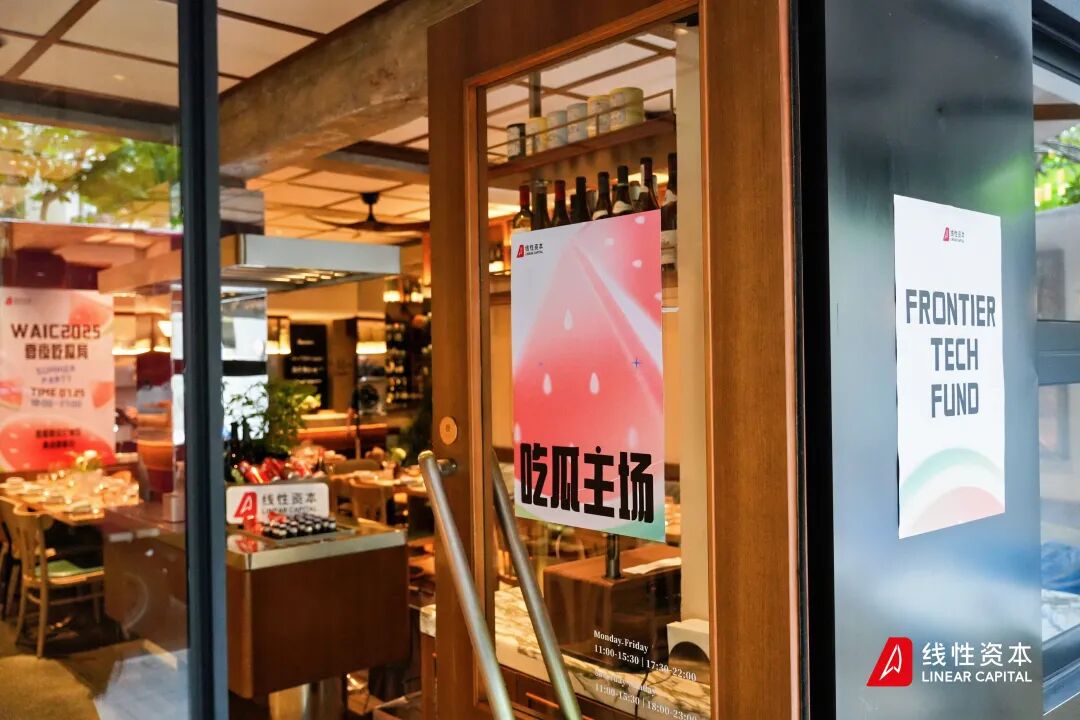
After we posted the registration link, we were pleasantly surprised to receive 220+ applications. Limited by venue capacity, we ultimately invited 50 friends old and new from the Linear community to join.

Among them were founders from startups including Baoxiaohe, Deep Principle, Tanxu Zhiyuan, DP Technology, FinalRound, Chikka, and Tuixing Technology, as well as technical leads from NVIDIA, SenseTime, Moonshot AI, and StepFun working on AI models, products, and infrastructure. There were also friends from internet giants like ByteDance, Xiaohongshu, and Bilibili, plus representatives from top AI media outlets and leading university research institutes. Our thanks to everyone who applied but couldn't join us this time — we hope to meet at future Linear events.
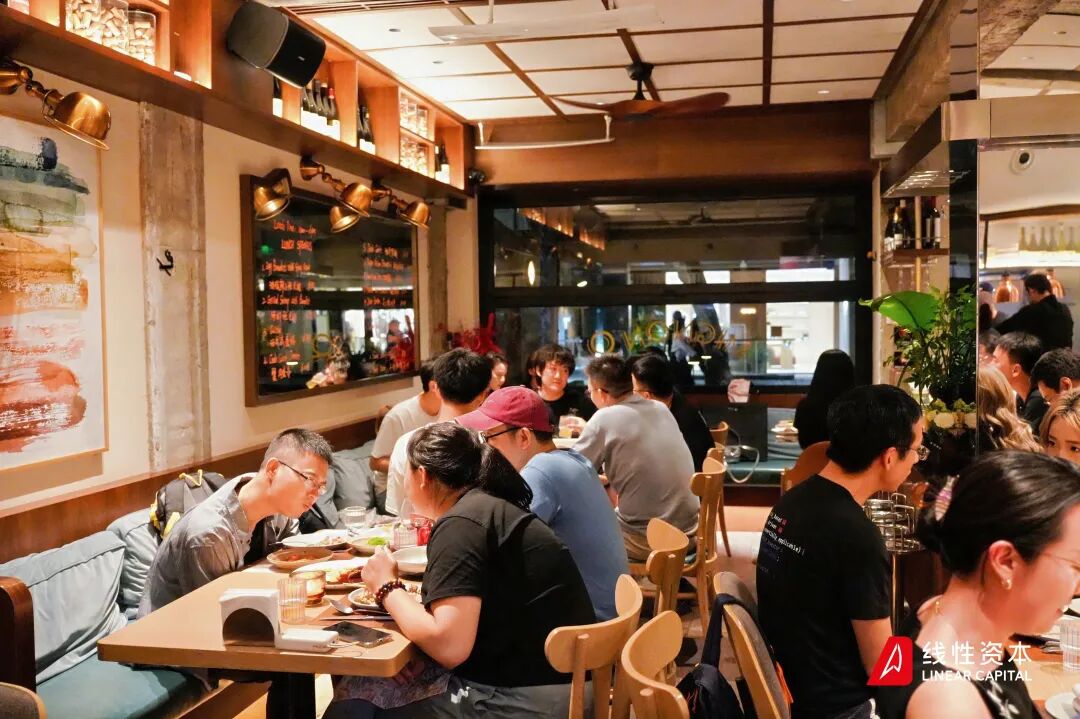
Given how brain-intensive the three-day conference agenda already was, we cut all formal presentations and keynote speeches, handing the mic to attendees themselves. Perhaps because the room was packed with people actually building AI, the conversation flowed from 6 p.m. to nearly 11 p.m. with no one ready to leave. We believe that at the singularity of ideas, the future may be compiling itself.
Back at the main WAIC 2025 venue, over a dozen Linear portfolio companies including Manycore Tech, Rokid, Tezign, Deep Principle, White Rhino, Tashi Intelligent, D-Robotics, Ling Universe, Lingshu AI, Douxiang Tech, Zion, and Bizhen Tech set up booths or participated in forums, discussing technical advances and commercial possibilities with global attendees.
Here's a quick tour of select highlights — one minute per company:
#01 Rokid Debuts Rokid Glasses
Cross-National Café and Tech Concert Become Convention Center Sensations
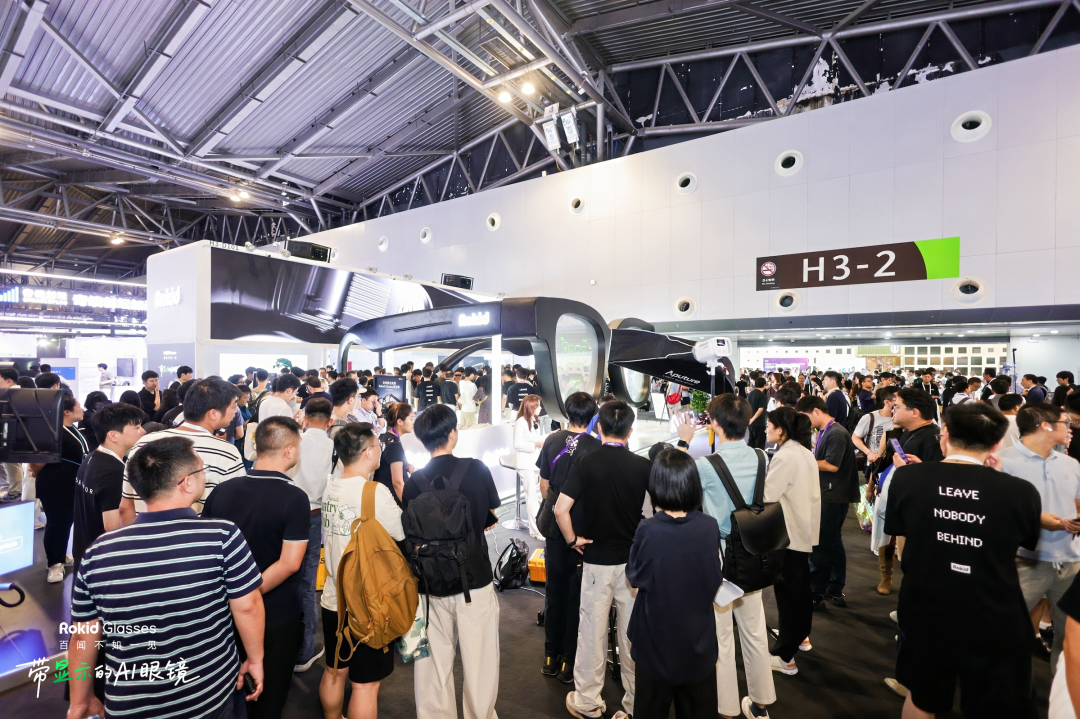
This marked Rokid's first WAIC, yet the company became one of the absolute hottest booths thanks to its new Rokid Glasses. The smart glasses represent the culmination of over a decade of Rokid's work in optics, acoustics, and interaction algorithms, using diffractive optical waveguide imaging technology at just 49 grams for a "near-weightless" wearing experience. According to founder and CEO Misa Zhu, Rokid Glasses sales have already hit 300,000 units. "We're not worried about sales this year — production is the bottleneck."
Rokid also brought "Cross-National Café" and "Tech Concert" experiences. To demonstrate real-world applications, the company simulated a coffee shop where foreign baristas wearing the new glasses served customers in English and Russian, while attendees wearing Rokid Glasses conversed seamlessly in Chinese. In the atrium, an AI-powered tech concert featured singers using the glasses' teleprompter function, a BrainCo bionic hand controlled by thought playing the keyboard, and a Unitree robot dog as backup dancer — painting a picture of AI integrated into daily life.
#02 Manycore Tech Releases InteriorGS Dataset
Teaching Robots to Understand Physical Space
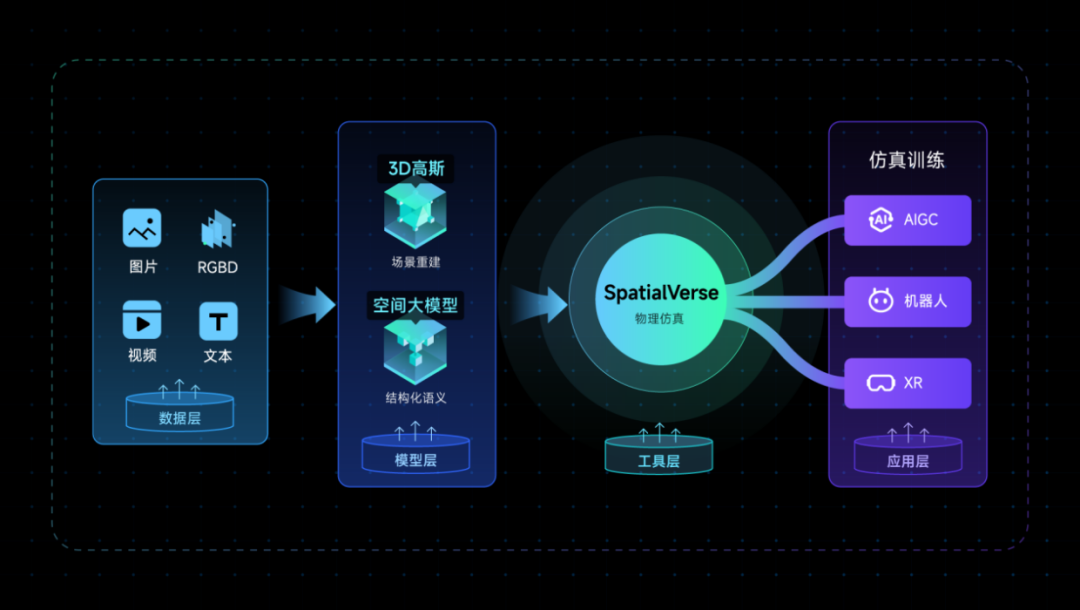
At WAIC 2025, Manycore Tech released its latest high-quality 3D Gaussian semantic dataset, InteriorS, comprising 1,000 3D Gaussian semantic scenes covering 80+ indoor environment types — the world's first large-scale 3D dataset suitable for free agent movement, designed to build a "spatial brain" for intelligent agents and enhance their environmental understanding and interaction capabilities. The dataset pioneers the use of 3D Gaussian technology in AI spatial training, leveraging 3D Gaussian efficiency and cost advantages in scene reconstruction combined with Manycore's self-developed spatial foundation model to achieve both photorealism and semantic richness. It's now available for download on HuggingFace and GitHub.
As a leading spatial intelligence training platform, Manycore open-sourced its spatial understanding model SpatialVerse in March, accumulating massive amounts of interactive 3D data and physics simulation tools, with the goal of becoming the "ImageNet of spatial intelligence" — just as ImageNet catalyzed computer vision, providing a "digital dojo" for AIGC, XR, and embodied intelligence. AgiBot, Galaxy Universal, Noematrix, ZhiPingFang, and Songying Technology are among the embodied intelligence companies already partnering with Manycore.
#03 Ling Universe Showcases AI Learning Companion Xiaofang
Parents Placing Orders On-Site After Demo
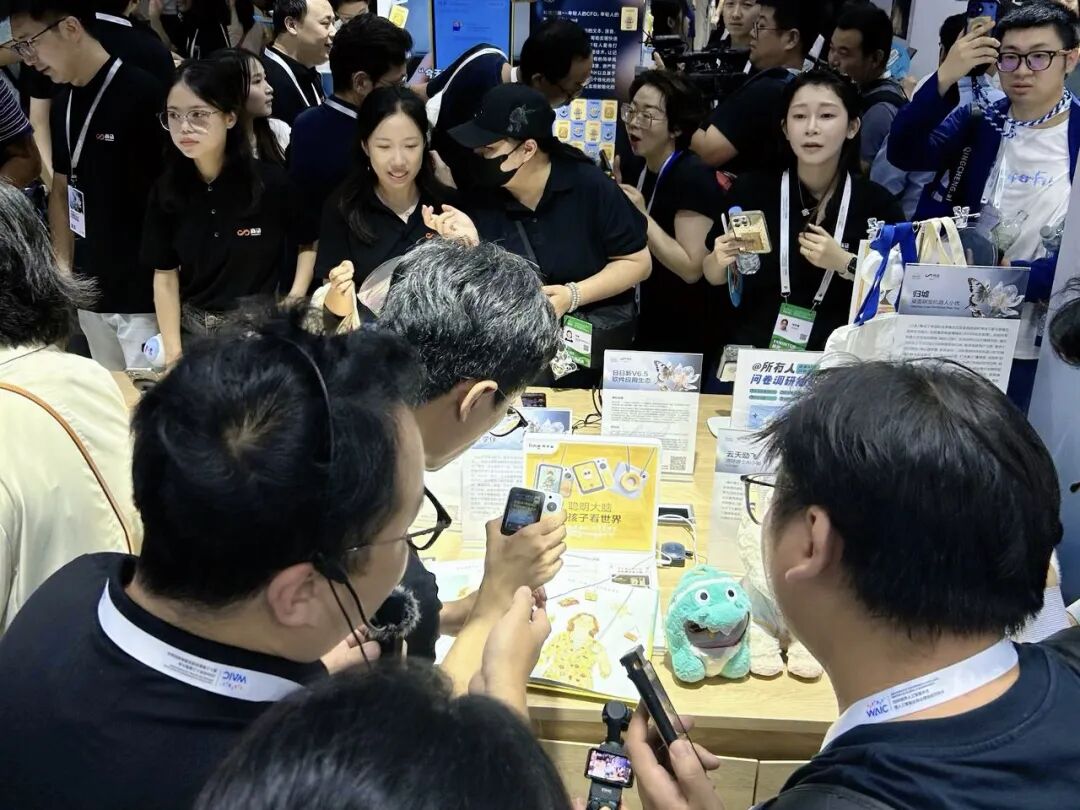
In the view of Ling Universe founder Jiawei Gu, next-generation educational companion devices won't be cold knowledge vessels, but "AI symbiotic" growth communities that accompany children from curiosity toward deep cognition. At WAIC 2025, the company's AI learning companion Xiaofang attracted steady foot traffic with its innovative multimodal interaction approach. Numerous parents placed orders on the spot after watching demonstrations.
The device provides full-scenario solutions for children aged 3–15, with one-click calling, "locate on map to find my child," and other features enabling seamless transitions between learning assistance, play companionship, and Q&A — giving parents peace of mind. Its core breakthrough is building a "cognitive interaction ecosystem" with AI characters at the hub, featuring built-in AI learning companions integrating Harvard's Project Zero thinking model and supporting real-time audio-video interaction, far exceeding competing products. Ling Universe aims for an "interaction defines device" product logic, with its self-developed LingOS "4D spatial interaction system" bringing the physical world "to life" and constructing an AI-OS-driven interaction paradigm, underpinned by a multimodal, multi-Agent collaborative AgentNet system. The product went on sale through JD.com at the end of May.
#04 Tezign Partners with Tongji D&I
Playing with "Computational Creativity"
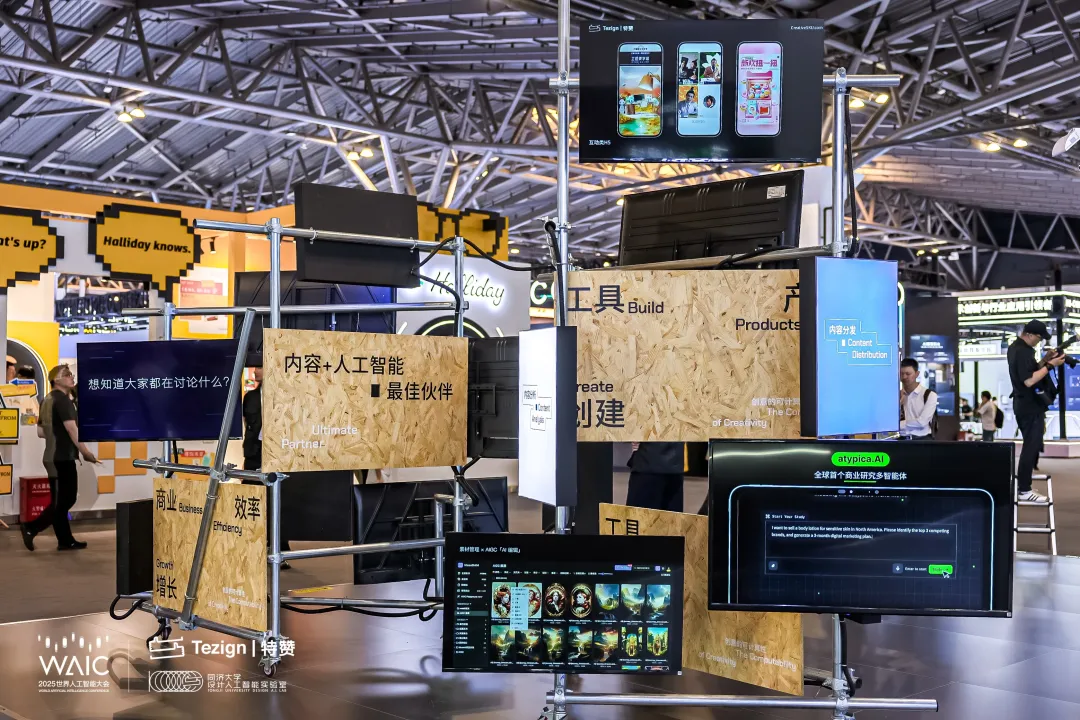
Tezign joined forces with Tongji University College of Design and Innovation to bring the hard results of industry-academia integration to a global stage under the theme "Computational Creativity." Their co-curated exhibition used three "Digital Trees" as visual anchors, moving from cutting-edge academic research to industrial application to future blueprints, making tangible how "content + AI" drives commercial innovation and social evolution. In the intelligent agent experience zone, visitors tried out atypica.AI, sparking human-machine collaborative creativity.
Concurrently, the "Design AI Education Innovation Symposium" concluded at Tongji, drawing 300+ online registrations and 220 offline participants. Three teaching and research achievements from the Design AI Lab were released. Education innovation leaders from industry, academia, and research shared interdisciplinary education practices, while university leaders emphasized AI-empowered design education and returning to educational fundamentals, bringing cutting-edge perspectives to the design AI field.
#05 White Rhino Cracks Urban Complex Delivery
Accelerating Commercialization of Autonomous Delivery
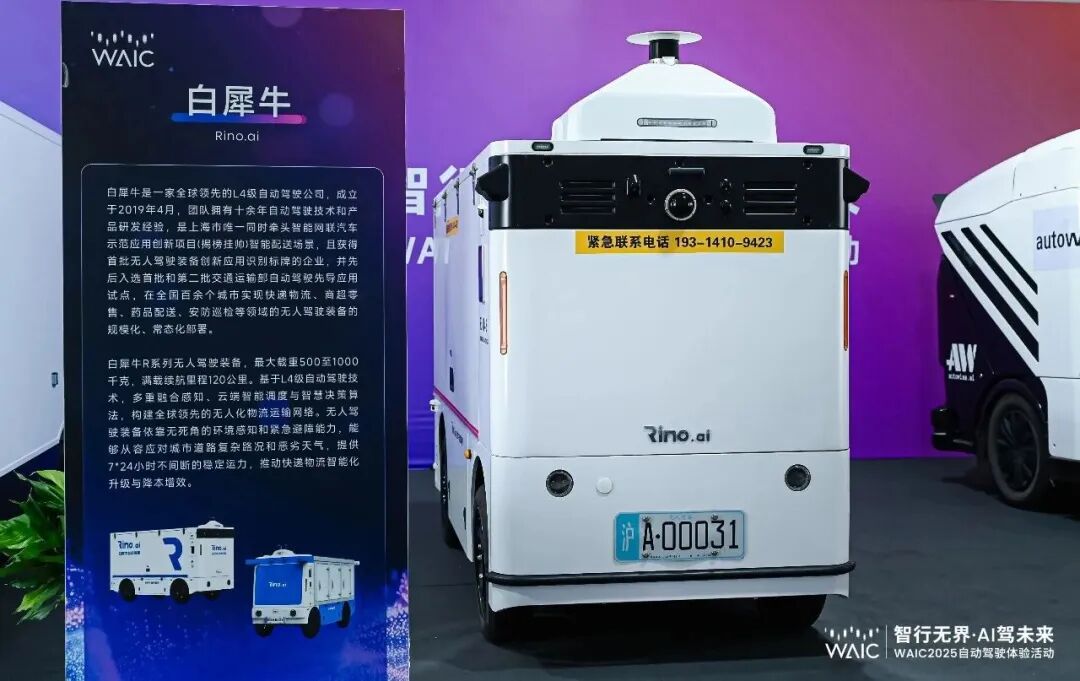
Global L4 autonomous driving leader White Rhino focuses on unmanned delivery. The R3 model unmanned vehicle displayed at WAIC has received approval for road testing in Pudong New Area. It packs serious technical chops: highly intelligent autonomous driving capability enabling precise delivery in complex road conditions. Today, its "siblings" are already operating in 100 cities nationwide across nine scenarios, providing reliable solutions for urban delivery's intelligent transformation.
At a closed-door exchange themed "Unmanned Equipment Empowering Urban Services," White Rhino government relations lead Yan Ming delivered a keynote, arguing that autonomous driving is a key force reshaping future logistics and transportation, and a critical element in reducing logistics costs. He proposed establishing autonomous driving capability grading assessments and dynamic road rights approval mechanisms. White Rhino insists on full-stack self-developed L4 technology, providing all-weather delivery solutions, and is deeply partnering with leading companies like SF Express to explore large-scale unmanned delivery applications, driving intelligent upgrading in logistics.
#06 D-Robotics Unlocks Multiple Deployment Forms
Building a Hub for Robotics Innovation
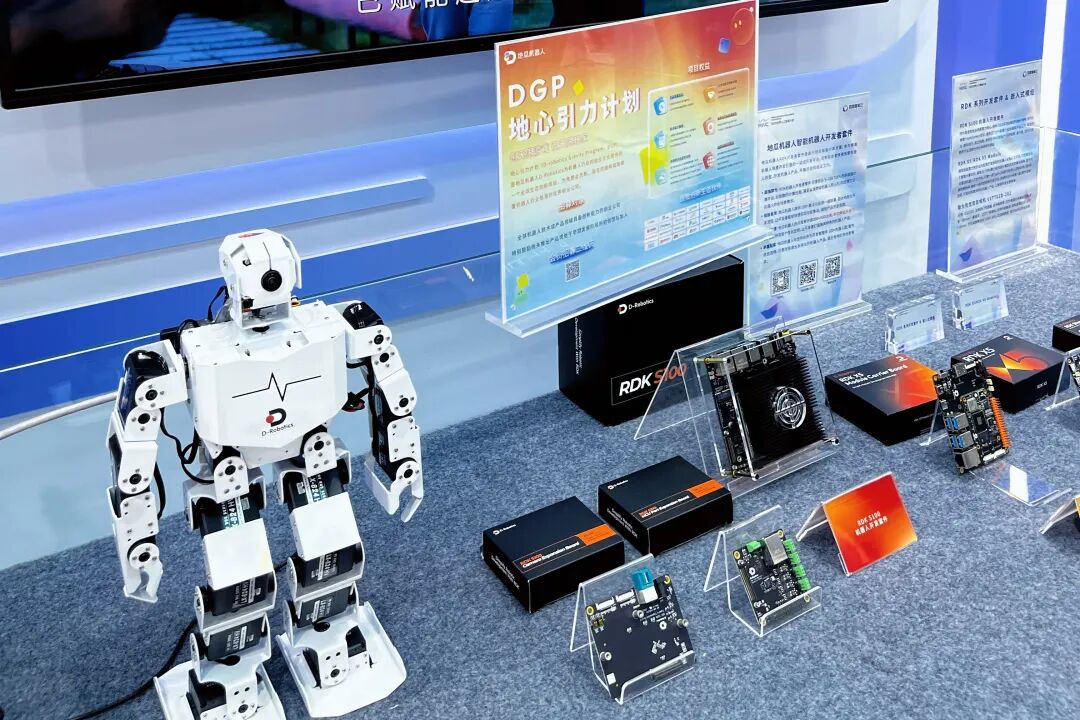
D-Robotics won plenty of fans at this year's show. Say "bring me the water," and the RDK S100x Qinglong robot immediately executes voice recognition, visual localization, and grasping delivery — fast, accurate, and steady. A Senyun Vision GMSL2 camera paired with the RDK S100 developer kit gives robots "X-ray vision," turning complex scenes into 3D models in seconds with upgraded perception. A smart follow-along robot, powered by the RDK S100's computing muscle, trails pedestrians while nimbly avoiding obstacles like a sidekick with maxed-out chemistry. The D-Robotics and Baidu joint demo drew crowds too — with edge computing and cloud resources connected, once-complex development workflows became dramatically simpler. One visitor after trying it remarked: "The barrier just dropped so much!" D-Robotics also took home a SAIL Star award for outstanding technical strength and innovative applications.
From end-to-end VLA fluid collaboration to large-brain-small-brain coordinated dexterity, D-Robotics is using these deployed forms to prove: robots aren't just lab exhibits, but practical helpers that can integrate into daily life. Going forward, they'll take these "skill packs" into more scenarios, unlocking new possibilities for intelligent living.
#07
Lingshu AI Appears at WAIC
"AI + Manufacturing" and "AI Empowering the Ocean" Forums
Lingshu AI, representing the industrial AI sector, attended the WAIC "Cloud-Powered Intelligent Manufacturing, Industry-Enabled New Era" AI + Manufacturing Summit. Founder and CEO Wenwei Guo shared Lingshu's technical deployment results in shipbuilding and marine engineering, aerospace, and other industries, helping enterprises reduce costs and improve efficiency through vertical large models and other solutions. He also proposed that global openness and cooperation are needed, while domestically strengthening industrial chain coordination and upgrading enterprise cognition for ecosystem building.
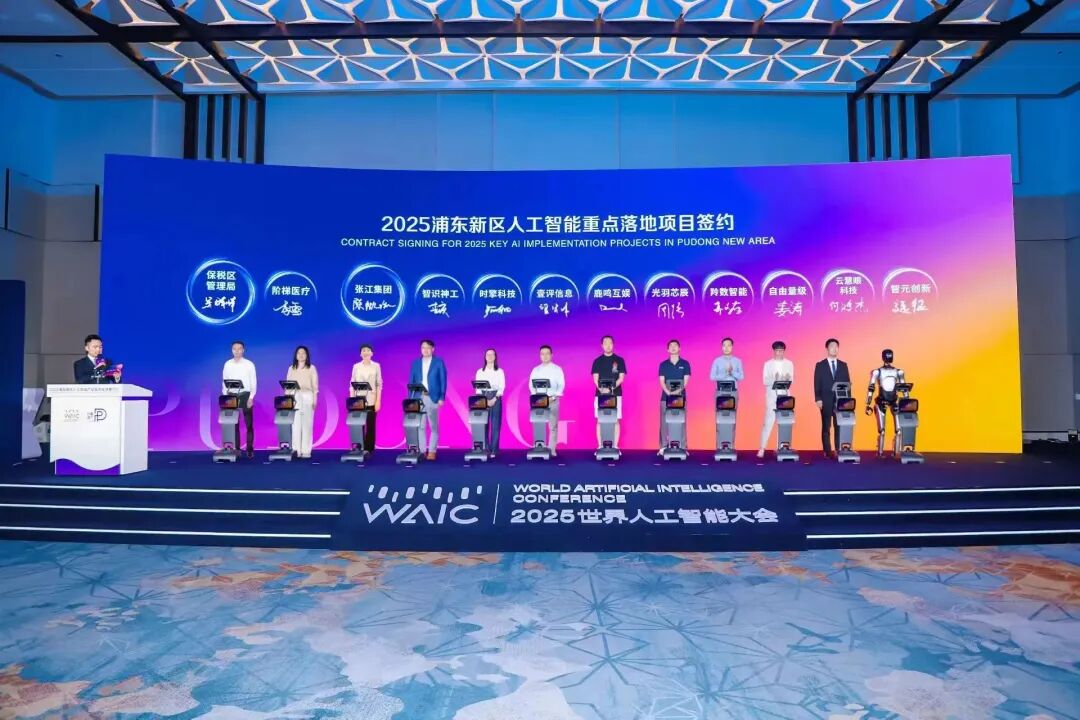
The same day saw the "AI Empowering the Ocean — Smart Leadership in Deep Blue, Accelerating Cross-Boundary Integration for Future Ships" forum, WAIC's only professional forum focused on the ship and marine industry. At the event, Lingshu AI's intelligent agent case for materials control optimization at a leading ship repair enterprise was selected as a 2024 Ship and Marine Industry AI Innovation Practice Case by CSSC. Additionally, at the AI Industry Ecosystem Global Promotion Conference, Lingshu AI signed with Pudong New Area as a key annual project alongside 17 other outstanding enterprises.
#08
Douxiang Tech Hosts WAIC 2025
"AI Industry Technology Security" Forum
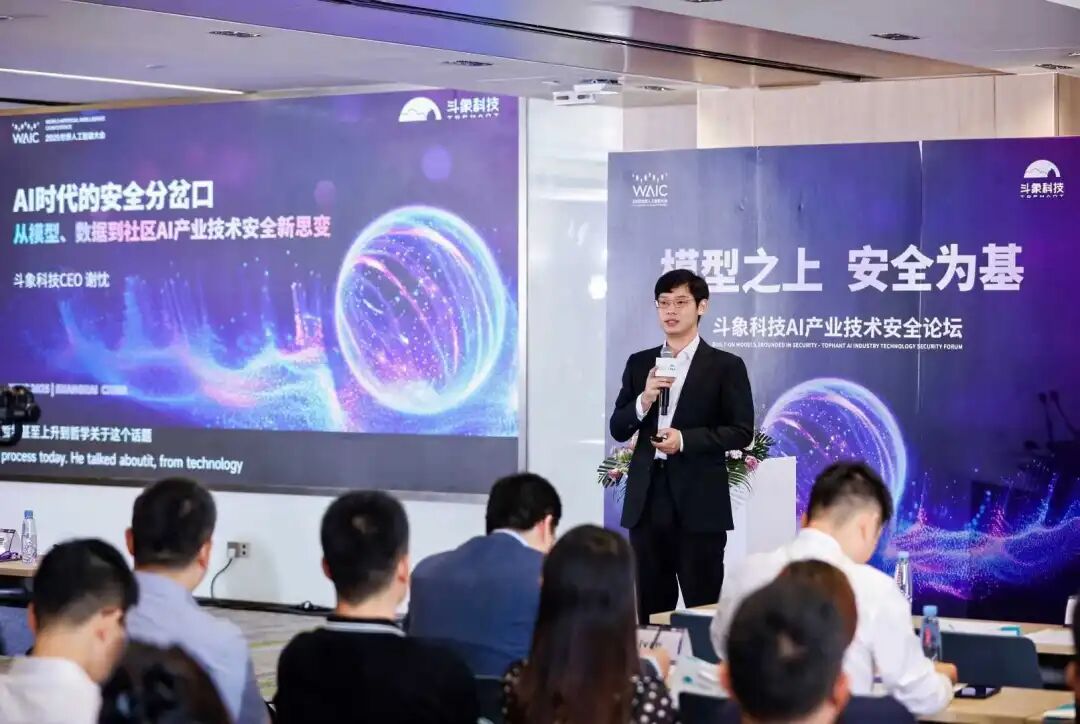
As a key component of WAIC 2025, the "AI Industry Technology Security Forum" hosted by Douxiang Tech opened at the Shanghai World Expo Exhibition and Convention Center. The forum took "Above the Model, Security as Foundation" as its theme, emphasizing AI security industry co-building from models to data to community, grounded in national cybersecurity strategic needs, aligned with global AI governance trends, and focused on the "AI industry technology security" domain. It brought together government representatives, international organization delegates, top experts and scholars, industry leaders, technical communities, and research institutions for deep dialogue and strategic cooperation around the technical frontiers and governance challenges of AI industry security.
The forum delved into AI model security, AI data security and control security, intelligent attack-defense evolution, intelligent connected security, and other key technical directions, exploring the latest advances, practical applications, and future trends of artificial intelligence in the cybersecurity domain, driving technological innovation and industrial ecosystem coordination, and contributing Chinese wisdom to global AI security governance.
#09
Zion Lets Visitors Build AI Agent Workflows On-Site
Demonstrating Unlimited Possibilities for AI Tool Deployment
Hanzi Tech's no-code tool Zion provides systematic capability support for student organizations, entrepreneurs, and educators, helping transform ideas into actual projects faster. Its booth at this year's WAIC brought a series of activities blending AI and tool innovation that attracted significant attention from developers and entrepreneurs. In the most popular "AI Agent Interactive Check-In" session, Zion allowed visitors to personally build and direct their own AI Agent workflows — not simple chatbots, but intelligent applications capable of handling real business processes.
Hanzi Tech CEO Yaokai Jiang also took the stage at the conference's FutureTech100 Innovative Enterprise Demo Day, sharing how Hanzi Tech uses Zion at its core to efficiently help entrepreneurs make the leap from idea to commercialization, showing more people the unlimited possibilities for AI tool deployment.