WEFLY Closes Nearly 100 Million Yuan Funding Round, Crewed eVTOL Receives TC Application Acceptance | Linear Portfolio

Officially entered the airworthiness certification phase.

Recently, Linear Capital portfolio company WEFLY announced the completion of a strategic funding round of nearly RMB 100 million.
Since its founding over three years ago, WEFLY has been advancing product development and airworthiness certification for large-payload, all-electric eVTOL aircraft. Following a "three aircraft in three years" rhythm, the company has progressed from subscale validation to full-scale prototype flight testing. Its passenger model, the W280, has received Type Certificate (TC) acceptance from the East China Regional Administration of the Civil Aviation Administration of China (CAAC), officially entering the airworthiness certification phase.
Linear Capital was WEFLY's angel round investor and has continued to support the company in subsequent funding rounds.
Recently, Linear Capital portfolio company WEFLY announced the completion of a strategic funding round of nearly RMB 100 million. This round was led by Suzhou Innovation Investment Group, with participation from Jiangsu Strategic Emerging Industries Future Angel Fund and Xiangcheng State-owned Assets Control Group. The funds will be primarily used for product development, flight testing, and airworthiness certification.
As the low-altitude economy gradually enters the product validation and commercialization phase, market attention toward eVTOL companies has increasingly shifted to engineering progress, airworthiness certification, and actual delivery capabilities. For airframe developers, steadily advancing product iteration and translating technical solutions into verifiable engineering outcomes is a critical foundation for moving toward commercialization.
WEFLY was founded in May 2022. Over the past three-plus years, the company has followed a "three aircraft in three years" rhythm, progressing from subscale validation to full-scale prototype flight testing. Its passenger model, the W280, received Type Certificate (TC) acceptance from the East China Regional Administration of the CAAC on September 1, 2026. From final assembly rollout to maiden flight, transition flight, and airworthiness acceptance, the W280 took one year.
Following this funding round, WEFLY has established a shareholder structure with participation at the provincial, municipal, and district levels of state capital, which will provide further support in terms of industrial resources, policy coordination, and regional ecosystem development.
Behind this series of developments is a team with comprehensive aviation engineering experience and a product strategy grounded in real-world operational requirements.

WEFLY's founder has spent nearly two decades in the aviation sector, with experience spanning aircraft design, engineering, testing, certification, manufacturing, and operations. Core team members have worked on Gulfstream G500, G650, G600, G700, and G800 large business jets; Bombardier C Series and Global series; Airbus A350 and A400; Boeing 787 and 777X; and COMAC C919/ARJ21 programs. This is a team where every link in the chain — from design, manufacturing, and flight testing to airworthiness certification and operations — has been done before.
Unlike the tiltrotor approach that attracted more attention in earlier years, WEFLY chose to enter the market with a compound-wing (lift-plus-cruise) configuration, focusing on large-payload, all-electric eVTOL aircraft.
The technical trade-off stems from an assessment of actual application requirements. In the founding team's view, eVTOL represents the extension of the new-energy power revolution into the air, and its largest application scenario is point-to-point urban and intercity travel within a 30–150 kilometer range. This range essentially covers trips from CBDs to transportation hubs, as well as travel between cities in the Pearl River Delta and Yangtze River Delta regions.
Within this distance band, multirotor aircraft lack sufficient endurance. While the tiltrotor approach offers faster cruise speeds (typically 250–300 km/h for mainstream models) compared to compound-wing designs (roughly 160–200 km/h), the difference amounts to mere minutes — barely perceptible to passengers — while entailing significantly greater challenges in technical maturity, airworthiness difficulty, and supply chain constraints.
"For example, from Lujiazui to Pudong Airport, a tiltrotor might take nine minutes, a compound wing twelve. What users care about is going from one hour to ten minutes, not a three-minute difference," the founder noted. This is a route that works backward from application requirements to drive technical iteration. Startups don't have many chances to试错; what matters is who can get technology to market fastest.
Application scenarios determine configuration choices, while product strategy must follow the objective evolution of complex systems engineering: higher fault tolerance first, then lower fault tolerance.
WEFLY's approach is platformization: integrated passenger and cargo capability, one platform, two aircraft.
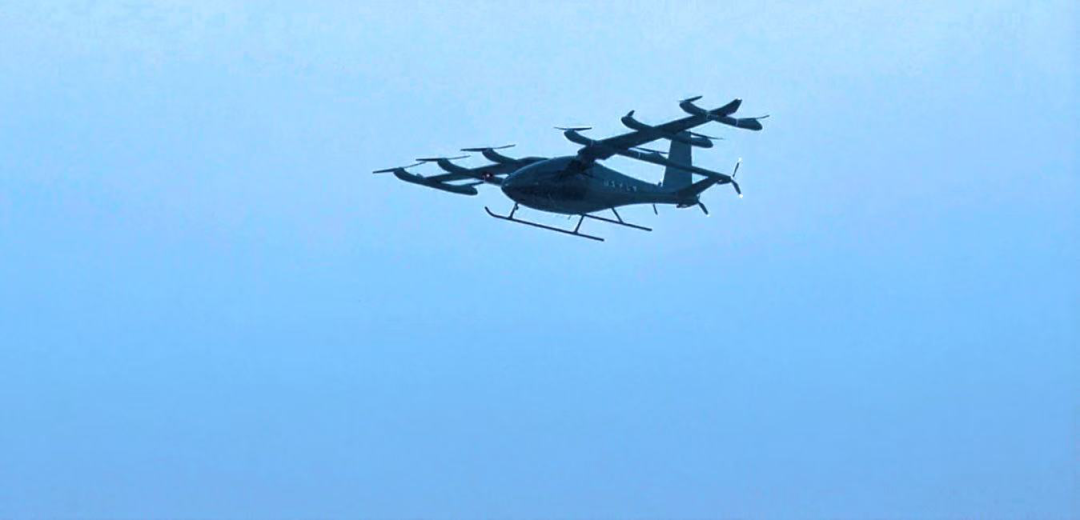
Specifically, based on the W280 underlying flight platform, the company has simultaneously defined two models: the W280 (passenger) and W280F (cargo). The two share aerodynamic configuration, overall layout, tri-electric systems, flight control, and suppliers, employing a modular design with differences concentrated primarily in system redundancy levels.
Its flagship product, the W280, is a full-scale, compound-wing, all-electric eVTOL designed strictly to passenger-carrying standards. It has a maximum takeoff weight of 3.18 tons, a 5–6 seat layout, maximum speed of 280 km/h, and maximum range of 300 kilometers. The cargo variant has a maximum payload of one ton.
"This isn't taking a detour — it's commercializing intermediate products from the R&D process." In the founder's view, the core value of this solution lies in converting the unavoidable weight and time costs of eVTOL development from sunk costs into reusable experience and monetizable assets: getting the cargo configuration through airworthiness certification and real-world operations first, generating revenue while continuously accumulating flight hours, maintenance records, and supply chain stability data for the passenger configuration, thereby accelerating its certification.
The path from cargo to passenger, from specialized to general, has been validated by history.
As a reference, the Cessna 208 "Caravan" began as a multi-purpose design, delivering cargo baseline products for FedEx starting in 1985. In 1990, sensing a gap in the commuter market, it restored cabin windows, upgraded interiors, and introduced the stretched-fuselage 208B "Grand Caravan." Ultimately, over 3,000 units were delivered globally, making it one of the most successful and best-selling aircraft in the general aviation sector.
Of course, for a late-entering team, more pragmatic development rationale also comes from assessing timing and competition. Optimistically, true commercialization of passenger eVTOL remains at least 3–5 years away, but cargo demand in rigid scenarios such as offshore oil platforms and island transport already exists. Rather than staking survival entirely on distant market realization, the coordinated, incremental development of both aircraft models improves the odds for a startup.
Last May, WEFLY's W280 full-scale engineering validation aircraft rolled off the line, completing its maiden flight two months later at the Suzhou Shengze Lake All-Space Unmanned System Demonstration Island. In the first half of this year, the W280 entered regular transition-phase flight testing, received TC acceptance on September 1, and its passenger model entered the airworthiness certification phase.
The密集兑现 of key milestones has brought this team, which has kept a low profile in recent years, back into industry discussions.

In terms of engineering progress, the efficiency behind it stems from the combined force of three dimensions: the founding team's experience, core technology self-development, and 100% domestic supply chain.
WEFLY has proposed a "software-defined aircraft" development approach, based on the judgment that future aircraft will become as highly electronic and integrated as today's automobiles — with functional iteration and system integration increasingly driven by software, while hardware trends toward standardization and通用化.
"We were already thinking in terms of platformization, self-developing flight control and operating systems, connecting onboard hardware through a unified computing platform, with the software platform handling data collection, integration, judgment, and intelligent processing." In the founder's view, eVTOL is inherently fly-by-wire, with control logic highly dependent on software and algorithms; platformization is the inevitable direction. In the future, when pilots operate aircraft, they will issue commands rather than movements; the aircraft will calculate optimal routes based on real-time traffic and airspace conditions, with human takeover required only in emergencies or forced landings.
At the hardware level, WEFLY chooses to leave the "experience-intensive work" to more specialized partners.
For example, in flight control, WEFLY has established an exclusive strategic partnership with AVIC Automatic Control Research Institute covering "from stick to rudder." In airframe structures, propulsion, and energy systems, WEFLY has also collaborated with multiple central SOEs and leading listed companies to jointly develop material systems, airframe structures, motors, batteries, and other critical systems. Through forward design adaptation, the company has overcome compound-wing vibration challenges, achieving continuous optimization of weight and performance.
"AVIC Automatic Control Research Institute is a major supplier of civil aircraft flight control in China. They handle the hardware platform and flight control computers — that's their strength. The most core software and control laws are written by us, ensuring autonomy and controllability. The two sides work together, complementing each other's capabilities to ensure flight safety." The founder noted that many eVTOL manufacturers outsource the entire flight control software and hardware architecture, while WEFLY is one of the few airframe developers that has done passenger-grade flight control in-house and retains control laws and core software.
According to the company, WEFLY has currently achieved 100% domestic supply chain localization, with AVIC system companies accounting for over 50%.
WEFLY summarizes this as an "airframe developer + national team + industry leader" collaboration model. For a startup, being backed by the strongest domestic supply chain system centered on state-owned enterprises not only provides engineering support and autonomy guarantees for subsequent aircraft airworthiness certification and scaled production, but also helps the team improve R&D investment efficiency and optimize cost structure.
The founder noted that for three aircraft in three years, WEFLY used a team of fewer than 50 people and roughly one-third the R&D costs of peers to achieve comparable engineering progress. "The validation aircraft phase doesn't actually require that much money. With core technology self-developed and no盲目扩张 of the team, we're standing on the foundation of China's manufacturing advantages and maximizing supply chain utilization."
This accumulation is also gradually translating into market recognition. Previously, WEFLY has established an airworthiness assurance alliance with multiple AVIC subsidiaries and partnered with China Telecom Suzhou, Reo Aviation Transport, and other enterprises to jointly build urban low-altitude service ecosystems.
Last November, WEFLY signed a letter of intent for 105 eVTOL aircraft with three companies in the Guangdong-Hong Kong-Macao Greater Bay Area, advancing the construction of an urban cluster three-dimensional logistics network.
All companies are locking in market demand ahead of time; what comes next is a competition over whether products can fly and who flies first.
For WEFLY, receiving TC acceptance is an important milestone on the W280 product development journey, but far from the finish line. The team's assessment of this赛道 is that it's a long-cycle, protracted war — elimination hasn't even begun yet, pace matters more than ranking, and passenger eVTOL commercial operations won't arrive until at least 2028. Before then, continuously refining the product and surviving is what matters most.