"WEFLY W280 Manned eVTOL Completes First Flight, Setting New Engineering Efficiency Record | Linear Portfolio"

From final assembly rollout to maiden flight took just over a month.

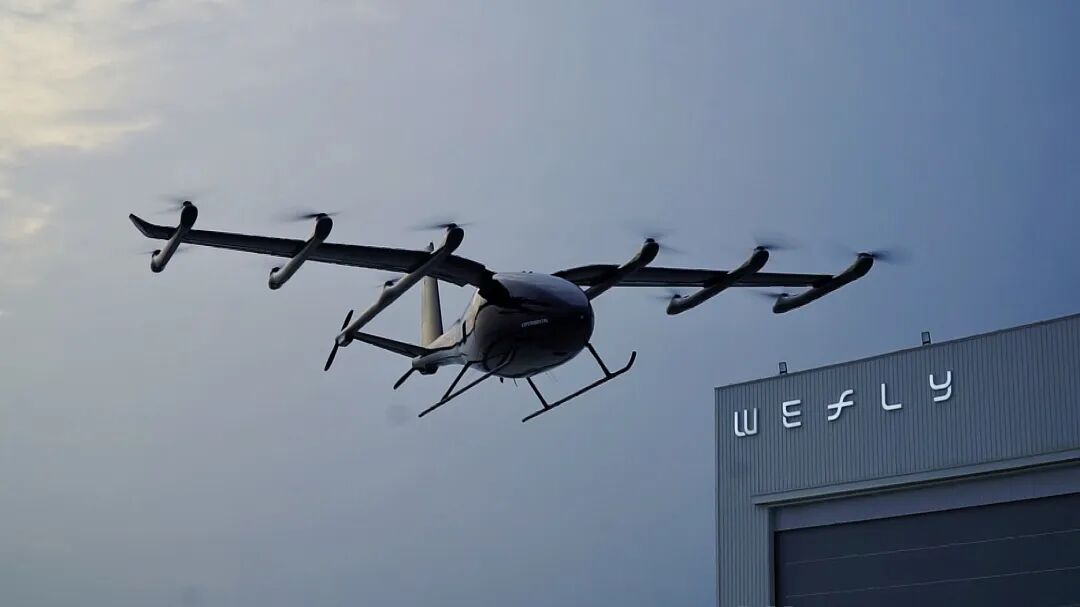
Today, WEFLY, an angel-round portfolio company of Linear Capital, successfully completed the maiden flight of its self-developed W280 — a full-scale, 2-ton, five-seat passenger eVTOL — in Suzhou.
As the world's first eVTOL purpose-built for megacity clusters from the ground up, the aircraft now enters the flight-test validation phase. The milestone comes just over a month after the company completed final assembly this year, setting a new record for engineering efficiency in the electric vertical take-off and landing sector.
On the morning of July 14, WEFLY Aviation Technology's self-developed W280 successfully completed its maiden flight at the Shenze Lake All-Space Unmanned System Demonstration Island in Suzhou.
This marks the formal entry of the world's first eVTOL purpose-built for megacity clusters into flight-test validation, and sets a new record for engineering efficiency in the electric vertical take-off and landing sector with its compressed timeline from final assembly to first flight in just over a month.
When the W280 rolled off the production line in Suzhou this May, its technical profile — "compound-wing configuration, all-composite fuselage, 95% domestic content" — already drew significant industry attention. After rollout, the physical aircraft was showcased at the 3rd Low-Altitude Economy (Suzhou) Industrial Innovation Ecosystem Conference and 2025 Digital Low-Altitude Conference from June 27–29, generating considerable interest. Excluding the two weeks of preparation and reassembly before and after the exhibition, the actual engineering time from rollout to maiden flight was merely a month.
Behind this rapid first flight lies the WEFLY team's hardcore technical capabilities and comprehensive command of engineering programs, particularly its core competence in developing a piloted-airworthiness-grade flight control system from scratch rather than cutting corners by skipping necessary processes. The successful maiden flight further validates three core capabilities:
- Autonomous, integrated R&D and system-integration capabilities for aerodynamics, flight control, avionics, and electric propulsion: Leveraging its fully self-developed "three-loop integration platform" (software-hardware-pilot-in-the-loop verification), the team completed thousands of hours of pre-flight CFD and structural validation calculations, thousands of hours of full-aircraft large-system physical simulation testing (including battery cells), hundreds of hours of electric propulsion testing (various vibration coupling and thermal scenarios), and hundreds of frame, indoor, and tethered flights;
- Aerospace engineering at the limits of efficiency, underpinned by a safety culture: From WF-01 through to WF-02 (validation model W280), a safety culture drives company processes, and R&D processes safeguard flight safety. An ultra-lean team of elite engineers focuses on core technical details of the aircraft, single-mindedly committed to safe flight. From overall design, aerodynamic analysis, structural drafting, manufacturing, final assembly, and complex large-system integration to aircraft integration, WEFLY has practically authored its own aircraft design assurance system;
- Manned large-aircraft and large-system development experience: From WF-01 through WF-02 (validation model W280), every test flight and experiment has drawn fully upon technical foundations and accumulated expertise in manned large aircraft and large systems. This enables the fastest, lowest-cost identification, analysis, and resolution of real-world engineering and flight-test issues — such as the highly coupled structural, propulsion, aerodynamic, and control problems most commonly seen in eVTOL aircraft today. Sophisticated mathematical models and software integration allow problems to be automatically parsed within an hour after testing or flight. Engineering experience from previous large-aircraft programs rapidly points the way to solutions, and close teamwork enables the fastest possible implementation.
As a three-dimensional transportation solution purpose-built for world-class urban agglomerations such as the Yangtze River Delta and Pearl River Delta, the W280 features a 2.8-ton maximum takeoff weight, 280 km maximum range, 280 km/h maximum speed, and noise control below 50 decibels, enabling seamless connections between urban CBDs and transportation hubs. A trial route map displayed at the maiden flight — "Suzhou Center to Suzhou North Railway Station to Yangcheng Lake Scenic Area" — signals that closed-loop demonstration operations for business commuting and aerial tourism will launch in 2026.
"The W280 maiden flight represents WEFLY's full commitment to the promises made to investors, the expectations of government, and collaboration with industry partners," the WEFLY team emphasized upon completion of the flight. The company has already established an airworthiness assurance alliance with five subsidiaries of AVIC, and partnered with China Telecom Suzhou, Ruo Aviation Transportation, and other enterprises to jointly build an urban low-altitude service ecosystem. Deep coordination with domestic supply chains has delivered a 40% optimization in material costs, laying groundwork for commercial deployment.
The "WEFLY speed" from rollout to maiden flight marks the company's formal transition from R&D into the engineering phase. Following this milestone, the W280 will enter an intensive airworthiness validation cycle, kicking the low-altitude economy into a higher gear.