YC Partner Shares: From a Startup on the Brink of Collapse to Building the Fast-Growing Google Photos | Bolt Picks

Always stay focused on what users need.

In the mobile internet era, there was once an app called Bump that let you exchange contact info by simply bumping phones together. At its peak, it ranked second on Apple's App Store. But despite its sudden viral success, the team quickly realized it lacked long-term value. Through user interviews, they discovered that people actually loved the photo-sharing feature more. So they pivoted to build a new product called Photo Roll. The company was later acquired by Google, and Photo Roll's functionality, combined with Google's technical muscle, became Google Photos — an app that once grew at breakneck speed.
On the latest episode of Y Combinator's Backstory series, David Lieb, Bump's co-founder and now a YC partner, shared his journey as an entrepreneur — from Bump's overnight fame to standing his ground after being acquired by a tech giant, and the psychological blow of being diagnosed with blood cancer. His story offers lessons on staying user-focused and iterating fast, navigating disagreements with a large company by building support and consensus, and facing life's biggest challenges.
We've compiled and translated portions of David's account. You can click the "read more" link to listen to the original video.
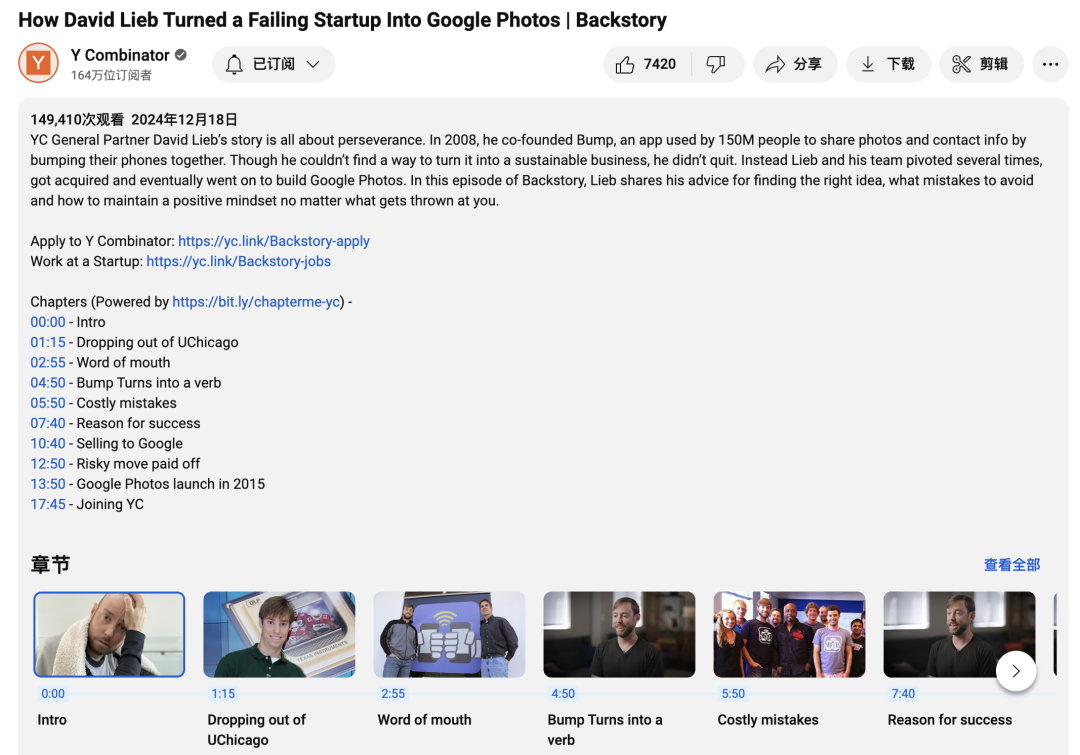
Image | Video Shownotes
Part.01
Early Years: From Average Student to Founder
David Lieb grew up in the suburbs of Texas. His parents were an engineer and a teacher. He loved math, science, and computers, and always pushed to be at the top of his class. He studied electrical engineering and computer science at Princeton, then went to Stanford for his PhD to work on AI-related projects. Though he met some brilliant people at Stanford and worked on a DARPA challenge project — essentially the precursor to today's self-driving cars — David soon realized he wasn't cut out for academic research. He dropped out of the PhD program and joined Texas Instruments.
Part.02
The Spark: How Bump Became a Sensation
In 2005, while working at Texas Instruments, David saw the news that two 25-year-olds had sold YouTube for $1 billion and thought — "They're not so different from me." Back then, if a smart engineer wanted to do something beyond engineering, the path was business school, then management at a tech company. So David enrolled at the University of Chicago's business school.
During his first week, Apple had just released the iPhone. Everyone was exchanging phone numbers and texting to stay in touch. After manually entering ten classmates' contact info and confirming each one, it hit him — phones were incredibly powerful computers. Why were they still punching in digits to swap contact details? That became the foundation for Bump: two phones tap together, contact info exchanged.
David and his friend Andy decided to build it. Working nights and weekends, they spent about three to four weeks developing it and released it on the App Store. Bump launched in late March 2009. With zero marketing, it got a few dozen downloads on day one, a few hundred on day two, and over a thousand by day three. The app quickly caught media attention, and as the user base grew, so did its visibility.
All three founders came from engineering backgrounds. Andy handled coding, David worked on algorithms and design, and Jake helped with design and marketing.
Part.03
Early Lessons: Letting Intuition Drive Decisions
Bump's early days taught David two key entrepreneurial principles:
-
Anyone can create anything. Even without relevant experience, decisions made purely on intuition can succeed.
-
If you're building for yourself, you can trust your own intuition. David and Andy's design and product calls weren't based on market research or outside opinions — they came from their own needs and experiences as users.
Step one: find a problem that bothers you. Step two: solve it.
Part.04
YC's Backing: From Small Team to Accelerated Growth
To convince their parents and the school that they were doing "something serious," David and Andy applied to Y Combinator. After getting in, they received $16,667 in seed funding. David dropped out of business school to focus on the startup. By Demo Day, Bump had already climbed to the #2 spot on the App Store. Even MC Hammer — the American rapper, dancer, and entrepreneur — invested in them. Steve Jobs featured Bump in one of his keynotes.
However, despite Bump's rapid growth, David noticed that people weren't sticking with it. Bump was fun, but its lasting value and user retention remained a problem. The team had raised too much money while investors were still enthusiastic, yet failed to answer this most critical question. In David's own words, they made every mistake that YC now warns founders against. He mapped value against frequency in a quadrant — some products are high-value, high-frequency; some high-value, low-frequency; some low-value, high-frequency. What founders dread most is landing in the low-value, low-frequency quadrant. That's exactly where Bump sat.
Part.05
The Second Act: From Bump to Flock
They returned to a stripped-down approach: talking to users. By then, Bump had burned through over $15 million. David personally reached out to the first 100 users and discovered they were actually using it to share photos, not exchange contacts. At first he couldn't understand why. He later figured out the specific scenario: family members were using Bump to send photos to each other. He decided to build a dedicated photo-sharing app. That became Flock.
Flock was a location-based, socially-aware photo-sharing app. Its standout feature was identifying which friends you had taken photos with, letting you share those photos with them. David's team poured enormous effort into improving Flock, but couldn't get users to stick around. He did user research and realized that while people said they "loved the app," they weren't actually using it. "I think getting people to tell you uncomfortable truths is genuinely hard," he reflected. David turned to the data — a painful period for the team. They had high hopes for Flock, but the results fell flat. They knew Bump had downloads, but its business prospects were murky. The frustration was compounded by the risk of running out of money.
"I needed to find a way fast to keep this startup plane from crashing," David said.
Part.06
The Payoff: Google Photos
He went back to YC and sought advice from Paul Graham, the renowned Silicon Valley entrepreneur, investor, and co-founder of Y Combinator. Graham told him: "What you should do is replace the default photos app on people's phones. That's the only way they'll actually use your sharing features."
At first, David thought this was impossible. But then he considered it — the iPhone's built-in Photos app wasn't particularly good. What if they built something better?
So he set out to design an entirely new photo app. The company had only four to five months of cash left. Internally, they called it Photo Roll. It never officially launched; David said he was basically the only one using it on his phone. But he realized he had built a photo app where sharing felt completely natural.
He approached many companies to see who might acquire Bump and see value in Photo Roll. Surprisingly, no one wanted Bump, but several were interested in Photo Roll. Eventually, his company was sold to Google. Photo Roll's features, combined with Google's technology, became Google Photos.
The post-acquisition period was a long one. Initially agreed-upon plans were shelved. Google wanted to prioritize integrating the features into Google+, its heavily promoted social app at the time. David disagreed. He described his routine: finish his assigned work in the mornings, then spend afternoons seeking out engineers and designers to discuss how to build Google Photos. In the process, he won their support — even they would say while working on the app, "This is the photo-sharing app I actually want to use."
Looking back, David said, his drive to stick to his convictions came from recognizing how many opportunities he had missed during the Bump years. Looking back, he felt he had spent five years building something that ultimately lacked lasting value. By contrast, if Photo Roll could be amplified by Google's capabilities, Google Photos represented that long-term value — and creating it felt like giving something back to the 30-plus employees who had worked at Bump. That's why he was so determined to make Google Photos happen. Even when a group lead kicked him off the team over disagreements, he didn't give up. He was removed twice. Both times, he kept searching for allies inside Google until he finally got the green light to continue.
"The lesson from this long journey is that a person can take on far more risk than they expect or imagine. If you can endure it, there will always be a big opportunity waiting on the other side," David Lieb said.
Though it launched without major marketing, Google Photos — incorporating Photo Roll — became one of the fastest-growing products globally within just nine months. In under four years, it surpassed one billion users.
Part.07
Life Lessons: Don't Waste Time on Meaningless Things
During COVID, David was suddenly diagnosed with leukemia. From the devastating blow of believing he might not have long to live, to gradually accepting reality, to starting chemotherapy — he went through a harrowing period. It made him realize life is short and shouldn't be squandered on meaningless things. So he made a pivotal decision: leave Google and join YC to support founders on the front lines of entrepreneurship. He wanted to pass on the lessons and mistakes from his own journey to a new generation of founders, helping them avoid unnecessary detours — "the kind of advice I wish someone had given me when I was starting out."
📮 More Reading



Linear Bolt
Bolt is an investment initiative by Linear Capital focused on early-stage, global-market-facing AI applications. It upholds Linear's investment philosophy, concentrating on projects driven by technological transformation. Bolt aims to help founders find the shortest path to their goals — lighter, faster, and more flexible in both execution and investment approach. In the first half of 2024, Bolt invested in seven AI application projects including Final Round, Xinguang, Cathoven, Xbuddy, and Midreal.