72 Hours After Launch, Moonshot AI K3 Posts Its First Results

Open-Source Players in the First Tier


In the early hours of July 17, Moonshot AI released Kimi K3. It's a 2.8-trillion-parameter MoE (Mixture of Experts) model, activating 16 out of 896 experts per token, with native visual input support and a 1-million-token context window. The company calls it the "first open 3T-class model."
After a new model drops, benchmark tests are usually the first reference for understanding its capabilities. But scores alone mean little. What matters is what each test actually answers — can this model write code, do a lawyer's job, build your spreadsheets for you.
As a first-round investor in Moonshot AI, we've supported and witnessed every evolution from Kimi Chat to Kimi K3 over the past three-plus years.
This time, we've compiled third-party test results that emerged within 72 hours of K3's release. What we see is that across multiple comprehensive evaluations, the only models ahead of K3 are the latest releases from Anthropic two weeks ago and OpenAI one week ago — the time needed to catch the frontier has shrunk to weeks.
This confirms the judgment we made three years ago when we invested: whatever the industry's narrative, this team has the ability to stay at the cutting edge of model competition long-term, to bring itself to the center of the table.
General Intelligence
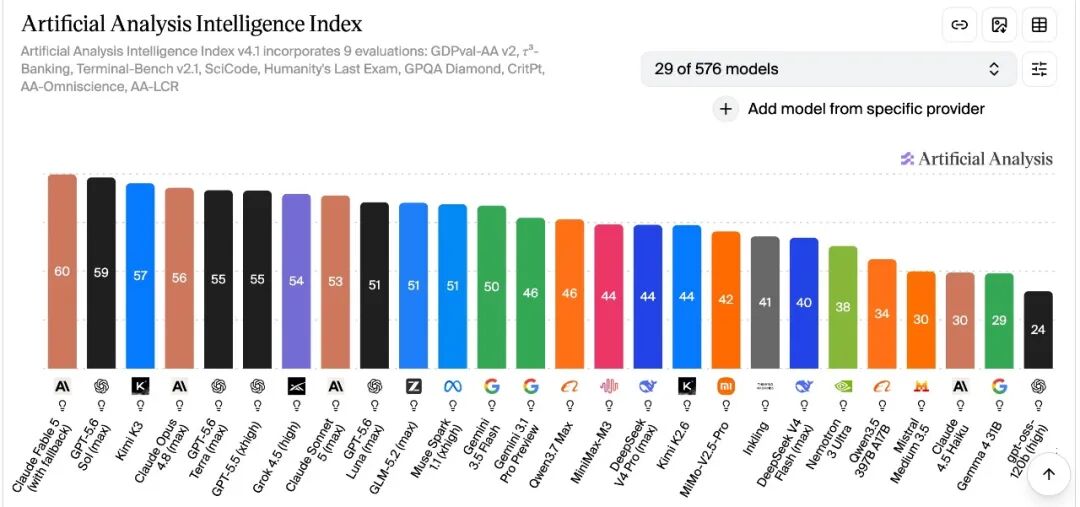
Artificial Analysis's "Intelligence Index" is a comprehensive exam testing AI's general intelligence: it aggregates scores from nine demanding evaluations — covering reasoning, math, coding, agentic tasks, and knowledge work — into a single total score, with independent third parties running uniform tests, calculating costs and token efficiency under identical conditions so models can be compared directly.
Kimi K3 scored 57, ranking third on the index, behind only Claude Fable 5 (60) and GPT-5.6 Sol (59), and ahead of Claude Opus 4.8 (56).
We also note that average cost per task is roughly $0.94, comparable to GPT-5.6 Sol ($1.04) and about half that of Claude Opus 4.8 ($1.80).
What this means: This is the first time an open-weights model has cracked the top three of this leaderboard. Previously, "open source lags closed source by half a generation" was the industry's default assumption, and that assumption is now breaking down — for any organization that needs private deployment but won't compromise on capability, there are now more options.
https://artificialanalysis.ai/models/kimi-k3
Front-End Development
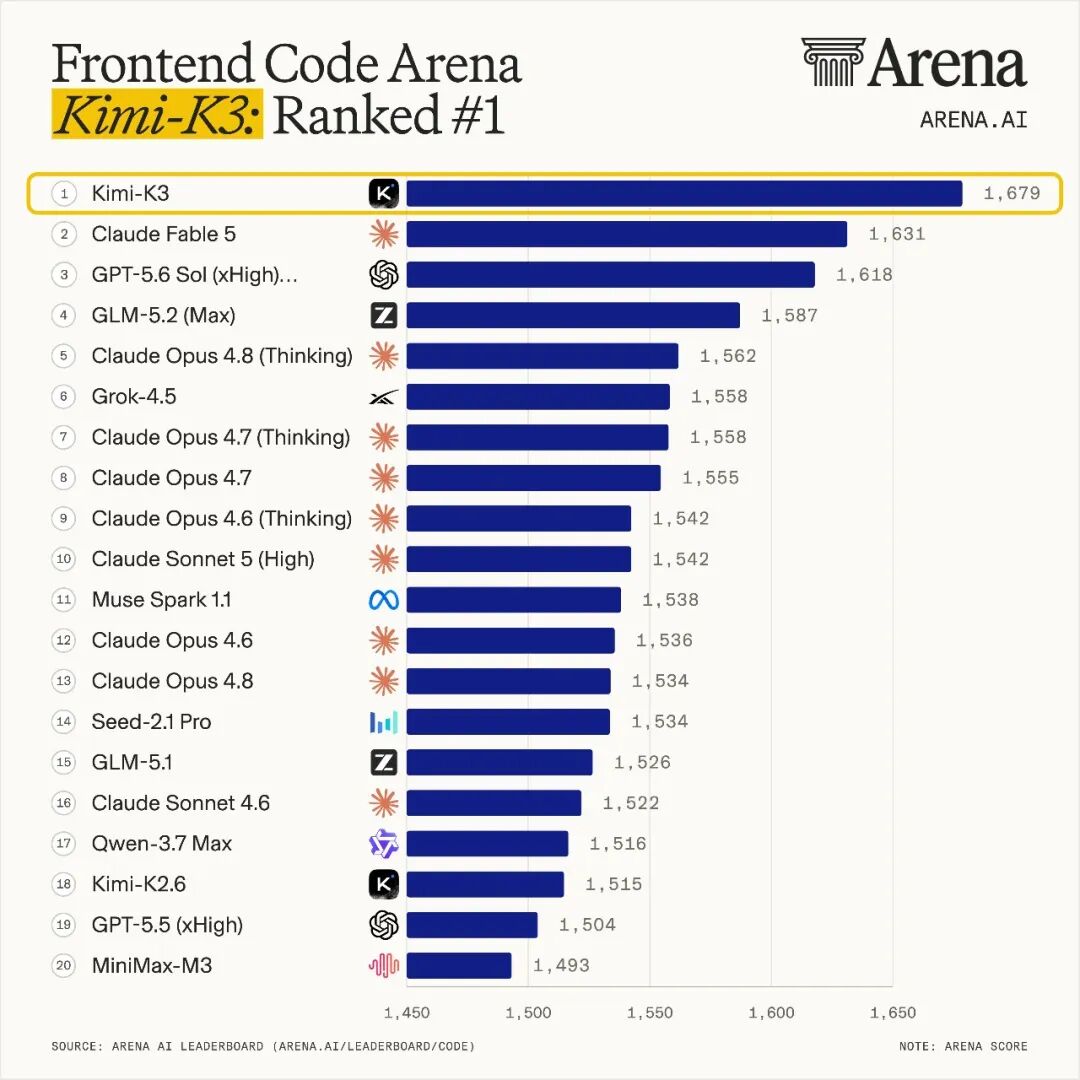
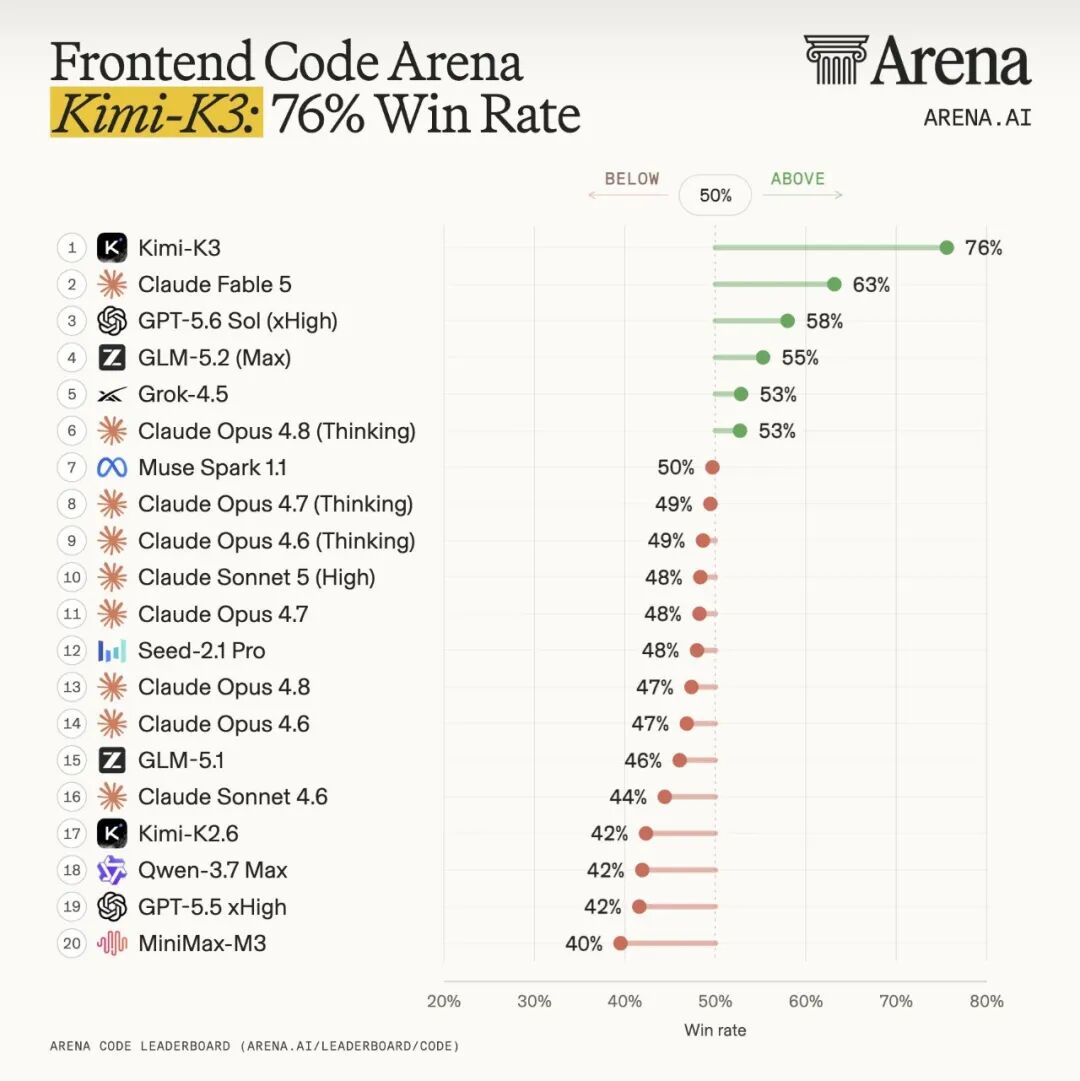
Code Arena, created by UC Berkeley researchers, uses an anonymous double-blind battle format and aggregates millions of real user feedback globally, widely considered the gold standard for large model programming ability. Kimi K3 ranked first in 6 out of 7 front-end development categories, placing second only in gaming, behind Fable 5.
On the overall leaderboard, K3 topped the rankings with a 76% win rate, surpassing Fable 5's 63% and GPT-5.6 Sol's 58% — meaning that when its output was compared one-on-one with other models on the same task, it was chosen as the better one 76% of the time on average.
What this means: Unlike standardized tests, Arena scores come from blind human voting, measuring "which output people actually prefer." Front-end is a subjective domain where you can't win by memorizing problems — whether an interface looks good and works well is for humans to decide. K3's top ranking here shows its strengths extend beyond closed tasks that can be gamed through test prep.
https://arena.ai/leaderboard/code/webdev
Long-Horizon Development
DeepSWE is a practical programming exam testing "can AI work as a software engineer": Datacurve wrote 113 original long-cycle engineering tasks from scratch, spanning 91 real open-source repositories across 5 programming languages, requiring AI agents to read unfamiliar codebases, modify across multiple files, and pass behavioral verification.
Since all questions are newly written and don't exist in training data, memorizing answers is useless.
K3 debuted at third place with a 69% task completion rate, behind GPT-5.6 Sol (73%) and Claude Fable 5 (70%). Test creator Datacurve noted: this is the first open-weights model to deliver frontier-level performance on this test.
What this means: This test simulates a real engineer's first week on the job — independently working in an unfamiliar codebase. A score around 67 means roughly two-thirds of long-horizon engineering tasks can be completed end-to-end. AI coding is currently the most certain commercialization scenario for large models (Claude Code alone generates over $1 billion in annual revenue), and now this business has its first open-source competitor at the same magnitude.
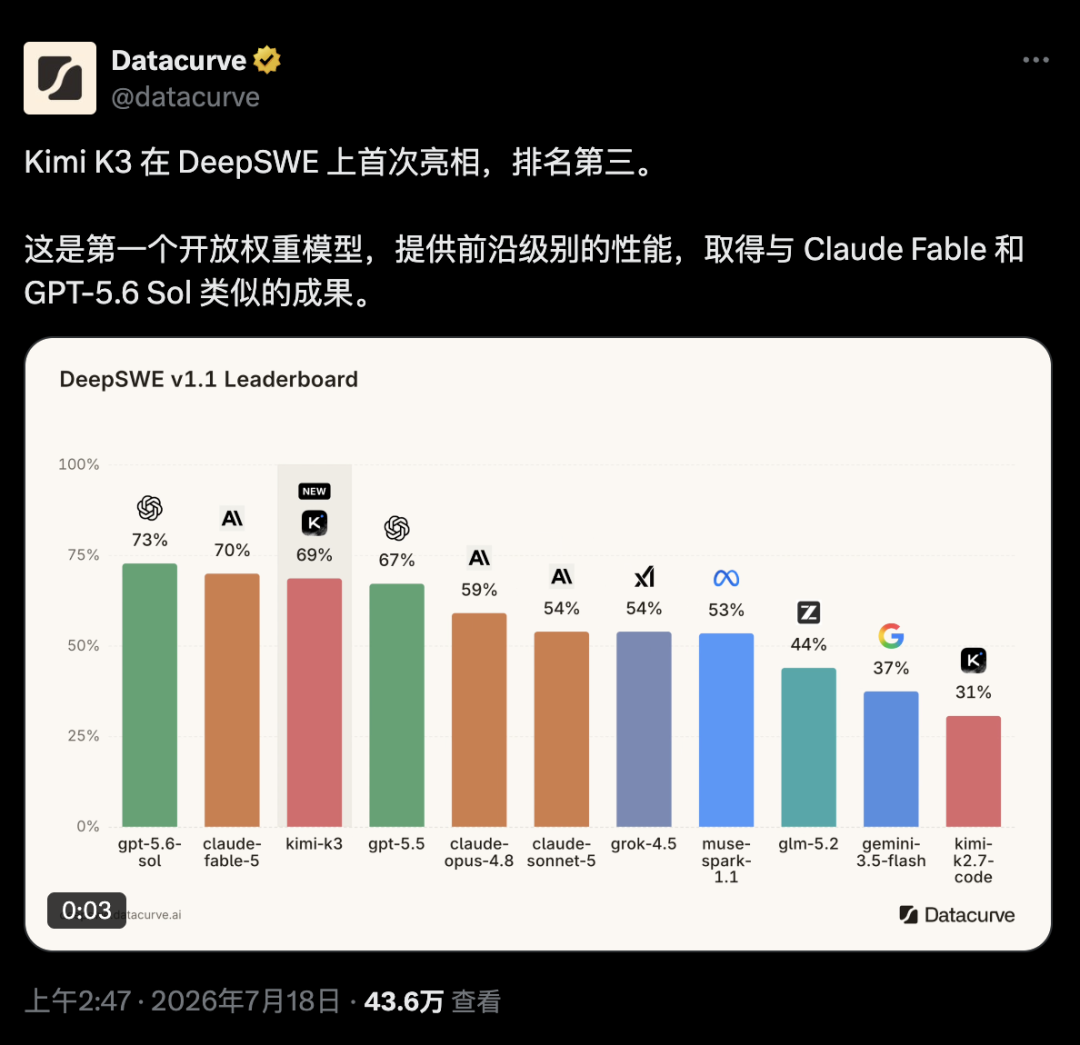
https://x.com/datacurve/status/2078189882707730535
Extreme Programming
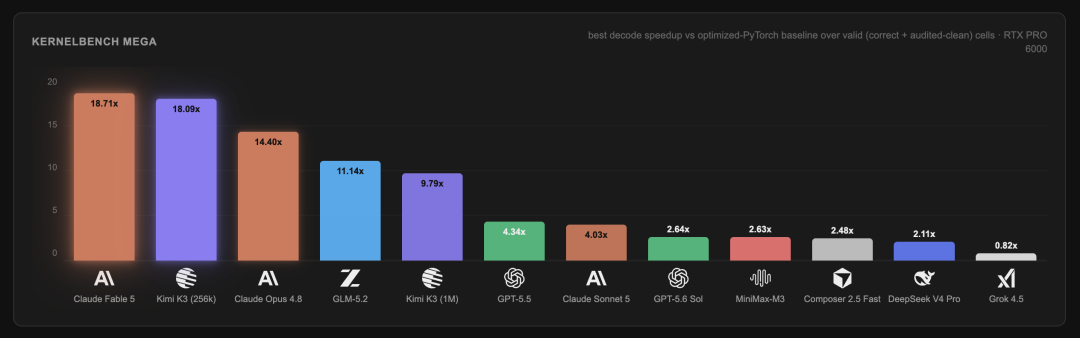
KernelBench is an extreme programming exam testing "can AI write GPU-level code": it has AI agents hand-write and optimize CUDA kernels for PyTorch tasks on real GPUs, scored on only two criteria — does it run correctly, and how many times faster is it than PyTorch's official optimization. The Mega suite goes further, requiring the entire model to be compressed into one "mega kernel."
On the hardest Mega suite, K3 (256k version) ranked second with a best speedup of 18.09×, behind only Fable 5's 18.71×, well ahead of Opus 4.8 (14.40×) and GPT-5.6 Sol (2.64×).
What this means: Hand-writing CUDA kernels is a skill perhaps only a few thousand people globally truly master, and it's a critical lever for AI infrastructure costs — a 2× faster kernel means the same card can serve twice as many users. Models becoming capable of this kind of work means AI is reaching the bootstrapping phase of "optimizing AI's own runtime efficiency."
Legal Work
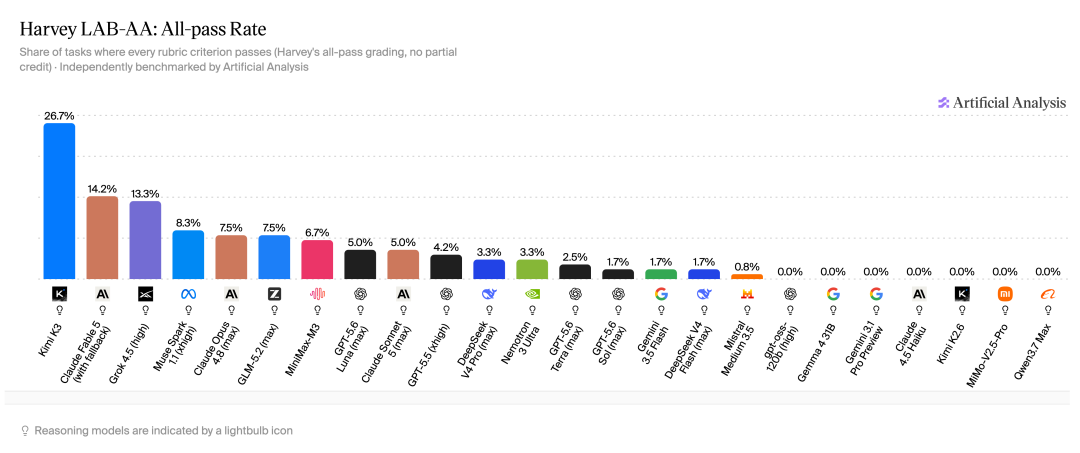
Harvey LAB-AA is an exam testing "can AI work as a lawyer": it assigns AI agents over 1,200 tasks drawn from real law firm workflows (reviewing emails, checking contracts, writing legal reports), with extremely strict grading — each question has dozens of expert scoring points, all of which must be satisfied to pass.
K3 ranked first with a 26.7% full-credit pass rate — this number looks low because every question requires satisfying dozens of scoring points to count; second-place Fable 5 scored 14.2%, making K3 nearly double.
What this means: The "all or nothing" grading method doesn't measure whether the model "sounds like a lawyer," but whether its output can be delivered directly. Law is among the highest-unit-price professional services, and scores like these will determine whether open-source options are genuinely on the shortlist when legal AI companies like Harvey select underlying models.
https://artificialanalysis.ai/evaluations/harvey-lab-aa
Spreadsheets
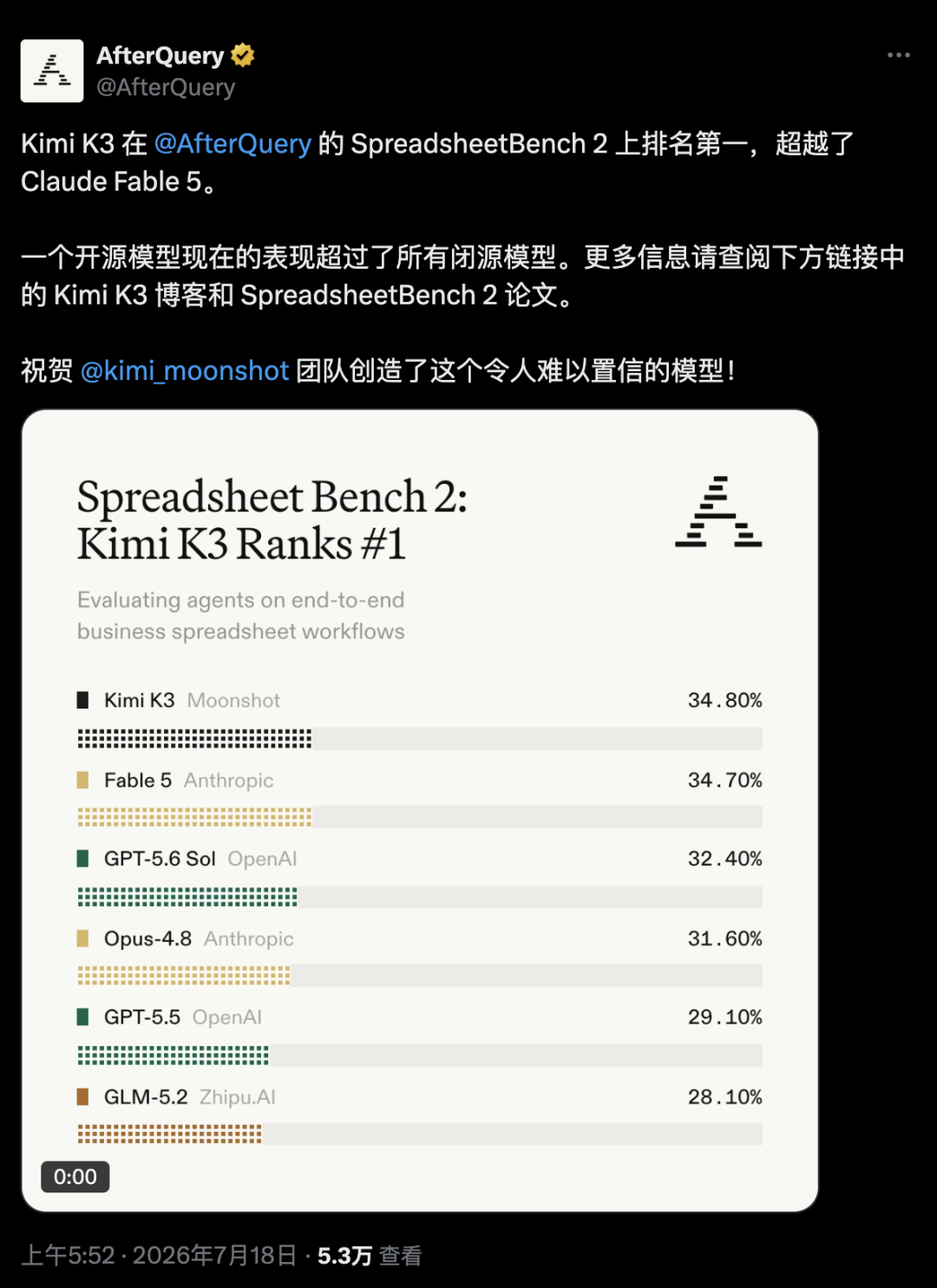
SpreadsheetBench 2 is a practical exam testing "can AI do Excel tasks for you": it uses real company financial reports and business data to have AI agents complete 321 full-workflow tasks including building financial models, debugging spreadsheets, and creating visualizations — averaging 12 worksheets and nearly 600 cell modifications per task, with results required to match the standard answer exactly.
K3 ranked first with a 34.8% pass rate, edging out Fable 5 (34.7%) by 0.1 percentage points, with GPT-5.6 Sol at 32.4%.
What this means: Spreadsheets are the daily work interface for hundreds of millions of white-collar workers globally, and the most universal scenario for "AI doing ordinary people's jobs." This test measures reliability, not cleverness — 600 cell modifications with zero tolerance for error.
https://x.com/AfterQuery/status/2078236494326817017
Creative Writing
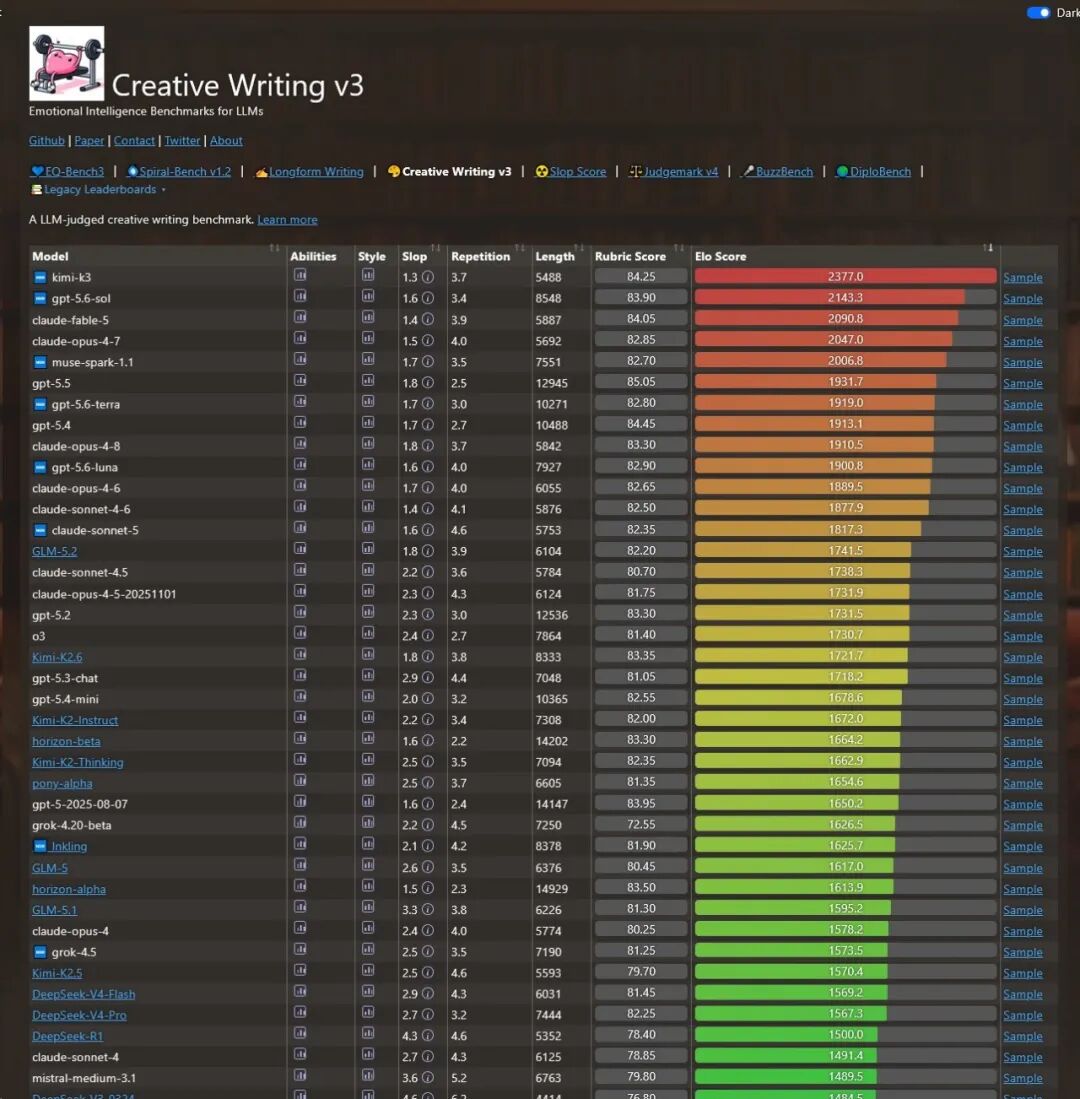
Creative Writing is a literary competition testing "can AI write good fiction": it uses 32 deliberately tricky prompts (testing humor, romance, spatial sense, unique perspective) to have models write stories, then has another large model score them against 22 criteria and run pairwise matchups to produce Elo rankings, while also tracking "Slop cliché index" and "Repetition index" to catch the most annoying formulaic tics in AI writing.
K3 ranked first with an Elo of 2377, ahead of GPT-5.6 Sol (2143) and Fable 5 (2091), with a cliché index of 1.3 — the lowest among top models.
What this means: Writing ability has long been considered strongly tied to the cultural foundation of training data, a traditional weak spot for Chinese lab models in the English-speaking world. This result shows K3's improvement isn't limited to "hard" tasks like code and math — for developers of content, marketing, and education applications, this is a dimension easily obscured by benchmark scores during model selection.
https://eqbench.com/creative_writing.html
Web Development
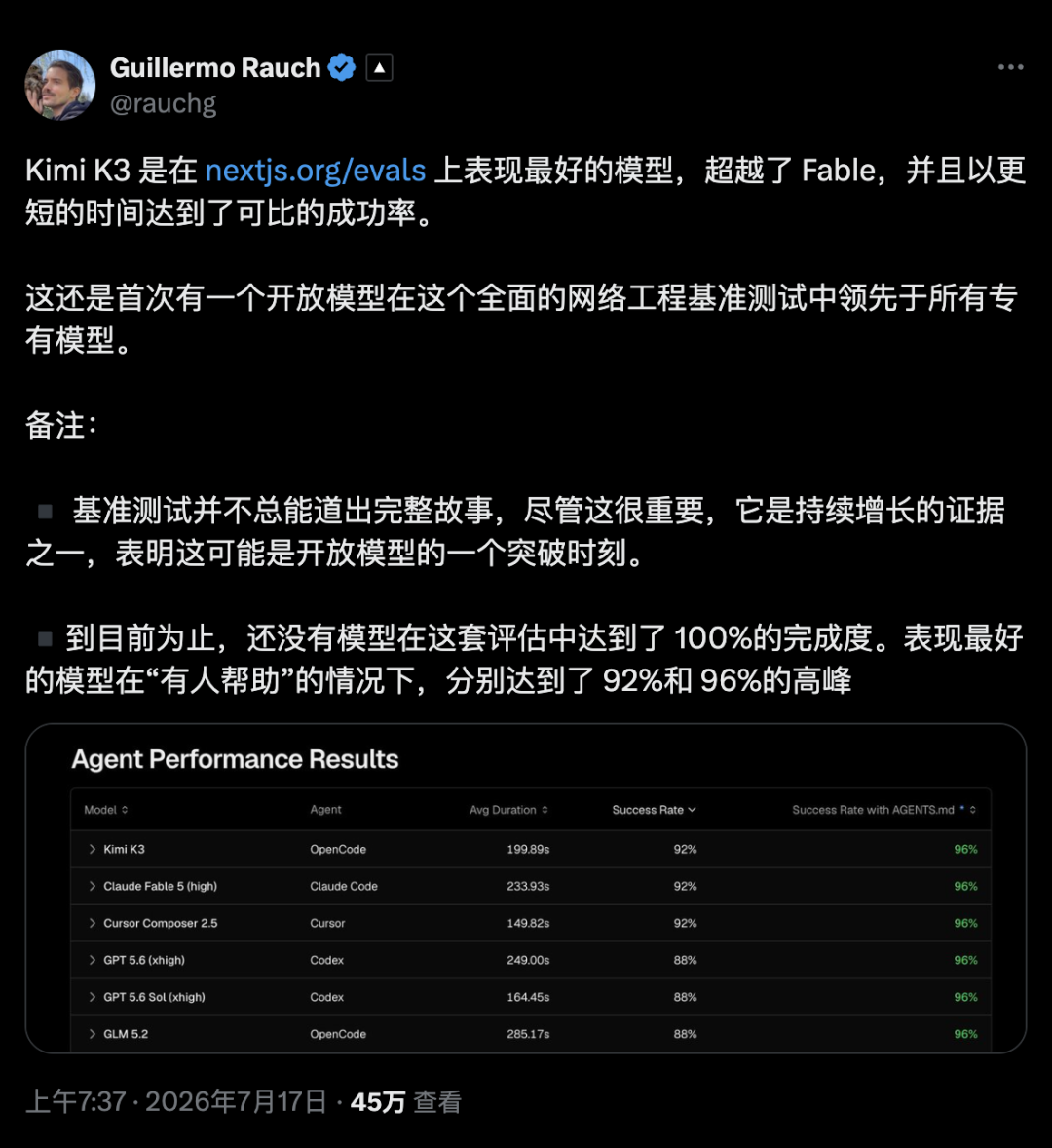
Next.js Evals is a vertical practical exam testing "can AI build front-end projects": officially authored by Vercel, it has AI coding agents complete Next.js framework code generation and version migration tasks, ranked by task success rate and execution time.
K3 topped the rankings: 92% task success rate, tied with Claude Fable 5 and Cursor Composer 2.5 for highest, with average completion time of 199.89 seconds — about 15% faster than Fable 5 (233.93 seconds). Vercel CEO Guillermo Rauch stated this is the first time an open model has led all proprietary models on this test.
What this means: Unlike general leaderboards, this is a test by a framework vendor for selecting models for their own users — the test authors actually need the answers. Version migration and similar tedious tasks are precisely what developers most want to hand to AI, and ranking well here means being close to real daily engineering needs.
https://x.com/rauchg/status/2077900518404321759
Economic Value
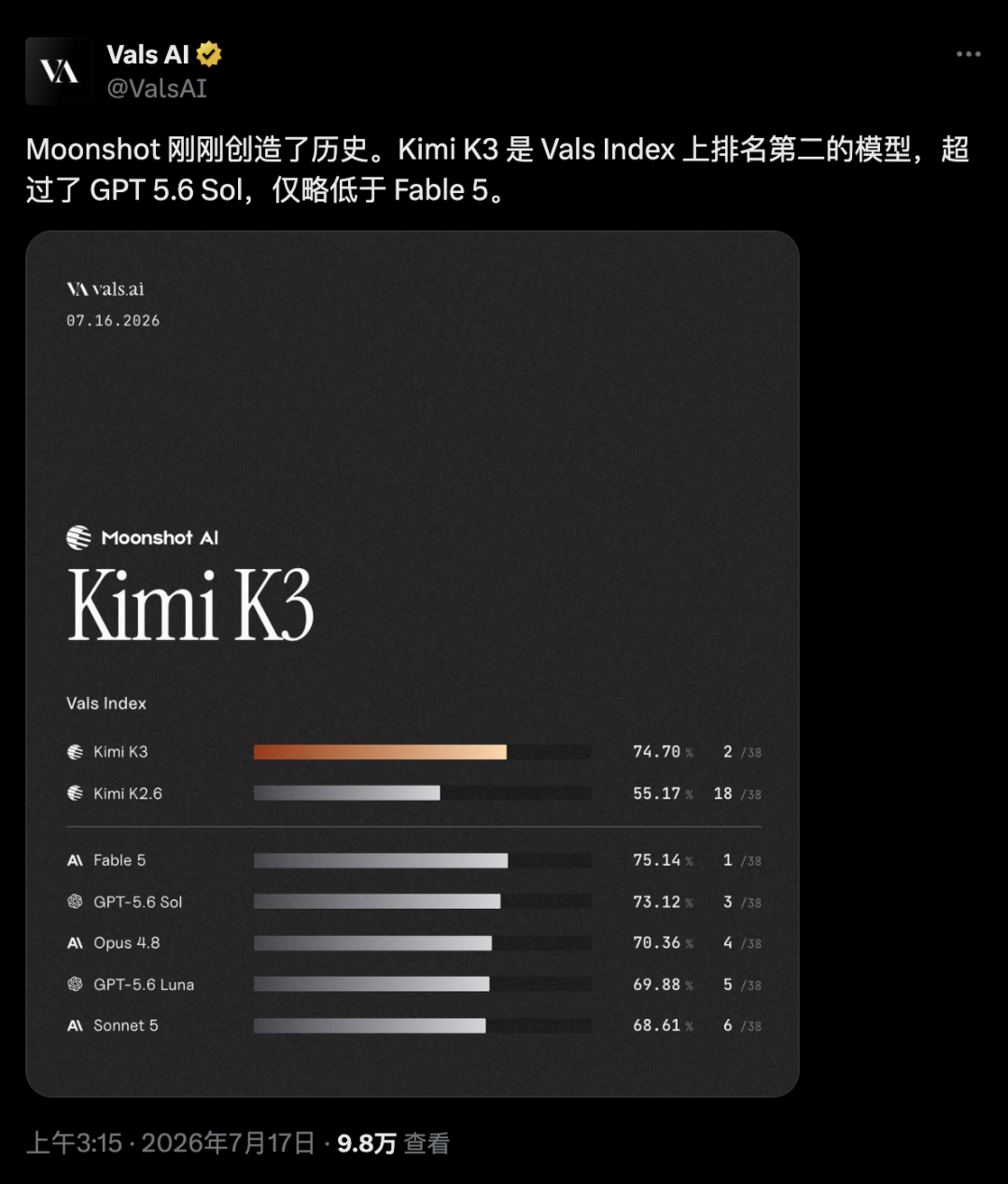
Vals Index is a comprehensive exam testing "how much actual economic value can AI create": unlike ordinary leaderboards that weight all capabilities equally, it weights scores by industries' actual contribution to GDP — finance tests corporate financial analysis and multi-step financial reasoning, programming tests bug fixing, command-line operations, and end-to-end app building, ultimately synthesizing a single "economic impact" score.
Among 38 tested models, K3 ranked second with 74.70%, behind only Fable 5 (75.14%), ahead of GPT-5.6 Sol (73.12%); compared to previous-generation K2.6 (18th place), it advanced 16 positions.
What this means: This leaderboard represents a shift in the evaluation industry: from "who scores highest on tests" to "who creates the most economic output." Ranking highly under this commercially-weighted methodology shows K3's capability distribution aligns with real economic demand, rather than being skewed toward academic tasks.
https://www.vals.ai/benchmarks/vals_index
The Open-Weights Contender in the Top Tier
Putting the nine tests together, the picture is clear: K3 ranks first in five individual categories — front-end development, legal work, spreadsheets, creative writing, and web development; on comprehensive leaderboards measuring overall strength, it places third on Intelligence Index, second on Economic Value, and third on Long-Horizon Development — overall still behind Claude Fable 5, but trading wins with GPT-5.6 Sol.
Community experience aligns with the benchmarks: multiple developers on Hacker News reported that in blind tests on real programming tasks, they couldn't distinguish it from Fable 5. Given that Fable 5 and GPT-5.6 Sol were released just two weeks and one week ago respectively, this convinces us: the gap between open-weights models and closed-source frontiers has narrowed from months to weeks.
Of course, there's another side to this report card that needs to be recorded honestly: at $3 per million input tokens and $15 per million output tokens, K3 is no longer the budget option it once was, though it still offers tremendous value — just 40% of Opus's price, 20% of Fable's.
The real milestone comes in one week. On July 27, K3's full weights will be officially released, at which point researchers and developers globally can build on top of it. Leaderboard positions will obviously shift month to month, but the capabilities at the intelligent frontier are being developed and delivered to more people in a more open form, at a faster pace.
Scores and commentary current as of July 19, from third-party evaluators including Artificial Analysis, Datacurve, Vercel, EQ-Bench, and public Hacker News discussions; official self-reported results per Moonshot AI's release blog.