From Medallion to AI-Native Asset Management: GIM Closes Three Funding Rounds

Will a Century-Old Asset Management Industry Be Rewritten by AI?



GIM, an AI-native asset management firm, recently closed a Series A round of tens of millions of dollars, co-led by Jinyong Investment (a HONY Capital vehicle) and B Capital, with IDG Capital participating. Howard Morgan, global chairman of co-lead investor B Capital, is also co-founder of quantitative investing giant Renaissance Technologies.
This marks GIM's third funding round in six months since its founding last July — its angel round was co-invested by MONOLITH and 5Y Capital, and its angel+ round was led by SAIF Partners.
MONOLITH, one of GIM's earliest institutional investors, continued to invest in this round.

GIM founder Jiahao Xu spent over a decade in tech investing at Neumann Capital and 5Y Capital — a rare cross-stage, cross-market background among Chinese investors.
His decision to start a company crystallized in early 2025, as OpenAI's o-series reasoning models iterated rapidly and DeepSeek laid out its chain-of-thought for everyone to see. Analyzing and reasoning from public information — something AI could now do, and do faster and more comprehensively than most analysts. From this, he concluded that investing was due for a new methodology, one that would unify discretionary and quantitative approaches.
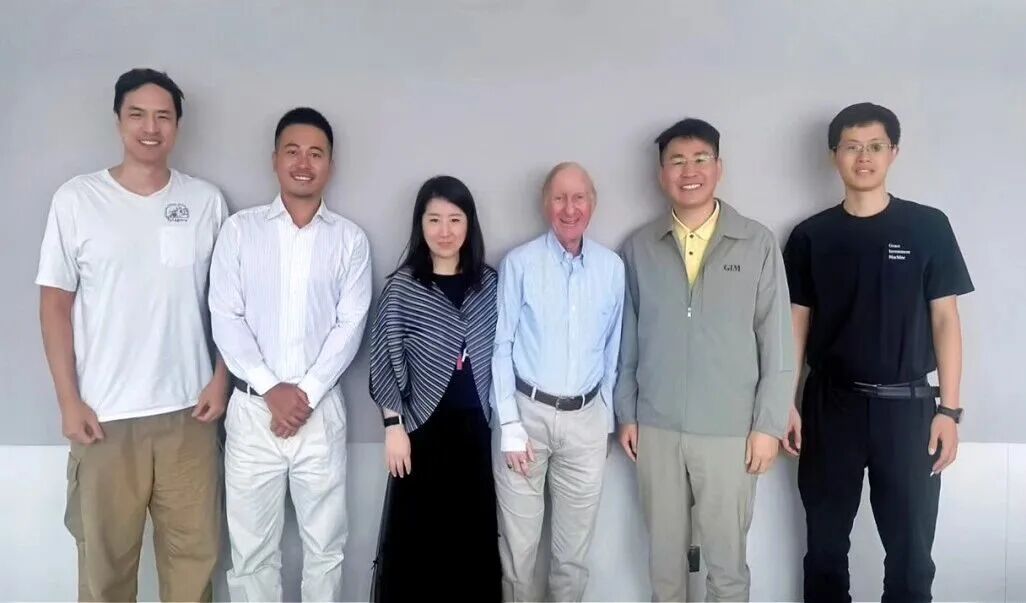
Global Partner Howard Morgan (third from right) with GIM founder Jiahao Xu (second from right)
GIM co-founder Qi Liu holds a PhD from Oxford University and is an assistant professor at the University of Hong Kong, with extensive background in large model pre-training and multimodal research, having worked at DeepMind and Meta FAIR.
The team now numbers roughly 25, with core members from leading international AI labs, top quantitative firms, and elite university research groups. The advisory bench includes several seasoned veterans from quantitative and asset management industries.

To understand what GIM is building, start with the problem it's trying to solve.
Traditional investing splits into two paths: discretionary investing relies on human experience and judgment; quantitative investing relies on mathematical models analyzing price and trading data. GIM believes that as large models' reasoning capabilities leap forward, these two paths are being merged by a new capability — AI now possesses semantic understanding and reasoning approaching human analysts, while retaining the efficiency of quantitative models in processing massive datasets.
GIM aims to fuse both capabilities into one system, where AI doesn't merely assist human decision-making but progressively takes over the entire pipeline from research to trade execution.
This breaks down into two technical tracks.
The first is a proprietary financial time-series foundation model. This isn't a matter of fine-tuning a general-purpose model like ChatGPT — the team tried that, found it unsatisfactory, and rebuilt from scratch. The logic parallels AlphaFold in biology: train a dedicated model from scratch on tick-by-tick market data, letting it learn directly to predict asset returns across time horizons and extract complex market features.
The model currently scales to 8B parameters, and the path from 30M to 8B has shown clear scaling-law effects — a clean upward curve. The endgame here is AI that understands market dynamics without human-defined rules. Of course, this track remains early-stage; the bottleneck is data volume — financial time-series data is far smaller than internet text, requiring expanded synthetic data through mixed frequencies and cross-asset approaches.
The second is the CogAlpha multi-agent system, which is already running live and represents the most concrete progress to date. The core idea isn't having a large model directly call trades, but having it write code to search for market patterns — these patterns are the "factors" of quantitative investing, except instead of being hand-written by humans from experience, they're automatically generated, validated, and culled by AI, with each signal undergoing hundreds of rounds of self-optimization before stabilizing.
The efficiency gains so far are stark: in October 2024, the GIM team needed two weeks to produce a new factor; now they generate dozens to hundreds per day.
The core paper underlying this methodology, Cognitive Alpha Mining via LLM-Driven Code-Based Evolution, has been accepted to the main conference of top NLP venue ACL 2026 with an Oral recommendation — it proposes a multi-agent collaborative framework covering market structure, risk characteristics, price-volume relationships, and other dimensions for signal mining, outperforming 21 baseline models including GPT-4 series across multiple datasets covering US, China, and Hong Kong markets.
Globally, few teams are systematically exploring AI-driven investment research from the foundation-model level and earning academic recognition. GIM is one of them.

GIM maps its technical evolution to autonomous driving levels: from L2 "copilot" (helping organize information and generate insights, akin to today's Perplexity or DeepSeek), to L3 "advanced copilot" (simulating senior analyst-level deep analysis to assist decisions), to L4 "full self-driving" — AI independently completing research, signal generation, and portfolio management without human intervention. GIM's self-positioning aims directly at this endpoint: L4.
In other words, the company's ultimate goal isn't to build a "better research tool," but to become the asset management infrastructure of the AI era — replacing traditional fund managers with AI agents, transforming the entire investment decision chain that previously depended on human judgment, energy, and experience into a continuously learning, self-iterating automated system.
Internally, the team calls this direction the "third-generation investment paradigm": first generation was Buffett-style discretionary investing, second was Renaissance-style quantitative investing, and third is AI agents dominating research, decision-making, and execution end-to-end.

MIT professor Andrew Lo last year mapped out a "century of investment innovation": from 1920s speculation, to Graham and Buffett's value investing, to Markowitz's modern portfolio theory, to the efficient market hypothesis and rise of passive investing, to David Shaw and Jim Simons defining quantitative investing, to ETFs and high-frequency trading — the industry undergoes a paradigm shift roughly every decade or so.
GIM's ambition is to write the next entry on this timeline.
Supporting this thesis is a set of real-world figures: over the past three years (2021–2025), China's ETF (exchange-traded fund) market has exploded, growing from 1.4 trillion yuan in 2021 to surpassing 6 trillion yuan in 2025, with extremely high compound annual growth. Overseas, leading asset manager BlackRock's AUM has broken through $14 trillion, maintaining double-digit annual growth. Over 70% of US equity trading is already executed through automated systems.
Capital is voting with its feet, migrating from reliance on human judgment toward more systematic, more automated investment approaches.
A significant investor in this round, industry legend Howard Morgan, is himself a living fossil of asset management. In 1982, he co-founded Renaissance Technologies with Simons and served as its first president for seven years — among the earliest core architects of the hedge fund that would go on to produce the most astonishing track record in investing history (the Medallion Fund's 30+ year annualized returns exceeding 40%). He later co-founded early-stage firm First Round Capital, backing companies including Uber, Roblox, and LinkedIn, and now steers B Capital with over $6 billion under management.
His involvement is a notable signal — someone who personally built the operating system of the last quantitative paradigm is now placing his bet on the next generation. The significance of this investment extends beyond capital itself: it indicates that AI-native asset management has entered the sightlines of top quantitative practitioners.

GIM's first AI-driven asset management products have completed registration with the Asset Management Association of China and opened for fundraising. The company has also established a Hong Kong entity licensed for Type 4/9 (securities advisory and asset management) activities. The team plans to gradually extend its existing price-volume signal capabilities into fundamental information such as earnings reports and news, with the ultimate goal of building a fully self-developed, mutually reinforcing closed loop across data, models, agents, and products.
A company founded less than a year ago, completing three rounds in six months while simultaneously earning an ACL Oral and going live with real trading — for GIM, this is a strong start. But the real test is just beginning. The next step is to push the methodology's boundaries from price-volume data into genuine fundamental judgment, and to consistently generate stable alpha.