The Eve of BrainGPT?

When AI Starts Reading Minds


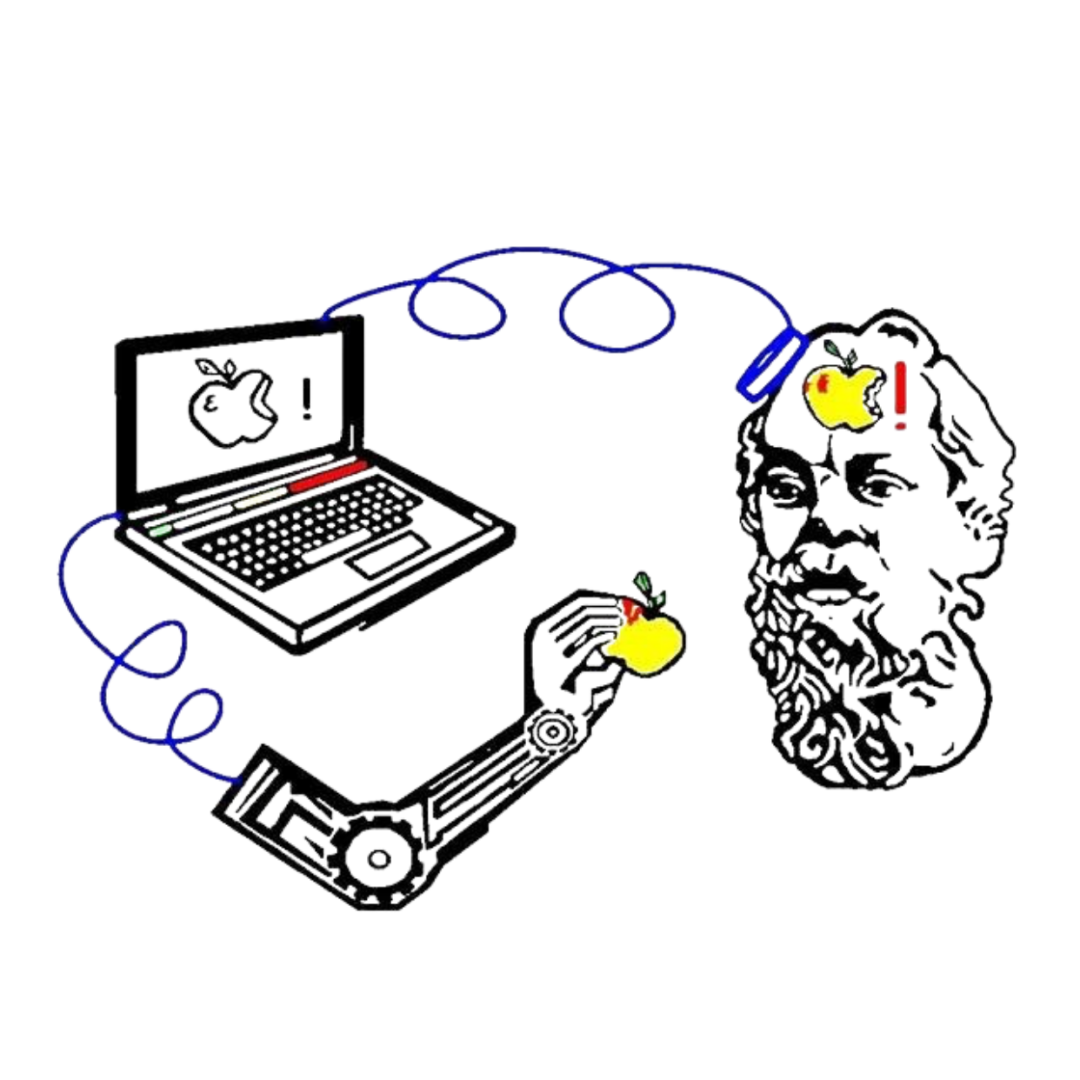
In 2006, a patient paralyzed by spinal cord injury had a microelectrode array implanted in his motor cortex. By imagining hand movements, he could control a computer cursor, open email, adjust the TV, and even perform simple robotic arm motions. The paper, titled Neuronal Ensemble Control of Prosthetic Devices by a Human with Tetraplegia, was the first to so directly demonstrate that motor intentions in the brain could bypass the body entirely and reach a machine.
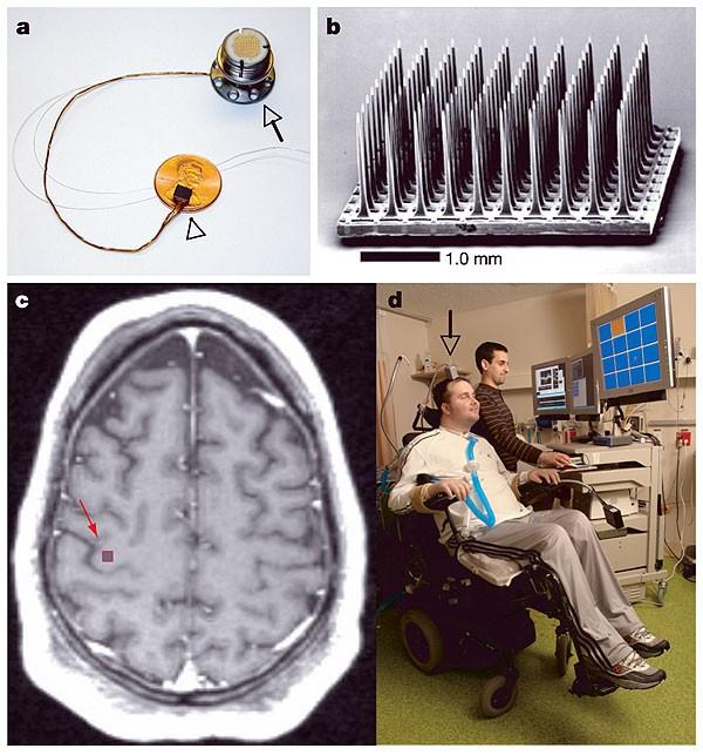
In 2006, Hochberg et al. demonstrated an early BrainGate invasive BCI implantation method in the paper Neuronal Ensemble Control of Prosthetic Devices by a Human with Tetraplegia
Fifteen years later, another paralyzed patient imagined handwriting letters and produced text at 90 characters per minute. By 2023, language BCIs reached 62 and 78 words per minute, and could even drive a digital avatar to speak.
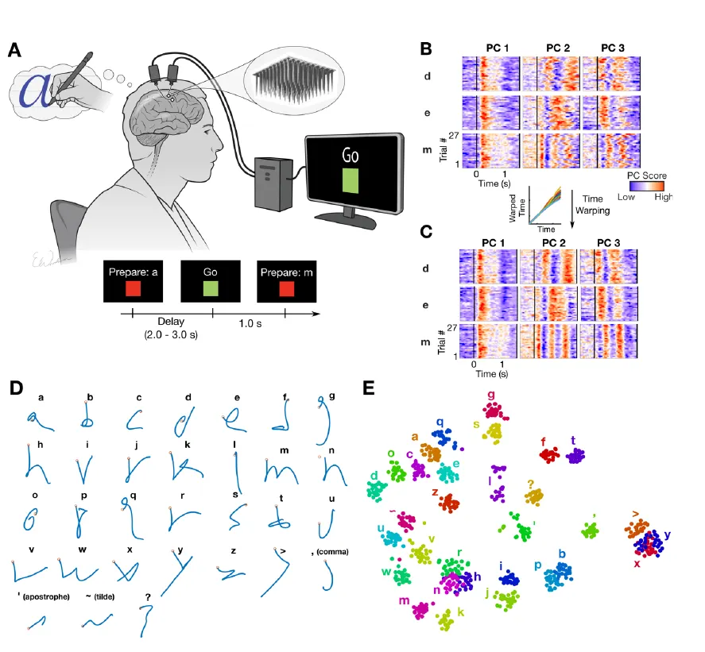
Neural activity encoding of imagined handwriting, as shown in Willett et al.'s 2021 paper High-Performance Brain-to-Text Communication via Handwriting
Neuralink continues to push forward with human trials, and AI companies are entering the space too. OpenAI participated in Merge Labs' seed round, offering a straightforward thesis: advances in interaction methods drive advances in computing power. In this vision, BCIs provide a more direct conduit for intent, while AI handles the task of interpreting those limited, noisy neural signals.
This is why we've been following brain-computer interfaces closely.
Looking back at the evolution of computing, the distance between humans and machines has steadily shrunk: keyboard and mouse, touchscreens, voice, and now natural language and AI agents. As machines grow smarter, a natural question arises: Will humans still need fingers and language to tell machines what they want?
On August 29, Monolith hosted a closed-door MonoX Brain-Computer Interface Salon, bringing together voices from invasive BCIs, brain foundation models, language and visual neural prosthetics, electronic skin, and ultrasound. We wanted to answer two questions:
Where exactly is BCI today? And what's still missing for a real product leap?
After several hours of brainstorming with over a hundred participants, here are a few observations we found worth sharing.

MonoX: Brain-Computer Interface Closed-Door Salon
Same Name, Different Businesses
What "BCI" means depends entirely on who's using it
Today, it's tempting to put all BCI companies on one spreadsheet and compare. But for a paralyzed patient versus an able-bodied person, the value proposition is completely different.
The former might use a BCI to type, speak, or control a robotic arm again. If the effect is dramatic enough, more complex clinical workflows, higher costs, even certain surgical risks — all become negotiable.
The average person is far more demanding. Phones, voice, and gestures already work well. A BCI device that merely lets me "click a mouse with my mind" is a hard sell for the extra hassle of wearing it, let alone implantation surgery.
Technical approaches have thus settled into distinct niches.
Invasive electrodes sit close to neurons, capturing clearer, higher-bandwidth signals at the cost of surgery and long-term implant risks. EEG (electroencephalography) is far safer and more scalable, but the signal must pass through scalp and skull, introducing substantially more noise. ECoG (electrocorticography), endovascular, electronic skin, and ultrasound each strike their own balance between signal quality, invasiveness, duration of use, and cost.
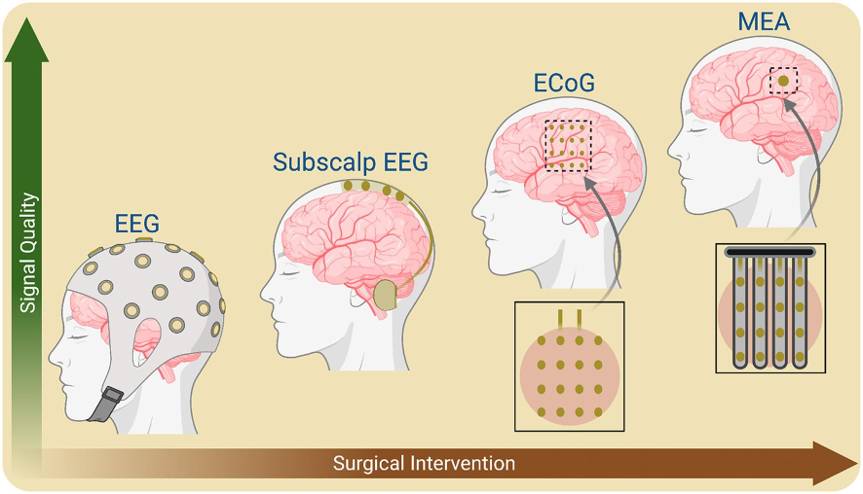
The closer to the brain, the higher the signal quality and surgical invasiveness.
Source: Saha et al., Frontiers in Human Neuroscience, 2026
So it's no longer useful to simply ask: "Which approach is best?" The better question is: Does this application justify what users must give up?
Right now, the clearest answers come from the medical side. Consumer-grade human enhancement remains distant.
This is the first reason BCI hasn't had its iPhone 4 moment: the technology has splintered into many paths, but the market hasn't converged.
BCI Hasn't Found Its "Data Recipe" Yet
AI is the biggest variable in this wave of BCI enthusiasm.
Language, images, and video all have foundation models now, so naturally people ask: Can we train a general model for the brain too?
The trouble is, brain data is far harder to work with than internet data.
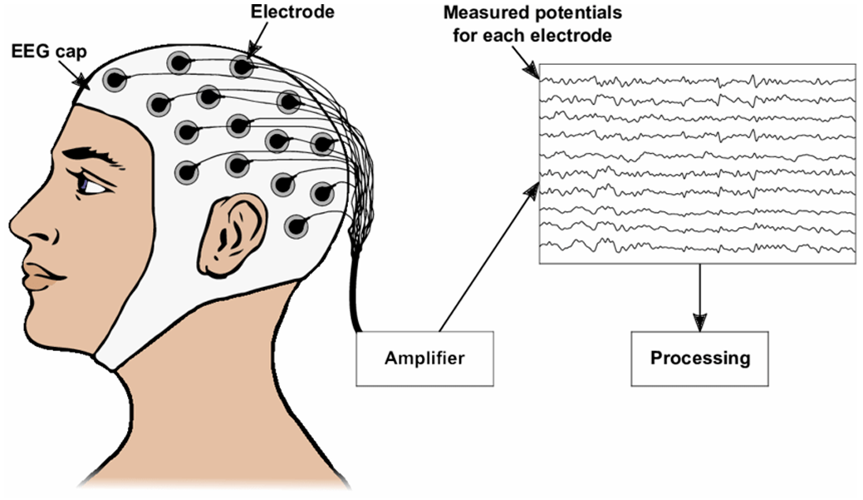
Taking EEG as an example: brain data must first be collected through scalp electrodes, then amplified and processed before it becomes usable for analysis.
Source: Nagel & Spüler, Scientific Reports, 2019
Text is high signal-to-noise information that humans have already structured; brain signals are contaminated with blinking, jaw clenching, speech, body movement, and environmental interference. The deeper problem is that much data still comes from hospitals and labs: someone sits for a few hours of recording, the experiment ends, and the data stream cuts off.
One attendee called this a "data wall": quality, scale, and diversity are extremely difficult to satisfy simultaneously.
Public EEG datasets have accumulated to dozens of terabytes, but much of it comes from different devices, different hospitals, different tasks, with inconsistent metadata. Dozens of terabytes of files and dozens of terabytes of actually trainable data are two very different things.
Interestingly, there was no consensus at the event on this point.
One camp believes the priority is better collection. Brain signals drift constantly: electrodes shift, impedance changes, the person sweats or speaks, and the model's input changes. Without long-term, stable real-world data, even the largest models struggle to learn.
Another camp is more optimistic.
One participant shared that on UK Biobank MRI data, model performance kept improving as samples scaled from roughly 1,000 to 100,000 people. Some signs of scaling in brain signals are already emerging; perhaps what's missing now is better models, more compute, and the ability to industrialize lab methods.
But everyone agreed on one thing: today's data isn't perfect, and the models are still early.
Should the urgent priority be capturing better signals, or reading existing signals more intelligently? No one could say for sure.
Because of this, BCI and AI are on very different development rhythms. AI is already discussing how to scale; BCI is still searching for its scaling starting point.
The Smarter AI Gets, the Less the Brain Needs to "Say"
Traditionally, BCI research has pursued higher bandwidth: Can we read more neurons, more channels, more information?
Advances in AI and robotics are reframing this question.
Imagine a paralyzed patient wants a robotic arm to grab water from a table. If the arm is dumb, the BCI must constantly output: "Forward a bit, right a bit, open, grasp..."
If the robot can see, plan, and grasp on its own, the brain only needs to tell it: "I want that glass of water."
One attendee put it more vividly: an intelligent agent needs only "the faintest trace" from the brain to "read between the lines" — "I cast a sidelong glance, and it understands my meaning."
This interaction is called shared autonomy: the human provides goals and key decisions, the machine handles execution.
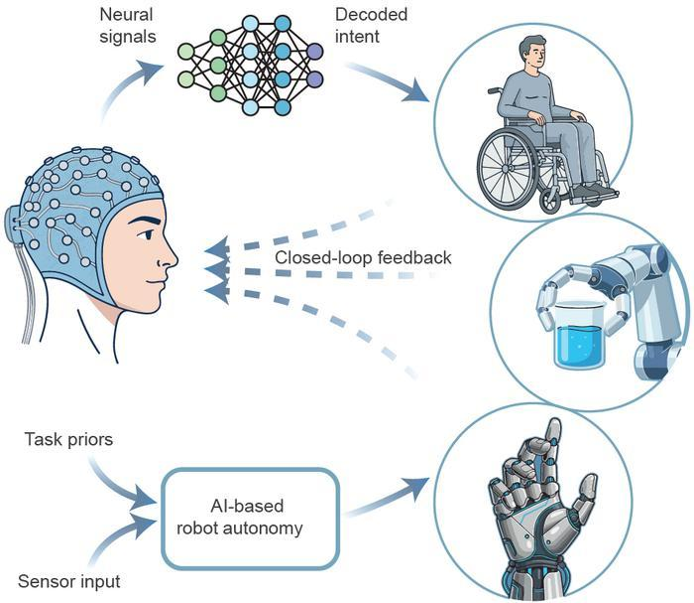
In shared autonomy mode, the BCI decodes user intent, and AI combines task priors with environmental information to assist the robot in completing specific actions
Source: Ding & He, National Science Review, 2026
Similar shifts may occur in language brain-computer interfaces.
First, a common misconception to correct: today's language BCIs are nowhere near "mind reading."
The more mature language BCIs today mainly decode how the mouth, lips, tongue, and throat prepare to speak. Even when a person "speaks" silently in their mind, they must still articulate each word distinctly. Simply put: today is closer to "reading the mouth," not yet "reading the mind."
But with AI, BCIs may not need to reconstruct every syllable. Neural signals provide rough intent, and language models fill in the expression from context.
So "bandwidth" takes on new meaning — traditionally, people asked how many bits per second the brain could transmit to the machine. Going forward, we may also need to ask: How much can this limited information ultimately help the user accomplish?
With sufficiently capable AI, a small but reliable snippet of intent could leverage a complete task, generating substantial real-world value — a prospect that excites many practitioners.
What Will Really Determine Whether BCI Leaves the Lab
Might Be a Bunch of "Boring" Numbers
Across the discussions, we saw that for two decades, BCI has been proving one thing: what it can do.
Controlling cursors, typing, robotic arms, language restoration — these capabilities have been demonstrated repeatedly. Today, the questions are becoming more practical.
How well you perform in one experiment and whether a system can be used long-term are two very different things.
Performs well today — will it still be accurate tomorrow? When you switch to a new user, does it need retraining? After six months or a year, is the signal still stable? Outside the lab, can users calibrate and operate it themselves?
These questions are growing in importance.
The BCI field has long loved comparing one number: channels.
Simply put, one channel is one entry point for recording neural signals. 100, 1,024, 4,096 channels — larger numbers theoretically mean more brain signals "heard."
But more electrodes don't necessarily mean more useful information.
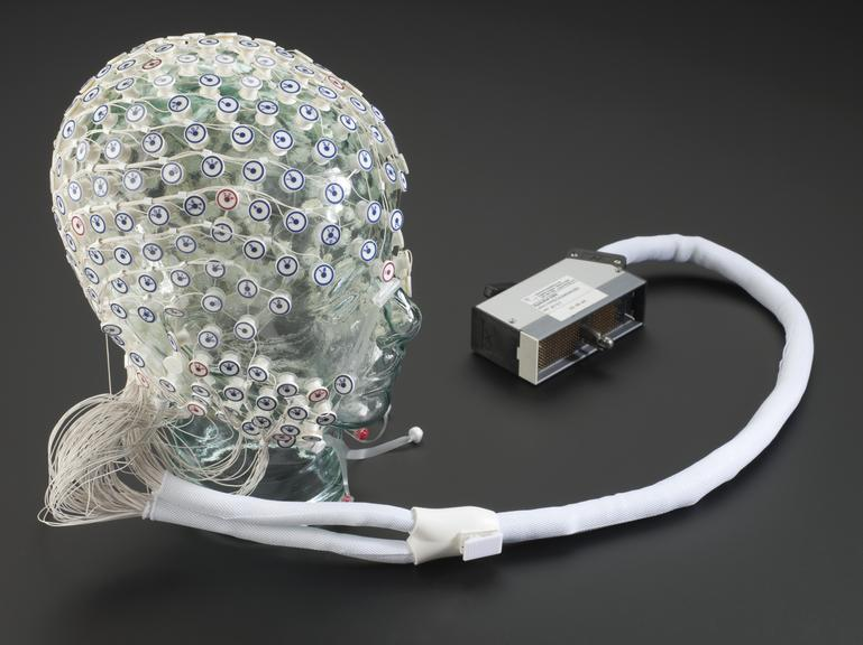
High-density EEG can deploy hundreds of physical electrodes, but physical channel count does not equal independent information sources or actual information bandwidth.
If many electrodes record roughly the same thing, the result is redundant information. One example from the discussion: some non-invasive EEG systems may have 256 physical channels, but due to crosstalk and other factors, they might only decompose into roughly 20 relatively independent information components.
So at the stage of actual use, what matters more than "how many channels" is how much of that signal can persist over time.
Another metric worth remembering from this discussion: usable channel-hour.
What it really asks is simple: Under acceptable cost and user burden, how many hours of genuinely usable neural data can a device sustainably produce?
The discussion of electronic skin was telling. Traditional EEG relies on technicians to prep the scalp, apply conductive gel, wire up electrodes, check impedance. If every EEG session approaches a medical procedure, it's hard to reach daily use.
One six-month home EEG study found: by month 6, 83% of patients reported being willing to continue recording subjectively, but only 60% were actually still doing so.
That 23-percentage-point gap says a lot.
Because that missing 23% likely hides in small things: how annoying it is to put on, whether it falls off during sleep, whether signal stays stable after sweating, whether you need to set it up again every day.
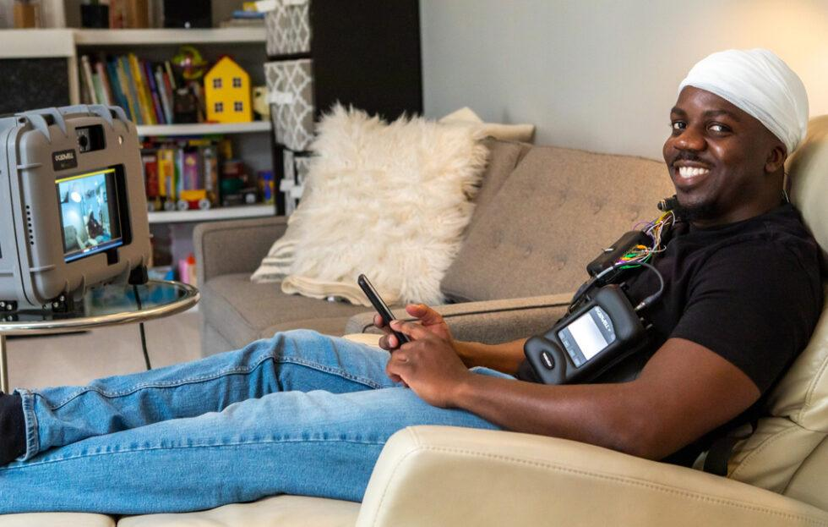
A study attempting to let participants conduct long-term EEG monitoring at home, to obtain more continuous real-world data outside the lab
Invasive systems face similar challenges.
Achieving high accuracy in one experiment matters, but stretch the timeline to 12 months, 24 months, and you must also ask: how long do post-implant signals remain stable? How much daily calibration is needed? Are there device failures or infections? Can the patient use it independently long-term?
BCI has reached a point where eye-catching demos are plentiful.
But what will most determine whether it can leave the lab may instead be these somewhat "boring" advances: less signal drift, a few more months of stable operation, cutting half-hour calibration down to minutes, and making devices usable at home for the first time.
Can do it, and can do it every day, remain two different things.
A New Understanding Between Human and Machine
Returning to our central question: Has BCI reached its GPT moment?
The answer may be: not yet, but it's accelerating.
From keyboard and mouse to touchscreen, voice, natural language, and agents, human-computer interaction has steadily reduced one cost: letting machines know what humans want. BCI takes one step further, trying to let machines access human intention earlier — before it fully becomes language and action.
But today, we don't even know what the final device will look like. It may be an implantable chip, or it may approach the nervous system through the brain surface or vasculature; electronic skin, ultrasound, and optical approaches are all being explored. Whether high bandwidth depends on local ultra-high density or broader whole-brain coverage also remains unresolved.
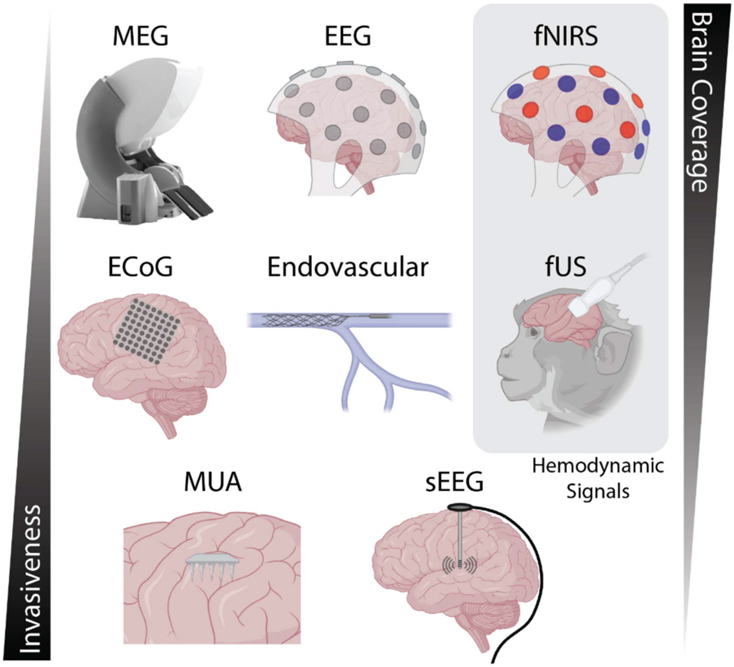
Future human-computer interaction interfaces may approach the brain in different ways
What has clearly changed is that the industry is starting to ask a different set of questions.
A decade ago, the first thing to prove was: Can brain signals control machines at all?
Today, this has been proven many times over. The new questions are more practical: Can it still work the next day? Can limited neural signals be reliably converted by AI into meaningful action?
When someone at the event discussed BCI's own "GPT moment," they used two words: Accessibility + Intelligence.
One side is safe enough, comfortable enough, cheap enough, convenient enough; the other is smart enough to truly understand human intention.
When both conditions cross the threshold simultaneously, BCI may finally have its product moment.
The next leap may not come from any single parameter suddenly increasing tenfold. More likely, it will come when several previously scattered pieces finally connect: more stable signals, data that can accumulate long-term, AI that better understands intent, and robots and agents on the other end that are sufficiently capable.
At that point, people probably won't care how many channels it uses, how many parameters it has, or even whether it's still called a "brain-computer interface."
They'll simply notice: things that were impossible before, finally work.