Oxus: AI Prospecting, Turning Stone to Gold

This technology can find gold, but that's not what we're after.


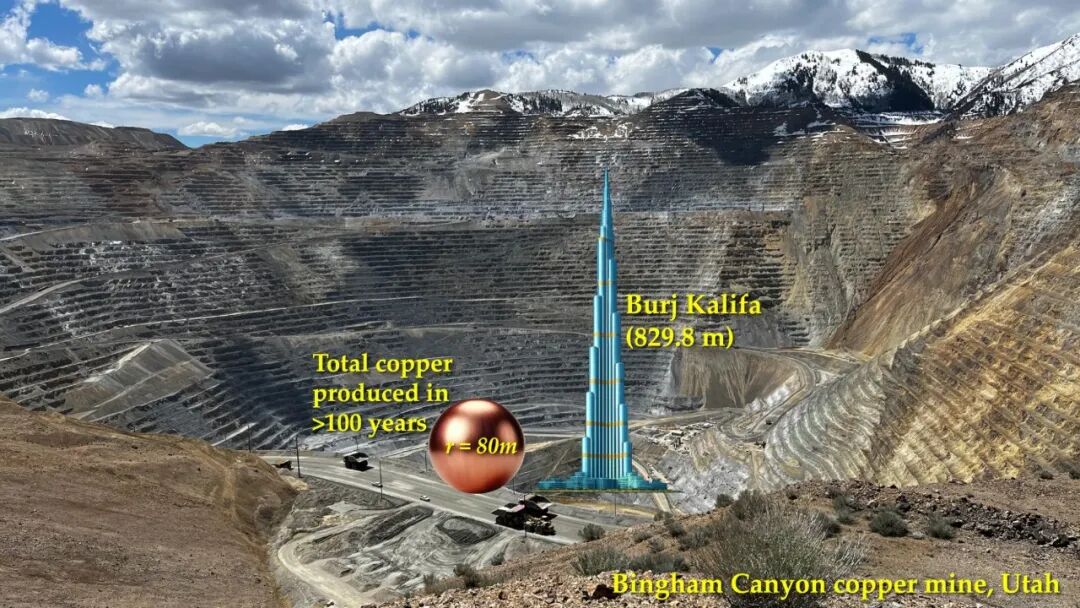
The Bingham Canyon copper mine in Utah is the largest excavation ever dug by human hands. From satellite, it looks like a laceration torn into the crust — four kilometers across, more than 1,200 meters deep. Drop the Burj Khalifa in and you'd need to stack dozens more to reach the surface.
From Utah Copper to today's Rio Tinto, humans have been digging in this pit for over a century.
On his first visit to the mine, Zhen Yin ran a calculation: compress all the copper produced from this, the largest man-made cavity on Earth, into a solid sphere, and its radius would be just 80 meters.
"You can imagine how much damage we've done to the planet for so little."
Yin, 37, from Shandong, is a former senior research scientist at Stanford University. In early 2026, he left academia to found Oxus — a company using AI to hunt for copper, lithium, and other critical minerals hundreds to thousands of meters underground. Monolith is its first institutional investor.
The name comes from an ancient Central Asian river. Two millennia ago, the Oxus was a strategic corridor for Alexander the Great's eastern campaigns and a natural dividing line between East and West, witness to millennia of Silk Road exchange.
Oxus focuses on copper, the foundational material of civilization — power grids, EVs, wind turbines, data centers, all depend on it. Yet today's largest copper mine, Escondida, averages around 0.5% grade. Move 100 tons of rock, extract less than half a ton of copper. Below 200 meters, grades can hit 5% — ten times the yield for the same effort.
The problem: you can't see underground.
Oxus aims to change that.
The Source
Born in 1989, Yin holds a bachelor's from China University of Petroleum and a PhD from the University of Edinburgh's Time-Lapse Seismic Centre, specializing in seismic exploration. After his doctorate, he worked on oil and gas exploration at Norway's Equinor, then rose to research scientist at Stanford, where he co-founded and led the Stanford Mineral-X Research Center.
Mineral-X is the earliest and most influential AI mineral exploration research group globally. Companies incubated or advanced from this lab include KoBold Metals, TerraAI, Fleet Space Technologies, ExploreTech, and Ideon Technologies — covering nearly half of this emerging industry. Among them, KoBold — backed by Bill Gates and Jeff Bezos, valued at $3 billion, and discoverer of Zambia's largest copper find in a decade — drew much of its early core algorithmic thinking from Mineral-X.
"If you trace it back, we're the source," Yin says. KoBold founder Kurt House co-authored decision-model papers with him, and students from his group were deeply involved in the AI exploration design for Zambia's Mingomba copper mine.
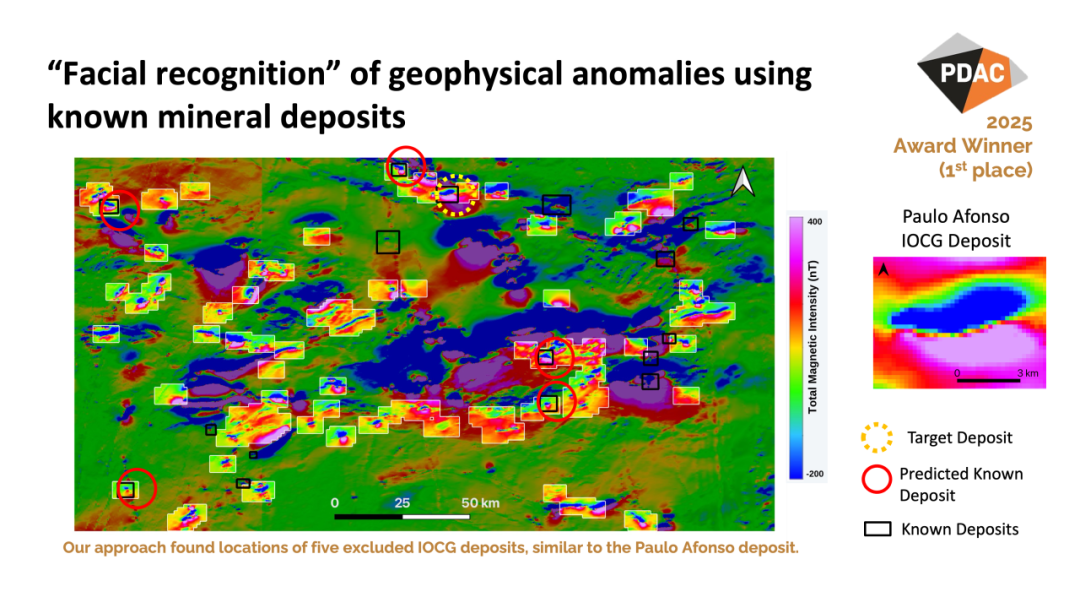
Stanford PhD student Sofia Mantilla Salas, advised by Yin, won first place at the 2025 PDAC competition (the world's largest mining conference) in Toronto for her AI-driven mineral exploration research.
Yin's book Data Science for the Geosciences, published by Cambridge University Press, won the 2025 PROSE Award for Best Book in Earth Science — known as the "Oscars" of scholarly publishing. It has long served as the textbook for Stanford's data science curriculum in earth sciences. Beyond academia, he founded the Silicon Valley Minerals Forum, an annual gathering of top mining companies, tech firms, investors, and government representatives — now nearly impossible to get into.
Oxus's core team currently hails from Stanford, MIT, and Tsinghua University. Among them: someone who led global large-scale copper-gold development projects for BHP and Ero Copper; someone who spent years building Data Infra and AI platforms at Amazon AWS; someone from Kyrgyzstan with over a decade of operations in Central Asia; and a Canadian veteran inducted into the Mining Hall of Fame.
"Going all-in at a critical moment in life" — that's how Yin describes his decision to start a company for the first time. His wife also resigned from her teaching position at Monterey Peninsula College to return to Asia with him. She studies the PETM extreme warming event 55 million years ago — when global temperatures rose at least five degrees and forests covered Antarctica.
"My wife is very supportive of this venture. She knows what humanity faces if we don't transition our energy systems and climate change continues."
Against the Grain
Oxus's entire exploration methodology rests on acknowledging one fact: "We can observe distant galaxies, yet still struggle to see 200 meters beneath our feet."
The zone between 200 and 1,500 meters underground is Oxus's main battlefield, and also a region where human knowledge is essentially blind. The only information comes from geological model hypotheses accumulated over decades or even centuries, low-resolution geophysical data, and the occasional core sample from sparse drill holes. Sparse and indirect, this data nonetheless carries most of what we know about the subsurface.
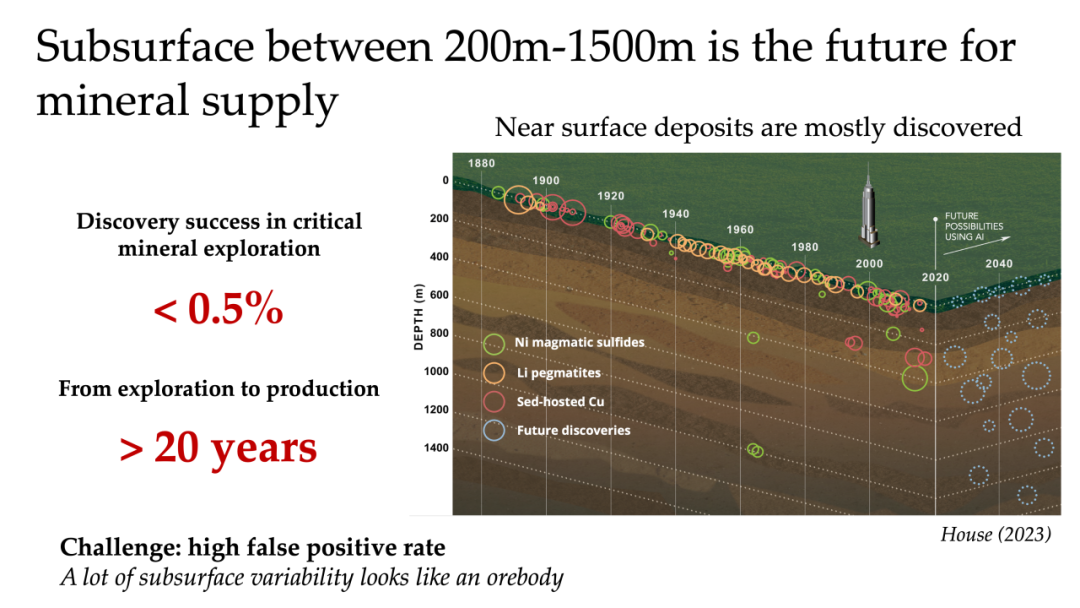
Over 140 years, humans have basically found all the surface-exposed ore @KoBold Metals
Imagine: you're on a beach with a metal detector. It beeps — could be a lost gold ring, could be a buried soda can. In mineral exploration, these false positives are everywhere. A helicopter drags aeromagnetic equipment across a region, anomalies light up everywhere, but most are false positives — various subsurface structures create interference; something that looks like an ore body may be nothing at all.
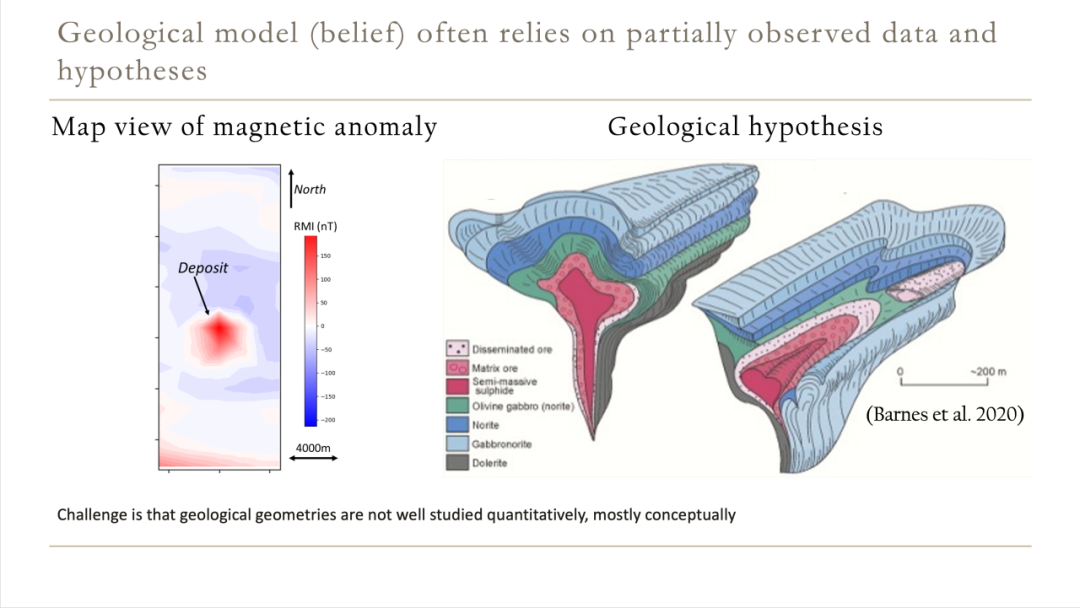
The same signal, two equally valid hypotheses.
The logic of most AI applications is "convergence" — more data, more certainty, more precise predictions. But Yin believes that in data-starved subsurface exploration, this approach necessarily converges on wrong answers. His method does the opposite: diverge first, then converge.
Oxus's predictive model doesn't output a single subsurface structure. It simultaneously generates tens of millions of possible underground configurations — each consistent with existing data, yet morphologically distinct from one another. "Imagine a thousand geologists drawing maps of what's underground for you simultaneously. Every drawing is different, but none contradict the data you have."
The mathematical foundation of this 3D random generator comes from early collaboration between Yin's Stanford group and Stanford professor Ronald Fedkiw. Fedkiw is the only Stanford professor to have won two Academy Awards for technical achievement. His Level Set method, originally invented for fluid simulation in film visual effects, was adapted by Yin for subsurface ore body modeling. From Hollywood ocean wave effects to ore prediction a kilometer underground — the same mathematics underlies both.
Generating tens of millions of models isn't the goal; it's the beginning of quantifying geological uncertainty. What follows is continuous falsification through data evidence, systematically eliminating wrong answers until only a few mineralization hypotheses that withstand scrutiny remain.
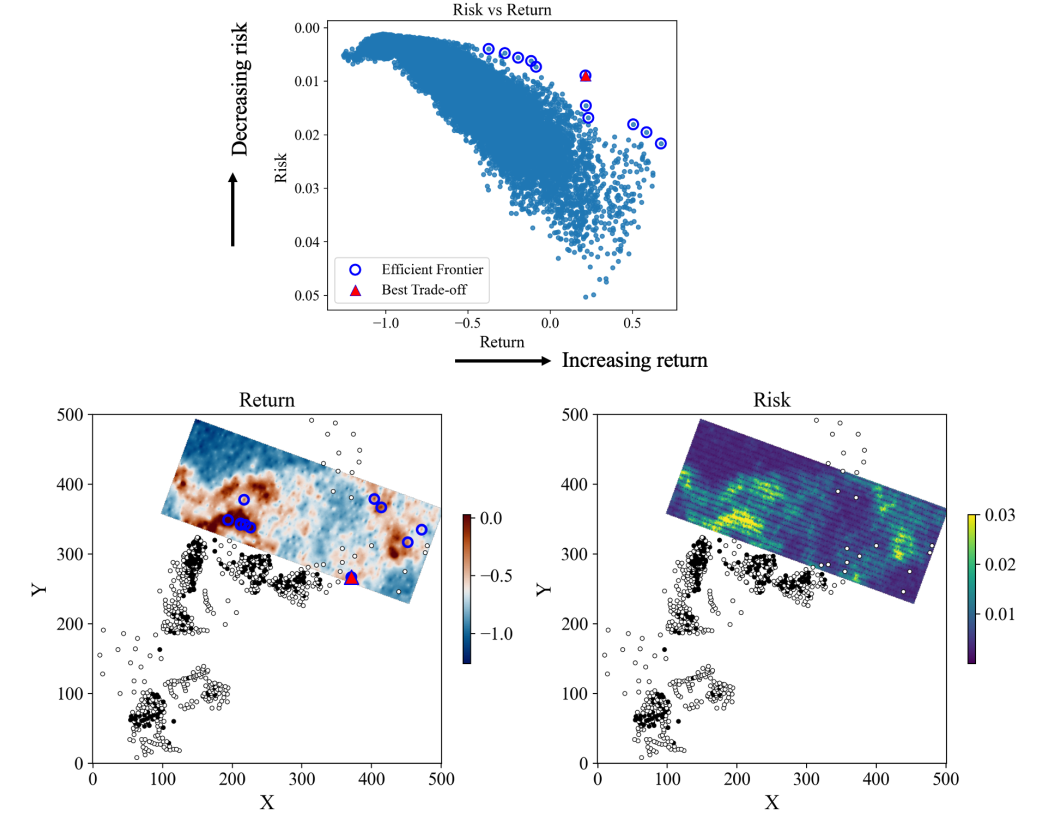
Risk-to-return exploration decision making
Yin traces this methodology back to Karl Popper — the 20th century's most important philosopher of science. Popper spent his life insisting on one thing: the line between science and non-science lies not in what you can prove, but in what you're willing to let be overturned — George Soros is his most famous student.
Popper said: "For a hypothesis to be scientific, it must be falsifiable." Every model we have of the subsurface is a hypothesis — tens of thousands of hypotheses existing simultaneously. We drill our first hole, get data, some hypotheses are overturned and eliminated; then we drill a second hole, and another batch falls. It's a process of continuously shrinking the possibility space, each decision a subtraction.
Traditional exploration is inductive — look at a few data points, guess an answer, bet it's right. Oxus is deductive — use generative AI to exhaust all possible answers, then use each new piece of evidence to eliminate the wrong ones. Not claiming a priori "the ore is here," but continuously proving "the ore is not there," until the answer emerges on its own.
This decision-making philosophy originates from the autonomous decision algorithms of the Stanford Intelligent Systems Lab (SISL) — the same class of algorithms used in autonomous driving and robotics, addressing the same fundamental problem: in an environment of incomplete information, how to make the optimal action at each moment. Yin imported this into complex subsurface systems, enabling exploration agents to continuously learn, reason, and autonomously optimize each decision.
This is what Yin means by "playing Go with the Earth."
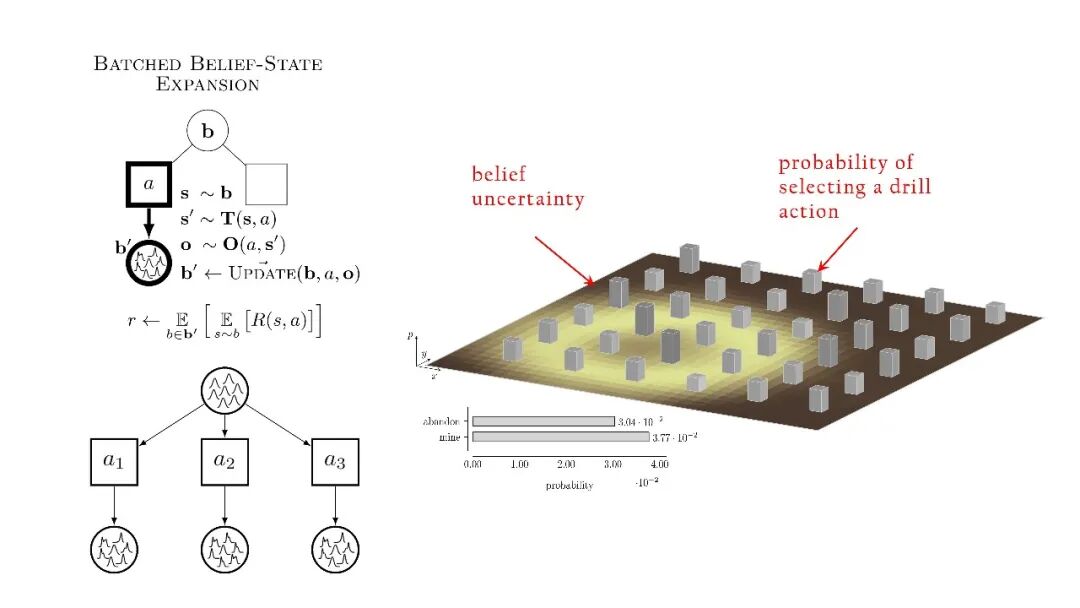
Making underground drilling decisions like a game of Go with the Earth
The AlphaGo-Lee Sedol match was a game of perfect information — both players could see every stone on the board. But Oxus's board is dark: the Earth is playing hide-and-seek with you; each drill hole only lifts a tiny patch of the board. Based on this fragment of information, you decide where to drill next — every move aims to illuminate a little more of the darkness.
Listening to the Earth
Beyond software, Oxus is pursuing something even more imaginative — installing microphones on Earth.
Thousands of abandoned drill holes dot mines worldwide, each hundreds to over a thousand meters deep, costing hundreds of thousands to millions of dollars, sitting idle after cores are extracted. Yin and his technical team are developing an ultra-sensitive, low-cost acoustic sensor to implant at the bottom of these abandoned holes.
Daily mine operations — blasting, machinery, artificial signals — transmit into the subsurface as sound waves; different geological structures reflect and attenuate these waves differently. Install "microphones" at the bottom of dozens or even hundreds of holes, and you have an underground listening network covering the entire mining district. "You're listening to the structure of the whole Earth."
But technology is only half; business model is the other half. Unlike KoBold's asset-holding development route, Oxus has chosen the "joint venture" path.
"Mineral resource development requires not just technology, but government relations, local operational experience, and massive capital — things major miners have and we don't. What we bring is a paradigm shift in exploration."
Oxus uses AI to help large enterprises discover critical minerals in Central Asia and Mongolia, sharing the upside. This model has higher fault tolerance — large companies' risk tolerance far exceeds that of startups, and Oxus's AI reduces exploration costs and shortens timelines, effectively raising large companies' tolerance for failure.
In Kazakhstan, Oxus's JV project is personally championed by the country's Vice Prime Minister in charge of AI policy. "We're not there to extract resources; we're bringing cutting-edge AI and international teams to create value together with local partners."
In reality, the geopolitical contest over mineral resources is intensifying: Asia consumes nearly 80% of global copper, yet 80% of supply comes from Latin America. The Panama Canal, geopolitics, the Strait of Malacca — disruption at any link sends shockwaves through Asia's mineral supply chain.
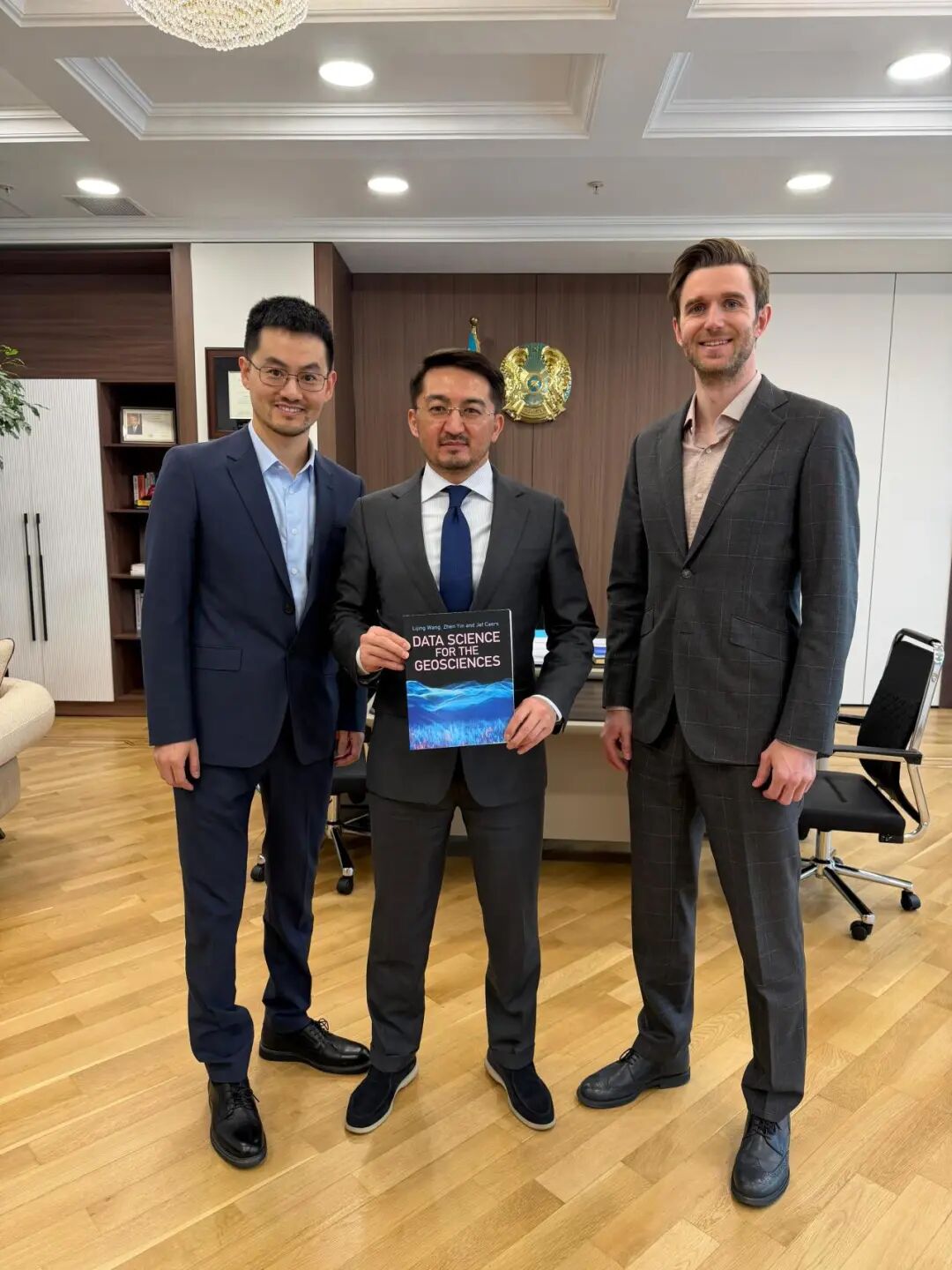
Far left: Zhen Yin; center: Kazakhstan Vice Prime Minister for AI Zhaslan Madiyev; far right: Oxus team member Alex Ershov (MIT MBA '26)
Oxus's choice of Central Asia and Mongolia as its main battlefield is, at its core, about finding Asia's energy transition a shorter, closer, more stable supply path.
Heaven's Gift, Unclaimed, Becomes Curse
Behind all this technology and strategy lies a simple arithmetic problem.
Lifetime copper consumption per capita: roughly 595 kg for an American, about 100 kg for a Chinese, just 30 kg for an Indian. India is the world's most populous country, now rapidly modernizing. If 1.4 billion Indians are to achieve Chinese living standards, if 1.4 billion Chinese are to achieve American living standards — the copper required "couldn't be found even if you turned the entire planet inside out."
From the Bronze Age to today, humanity has produced roughly 700 million tons of copper. Achieving net-zero emissions by 2050 requires an additional 1.4 billion tons — twice all of human history's output. And AI data centers and robots are pushing demand even higher.
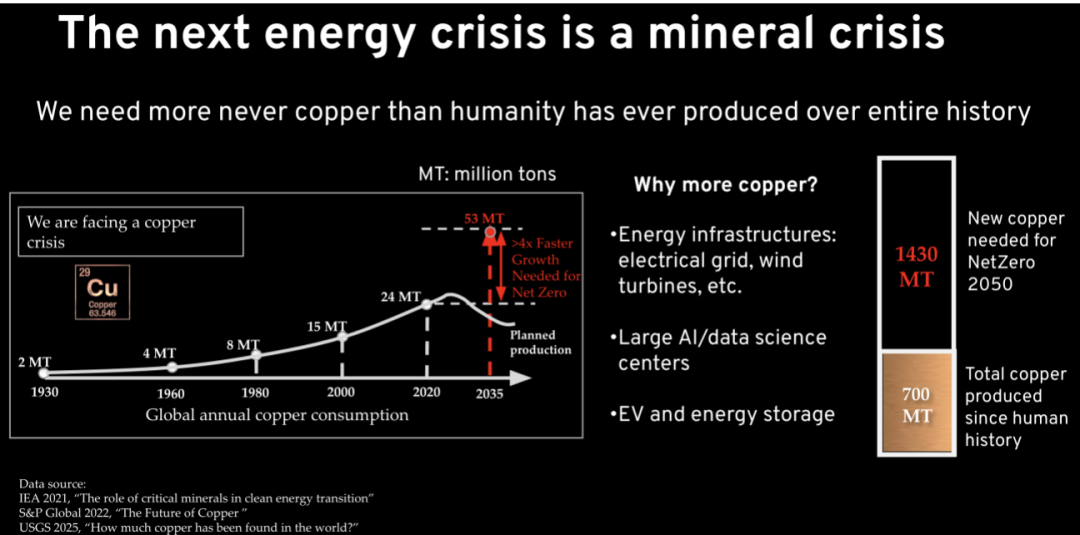
Five thousand years vs. 25 years @IEA, S&P Global, USGS
Humanity is in its fourth energy and materials transition. Each transition doesn't mean we no longer need Earth's resources; it means the kinds of resources we need shift — this time, "the oil and gas of the future are critical metals like copper and lithium."
Yin uses an ancient saying to explain why he resigned to start a company: "Heaven's gift, unclaimed, becomes curse."
We might understand it another way: someone who spent fifteen years immersed in Earth resources, who built a world-class AI mineral exploration research center at Stanford, who watched his own group's technology discover a world-class copper mine in Zambia — he knows better than anyone that this works.
Not building a SaaS company selling software to miners, but going personally to the mountains of Central Asia and the grasslands of Mongolia, using AI and sound waves to CT-scan the Earth, finding things hidden for billions of meters beneath the surface.
"We don't do gold. Most of the wars and environmental damage from mining are tied to gold, and 95% of gold just goes back underground for storage. Our mission is to find the resources that truly drive industrial human development."
He paused after this, then added: "Of course you could use our technology to find gold. But that's not what we're after."

Founded in 2026 by Zhen Yin (David Zhen Yin), former senior research scientist at Stanford University and co-founder of the Mineral-X Research Center, Oxus is registered in Singapore. The company is dedicated to deeply integrating next-generation AI technology with geoscience, discovering critical mineral resources needed for the energy transition in underexplored but resource-rich regions such as Central Asia and Mongolia. Its core team comes from Stanford, MIT, and Tsinghua University, with direct support from the Kazakhstan government. Monolith participated in the early investment.
Note
Feel free to share your thoughts, observations, or reflections in the comments. By midnight on July 21, we will select three outstanding comments based on quality and likes to receive special Monolith commemorative gifts.