UniPat AI Puts 100 Million Yuan on the Line for Researchers Who Can Transform How Science Is Done

Let top experts' knowledge and experience become the evolutionary fuel for the next generation of AI.


UniPat AI is an artificial intelligence company in Monolith's early-stage portfolio, dedicated to connecting AI with the real world and driving continuous evolution in model capabilities through complex tasks, domain expertise, and verifiable feedback.
Over the past year, UniPat AI has produced a stream of research outputs including BabyVision, UniScientist, and ExpertEval, focusing on directions such as model evaluation, agent training in real-world environments, and scientific research. It has continued to explore how real-world experience can become the foundation for further AI development.
Today, UniPat AI announced the establishment of its AI Discovery Lab and the launch of the UniPat Fellows program. Over the coming year, UniPat AI will invest 100 million yuan to invite top researchers from across scientific disciplines to work alongside AI researchers and engineers in exploring the capability boundaries of next-generation models, and to push AI deeper into real scientific research processes.
From Monolith's perspective, complex real-world tasks and expert feedback will become a critical force in driving the next phase of AI capability advancement. We are optimistic about UniPat AI's exploration of deeply integrating cutting-edge AI technology with domain expertise across fields, and we look forward to more outstanding researchers joining this effort — so that AI's progress in capability can truly translate into scientific discoveries and real-world value.
Over the coming year, UniPat AI will invest 100 million yuan to invite top researchers across scientific fields to collaborate continuously with AI researchers and engineers. Drawing on the research organization model of Bell Labs, the program will provide ample model access, compute, and experimental support. Ultimately, real tasks and feedback will be used to improve model capabilities, producing results that advance scientific research and generate industry impact.
Each Fellow starts from a research problem they already know well, identifying tasks that today still depend on expert human researchers but might in the future be completed by AI. Together, they will clarify the hardest bottlenecks and design these tasks into evaluable, trainable, and scalable forms.
At the UniPat AI Discovery Lab, the process begins with building evaluation benchmarks to assess model performance on these tasks. Then professional software, simulation systems, and experimental feedback are integrated into interactive environments where AI can propose solutions, use tools, and iteratively improve based on feedback. Evaluation identifies capability gaps in models' performance on real research tasks and validates the effectiveness of subsequent improvements. As models gradually become competent at these tasks, they can also assist Fellows in advancing their original research programs.
Research directions are not constrained by fixed disciplinary boundaries. UniPat AI cares about important problems in the real world, whether they come from physics, chemistry, biology, medicine, materials science, chip design, or other fields.

A researcher from Peking University with a physics background is exploring AI-automated optical chip design: having the model call electromagnetic simulation tools based on design objectives, analyze optical field and device response, and iteratively adjust the design based on simulation feedback.
A researcher from Peking University's School of Pharmaceutical Sciences is focused on automated antibody design and engineering: having the model propose mutations by integrating sequence, structure, and experimental data, then determining the next round of experiments based on wet-lab feedback — testing whether AI can truly participate in the closed research loop of "design-experiment-feedback-redesign."
A researcher from UCLA is exploring AI-automated chip layout design: having the model operate professional design tools to generate and modify layouts under complex constraints, continuously optimizing based on feedback from verifiers and simulation.
Other researchers are focused on prediction models and market forecasting. What makes market forecasting distinctive is that the answer does not yet exist at the time of prediction — judgment can only be tested once outcomes are revealed. Researchers hope to examine whether models can identify valid signals from relatively noisy information and produce reliable, well-calibrated predictions.
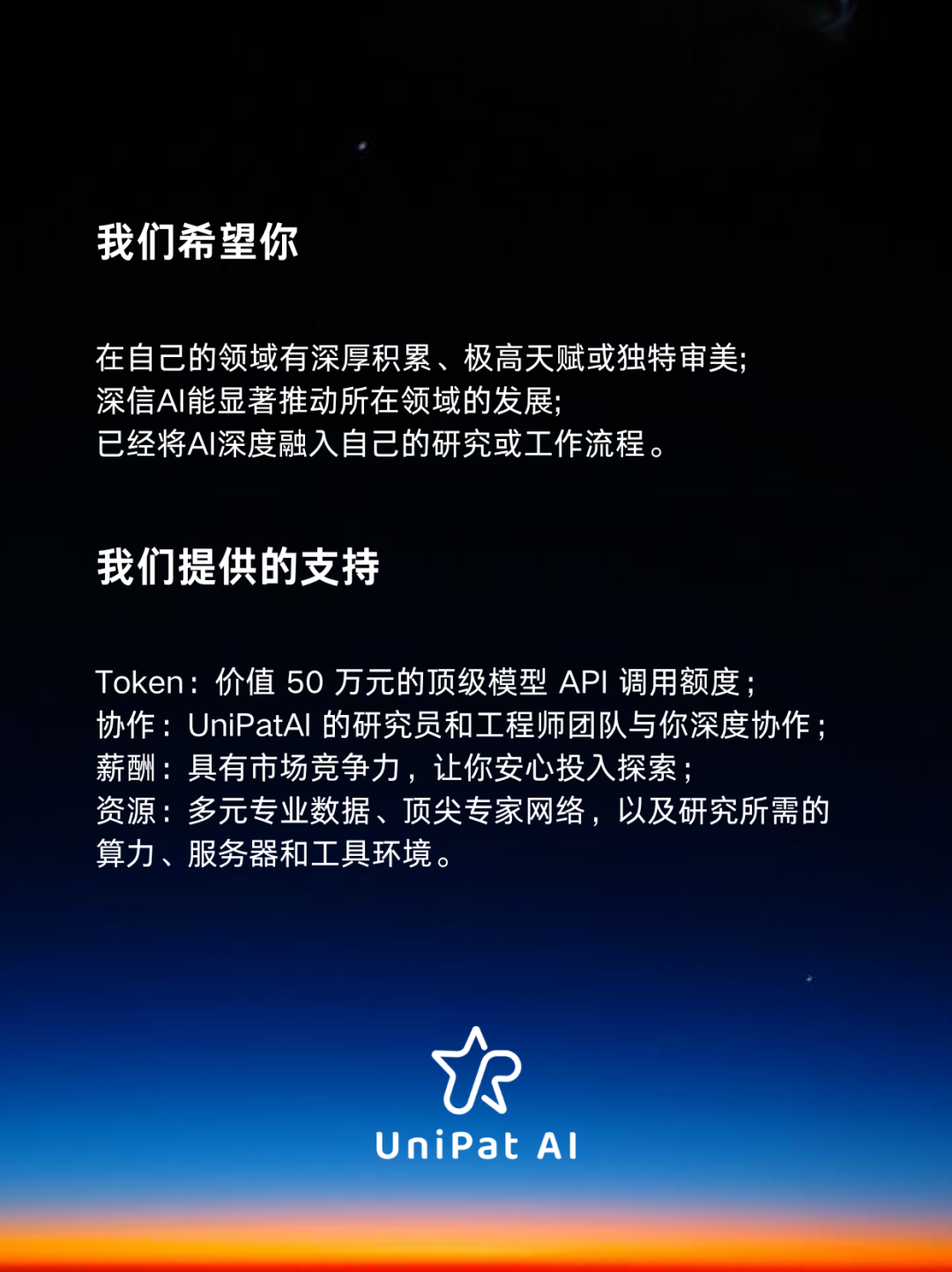
The program offers two participation models
Full-time Fellow: Long-term commitment to UniPat AI, continuously advancing research and applications in your field;
Project-based Fellow: Participation on a project basis, with a minimum cycle of 3 months. Suitable for those who wish to maintain existing academic or work arrangements while intensively researching the intersection of AI and their domain.
We encourage Fellows to work on-site with the UniPat AI team in Beijing's Zhongguancun area, enabling spontaneous discussion and collaborative research progress. For those who need to balance existing research or work commitments, hybrid arrangements can also be discussed.
How to Apply
Please send application emails to fellows@unipat.ai, including:
One core question: If you could only advance one problem in the next 3 months that AI currently cannot solve but is worth solving, what would you choose? And why?
Your CV and 1-2 representative works. If you have research or projects completed in collaboration with AI, please include those as well.