"Xi Wang" Raises Another Billion-Plus Yuan Round, China's Inference GPU Unicorn Reshapes AI Inference | Xinxing PORTFOLIO

One of the largest single funding rounds ever raised in China's domestic GPU sector.
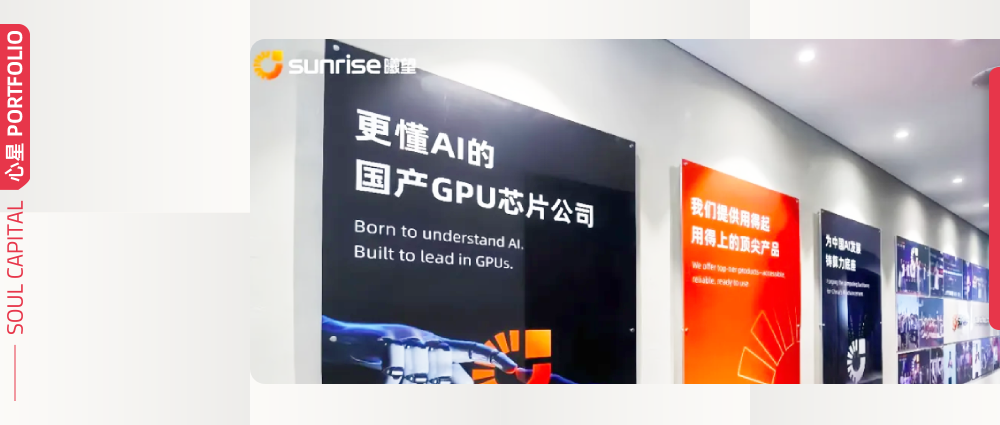
On April 20, Xi Wang, a domestic full-stack self-developed AI inference GPU company, announced the completion of a new funding round exceeding RMB 1 billion. This marks one of the largest single financing rounds in China's domestic GPU sector since the AI industry fully entered the "inference deployment, agent proliferation" era in 2026.
To date, Xi Wang has completed seven funding rounds totaling approximately RMB 4 billion in the little over a year since its spin-off and independent operation, becoming China's first pure inference GPU unicorn valued at over RMB 10 billion. In January this year, Xi Wang announced nearly RMB 3 billion in strategic financing completed within a year, with Heart Capital investing in its Series A.
Proceeds from this round will primarily fund the scaled mass production and delivery of its next-generation Qiwang S3 inference GPU, full-stack software ecosystem development, and R&D iteration of subsequent S4/S5 chips.

The Year of AI Agents: Inference Compute Becomes the Industry's Biggest Bottleneck
2026 is widely recognized by the industry as the "Year of AI Agents." As large models evolve from "chatting" to "thinking and executing" digital workers, inference demand has exploded. NVIDIA's GTC 2026 conference formally declared that the AI industry has fully entered a new era of "inference deployment, agent proliferation," defining "tokens per watt throughput" as the core competitive advantage of the AI age. This aligns closely with the battlefield Xi Wang locked onto from day one.
"The center of gravity in AI compute infrastructure has completely shifted," said Xu Bing, Chairman of Xi Wang. "In 2026, AI inference compute demand will reach 4-5x training demand, with inference compute rental prices rising nearly 40% in just six months."
Unlike the industry mainstream "training-inference unified" approach, Xi Wang has been firmly all-in on inference since its founding, designing chips around real user token costs, per-unit energy consumption, and service stability. The company has now advanced through three generations of inference GPU iteration, with tens of thousands of GPUs in mass deployment, achieving a complete closed loop from chip R&D and product manufacturing to solution delivery — while maintaining a top-tier industry standard of "first-tapeout success on every chip, with post-tapeout performance meeting design targets."
Qiwang S3: An Inference-Native Architecture Rebuilt for Agentic AI
In January 2026, Xi Wang officially released its new flagship product, the Qiwang S3 inference GPU. This is China's first inference GPU equipped with LPDDR6 and compatible with LPDDR5X memory. Rather than blindly copying the HBM memory route of high-end training GPUs, it rebuilt the full chain from AI Core compute architecture to memory I/O systems based on the essential needs of agent inference.
With agent inference represented by OpenClaw, the high-frequency "perception-planning-execution-feedback" loop creates entirely new compute loads from intensive KV-cache access. General-purpose GPUs, optimized for training, often see actual inference compute utilization far below peak — the efficiency bottleneck on the inference side is no longer "not enough compute," but "compute going unused."
This is precisely the structural opportunity Qiwang S3 is betting on: abandoning training capabilities to make deep, native customization for large model inference. By trimming modules needed for training states, it redirects saved transistor and power budgets toward inference, boosting effective compute efficiency per unit area by over 5x.
Compute Layer: AI Core Architecture Rebuilt for Inference
Through deep customization at the compute layer, Qiwang S3 addresses the core pain point of general-purpose GPUs — "compute going unused" — delivering 5x inference performance over the previous S2 generation, targeting a 90% reduction in token costs.
1| Operator Utilization Approaching Physical Limits
In large language model inference, GEMM and Attention operators account for over 90% of total compute, yet constrained by general architecture design limitations, actual utilization of these two core operators typically falls far below theoretical peaks. Qiwang S3 pushes GEMM and Flash Attention utilization to approximately 99% and 98% respectively, with rated compute largely converting to effective throughput, allowing the same hardware investment to serve more concurrent requests.
2| Agent-Native Instruction Set and Microarchitecture
Adopting a 128-bit instruction set with 3D instruction support, with instruction density leading traditional SIMT architectures; independent thread scheduling precisely matches complex agent control flows, eliminating pipeline penalties from conditional jumps; through Block cluster and Broadcast and other technologies, it achieves on-chip data reuse, reducing external bandwidth dependency and substantially boosting agent multi-turn inference efficiency.
3| Full-Path FP4 Low Precision, 3-4x Throughput Leap
Natively supports full-path low-precision computation from FP16 to FP4, achieving near-lossless FP4 inference on mainstream models like DeepSeek V3/R1, with throughput improved 3-4x over FP16 — directly translating to gross margin space and pricing flexibility on the customer side.
System Layer: Three Interface Technologies Cracking Core Agent Bottlenecks
Qiwang S3 innovatively integrates three advanced high-speed interface technologies, tackling the two most critical bottlenecks of the inference era — memory and I/O — to solve three core agent bottlenecks.
1| LPDDR6 Memory Interface Technology, Solving the Agent "VRAM Lifeline" Problem
A core characteristic of large model inference is that in mainstream cloud inference scenarios with high concurrency and long context, KV Cache VRAM share can exceed 80%, growing linearly with concurrent user count. Qiwang S3's LPDDR6 solution, while providing sufficient inference bandwidth, substantially raises VRAM capacity ceilings while cutting power consumption by 50%, matching inference scenarios' core needs of "large capacity, high cost-effectiveness, low power." Meanwhile, LPDDR6's compatibility with LPDDR5x allows Qiwang S3 to launch product versions with different VRAM specifications, covering inference scenarios from edge to cloud without requiring chip redesign.
2| High-Speed SerDes + SUE Converged Interconnect Technology, Solving the Agent "Multi-Model Collaboration Bottleneck"
Xi Wang practices a "software-defined interconnect" design philosophy, deeply optimizing interconnect architecture for inference scenarios. From supernode protocols, on-chip interconnect, die-to-die interconnect, switching equipment, to high-speed communication software stacks, it achieves a TCO- and performance-balanced inference interconnect system.
The arrival of the Agent era has placed unprecedented demands on inference cluster interconnect performance — a single agent request triggers dozens of inference calls, involving multi-model collaboration and massive KV Cache flows. If interconnect bandwidth is insufficient, protocols are fragmented, or latency is too high, overall system performance degrades super-linearly, with larger cluster scales causing more severe performance losses.
Qiwang S3 innovatively natively converges Scale-Up supernode and Scale-Out dual-mode interconnect foundations on-chip. In the supernode communication domain, Qiwang S3 carries an Ethernet-based supernode interconnect engine supporting load/store memory semantics and UVA unified addressing, with any two cards reachable in one hop, providing hardware-level acceleration for collective communications like AllReduce/AlltoAll. Qiwang S3's choice of an Ethernet-based supernode solution offers dual advantages: it can reuse standard Ethernet switches for cost savings, while seamlessly connecting to enhanced switches with ultra-low latency capabilities, compressing end-to-end latency to hundred-nanosecond levels, with performance approaching proprietary interconnect protocols. MoE ultra-large model inference systems based on supernodes and DeepEP can largely mask LPDDR's bandwidth disadvantage compared to HBM. Additionally, Qiwang S3 integrates an RDMA communication engine on-chip, specifically optimized for ultra-long context KV Cache transmission in PD-separated architectures, achieving zero-copy, high-throughput cross-node KV Cache transmission, breaking through the memory wall bottleneck of disaggregated architectures. For networking, Qiwang S3 supports 32/64/128/256 elastic scaling capabilities, providing flexible options for inference scenarios with different compute densities.
3| PCIe Gen6 Interface Technology, Solving the Agent "Resource Fragmentation" Problem
In the cloud-native inference era, ultra-long context has become standard capability for large models. When trillion-parameter models process sequences of tens of thousands of tokens, single-request KV Cache occupancy can reach hundreds of GB or even TB-level, with traditional PCIe bandwidth bottlenecks becoming heavy shackles constraining efficient KV Cache management.
Qiwang S3's PCIe Gen6 interface doubles bandwidth over Gen5, capable of simultaneously fully loading multiple high-speed NICs and NVMe storage clusters, meeting cloud-native inference's high-concurrency data throughput demands; through PCIe Gen6's high bandwidth, CPU DRAM truly becomes Qiwang S3's VRAM expansion pool. This enables building a "VRAM-DRAM-NVMe" three-tier heterogeneous KV Cache architecture:
- Hot data resides in VRAM guaranteeing low-latency access;
- Warm data expands to CPU DRAM through PCIe Gen6 for capacity doubling;
- Cold data sinks to NVMe SSD persistent storage, solving agent resource fragmentation.
"Inference-Native" Brings Accessible Compute Infrastructure
From an industry cycle perspective, the training side landscape has relatively solidified, while the inference side is entering exponential growth channels alongside Agentic AI scaling — multiple institutions predict inference compute market size will surpass the training side several-fold within five years, with agent-type workloads contributing the primary incremental growth.
Qiwang S3 simultaneously possesses three elements that are difficult to coexist:
- Forward-looking inference-native architecture;
- Top-tier engineering capability achieving 98-99% operator utilization;
- Complete ecosystem adaptation capability.
"Qiwang S3 is not simply a performance upgrade, but a reconstruction of the AI inference cost curve," said Xu Bing. "Our goal is to reduce inference costs to 'one cent per million tokens,' making AI as accessible as water and electricity."
Gathering Top Talent, Building China's AI Industrialization Compute Foundation
Xi Wang's team has grown to 400 people, with R&D personnel exceeding 80%, bringing together core talent from top domestic and international chip companies including NVIDIA, AMD, and Huawei HiSilicon, with master's degree or above exceeding 80%. The team blends cross-industry talent in chip design, high-performance computing, AI algorithms, and software-hardware products.
In 2026, Xi Wang will focus on the core principles of "deployment, delivery, growth," fully advancing Qiwang S3 chip mass production and delivery, completing comprehensive adaptation with domestic and international mainstream large models, multimodal models, and agent frameworks. Meanwhile, the company has completed technical roadmap planning for Qiwang S4 high-performance inference GPU and Qiwang S5 secure and controllable inference GPU, continuing to invest in frontier technology exploration including near-memory computing and co-packaged optics.
Going forward, Xi Wang will continue to uphold its core mission of "making AI inference cheap, stable, and available everywhere," forging a solid compute foundation for China's AI development.
Heart Capital was founded in 2022 as an early-stage venture capital fund focused on technology and digitalization in China. The team is primarily composed of Lightspeed founding partner Yan Han, core investors, a chief financial officer, and senior investors from industry. The team's past investments include Series A investments in Xpeng Motors (NYSE: XPEV, 09868.HK) and Full Truck Alliance (NYSE: YMM), Pre-A investment in MetaX (688802.SH), as well as RoboSense (02498.HK), FinVolution (NYSE: FINV), LandSpace, MinoSpace, Huitian, Xi Wang, Polestones, Sunmi, World Logistics, Baichuan, Yunmanman Lengyun, Fan Deng Reading, Lanhu, Starfield, and others. Rooted in China with a global outlook, Heart Capital is committed to finding true value in non-consensus. Heart Capital respects the value of "people" and advocates the potential of "heart," looking forward to accompanying more young Chinese entrepreneurs to strengthen China and go global.