DouDong AI: "Heart and Shadow, Always Together" — 1 Million New Users in 10 Days. More Than a Tool, It's the Next Gateway for Emotional Companionship | Xingxing PORTFOLIO

Xin Ying Sui Xing doesn't want to make Doudou AI a pure utility product.

Recently, Liu Binxin, founder of Xinying Suixing — a Heart Capital angel-round portfolio company — sat down with Jiemian News for an in-depth interview about the development and thinking behind Doudou AI. Liu was clear: "Xinying Suixing has no intention of making Doudou AI a pure utility product."
Source: Jiemian News
After stepping down as vice president of Bilibili, Liu Binxin embarked on his first entrepreneurial venture. On August 28, at a conference hosted by his former employer Baidu, he announced that Doudou AI had surpassed 9 million users and launched its overseas 1.0 version in North America, Japan, and other regions. This marked two years since he founded Xinying Suixing. Just the week before, the company had released version 1.0 of Doudou AI, its AI gaming companion product. During beta testing, Doudou AI had accumulated 8 million users; within 10 days of official launch, that number grew by another million.
The concept behind Doudou AI, as an AI gaming companion, is straightforward — the AI plays the role of a gaming buddy. It can parse strategies, conduct post-match reviews, voice chat, and carry on real-time conversations. When using the product, the IP-character-driven AI functions somewhat like a desktop "digital pet," but far more intelligent.
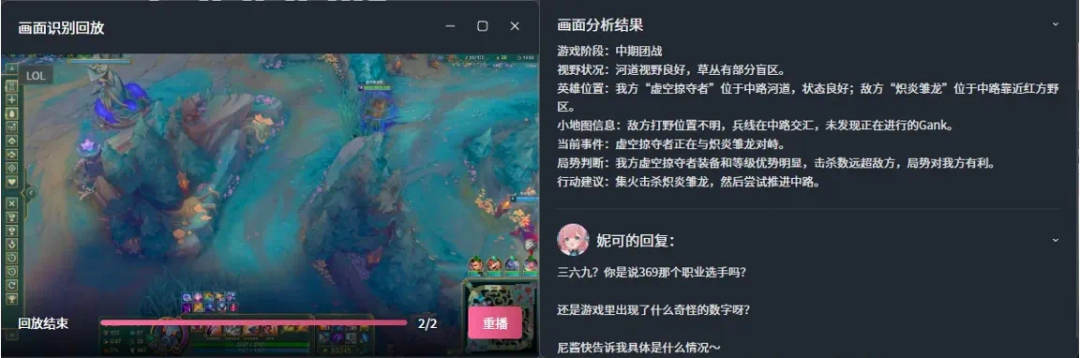
Doudou AI interface
But delivering genuine emotional value through a companion product is no small feat. Liu told Jiemian News that the biggest technical challenges in building an AI gaming companion boil down to three things: first, getting the AI to actually see the player's screen and in-game situation; second, understanding the player's emotional state; and third, remembering the player's experiences. Accordingly, the core innovations in Doudou AI 1.0 are real-time perception, long-term memory, and seamless companionship — with "perception" being the toughest nut to crack. Liu explained that this tests a model's ability to understand both breadth and depth — perceiving the screen and the player's surrounding context.
In fact, from late last year through early this year, progress on multimodal models fell short of the team's expectations. Liu believes that earlier approaches relying on OCR (optical character recognition) for screen matching didn't give AI adequate visual understanding, so Xinying Suixing spent more than half a year developing VLM (vision language model) technology. Doudou AI's real-time perception feature now leverages VLM to break through the perception layer, enabling real-time recognition and companionship across gaming, video, work, and study scenarios.
Xinying Suixing was founded in April 2023, when market attention was fixated on large language models and few domestic entrepreneurs were exploring AI companionship. But by the second half of 2023, companion products began proliferating. Doudou AI's R&D predated this wave, yet its launch and marketing remained deliberately low-key, with an extended testing period before official release.
In Liu's view, the primary reason was simple: "the technology wasn't good enough yet." Constrained by model capabilities and numerous technical bottlenecks that couldn't be solved overnight, Doudou AI remained in beta — yet still accumulated 8 million users. Liu sees this as proof of intense user demand and anticipation. Only in August of this year did he judge the product mature enough, with qualitatively improved results, to warrant an official 1.0 release.
As for why he chose AI companionship as his entrepreneurial direction, Liu's answer is unsurprising. With previous stints at Baidu, Qihoo 360, and Bilibili, he brings substantial "big tech" experience in commercial product development. He doesn't shy away from describing himself as someone who "rode the wave" of the previous internet boom.
After leaving Bilibili, Liu began exploring AI entrepreneurship. On one hand, he sensed gamers' unmet need for companionship; on the other, he firmly believes AI companion products should start as software, with eventual cross-platform account integration. Hardware, in his view, would mean longer timelines and slower iteration cycles.
Over two years since founding, Xinying Suixing has completed four funding rounds. When it comes to combining AI and gaming, investors typically ask about market size and monetization — and plenty simply "don't get" the value of gaming companionship.
On the choice of entrepreneurial direction, Liu wants to emphasize something beyond the product itself: his read on technology. Building products in the AI era, he argues, is fundamentally different from the mobile internet era — you can't rely on simple A/B tests to determine product direction. When technology is still maturing and evolving, a product's current state doesn't predict its future trajectory. Therefore, "anticipating" where model capabilities are heading becomes crucial. "When models reach the point you predicted, your business succeeds — you've made a major leap forward."
Returning to the product itself: from beta testing in June last year to now, Doudou AI's game coverage has expanded from open-world and anime-style games to SLGs and beyond. Liu believes AI companionship adds value whenever three conditions are met: first, the game has plenty of repetitive, low-information-density downtime; second, certain moments amplify the player's need for emotional value; and third, the player needs strategy guidance.
Currently, Doudou AI's user base skews 18–25 years old and roughly 70% male. Liu notes that female user share is rising as more IP characters are added. The official IP roster includes original anime-inspired characters as well as popular virtual streamers and content creators from Bilibili.
This year, Doudou AI has accelerated its marketing push. Revenue currently comes primarily from skins, virtual items, and subscription memberships. But longer-term, Liu sees greater monetization potential in advertising — for instance, having AI characters recommend games, e-commerce products, even food delivery.
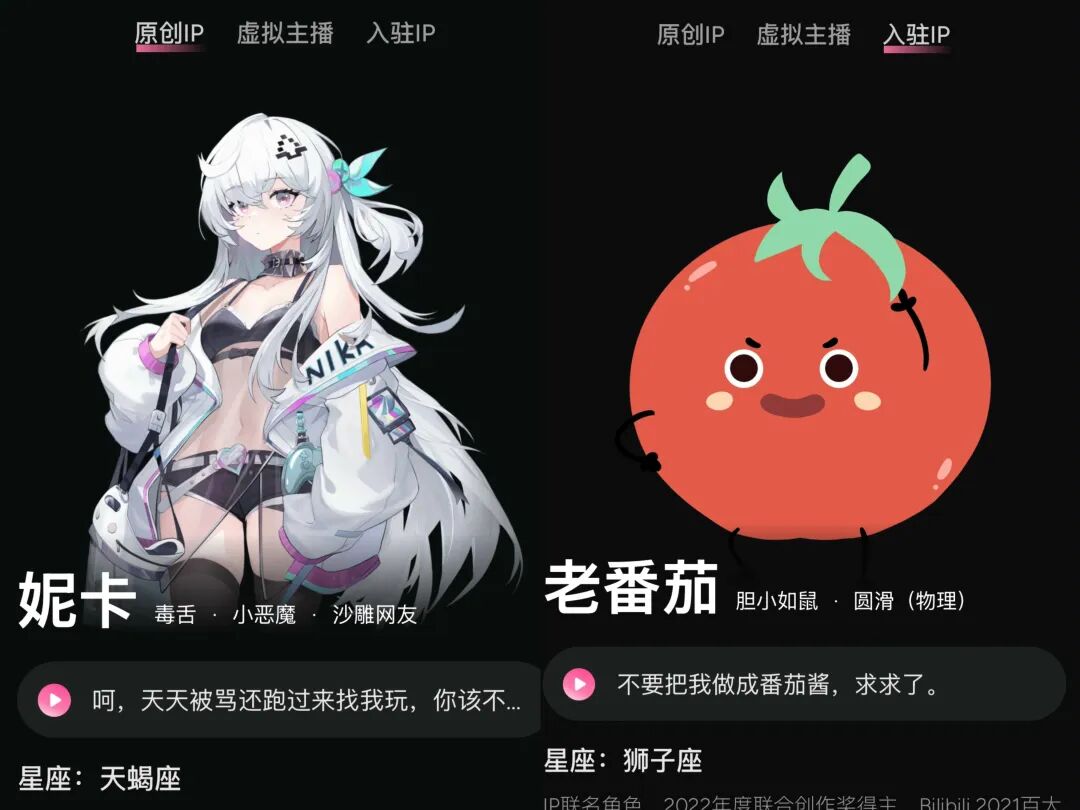
Doudou AI character selection. Source: Official website screenshot
2025 is being called the breakout year for AI applications. AI companionship has become a hot赛道, with Robopoet recently closing a multimillion-yuan angel round drawing industry attention. In the Agent space, following Manus, sector-specific Agent products have begun emerging.
Doudou AI's ambitions extend well beyond gaming. Going forward, it hopes to expand into watching shows, online shopping, even studying and working. Liu's confidence stems from gaming's "digital prison" quality — the fact that users are already locked into a contained environment for two to three hours makes chatting and socializing easier, so gaming becomes a natural pivot point from which to branch into conversations about life and TV dramas. Doudou AI's data shows that non-gaming usage already accounts for half of total user time.
Yet it must be acknowledged: the market has offered few correct answers on how AI applications can successfully commercialize. This is the question every entrepreneur must grapple with, Liu included.
How to make money comes down to how the company positions its AI application. One thing is clear: Xinying Suixing does not want to make Doudou AI a pure utility product, "because pure utilities get switched out easily — no emotional connection, easily replaced," Liu argues.
Yet Doudou AI does have utility attributes, which Liu calls the "hook." "For many users, strategy guides are their first touchpoint with the product. From there, it becomes something they can chat with, gradually forming an emotional connection, and naturally expanding into other scenarios." A simple analogy would be Douyin — once the community was established, users gradually moved into shopping, video editing, and more. For now, though, Doudou AI isn't overthinking monetization; Liu's priority is scaling the user base first.
· Recommended Reading ·
 "Xinying Suixing" Liu Binxin: Building AI Products That Don't Compete for Users' Time
 "Xinying Suixing" Named to The Information's 2024 "Top Asian Startups" List
 Black Myth: Wukong's AI Battle Buddy: Destined One, You're Not Fighting Alone

Founded in 2022, Heart Capital is an early-stage venture capital firm focused on technology and digitalization.
The Heart Capital team comprises founding partners and core investors from Lightspeed, alongside seasoned industry investors from Cainiao and Baidu. Past investments include Xpeng Motors (NYSE: XPEV, 09868.HK), Full Truck Alliance (NYSE: YMM), Ambiq Micro (NYSE: AMBQ), RoboSense (02948.HK), QSG (NASDAQ: QSG), FinVolution (NYSE: FINV), Hanshow Technology (301275.SZ), DUO (NASDAQ: DUO), Micro-nano Starry Sky, LandSpace, Baichuan, Manbang Cold Chain, Fan Deng Reading, World Logistics, Lanhu, and Starfield, among others.