AI Transformation: If History at the Port of New York Is Any Guide, Transformation Is a Pipe Dream — You Have to Be Born Again | VOICE

Finding a new place in the AI era.
Lately I've been talking with friends at big tech companies every day, and everyone seems to feel that simply "using AI tools to boost efficiency" isn't enough. But — not enough in what way, and what should be done instead, nobody can quite see clearly. Using AI for efficiency is one thing. Rebuilding your organization for AI is another. And spotting what new opportunities AI opens up at the ecosystem level is yet another thing entirely. These three differ wildly in difficulty, investment required, and payoff — yet we lump them all together under "AI transformation."
To help make sense of this, let's tell a story. Let's go back to 1956, to the shipping container.
What One Box Changed
At 4 p.m. on April 26, 1956, a converted WWII oil tanker named the Ideal-X set sail from Newark Port bound for Houston. Its owner, Malcom McLean, wasn't a shipping man — he was a trucking company boss from North Carolina. On its deck were 58 metal boxes strapped down.
The numbers from that first voyage: loading loose cargo onto a ship at the New York dock cost $5.83 per ton. Loading containers onto the Ideal-X cost $0.16 per ton — a 36-fold drop. Over the next 40 years, international shipping costs fell another 90%, and global trade volume grew tenfold. Marc Levinson's conclusion in The Box is blunt: without the container, there is no globalization as we know it today.
But the most worth-telling part of this story isn't how much efficiency improved. It's this: over the next 30 years, the global top ten ports were completely reshuffled by this box — and among the top ten, almost none survived from the previous era.
Why?
Because the container didn't just "load and unload faster." It changed the rules of the game on three levels simultaneously. Most old ports only captured the first level — so they lost.
Level One: Efficiency of Individual Tasks
This is what everyone sees first: loading and unloading got faster. Before, dockworkers moved loose cargo piece by piece, and a ship might sit in port for days. With containers, cranes lifted them on and off in hours.
The Port of New York certainly saw this in 1956. Its response was perfectly reasonable: add container berths alongside existing loose-cargo docks. Loading efficiency did improve — but this was only a Level One fix.
The problem with point efficiency: if you can use it, so can everyone else. You load faster, other ports load faster too. The efficiency premium quickly gets flattened out.
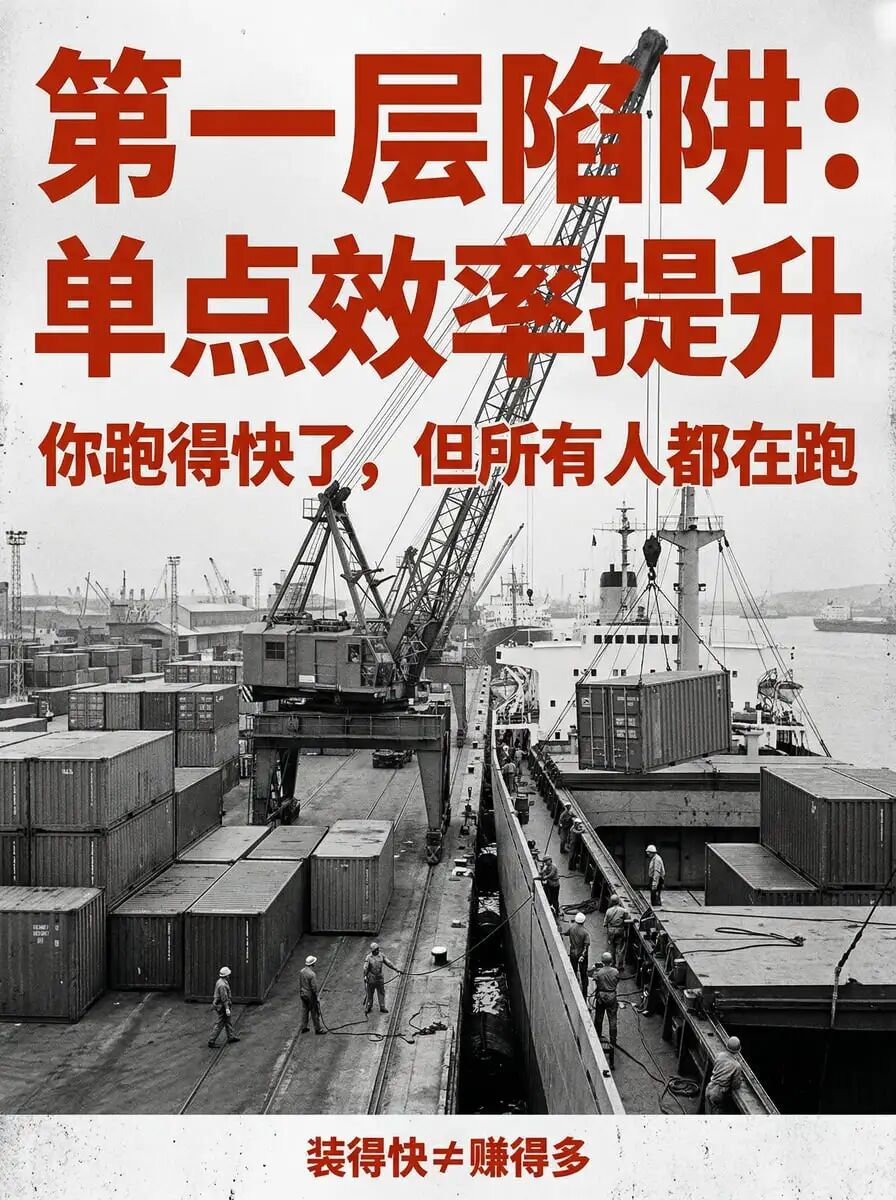
This is how most companies use AI today. Deploy Copilot, write emails faster, make slides faster, research faster... but you're not making more money. Many industries are now at 100% efficiency gains, everyone's excited, but after a while the accounting shows profits haven't increased one cent — because competitors are using the same tools, and customers quickly treat the savings as the new baseline. You're running faster, but everyone on the track is running faster too; you haven't pulled ahead.
Level Two: Rebuilding Organizational Form
This is where the container's real power lay — but also what old ports couldn't change.
The container wasn't just a faster box. It required an entire organizational form to change with it: large flat storage yards (containers lie flat, not stacked vertically into warehouses), rail lines running directly into the dock, highways running directly in, completely different union contracts (no longer needing masses of dockworkers), brand-new electronic tracking systems (every box needs to know where it is, where it's going, what's inside).
Viewed separately, each item looks like an "improvement." But combined, they demanded a total reconstruction, not patches on an old framework.
The Port of New York couldn't do any of this. Not because it didn't want to, but because each one was blocked by existing assets. Manhattan land prices were too high to build yards. Rail access would require demolishing half the city. Union contracts were the product of decades of strikes and struggles — untouchable. Electronic tracking systems completely conflicted with existing management processes.
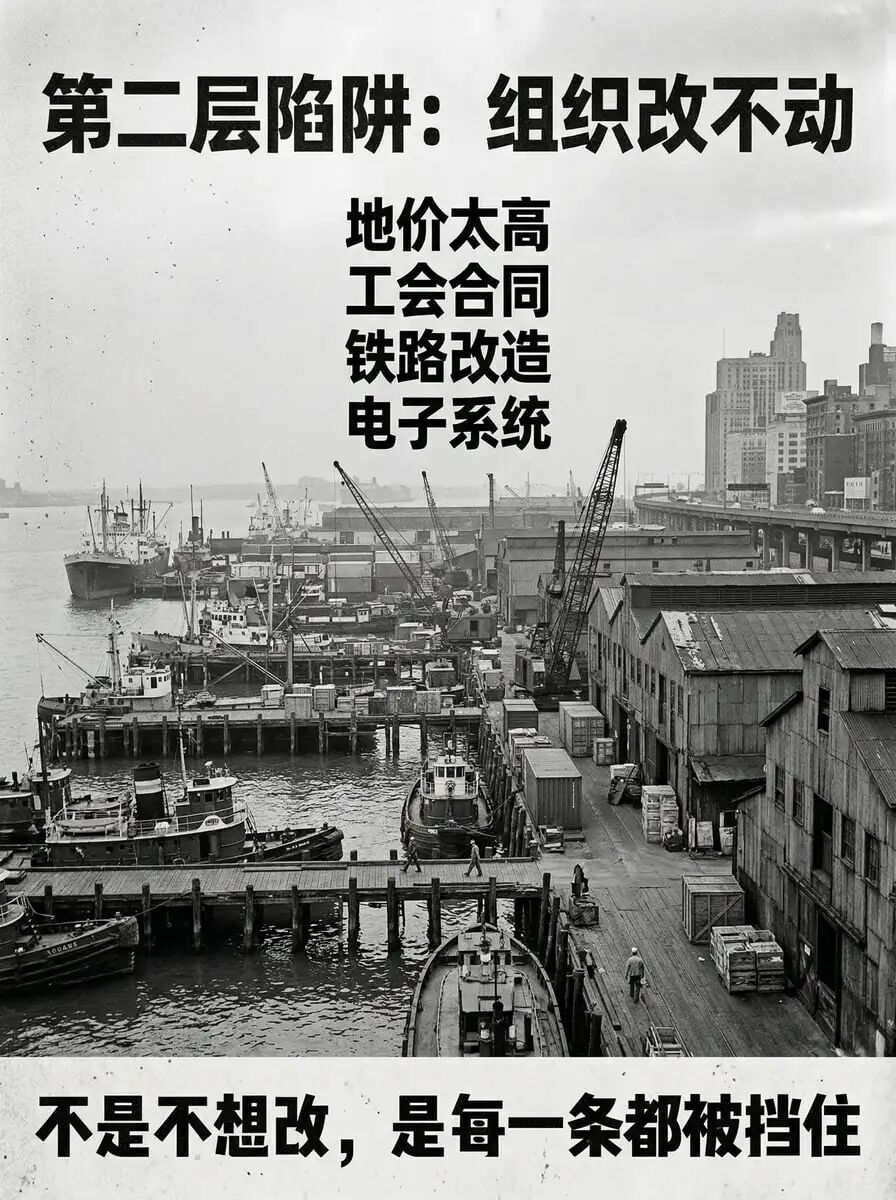
I was talking with the founder of a listed company about AI transformation recently, and he started by saying: "I know what needs to change. But I can't change it — actually, I can't move [certain things]." Not because he didn't want to, but because knowledge structures, interest structures, and power structures were layered on top of each other — what could move and what couldn't wasn't something the boss could solve with a single sentence. The boss pushed to professional managers, professional managers pushed to organizational inertia. In the end everyone added AI tools on top of the old system, looking like every part improved a little, but there was no qualitative change overall.
New York's problem was exactly this: it absorbed point efficiency improvements — "loading faster" — rather than whole-system reconstruction. Like swapping in a new engine but keeping the chassis, transmission, and suspension all old. It won't run.
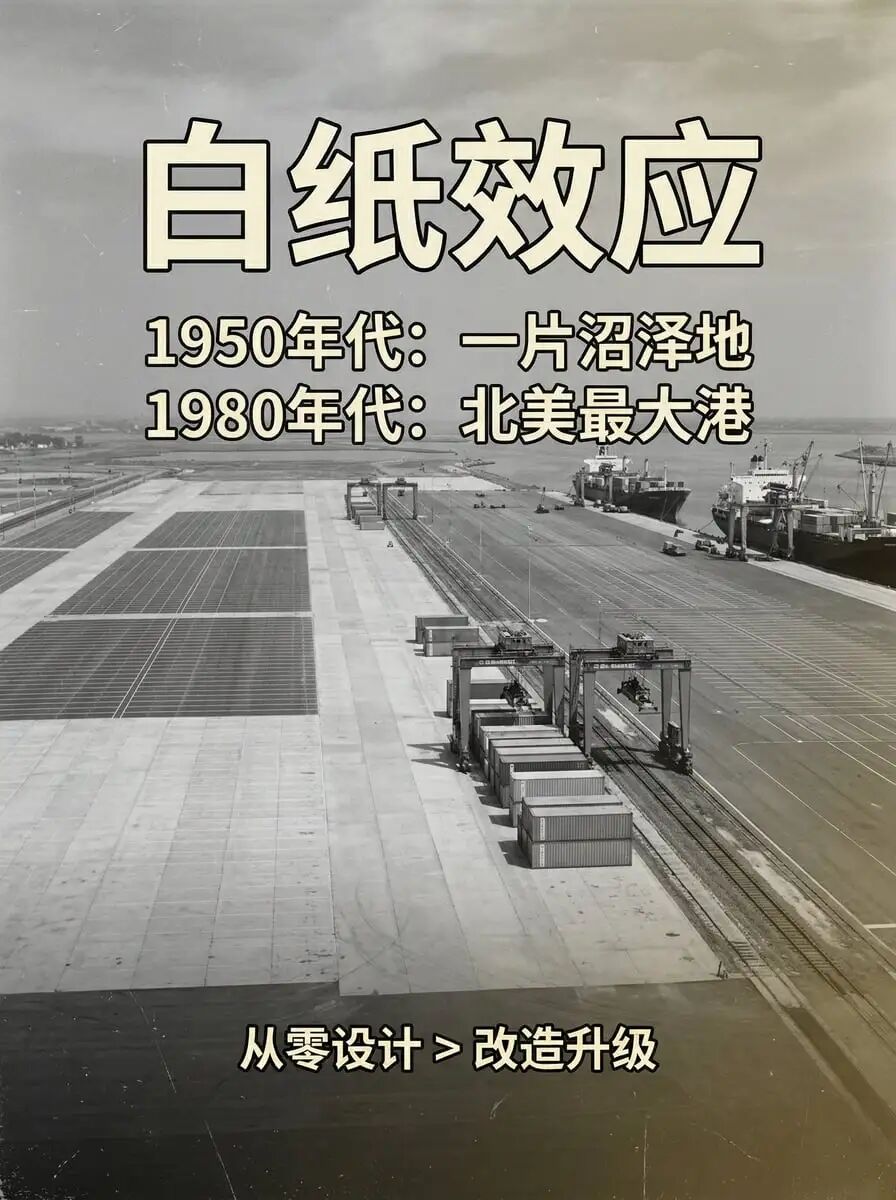
Across the Hudson River, Elizabeth, New Jersey was still marshland in the 1950s. No port history, no talent accumulation, no hinterland advantage. The only thing it had was a blank slate. In 1958, the Port Authority of New York and New Jersey decided to design Elizabeth entirely from scratch for containers — yards, rail, roads, unions, systems, all new. It opened in 1962, surpassed New York by the 1970s, and became one of North America's largest container ports by the 1980s. Just a few kilometers away, the Port of New York basically shut down during the same period. Today Manhattan's old docklands have become the South Street Seaport Museum and luxury apartments.
This wasn't an isolated case. The Port of London collapsed entirely in the 1970s, freight shifting to the small eastern port of Felixstowe — built from nothing, today handling 36% of Britain's container freight. London's old docklands are now called Canary Wharf, a financial district. San Francisco's old piers became Pier 39, a tourist spot selling souvenirs and crab chowder.
The pattern is clear: every port that won position in the container era was either built from scratch or tore itself down and rebuilt. Not a single old port survived by "using containers best within the old framework."
For big companies today, the implication is direct: the AI transformations that actually work often aren't changes to the old organization, but carving out an "enclave" inside — a new team unconstrained by the old system, built from zero in an AI-native way. We recently helped an industrial software company with exactly this situation: the existing system looked like AI could be added everywhere, every module could improve a bit, but the whole couldn't actually be changed. The final solution wasn't to modify the old system, but to build a completely new CLI alongside it, designed directly for agents — like building Elizabeth Port across the marsh.
Level Three: Shifts in Ecological Position
The first two levels are still about individual ports. But the container's deepest impact was at Level Three: it changed the structure of the entire shipping ecosystem, creating positions that simply hadn't existed before.
To understand this level, you need to know one thing: before the container, "transshipment" was barely a business at all.
Why? Because in the loose-cargo era, if goods needed to change ships at a port, workers had to move items piece by piece out of one ship's hold, store them in a warehouse, then move them piece by piece onto another ship when it arrived. This process was extremely slow, expensive, and prone to damage. So the shipping logic of the time was to go direct as much as possible — from origin port straight to destination, no stops in between. Changing ships was a last resort, not a segment worth building a business around.
The container flipped this equation. A standardized box, lifted from Ship A to the yard then onto Ship B, the whole process taking hours, cost minimal, goods never unpacked, never entering warehouses, damage risk near zero. When the friction of "changing ships" dropped from extremely high to extremely low, an entirely new business model emerged: ports that specialized in "making everyone else's ships connect and coordinate efficiently here."
Singapore saw this opportunity.
When Singapore became independent in 1965, by traditional standards it had no business becoming a major port — no large hinterland (the whole country is one city), no major manufacturing, no natural resources (it even had to buy fresh water from Malaysia). It didn't produce much to export itself; there was no industrial base to support it.
But Singapore made a choice that would have been impossible in the loose-cargo era, only viable in the container era: don't move your own cargo, coordinate everyone else's. In 1969 it decided to build a container terminal — at the time, the second in all Southeast Asia. Tanjong Pagar opened in 1972, positioned from day one as a transshipment hub: cargo didn't enter Singapore's local market, it just changed ships here. The Strait of Malacca is the necessary route from East Asia to Europe; if Singapore could make "changing ships here is cheaper, faster, and more reliable than anywhere else," it could take a small cut from every passing container. Small cuts times massive volume equals big business.
Today 85% of containers passing through Singapore Port never come ashore in Singapore — they simply change ships here. Singapore consistently ranks among the top two global container ports. A city-state with zero industrial base became one of the most irreplaceable positions in global trade by "making other people's goods flow more easily."
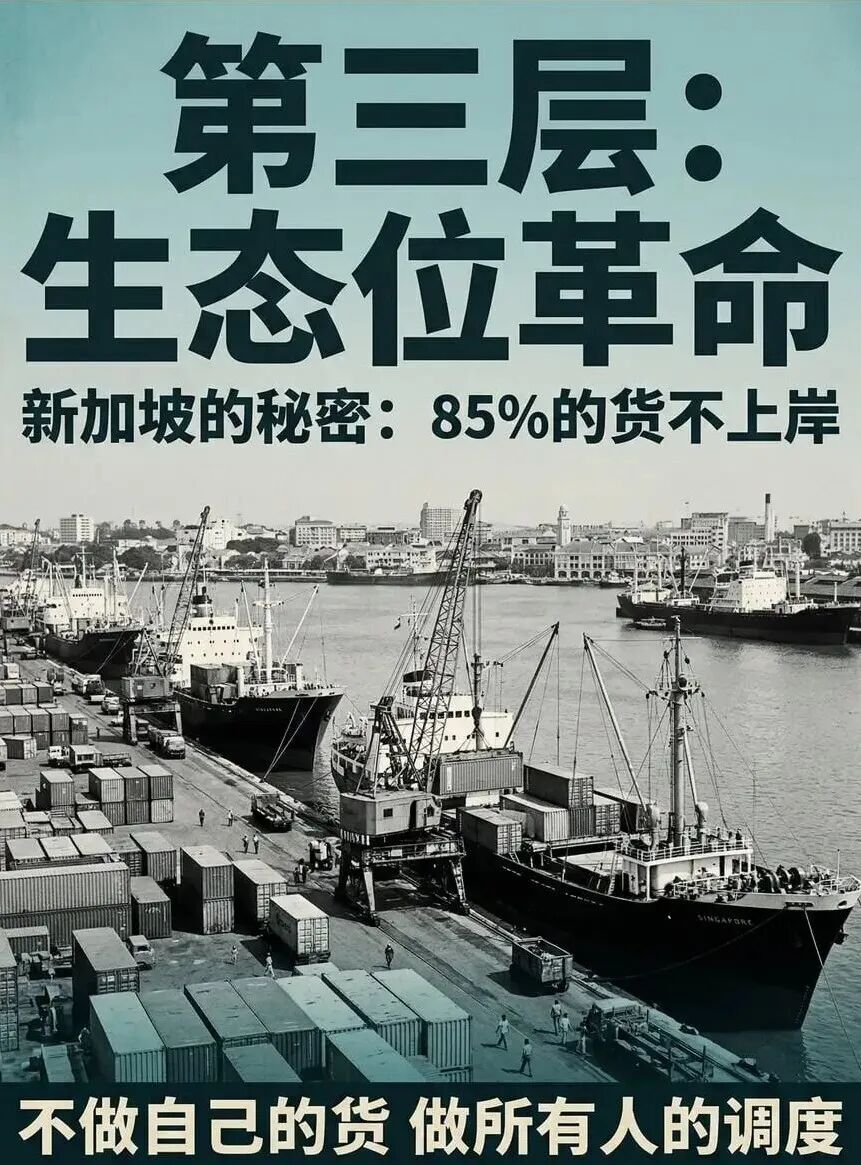
Singapore's success didn't come from "moving its own cargo better," but from seeing an ecological position that didn't previously exist — after the container drove friction across every link to near zero, the coordinator position of "who helps everyone connect efficiently" grew from nothing.
The Same Question in the AI Era
This pattern is replaying in the AI era — take learning, for example.
Before, the friction of learning was high — picking up a new skill took months, building software took a team, integrating two systems took a project group. But AI is driving this friction to near zero. A few days ago on the AI Alchemy podcast, I was chatting with Kejia Li, founder of BotLearn, about something like a Matrix scene: now an AI agent downloads three new skills and can make videos for you, downloads superpowers and it's like hiring a software engineering team. What used to take years to learn, the friction of "learning" itself is trending toward zero.
When this friction drops to near zero, the way people work, the way organizations collaborate, the structure of the entire ecosystem — all of it changes. BotLearn's positioning is interesting: he said "my users aren't humans, they're agents." Agents wake up every morning needing to learn, needing a trusted knowledge source — whoever becomes that "bookworm" occupies a new ecological position. This position didn't exist before AI, just as "transshipment port" didn't exist before the container.
Singapore's lesson isn't that there will definitely be a "transshipment hub" in the AI era — what exactly it looks like, nobody knows yet. Its lesson is a more fundamental pattern: every time infrastructure friction drops to near zero, new hub positions will inevitably grow from nothing. It might be a scheduling layer between agents, a protocol layer letting different AI systems share context, a new type of matching platform connecting dispersed supply and dispersed demand. None of these positions are occupied yet — like Singapore in 1972, the table is still in the early years of flipping.
A Possibly More Uncomfortable Judgment
The phrase "AI transformation" itself may be a misdiagnosis.
"Transformation" implies "A becomes A+," but the histories of the container, railroad, and camera all tell the same story — real change isn't A becoming A+, it's A disappearing and B appearing. The Port of New York didn't "transform" into a container port; it died, and Elizabeth Port grew from nothing. Portrait painters didn't "transform" into photographers; the portrait painting industry disappeared, and news photography and Impressionism grew from nothing.
Companies in history that truly managed "reincarnation" do exist — Netflix actively killed its most profitable DVD-by-mail business to go all-in on streaming; Amazon grew AWS and Kindle out of its book-selling e-commerce roots. But look closely, and the common thread of these "reincarnations" is: not adding new features to old business, but birthing something new alongside it, then letting the new thing gradually replace the old.
Most companies today saying "we're doing AI transformation" probably don't need "transformation" — they need "AI reincarnation" — admitting the old shell is becoming obsolete, then throwing core capabilities (brand, capital, customer relationships, data) into an entirely new shell. But almost no CEO will use the word "reincarnation" — because using that word is declaring that their old organization is to be replaced, and they're sitting on top of it.
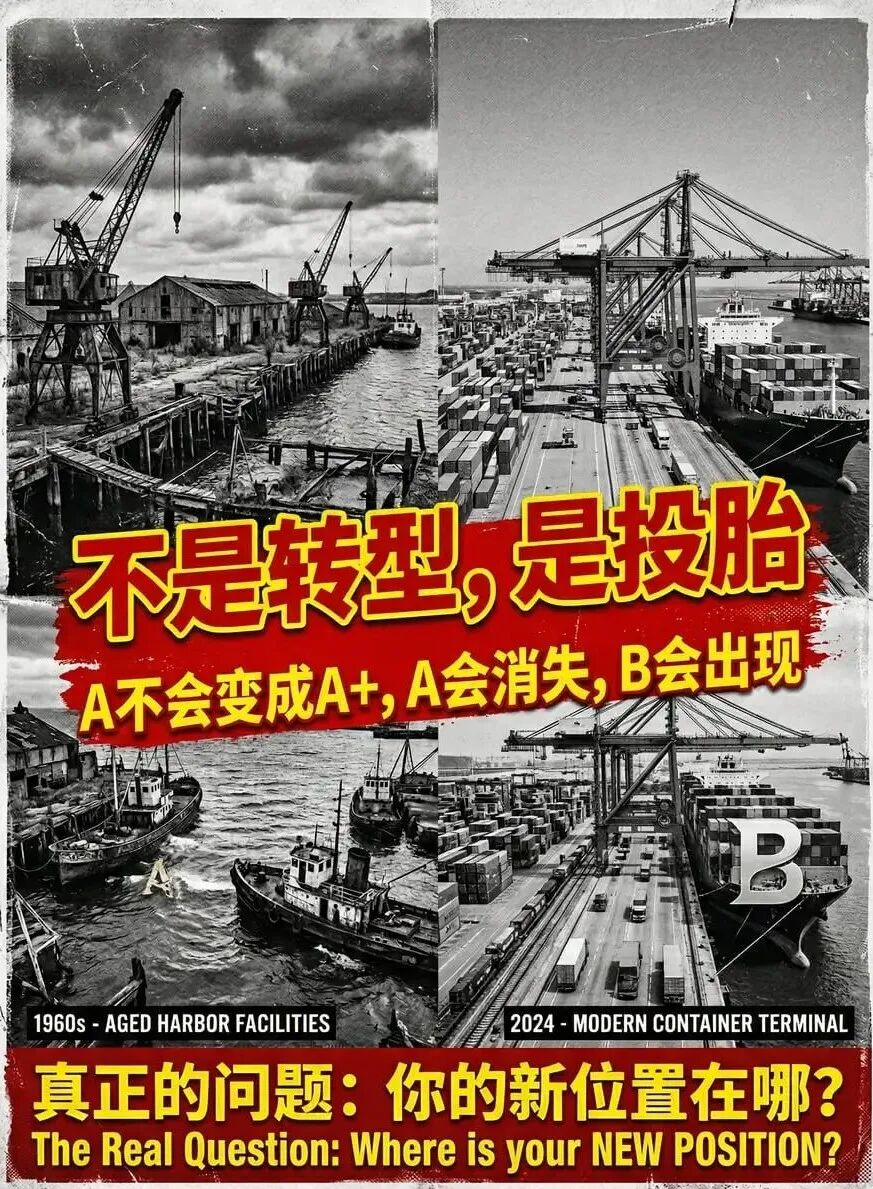
Tactically, of course, rush to deploy AI applications, push teams to use all the tools — this is Level One stuff, and it should be done. But behind closed doors, what really deserves your time is: how should my organizational form be rebuilt for AI? In the new ecosystem after AI drives various frictions to near zero, is there a new position that belongs to me?
The answers to these two questions probably won't emerge from your current org chart.
You might need to look across the river, in that marshland.

Heart Capital was founded in 2022 as an early-stage venture capital fund focused on technology and digitalization in China. The Heart Capital team is primarily composed of Yan Han, founding partner of Lightspeed, core investors, a CFO, and seasoned investors from industry backgrounds. The team's past investments include Series A investments in Xpeng Motors (NYSE: XPEV, 09868.HK) and Full Truck Alliance (NYSE: YMM), Pre-Series A investment in MetaX (688802.SH), as well as RoboSense (02498.HK), FinVolution (NYSE: FINV), LandSpace, MinoSpace, Huitian, Xi Wang, Polestones, Sunmi, World Logistics, Baichuan, Manbang Cold Chain, Fan Deng Reading, Lanhu, Starfield, and others. Rooted in China with a global outlook, Heart Capital is committed to finding true value in non-consensus. Heart Capital respects the value of "people" and advocates the potential of "heart," looking forward to accompanying more young Chinese entrepreneurs to strengthen China and go global.