Heart Capital's Bingjian Wu: When AI Becomes Consensus, We Choose Non-Consensus | Voice

Be the earliest companion to non-consensus value.

Earlier this month, at the 2025 Jazzyear Gravity Year-End Summit — themed "Rumbling Into Form, All Things Converging" — Wu Bingjian, Partner at Heart Capital, joined the tech investment roundtable alongside several fellow investors for a discussion on Navigating Cycles in Early-Stage Investing: From "Sector Thinking" to "Cognitive Alpha"**. Against a backdrop of cheap consensus and intense market competition, the panel explored how investors can survive cycles and shift from chasing sectors to capturing cognitive edge.
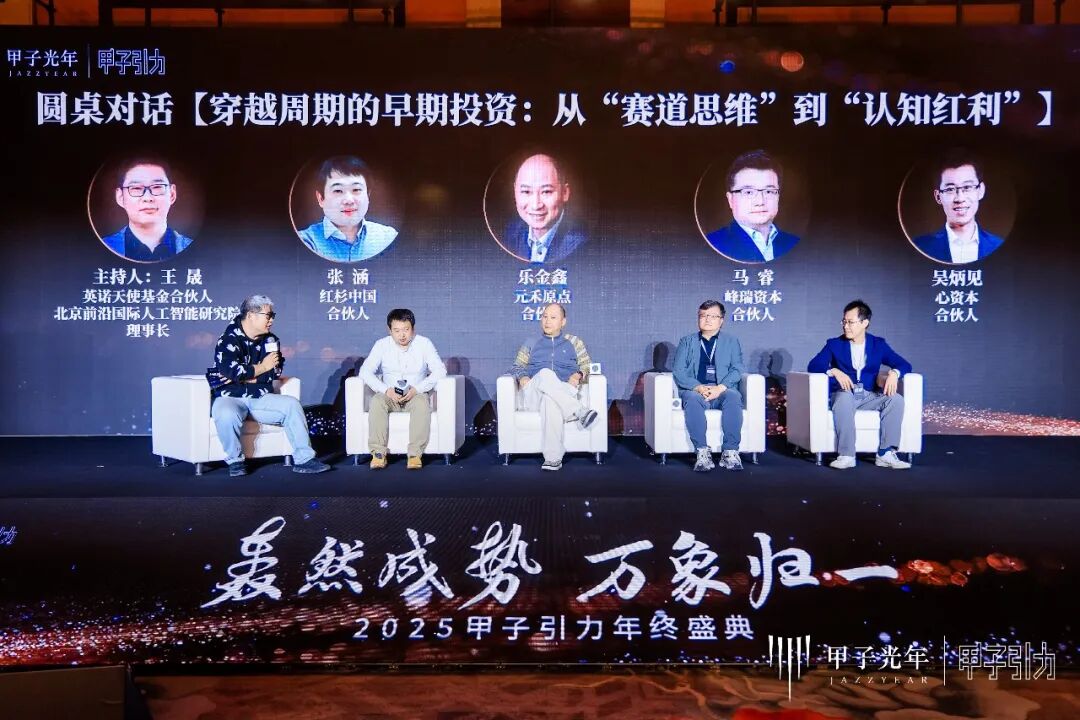
Below is a transcript of Wu Bingjian's remarks:
Rejecting Homogeneity: Finding Cognitive Non-Consensus in "Red Ocean" Consensus
Heart Capital is an early-stage venture firm focused on technology and digitalization. Our team has backed early rounds of companies like Xpeng Motors, Full Truck Alliance, and RoboSense. Personally, I focus on AI investment opportunities across models, applications, and AI infrastructure. Our AI portfolio spans GPU and inference chip design, controlled nuclear fusion, as well as AI applications, AI hardware, and the upstream and downstream robotics ecosystem. We also reserve some capacity for frontier technologies with higher uncertainty.
Heart Capital is rooted in China and committed to supporting Chinese tech entrepreneurs as they grow and expand globally.
On consensus versus non-consensus — if we go back to 2010 and the moderator asks everyone "what sectors are you investing in," the answer would probably be unanimous: mobile internet. But the biggest winners from that era, ByteDance and Pinduoduo, barely received ten term sheets in their early days. They even struggled to raise money. This shows that while the macro direction was the same, actual investment decisions on specific deals varied enormously. The same is likely true today: investing in AI is consensus, but deal selection differs significantly. Much of that difference comes down to founder preference — everyone has different taste, different biases.
An investor's brain is a bit like a large language model, full of parameters, and everyone's parameters are personalized. What does this produce? The same founder pitches for an hour or two — the input is identical — but the excitement levels among the investors across the table are completely different. Why? It relates to each person's background and experience. Life has been pre-training us for decades; our parameters are bound to differ. It also relates to each person's investment track record. Winning deals and losing deals teach lessons, create muscle memory. These cases perform reinforcement learning on our models, further tuning the parameters.
Let me share two small stories of my own.
I once invested in a company's angel round; six years later it went public. But during those six years, it pivoted several times. This gave me some feedback: the 0-to-1 stage of entrepreneurship is like Brownian motion — it can't be planned. But people with strong entrepreneurial ability can always identify and seize opportunities, even if they're neither technical nor product experts. They must, however, be good founders — decisive, fast-moving, bold. This taught me what someone who can seize opportunities smells like.
AI today is still in an extremely early stage; pivots will be the norm, and the ability to spot opportunities will be severely tested. Locking in product-market fit too early isn't a good thing — you're likely to pick up sesame seeds and lose the watermelon, with bigger opportunities still ahead. The Cursor and Manus we all know pivoted multiple times. What's behind this pivot ability? It's the ability to seize opportunities. So I care deeply about a founder's pivot capability — that's the positive feedback my previous investment gave me.
Now for a miss: I recently saw Soul's prospectus — it's about to list in Hong Kong. I was reminded that in 2017, the founder came to me for her angel round. We chatted for an hour one quiet afternoon, and that was that. Honestly, my parameters weren't activated at all. I asked her, "What's your 30-day retention rate?" She asked back, "What do you mean by 30-day retention rate?" My heart sank halfway. There really was no data to speak of at the time. Later I reminded myself: Shennong tasted a hundred herbs; investors need to taste a hundred herbs too. Only after tasting can you develop your circle of competence.
Wu Bingjian shared quite a few investment insights. Toward the end of the roundtable, during the "self-cultivation of investors" segment, when asked what he would invest in next year, Wu offered two keywords: "AI-related" and "people with 10,000 hours of accumulated expertise."
Toward Non-Consensus
The shift from "sector thinking" to "cognitive alpha" is, at its core, a practice of moving from consensus toward non-consensus.
Wu Bingjian's sharing reveals a central insight: in an era where technology waves have become collective consensus, the real cognitive gap no longer lies in "whether to invest in AI," but in how to see different people, different possibilities, and different value paths within the same wave. His concept of "people with 10,000 hours of accumulated expertise" is precisely where this non-consensus judgment lands — within a certain direction, finding uncertain yet most resilient individual value.
Navigating cycles has never been about avoiding the storm; it's about sailing through the same storm with a different posture. When AI becomes the era's context, non-consensus is no longer sailing against the wind — it means seeing earlier, accompanying longer, and creating value with more conviction.
Being the earliest companion to non-consensus value: this is Heart Capital's mission.

Founded in 2022, Heart Capital is a China-based early-stage venture fund focused on technology and digitalization. The team is led by Yan Han, founding partner of Lightspeed China, together with core investors, a CFO, and seasoned investors from industry backgrounds. The team's past investments include Series A bets on Xpeng Motors (NYSE: XPEV, 09868.HK), Full Truck Alliance (NYSE: YMM), MetaX (688802.SH), as well as FinVolution (NYSE: FINV), RoboSense (02498.HK), Baichuan, Yunmanman Cold Chain, Fan Deng Reading, World Logistics, Micro-Nano Starry Sky, LandSpace, Lanhu, Starfield, and others. Heart Capital is rooted in China with a global outlook, dedicated to finding true value in non-consensus. The firm respects the value of "people" and champions the potential of "heart," looking forward to accompanying more young Chinese entrepreneurs in strengthening China and going global.