Heart Capital's Bingjian Wu: I Don't Ask AI Startups About Their "Endgame" | Xinsheng VOICE

Build a boat and wait for the tide to rise.
The following is a paid post.
Recently, Jazzyear sat down with Wu Bingjian, partner at Heart Capital, to discuss his thinking on AI entrepreneurship. Here is the full interview.
Author | Shen Yiren
Editor | Wen Lihong
Total word count: 10,000. Estimated reading time: 20 minutes.
Imagine you're an investor. A young founder comes to you. He has no pedigree, no commanding presence, but he's sharp, executes ruthlessly, and has a good feel and strong opinions about AI.
By the time he finds you, he's built one product that works — the numbers look good, growth is fast — but you can see all its flaws. Oh, and it has no moat.
Three options lie before you:
A: You resonate with him. You feel he understands something deeply. You invest.
B: After rigorous analysis, you pass on rational grounds.
C: You wait for him to prove value, but by then his company might already be valued at $2 billion.
If you were the investor, what would you choose?
Wu Bingjian chose A. "The reason you resonate with a founder is because he understands something profoundly, and you get some of what he's getting. At that moment, you can't rely on logic."
"The best choice is really only the first one," Wu said.
This is Wu Bingjian's twelfth year as an investor. He began his career at Baidu as a mobile internet product manager, later pivoting to strategic analysis. In 2013, he left Baidu and joined the venture capital world. Today he is a partner at Heart Capital. At the end of 2022, he decided to go all in on AI.
As an investor who came of age during the mobile internet era, he witnessed firsthand the explosion and subsequent fade of traffic dividends. Yet history quietly marched into the AI era. From ChatGPT, he realized that the investment logic built on network effects and economies of scale — the very framework that had defined his career — had not yet taken hold in this new age.
So when Wu faces founders, he reminds himself: never ask "what's the endgame?" What matters more is the ability to "cross the river by feeling the stones."
In mid-2023, as a partner at Heart Capital, Wu invested in a company called "Xin Ying Sui Xing." Its founder, Binson (Liu Binxin), wanted to build an AI entertainment companion.
At their first meeting before the investment, Wu didn't ask about the endgame — a question with no answer. He didn't ask about market size — a question he already had a sense of.
Their conversation cut straight to the point: how to build the product. How to build it based on still-immature model capabilities. And after validating the product, how to conceal intentions and reduce competition.
Wu explained that the focus should be on questions that have answers now: "If you ask about the endgame, I can't see it clearly, and neither can he. Whatever he answers is just something he hasn't figured out. Wouldn't that be him deceiving me, and me absorbing the part where he's deceiving me?"
Wu Bingjian believes in thinking in public. To him, it's like a bird calling out in the forest — a way of finding kindred spirits. So alongside his work as an investor, he runs a WeChat public account called "AI Grand Voyage." His recent frustration is that he updates "too slowly"; he jokes that he's a quarterly blogger.
In his self-operated account, Wu once wrote about his "water, boats, and pillars" theory. According to this framework, technology is the water. Boats and pillars represent two types of entrepreneurial projects built atop technology. The former has the potential to rise with the water; the latter will be submerged by the era.
In this age of AI grand voyaging, all one can do is build a boat, read the rhythm of the waves, and wait for the water to rise. The challenge lies in distinguishing which projects are boats and which are pillars destined to be swallowed by the sea.
Wu says this is also the principle Heart Capital adheres to in early-stage investing — they hope to find boats in the AI space that can rise with the current. Heart Capital, where Wu is a partner, invested early in Xpeng Motors, Full Truck Alliance, RoboSense, Hanshow Technology, Micro-nano Starry Sky, and LandSpace. Many of these have since gone public.
Now, they have made AI their priority. When large language models were still nascent in early 2023, the Heart Capital team began positioning, investing in domestic LLM companies, GPU chip designer MetaX, AI-driven design collaboration platform Lanhu, and AI entertainment companion "Xin Ying Sui Xing." Recently, their investments have focused mainly on AI applications, AI hardware, and AI infrastructure.
In this piece, Jazzyear speaks with Wu Bingjian, partner at Heart Capital. As an investor, one is always watching the tides rise and fall. Sometimes boats rise with the water; sometimes they suddenly become pillars in the churn of technological iteration. We wanted to know: how does he read the rhythm of the waves, and how does he ride their crest?
I Want Founders to Understand My "Context"
Jazzyear: I've read many of your recent articles. I'm curious — at a time when many domestic investors are reluctant to speak publicly, why do you write a public account?
Wu Bingjian: I've found that learning — investing — outputting forms a cycle. When you invest, a public account becomes a byproduct.
In the U.S. VC circle, being a KOL and putting out content is already standard. A16Z's podcast, Greylock's blog — the quality is high. They're open-sourcing their views to attract like-minded founders. On the matter of speaking loudly, China's VC circle will gradually converge toward the U.S. model.
Founders open-source code on GitHub. I open-source thinking on my public account. Open-sourcing is to attract kindred spirits, to create resonance. Like a bird calling in the forest to attract its own kind.
My social circle has many founders, all highly capable, whether I've invested in them or not. When I put out AI views, I'm providing my "context."
Outputting is for better input and thinking.
Jazzyear: What do you mean by "context" here?
Wu Bingjian: When I output AI views, I'm giving founders my "context." Of course, I also look at founders' "context" — that is, the products they want to build.
If our "contexts" overlap significantly, we should sit down and talk properly. If our "contexts" have nothing to do with each other, there's no need to grab coffee. Attention is all you need — it means our attention is the same.
Jazzyear: Aren't you afraid of being wrong?
Wu Bingjian: There will definitely be rights and wrongs. I can only write my thinking at the moment; I'm also iterating my ideas.
Facing 10x growth is easy to predict. Facing a massive wave like AI with 1000x growth, our views will typically reverse at least three times — that's what makes the story exciting enough, beyond what we previously knew. I'm prepared for my views to reverse three times.
You'll find that being right or wrong doesn't matter. Keep open-minded, keep moving — that matters more.
Jazzyear: Your WeChat public account is called "AI Grand Voyage." Where did that name come from?
Wu Bingjian: "Grand Voyage" refers to a technological transformation, like the Age of Discovery. Continental plates are shifting — some disappear, some minor versions may become major plates. Isn't this exactly what's happening with startups?
I position the account as "deep thinking on AI entrepreneurship." Investors have a natural advantage: once you find a good question, you can take it to ten founders, ask layer by layer, think repeatedly, and deep thinking emerges.
Jazzyear: Can putting views online bring you investment opportunities?
Wu Bingjian: Yes. For example, in 2023, a product lead at a large model company found me. He said he resonated deeply with an article I'd written. There was a line: "What's most important about getting out there? Getting out there. What's most important about starting a company? Starting." He said it moved him greatly.
We hit it off. I told him: "You're going to start a company sooner or later. Remember to find me." Sure enough, a few months later he left to start up, and the first person he contacted was me.
Such experiences have given me a lot of positive feedback.
Jazzyear: Was it the same in your early days?
Wu Bingjian: Early on, it wasn't through writing public accounts but through one-on-one communication. For example, my first IPO exit came this way.
That founder was someone who loved tinkering with startups. A friend thought I was good at advising, so introduced us. He came to me for funding, and I directly told him, "This idea doesn't work," advised him not to do it, and explained why. He found it made sense.
He was the type to come up with three or four new ideas a year, so he'd come back to me repeatedly — three or four times a year. Over two years, I talked him out of it every time, yet he trusted me more and more, feeling I was someone who told the truth.
When he started another company later, he came to me again. This time I thought the idea worked, so I invested in his angel round, and the company later IPO'd. This was also a form of view output — just directed at an individual rather than the public.
If I hadn't spoken truthfully, if I'd defaulted to business courtesy — "What you say is excellent, let's keep in touch" — the relationship would have actually broken.
Later I realized: relationships need to be operated. When you speak truth, when you output effective views, trust increases. But one-on-one communication is too inefficient — you really can't drink 500 cups of coffee a year (laughs). So why not write it out?
Jazzyear: How do your views generally take shape? Do you record them in real time?
Wu Bingjian: I might suddenly have an idea and spend five minutes posting it on Moments. If it gets many likes and comments, the topic has resonance. I expand on those one-to-two-hundred characters, keep asking a few more questions, think dialectically from different angles, and that might become an article.

Actually, writing the article itself doesn't take much time — one night is enough. But much of the content isn't thought up on the spot. These are thoughts I already have, scattered everywhere. The writing process is connecting the dots.
Jazzyear: Through your choice of AI as an investment direction and your public account to express views, it seems you're someone quite good at finding relative advantage?
Wu Bingjian: There are two methods that have benefited me greatly: first, Tian Ji's horse racing — finding relative advantage; second, focused all-in, spending ten times the effort on one thing. In AI terms, it's choosing a direction, setting a reward function, and doing reinforcement learning with all your might.
The other side of finding relative advantage is admitting you have weaknesses, and accepting them.
Stand With the Strongest Model Capabilities
Jazzyear: In your previous sharing, we noticed you particularly emphasize "capability boundaries" and "historical stages," often advising founders to pay attention to large models' capability boundaries. Where are today's large models' capability boundaries? What direction might the next stage leap toward?
Wu Bingjian: What applications emerge is often related to the capability dimensions of the platform.
In the mobile internet era, major opportunities typically came from the phone's most distinctive capability dimensions. For instance, ride-hailing and food delivery emerged because of LBS; Douyin, Kuaishou, and Xiaohongshu emerged because of the camera; WeChat emerged because of the address book.
So what are the capability dimensions of large models? Two to three years into the development of large models, the answer is much clearer now.
The first capability dimension is summarization and generation. AI search, or products like Plaud for meeting notes, are essentially "context + summarization capability."
The second is coding capability. Teams like Cursor may not necessarily be stronger than others; they simply happened to ride the wave of rapidly improving coding capabilities in large models. Over the past two years, this experience has improved tenfold or even a hundredfold, propelling them to where they are today.
The third is reasoning capability. The breakout of DeepSeek-R1 was largely driven by reasoning capability — people can feel that its thinking has more depth.
The fourth is image generation capability. I'm talking about character consistency here, like GPT-4o's native image capabilities, or nano banana's high controllability. In the next six months to a year, I predict we'll definitely see a wave of AI apps and hardware related to photography — where a casual snap can approach the polished photos you see on Xiaohongshu.
Stand with the strongest model capabilities, because next to the steepest slope, many hard problems become easy ones.
I often think about this question: which model capability is this application built on? Can the experience of this model capability improve 10x in the next two years? Choosing right matters more than executing well.
Jazzyear: So which historical stage of AI are we in now? Can we draw an analogy to mobile internet?
Wu Bingjian: I don't think it's a good analogy to mobile internet. AI's development today is more like when computers were first invented.
After calculators came out, some people made DOS, some made Windows, then someone made browsers, and Yahoo emerged in browsers. People thought Yahoo was amazing, but then came Google, then Facebook, then the mobile internet that followed — wave after wave. AI will unfold the same way, wave after wave.
Today AI is in an extremely early stage. If the cycle is 20 years, there will definitely be three or four waves of boom and bust during this period. We're clearly in the first wave right now.
Many things are still immature. For example, models still hallucinate, lack long-term memory, aren't personalized enough, aren't tailored for you. This explains why there aren't many killer apps right now, why there aren't moats — because it's still extremely early, there genuinely aren't any.
But as models improve, the process of using them will train them. Parameters will be customized for you personally, long-term memory will develop, your data will accumulate, and you won't be able to leave. In the future, it won't be like today where "Claude is good so I use Claude, tomorrow ChatGPT is good so I switch to ChatGPT." You'll be bound to a particular brand.
In the very early days of the internet, building a portal site had no moat either. Scale effects only emerged with search and transaction platforms. This is a necessary stage.
Jazzyear: Based on the present, what's the state of applications in the market?
Wu Bingjian: Actually, it's still not rich enough. The applications on the market mainly fall into six categories:
Various ChatGPT variants, AI search, vertical industry ChatGPTs, and so on.
Various AI coding variants, like Cursor, Devin.
Various Character.ai variants, c.ai plus various gamified approaches.
Various Midjourney variants, text-to-image, some making tools, some doing anime.
Various Sora variants, various text-to-video.
Agent concept products, your "cyber beasts of burden," like Manus and Genspark.
About 70-80% of the projects we see now fall into these categories. I believe Agents are what will truly unlock the future.
Jazzyear: Aren't there already many Agents now? What do you consider an Agent to be?
Wu Bingjian: Although 8 out of 10 pitch decks say they're Agents, real Agents haven't arrived yet.
To use an analogy, in the early mobile internet era, people could browse web pages on their phones, and they would load. But what opened the door to mobile internet was Apps. AI agents will be the same — we're still in the "web page stage" now.
Agent is roughly equivalent to App in the mobile internet era, the core application form of the AI era. Agents can communicate with each other directly — for example, scheduling a meeting, where both parties don't need to arrange it personally, two Agents shake hands and it's done! This requires Agents to be from the same brand, which creates network effects.
We can't do real Agents today. What we have now are Workflows, step-by-step tool invocation. Real Agents will interact directly with the environment, self-adjust and learn, until they achieve their goal.
The future form of AI applications definitely won't look like what we have today.
Jazzyear: So before the Agent era arrives, what capabilities and moats can entrepreneurs accumulate?
Wu Bingjian: In today's AI entrepreneurship, there isn't much data asset that can be accumulated. The core is the team — you need a battle-tested team. You also need ample capital. Having 1 million RMB versus 100 million USD in the bank makes a huge difference in effect and confidence.
Using the false to cultivate the real is a skill. Cultivate until you reach the real.
Jazzyear: Using the false to cultivate the real? What's false and what's real?
Wu Bingjian: I mentioned earlier that many Agents today aren't real Agents. But these teams need to use "fake Agents" to first build up the team, build up the traffic. When real Agent capabilities emerge, they can cultivate the "real."
Let me give a mobile internet era example. Yiming Zhang's initial product, Neihan Duanzi, was "using the false to cultivate the real." Eventually ByteDance cultivated the real with ByteDance and Douyin.
Jazzyear: So if an entrepreneur realizes right now that their product has no market and the scenario isn't opening up, what advice would you give them?
Wu Bingjian: Never believe that if it's not working now, it will work later. You need to build something that works right now, even if you solve it with a less sophisticated method. Why? Because the team needs to grow, and building something that works is how you grow. Failure is not the mother of success — success is the mother of success. You need positive feedback.
Also, avoid crowded places. Directions that everyone thinks are good may not be real opportunities.
Jazzyear: But if everyone is in the only channel, what would you suggest?
Wu Bingjian: There will always be a "second" channel. How could there be only one? You need to find other paths. Even on the same main road, there are always small branches you can take.
Things that everyone is doing, that seem correct, that are conventional — I don't think they have much meaning.
Jazzyear: After all this discussion, AI entrepreneurship feels like a long-distance race where pace and timing matter quite a bit?
Wu Bingjian: I mentioned various model capabilities earlier, many of which are consensus. But I think what's more critical is having a rough feel for how these capabilities are developing — where are we now, where might we be in six months? You need to be six months to a year early, not three years early.
Being too early makes you a martyr; being six months to a year early makes you a pioneer.
Don't Over-Reason with Logic, Rely on Intuition
Jazzyear: You invested in Heart Shadow in 2023. Their product, DouDou Game Companion, can accompany users while gaming. In 2023, this was quite a non-mainstream direction. What were you thinking at the time?
Wu Bingjian: When I met Heart Shadow's CEO Binson, they were still at the idea stage, having put in several million of their own money to get started.
He told me he was going to build an AI game companion that could accompany you while playing games like Genshin Impact, providing strategy value and emotional value, roasting you or showering you with praise. It's like when you're playing cards, someone next to you giving you tips or teasing you — it's a very natural scenario.
He gave me several numbers: 400 million gamers in China, 3 billion globally, 300 million Genshin Impact players worldwide. They had researched Character.ai — Genshin Impact IP accounted for nearly half of the top 20 characters, reflecting the distribution of demand. So the entry point should start small and see the big picture, beginning with gaming.
He hit on several points for me. I felt the game companion thing had demand, at least for a segment of gamers. LLM capabilities were well-suited for this. If done well, thoroughly covering a few hit games, it could spread easily — essentially doing growth by standing on the shoulders of giants.
Looking at this idea today, it may not seem novel. But in early 2023, an idea with this kind of originality was quite refreshing. Everything comes down to an "early" principle.
Jazzyear: How do you understand this "early" principle?
Wu Bingjian: Stand on the wave early, ride it up, and ride it down when it falls. Do the surfing motion, understand the rhythm of the waves.
Jazzyear: Based on the Heart Shadow product, which model capability do you think it leveraged? How did it deal with model capability boundaries?
Wu Bingjian: The core capability was large models' multimodal recognition — that is, recognizing content on screen, the direction of game plot development, essentially the computer's "eyes."
Shortly after the investment, after several months of R&D, both Binson and I realized: this isn't working. Many of the features conceived at the time couldn't be supported by current model capabilities. For example, understanding game visuals — models' multimodal capabilities were far from sufficient. Or response latency — waiting four or five seconds for a reply.
Binson's solution was to first lower expectations, creating an AI desktop pet form that hovers on users' screens, providing emotional value. At the time, they acquired 8 million registered users, which was quite crucial for a startup, because 8 million users is already a laboratory — you can get a lot of user feedback and know which direction to iterate.
It wasn't until early 2025 that Binson said he was ready to bet on multimodal capabilities. He predicted that multimodal recognition capabilities would advance by leaps and bounds soon, quickly reaching a 60-point level. Then the model would have eyes, knowing what's happening on your screen, how the game is progressing, and the previously conceived features could be realized.
"Loading up early" is quite important. His recent release is an "eyes-equipped" version, essentially realizing the previous conception with good results. This is a way of dealing with model capability boundaries.
Jazzyear: What will Heart Capital invest in going forward? Why choose these directions?
Wu Bingjian: Heart Capital focuses on two things: first, full-stack investment in AI; second, major directions in Chinese technology. Many VCs might say similar things, but Heart Capital has some distinctive characteristics.
First, for AI, we want full-stack investment: from models to various applications, to AI infrastructure, semiconductors, robotics — we have systematic interest in all of these.
Second, for technology, we want to invest in "the next big thing for China," which is also what we tell our LPs. What does this mean? We've observed that most technological breakthroughs happen first in the United States, then China follows and may even do better. For example:
The United States has Apple, China has Xiaomi and Huawei;
The United States has Tesla, we invested early in Xpeng Motors;
The United States has SpaceX, we invested early in LandSpace and Micro-nano Starry Sky;
The United States has OpenAI, we invested in domestic large models;
The United States has NVIDIA, our team invested in MetaX GPUs.
These are things that have already happened, and there will be many more to come. The United States has brain-computer interfaces; China will have them too. The United States is researching controlled nuclear fusion; China will make corresponding breakthroughs as well.
These kinds of directions share several characteristics: first, they represent genuine technological progress; second, they are things the state wants and is actively pushing for; third, they have far-reaching ripple effects, generating a massive ecosystem of surrounding applications. The batch of deals we recently closed was invested according to this framework.
Jazzyear: Looking back at Heart Capital's past investments, which ones had particularly interesting stories behind them?
Wu Bingjian: Let me tell you a story about our founding partner Herry (Yan Han). He was among the earlier buyers of Tesla vehicles in China — back then, a Model X cost a million RMB. After driving it, he was blown away by the experience; step on the accelerator and you instantly overtake everyone else. Later, he invested in Xpeng Motors at a relatively early stage.
Recently, robots have become a hot and controversial topic. Out of curiosity, he bought a Unitree robotic dog named "Chouchou." Right now, that dog is lying in our office. So when it comes to controversial new things, we might as well experience them firsthand, get a feel for them — that way we can judge whether an era is truly beginning.
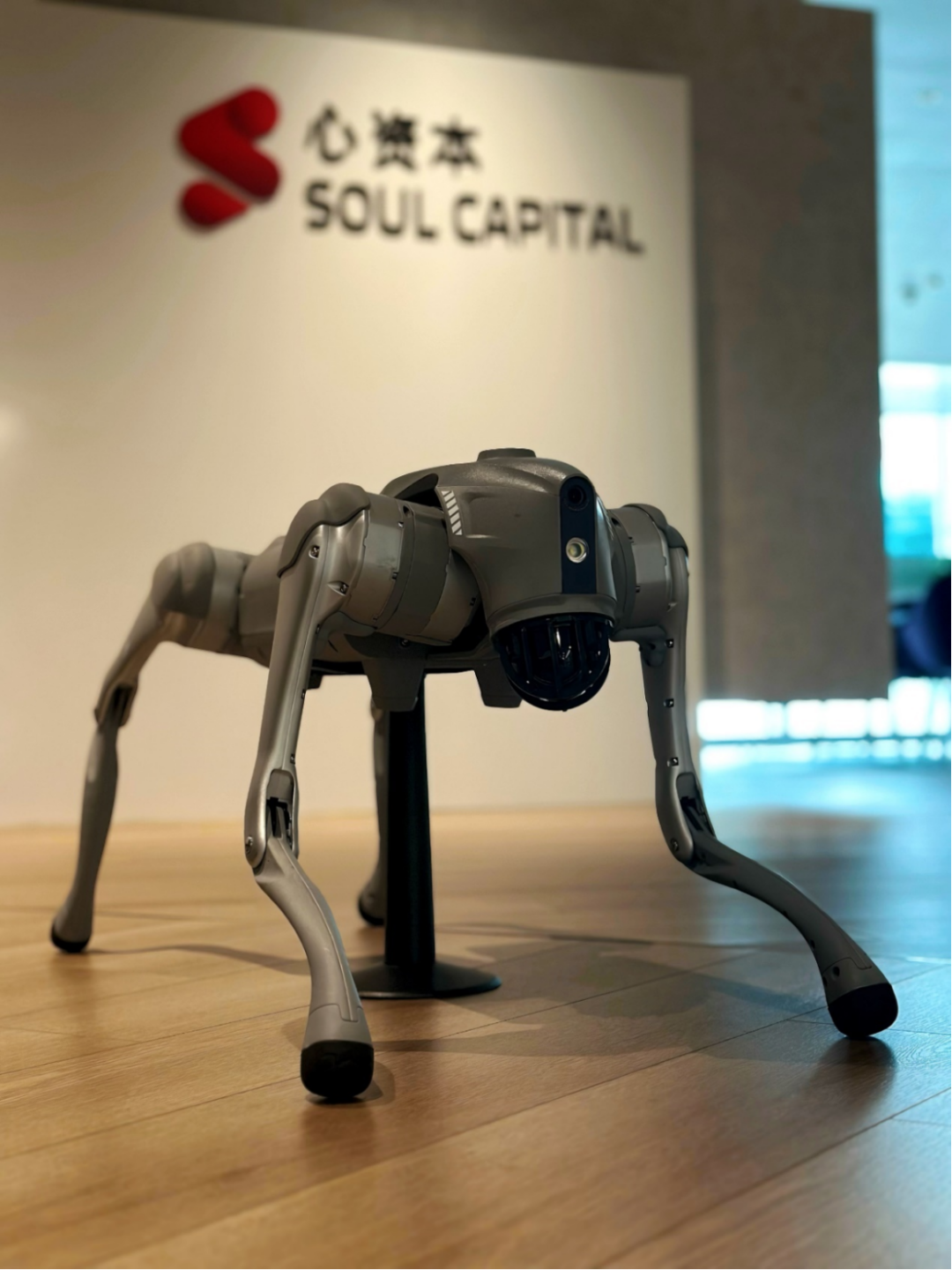
The robotic dog in Heart Capital's office
A few years ago, I saw some smart people around me buying Bitcoin. At the time, I thought, forget it, don't follow the crowd. Looking back, I should have kept an open mind — instead of questioning or believing, just open a wallet, buy a coin, feel it out, see if it resonates.
An era is often kicked off by a few super products. We approach them with curiosity: buy one, use it, see if we can resonate with the times.
Jazzyear: Does this kind of product experience lead to different investment perspectives?
Wu Bingjian: Many of our investment cases were discovered through "giving it a try." Investors can't rely solely on logical deduction; physical intuition matters.
For example, our team bought over a dozen Plaud devices — an AI voice recorder — and found that there really was demand there. This also inspired our investment thinking: AI hardware can easily monetize model capabilities, and some scenarios genuinely need hardware. Recently we've been investing in an AI photography-related hardware product.
Another example: after using the robotic dog, we found quite a few pain points. When it lunges at you, it's actually a bit scary; take it out and the battery dies, and you realize lugging it back is exhausting; or when the battery runs out, it might crash down and dent the floor. You only know these things from actual use.
Let me give another example. When we were looking at humanoid robots, Herry said: "Can I get a robot today that just leads visiting entrepreneurs to the conference room? If it can do that, I'll pay for one." I said: "No way, haha — it'd probably smash through a few glass doors."
The core is that we value experience, don't rush to conclusions, and avoid excessive logical deduction. We rely on physical intuition to understand.
Jazzyear: Many investment institutions say they want to be long-term companions to entrepreneurs. How do you view this "companion" role? Does it include cultivating the entrepreneur's own capabilities?
Wu Bingjian: Entrepreneurs can't be cultivated; they can only be selected. In a company's success, we account for at most 1% to 5%; the remaining 95% depends on the founder themselves.
An investor's real value lies in three things: choosing, betting, and catalyzing. Choose the right people and directions, bet capital, and catalyze on strategic pivots, hiring, and fundraising.
This catalysis manifests in several ways.
First, being a mirror. When an entrepreneur is considering a pivot, they can ask whether this choice aligns with common sense. I can think through it with them. But I can only tell them what's wrong; the right answer still needs to come from them.
Second, helping with hiring. There was one project where we helped them recruit twenty to thirty people. At IPO, two of the four executives were ones we'd helped bring in — I was especially happy about that. No matter what stage a company reaches, it always needs people, and good people.
Third, fundraising. We can help make connections, but we must be mindful of boundaries. Don't micromanage, and don't assume you're smarter than the entrepreneur. A mentality of humility is crucial. We have to admit we only know some common sense, not that we're experts.
All in AI, "Flashing My ROM"
Jazzyear: At the end of 2022, you decided to go all in on AI. Were there seeds of this decision planted earlier?
Wu Bingjian: I worked on an AI project back in 2013, related to deep learning. At the time, I had two confusions: first, the technology lacked generalizability — it could only be used in specific scenarios. Second, the marginal cost was too high; you needed to hire a massive team.
It wasn't until ChatGPT emerged that both questions were answered. When I first started using large models, I felt a sensation like electricity running through me. It made it easy to imagine all kinds of applications growing on top of it.
In 2008, I bought my first iPhone, and after using it, I had that same electric feeling. I was still a student then — I couldn't articulate any grand theories — but I found the iPhone incredibly addictive, playing games and flicking the phone around all day. Only later did I realize that was an inflection point for an era. After graduating, my first job was as a mobile internet product manager.
The two experiences share many similarities.
Jazzyear: Before deciding to go all in on AI, who did you talk to?
Wu Bingjian: Smart people, entrepreneurs.
Right after the 2023 Spring Festival, I organized a closed-door session with ten entrepreneurs and practitioners to discuss what large models really meant.
Honestly, there weren't any profound insights at the time. But I noticed that the truly sensitive people had already jumped in at the first opportunity. One education entrepreneur shared that his dual-teacher large classes had 130 steps, and he'd found that 80 of them could be solved with large models. He explained it clearly, thought it through clearly. Two months later, he started his AI education venture; it's doing quite well now. Of the ten people at that session, half later went on to start AI companies.
I realized that for AI, I needed to reach the 10,000-hour threshold — whether I got there this year or next, the opportunity would be completely different.
Jazzyear: Before Heart Capital chose to go all in on AI, did you struggle with what direction to invest in next?
Wu Bingjian: Before ChatGPT came out, I was genuinely quite lost about what direction to invest in.
Would it make sense to invest in advanced manufacturing with our past frame of mind? Why would we do better than people who've been investing in advanced manufacturing for over a decade? I didn't see any comparative advantage. It's like a Texas Hold'em player insisting on playing Chinese chess — there's a barrier in between.
So my conclusion was: bring along some past ways of thinking, but pair them with entirely new knowledge. Approach AI investing with an empty-cup mentality. This includes models, applications, infrastructure, and so on.
A crucial point is that understanding AI before and understanding large models now are completely different things. So our team buckled down and started from the fundamentals, collectively understanding model training mechanisms, inference pain points, and the new generation tech stack. You can't fully grasp these just by talking to projects; you also need curiosity, time to experience things. Only with the foundation can you build the house.
Jazzyear: How did you get through this learning and exploration phase?
Wu Bingjian: I gave this learning approach a name: "flashing my ROM." What does that mean? When you flash a stock Android system to MIUI, it takes time to flash, time to reboot. AI cognition also requires spending time to flash your ROM.
So I changed some habits. Before, as an investor, I'd pack my day full of meetings back-to-back. Why could I do that? Because the previous knowledge system was mature; you were just meeting different people. But that doesn't work for AI.
Now I deliberately block out chunks of time in my day for focused learning — reading materials, chatting repeatedly with models, trying out products, reading technical analyses, trying to understand why 1+1 equals 2. Then when I go into project meetings, I'm better able to identify which founders truly understand things from the ground up versus which ones are just parroting what they've heard.
Generally, there are two types of founders who come to pitch. One type understands from the roots and can explain the most essential logic clearly. The other relies on grand narratives to carry the show, delivering plenty of emotional value, but the moment you press on underlying logic, they're empty.
The human brain naturally loves grand narratives, but in investing, you should spend more time talking to people who "understand from the roots." But the prerequisite is that you need to understand a bit yourself; otherwise you can't tell the difference.
Jazzyear: From your mobile internet era experience, what is reusable and what do you think should be discarded?
Wu Bingjian: Some fundamental experience still holds value. For example, a startup needs a good product, and good products usually have retention. Or you'll notice that after mobile internet consolidated, the strongest logo wall only had about twenty companies — major opportunities are always scarce.
For example, the best mobile internet projects were all invested in before 2015, when VCs hadn't yet developed mature mobile internet investment methodologies. After 2015, VC firms started forming various industry groups, methodologies matured, and returns actually decreased. This shows timing is critical. Good investment opportunities usually appear when things are fuzzy; by the time they're crystal clear, you might be at the exit stage. These insights have informed my approach.
What needs to be discarded are some old judgment patterns. For example, when entrepreneurs talk to you about models and product implementation, but you keep wanting to talk about "network effects." Because in the mobile internet era, that's what we invested in. But current AI is in an extremely early stage — there's no network effect, no obvious moat. We need to discuss things as they are.
Inertia is the hardest thing to overcome. Replacing old knowledge with new knowledge is like antivirus: the virus is hard to completely eliminate; you can only spend ten times the effort to gradually clear out old habits.
Jazzyear: How do you "run antivirus"? For example, with the network effects you just mentioned — how did you discover they don't apply to AI for now?
Wu Bingjian: Very simple: use the product and you know. Does ChatGPT have network effects? A data flywheel? Neither. The more users it has, it doesn't get better because of that.
I believe AI will definitely develop network effects and data flywheels in the future — but not today.
Jazzyear: Many investors ask entrepreneurs "what's your endgame?" Do you care about AI entrepreneurs' "endgame"?
Wu Bingjian: I think we should discuss based on the current stage. Today, I don't ask AI entrepreneurs what their endgame is.
What's most frightening is investors carrying late-stage TMT-era thinking, casually asking entrepreneurs "what's your endgame?" We're still in AI's extreme early days; entrepreneurs are crossing the river by feeling the stones. Can you see the endgame at this stage?
If I can't even see it myself, how can I ask an entrepreneur to answer?
Seeking truth from facts is what matters most.
Heart Capital was founded in 2022 and is an early-stage venture capital firm focused on technology and digitalization.
Heart Capital's team is built around founding partners and core investors from Lightspeed, alongside seasoned industry investors from Cainiao and Baidu. The team's track record includes investments in Xpeng Motors (NYSE: XPEV, 09868.HK), Full Truck Alliance (NYSE: YMM), Ambiq Micro (NYSE: AMBQ), RoboSense (02948.HK), QuantaSing (NASDAQ: QSG), FinVolution (NYSE: FINV), Hanshow Technology (301275.SZ), as well as FangDD (NASDAQ: DUO), MinoSpace, LandSpace, Baichuan, Manbang Cold Chain, Fan Deng Reading, World Logistics, Lanhu, and Starfield.