Xpeng Aeroht's First CBD Flight Boosts China's Low-Altitude Economy | Xinwen NEWS

The road ahead is long, but the future holds promise.

On March 8, Xpeng Aeroht's flying car, the Voyager X2, took off in Guangzhou's Tianhe District, completing a low-altitude flight from Tiande Plaza to Canton Tower. During the flight, the Voyager X2 lifted off vertically from the Grade-A office building at Tiande Plaza in autonomous mode, crossing over landmark sites including the Guangdong Museum, Huacheng Square, and Haixinsha Asian Games Park. Deli Zhao, founder and president of Xpeng Aeroht, said this demonstration carried significant meaning. "Previous flights were conducted in the wild, in sparsely populated areas. Flying outdoors has some value, but true aerial mobility needs to happen above the CBDs of cities — that's the only way to genuinely showcase future air transportation. And being able to come to the urban CBD also shows us the government's resolve." Zhao said: "I believe low-altitude flight will progress from the suburbs to above cities, from experience flights and entertainment and scenic tours to daily commuting. This is a process, and I think it represents enormous opportunity over the next five to ten years."
Heart Capital's investment team was an A-round investor in Xpeng Aeroht, having also invested in Xpeng Motors at the A round. Regarding the successful flight of the Voyager X2, Yan Han, founding partner of Heart Capital, said: "Heart Capital has been continuously following the eVTOL space. As low-altitude airspace gradually opens up comprehensively in the future, with industry supporting infrastructure and corresponding policies becoming increasingly mature, the low-altitude economy holds tremendous market potential. We are very optimistic about the future growth potential of the low-altitude economy. With sufficient patience, the future is promising."
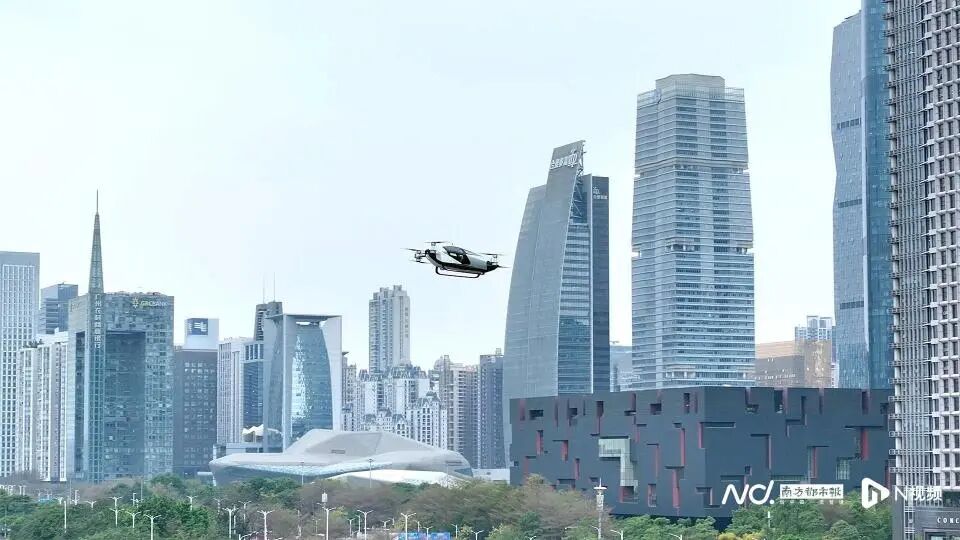
Voyager X2 in flight
In 2024, "low-altitude economy" was written into the government work report for the first time, regarded as a new growth engine for cultivating emerging industries and industries of the future. The government work report also mentioned implementing industrial innovation projects, improving industrial ecosystems, expanding application scenarios, and promoting the integrated and clustered development of strategic emerging industries — including consolidating and expanding the leading advantages of industries such as intelligent connected new energy vehicles. He Xiaopeng, chairman and CEO of Xpeng Motors, believes that flying cars, as advanced intelligent transportation tools integrating automotive and aviation industrial systems, are becoming a hot innovation and technology field that China, the US, Japan, Europe and others are rushing to enter, and have already entered a period of explosive growth. However, product certification, operational management, and operational safety are entirely new challenges. As a deputy to the National People's Congress, he recently submitted Suggestions on Promoting Flying Car Applications to Support the Development of New Quality Productive Forces in the Low-Altitude Economy. He stated that the low-altitude flying economy is equivalent to new energy vehicles ten years ago. From a top-level design perspective, the low-altitude economy is a massive industry, and low-altitude economic products — including new energy products and products combined with capital — will see enormous development in the next ten years. He Xiaopeng suggested establishing flying car driving qualification certification and training systems, accelerating the implementation of airspace classification and management policies, and speeding up the opening of low-altitude airspace. He also proposed establishing a unified regulatory command platform and low-altitude airspace management system covering unmanned aerial vehicles, flying cars, traditional low-altitude aircraft, and other types of aircraft.
At a State Council Information Office press conference in February this year, Han Jun, deputy director of the Civil Aviation Administration of China, revealed that China's low-altitude economy already exceeded 500 billion yuan in scale in 2023 and is expected to reach 2 trillion yuan by 2030. By the end of 2023, China had 689 general aviation enterprises, 3,173 registered general aviation aircraft, 451 general aviation airports, and 1.357 million hours of annual operation flight time.
The low-altitude economy has a long road ahead, but the future is promising.
Voyager X2 flight site
Source: Southern Metropolis Daily, Yicai; Images: Southern Metropolis Daily

Founded in 2022, Heart Capital is an early-stage venture capital fund focused on technology and digitalization in China. Heart Capital's team is primarily composed of Yan Han, founding partner of Lightspeed China, core investors, a chief financial officer, and senior investors from industry. The team's past investments include A-round investments in Xpeng Motors (NYSE: XPEV, 09868.HK) and Full Truck Alliance (NYSE: YMM), as well as FinVolution (NYSE: FINV), RoboSense (02948.HK), Baichuan, Manman Cold Chain, Fan Deng Reading, World Logistics, Micro-Nano Starry Sky, LandSpace, Lanhu, Starfield, and others. Rooted in China with a global outlook, Heart Capital is committed to finding true value in non-consensus. Heart Capital respects the value of "people" and advocates for the potential of "heart," looking forward to accompanying more young Chinese entrepreneurs to strengthen China and go global.