What It Cost Me to Become a Real CEO | Xinxing PORTFOLIO

He Xiaopeng: To Be a CEO of a Large-Scale Manufacturing Company Pursuing Technological Innovation
He Xiaopeng's transformation is a microcosm of internet entrepreneurs embracing hardcore manufacturing — technology must create tangible value for users, not just "self-indulgence"; scale matters more than short-term profits in manufacturing, survive first, ideals later; and a leader's hands-on involvement is the key to breaking through.
Recently, Xpeng Motors CEO He Xiaopeng gave us much to ponder in an interview with LatePost: as an entrepreneur, how do you go the distance in a "heavy-asset, long-cycle" track? That's the question.
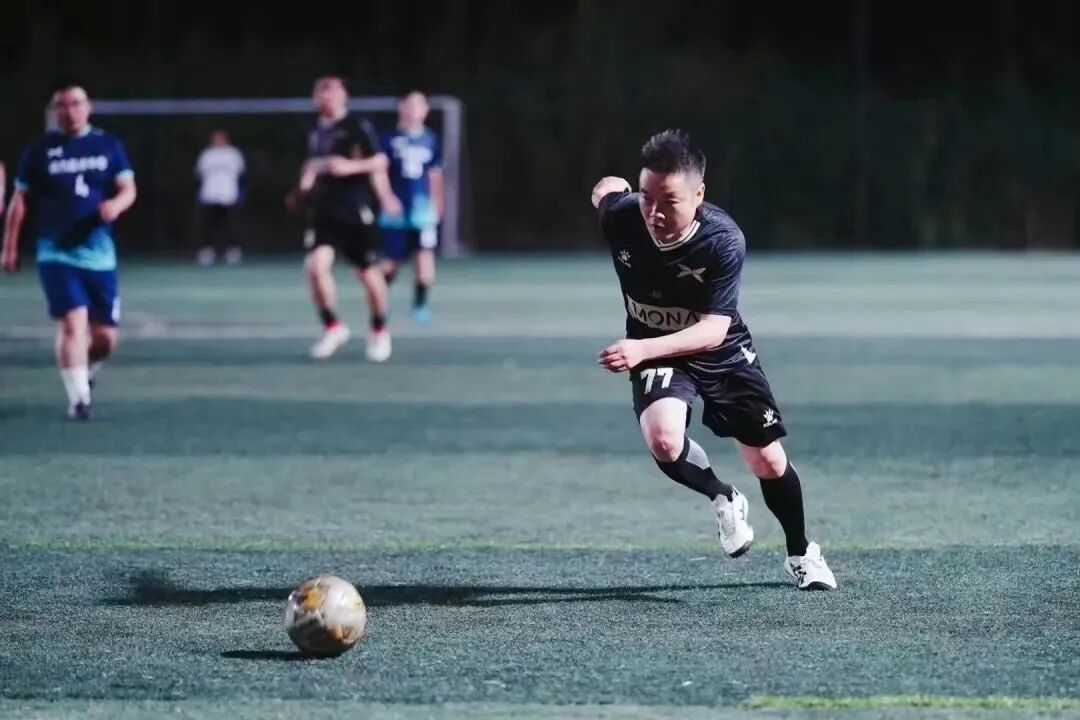
In August 2024, He Xiaopeng participated in a soccer match celebrating Xpeng Motors' tenth anniversary.
The following is from LatePost's interview with He Xiaopeng in early 2025. This article is republished with permission from LatePost (ID: postlate), by Song Wei and Zhao Yu.
He Xiaopeng has changed. Over a few years, he went from a light-footed dreamer to a heavy-handed industrialist.
In 2019, He Xiaopeng's third year as Xpeng Motors CEO, we first interviewed him. He was in excellent spirits, binge-watching A Record of a Mortal's Journey to Immortality. Now, he works six and a half days a week, arriving before 10 a.m. and still at the office at 10 p.m. An old colleague remarked, "He's basically working himself to death."
The former He Xiaopeng was a classic internet entrepreneur, chasing technological singularity with the romanticism of A Record of a Mortal's Journey to Immortality — raise enough money, explore, expand.
Entering the complex world of manufacturing, he took a beating.
In spring 2022, the Xpeng P7 sold 9,183 units monthly, a small victory; everyone thought the good times had arrived. Just six months later, the G9 launch bombed. Pricing and configuration missteps triggered waves of criticism; early technological elitism led to a pricing disaster. Competition in the auto industry rapidly intensified, and Xpeng's sales slid all the way to rock bottom.
He called Lei Jun, who had been through similar adversity. Lei Jun said Xpeng's biggest problem was: "You only want to be chairman, you don't want to be CEO."
Over two-plus years, He Xiaopeng relearned how to be a CEO. His own summary: become a CEO of large-scale, manufacturing-oriented, technology-driven companies — with technology innovation ranking last for now.
The previous He Xiaopeng was immersed in technology, loved flashy things. Now he's pulling the company from technology-driven to customer-driven, personally tearing down departmental silos, building horizontal processes, making technology translate into market-perceptible experiential differences — the core rule of PMF (Product-Market Fit) in manufacturing.
He Xiaopeng dislikes conflict, but "a chairman can be the good guy, a CEO cannot." In 2023, he axed 10 executives in one go.
The old He Xiaopeng rarely initiated communication. But early last year, he ate 30-plus meals with over 600 employees, eating, drinking, rallying, taking photos, telling them the company would be fine. "It nearly killed me."
He says he looks honest and keeps getting fooled, but the core issue was "not understanding the business, not managing it personally." Now he manages a lot — technology, all horizontal processes, and most granularly, procurement — where he once took big losses, with the attentiveness of a workshop foreman.
His survival philosophy has changed too. He's said repeatedly: "A company must first make money before spending it, not rely on fundraising."
He Xiaopeng's "working himself to death" isn't just his body and time — it's the tightrope between profit and scale: two new models, the MONA M03 pushing down to the 120,000 RMB price band, the P7+ down to 186,800 RMB. This is both strategic blocking and using manufacturing's economies of scale to break the curse of "new forces losing more as they sell more." This took Xpeng from barely maintaining seven to eight thousand monthly sales early last year to nearly 40,000 deliveries in December. In January 2025, Xpeng became the top domestic new force brand with 30,350 monthly deliveries.
When He Xiaopeng pores over costs line by line in his office, when he turns the dining table into a wartime rally site, he's begun focusing on human nature, efficiency, and cost — not just technology, growth, and fundraising.
He Xiaopeng has changed. The essence of that change is an era in transition — the "light-asset, high-growth" paradigm chased by dollar capital in the previous decade,失效 in manufacturing's "heavy-asset, long-cycle" hard reality. The 2019 and 2025 He Xiaopeng are very different, but more importantly, 2019 and 2025 are vastly different.
On Christmas 2024 and New Year's Day 2025 (yes, both holidays), LatePost interviewed He Xiaopeng twice in Guangzhou. In this 22,000-character interview, you'll see more about how this person and this company have changed.
He Xiaopeng's physique and appearance have barely changed from a few years ago — when he smiles, the corners of his mouth turn upward, the arc wide. But compared to his憨厚 on-screen persona, he carries more authority now. When not speaking, his expression is quite serious.
He says he's still a stay-young and simple person, but both he and the company have been through the abyss, and only death can make someone truly serious.
Two Small Victories:
"Small Wins Beat Death, But They're Not Enough"
LatePost: Some car reviewers say Xpeng went from the ICU straight to the KTV in one year.
He Xiaopeng: Far from KTV. Hard to get there within five years. We're clearly in the elimination rounds, how is that KTV?
LatePost: So has Xpeng left the ICU, or just sat up in bed?
He Xiaopeng: We're on the way out of the ICU now. I remember the last week of November, we ranked second on the new force weekly sales chart — 9,400 units. We were in a strategy meeting that day, everyone was happy, only Feng Ying and I were frowning and discussing. Because I went to ask her, can we maintain sales next week?
LatePost: In the first week of 2025, you even briefly topped the charts. But it seems you're not that confident about Xpeng Motors' steady-state sales.
He Xiaopeng: We're only at small wins today. Small wins beat death, but they're not enough. We're still far from first place. I think the top new force needs at least 15,000 units weekly. If we sell a million units a year, that's barely crossing the survival threshold.
I set very low sales targets for all 2025 new and facelift models. The team really didn't understand — they said they've never seen a boss lower targets, usually it's adding numbers. If this was four months ago, the team would think lowering is okay.
After two small wins, they feel capable of setting higher targets. But I still think you need to consider the brutality of elimination rounds, consider that we might make mistakes, we need to ensure we "go steady."
LatePost: You just finished several consecutive days of strategy meetings. What was the biggest consensus formed internally?
He Xiaopeng: The biggest consensus was forming a consensus at all.
One sentence summary is the calligraphy behind you — go steady to go far. I argued with the team quite a bit. They said this isn't really a goal at all. But I said sorry, my core expectation for 2025 is go steady to go far; 2026 needs scale with profit; 2027 needs global development.
LatePost: You characterize the MONA M03 and P7+ results as small wins. What's the core reason? Some say you've cracked the hit formula, is that true?
He Xiaopeng: Nobody can crack it, because markets change, users change. We reflected internally — an important logic of these two small wins was the company shifting from emphasizing technological strengths to working hard on filling weaknesses. A car has both ceiling and floor; we used to have too many floor problems. We've done a lot over the past two years.
Even swapping one or two models, we'd still be capable of small wins.
LatePost: But before Q4 2024, nobody believed Xpeng could have "two small wins."
He Xiaopeng: I think the hardest thing is helping a startup team that once hit bottom regain confidence, rebuilding their mindset. You do many things, but whether confidence can be rebuilt in the end, you can't control. In 2023 only Q3 was decent, due to Volkswagen and DiDi partnerships; other times were bad. All of 2024, before September wasn't good.
From February to May, I ate meals with over 600 employees cumulatively. I first summarized eight reasons, told them because of these reasons, the company would improve in October. In the end I ate thirty-plus meals, one per department, a dozen people per table, eating, drinking, rallying, taking photos — it nearly killed me. Telling the same thing dozens of times, you want to vomit too.
LatePost: What were the eight reasons?
He Xiaopeng: Product portfolio, operational improvement, AI capabilities, systematic capabilities, globalization changes, Volkswagen support, brand elevation, momentum building.
LatePost: You ate with over 600 employees. How many stayed in the end?
He Xiaopeng: Most stayed, but company-wide turnover was still not low. In a poor macro environment, the attrition rate was still relatively high, exceeding my expectations. Manager turnover was okay, but managers not leaving doesn't mean they believed. Some only believed in September-October 2024.
LatePost: During this long climb, when did you see light?
He Xiaopeng: I've studied this — most physical industries take 24-36 months to recover from adversity. Around 2015, Xiaomi's hardware manufacturing system faced challenges; Huawei faced challenges in 2019, they spent 2-plus years adjusting. But I also knew, 2-3 years is just turning around, not real transformation.
I see light when I put in effort — more optimistic than people think. In early 2023, I believed through effort we'd recover by end of 2024 or early 2025. By early 2024, I thought we could recover a quarter earlier. Ultimately we saw dawn in October.
LatePost: From 2022 to 2024, a pile of product pitfalls plus internal management pitfalls, yet you slowly climbed back up — so is this industry cruel or forgiving?
He Xiaopeng: Forgiving my ass! Sorry, I'm cursing. It's incredibly hard.
The vast majority of manufacturing companies that fall, the difficulty of climbing back up is far higher than internet. In internet I can take another shot two years later; internet companies besides headcount mostly don't spend money, have no upstream-downstream supply chain, no ecological environment, your software crashes, you write everyone an apology letter: "We regret to announce we're shutting down today." Users express condolences, regret, and that's it.
I was thinking about these things at end of 2022 — how do I climb back up, how long, what probability.
2025's Two Match Points: L3, and Selling Cars at Scale
LatePost: Your colleagues said the P7+ was initially priced at 189,800 yuan. Everyone wanted higher margins, wanted to find balance. Only you said, "I'm not doing this. I want scale." In the end, you set the price at 186,800 yuan. What made you so determined?
He Xiaopeng: I would have said the same thing before, but the old me would have given the team more decision-making power. Now, at critical moments, I'll exercise no-discussion authority — my call.
The P7+'s BOM (bill of materials) cost was controlled very well. The best-selling price point for market-leading models is 195,800 yuan. With equivalent range and standard intelligent driving included, we're 10,000 yuan cheaper than them. That's a very well-positioned price point.
LatePost: When did the importance of scale become seared into your consciousness? Does this mean Xpeng Motors' past model of "small scale, high R&D, high cost" is unsustainable?
He Xiaopeng: It was actually "medium scale, high R&D, high cost" — refined and beautiful. I realized back in 2022 that this path was very hard to sustain.
If you can't sell cars well, you can't have high R&D spending. Without enough R&D spending, you can't do technology well. Without good technology, long-term you can't beat others. Back to first principles: I need to build commercial capability (make good cars, sell good cars). Strategically, I needed to position in the 100,000–200,000 yuan price band, which led to the 2023 partnership with DiDi.
LatePost: Has Xpeng settled on this competitive path — achieving scale through low gross margins?
He Xiaopeng: Low gross margin is just a phase; it definitely won't be low margin forever. We expect to reach quarterly break-even at some point in 2025.
There's no so-called competitive path, really. We're doing several things. One, globalization — half our sales from overseas, half from domestic. Two, AI-driven, not just autonomous driving. Three, doing cars well, but not just cars — mobility (including flying cars). Four, expanding our price band from 200,000–500,000 yuan to 100,000–500,000 yuan. This is our overall reflection over the past two years on scale, changing consumer trends, and globalization.
LatePost: In the smartphone wars, one critical battleground was cameras and photography. Companies that missed it fell behind. What do you think is the next battleground in the auto industry?
He Xiaopeng: L3 is one battleground — it starts in the second half of 2025. Another one that many people underestimate is selling cars at scale. Some traditional automakers can sell at scale, but their AI and software capabilities aren't strong. They need to catch up to our capabilities; we need to catch up to theirs. From principle to practice, from strategy to execution — who can move faster.
LatePost: You've been talking a lot about "principle" (dao) and "practice" (shu) lately. Did you read something?
He Xiaopeng: I talked about it a lot before too, just less after 2019. Previously our plans always failed to land when they reached the lower levels. Aligning on direction isn't hard, but you discover the gap between practice and imagination is huge.
LatePost: So the two 2025 match points are: one, achieving L3 and making users strongly want it; two, selling cars at scale. Are these causally related?
He Xiaopeng: They're parallel. It's a multiplicative effect — it requires every capability to be strong: brand, good technology and product, different types and prices of cars, these cars need to satisfy different user groups (from individuals to families), and finally you need sufficient production capacity and supply chain management.
I once thought about why Xiaomi can make cars cheap and still good? Cheap is actually very hard. The technology index is easy to push high — it's just big R&D spending, big BOM. The question is whether customers will pay for this big BOM. Are they willing to pay 1,000 yuan or 10,000 yuan? The difference is massive. Most people use higher cost to make higher quality. We want to use lower cost to make higher quality.
To make a good car, control price to 150,000 yuan, and still have margin — combine these three conditions and you spit blood.
LatePost: The P7+'s BOM cost reduction was huge. I went to GAC Toyota — they have million-unit annual sales — and they were shocked how Xpeng could get costs as low as theirs.
He Xiaopeng: At the 2023 Q2 earnings call, I said Max-version vehicles would take 24 months to reduce BOM by 20 percentage points. No one believed it then. Now we've reduced by absolutely more than 20 points. How? One, we were too wasteful before. Two, technical innovation. Three, selling cars at scale.
We break down AI cars into three capabilities — AI capability, three-electric capability, and automotive capability. On automotive capability, Volkswagen helped us because of our partnership. How to make cars suitable for three-electric systems, how to design for AI — these two we're good at. For example, to make electronic/electrical architecture cheap and good, you need to integrate three-electric with chassis — safe, easy to repair, platformized.
For example, we do 600 km range with 60 kWh. Others use 70+ kWh for 600 km. One of the BOM tricks is in these 10 kWh — about 6,000 yuan.
LatePost: Xpeng's past R&D problem wasn't lack of technological advancement — it was ROI too low. The P7's R&D cost exceeded 2 billion yuan, but reportedly the P7+ only cost a few hundred million.
He Xiaopeng: R&D costs cut in half, down 50%. We were too wasteful before. I remember one year, the head of EEA (electronic/electrical architecture) said we needed to rewrite the architecture to save 100 yuan in BOM. But because you thought you could save 100 yuan, previous investment was wasted, partner molds had to be remade, supplier selections redone, upgrades all different.
Now I hold monthly cost-reduction meetings every month. Every环节 sorted clear. Don't spend what shouldn't be spent. Save money to spend where it should be spent.
LatePost: Share a recent cut of money that shouldn't have been spent?
He Xiaopeng: Our new building (points into distance) is under construction. I cut my own room by 40% to 50%. While I was at it, I cut meeting room space on my floor by 40% — I want to cut down executive space.
LatePost: Volkswagen, Xpeng, and DiDi were once three "disappointed parties" in the EV industry. But from June to August 2023, through two rounds of "table-setting," you somehow achieved a three-way win. How did you drag Xpeng back from the abyss to the table in two months?
He Xiaopeng: Volkswagen took a long time to negotiate; DiDi was faster. When we determined we needed to position in the 100,000–200,000 range, I proactively approached Cheng Wei. He didn't agree the first time; the second time he was interested. Acquiring MONA was actually very challenging for us — new brand, different electronic/electrical architecture, hard to put intelligent driving and cockpit on it. We spent a lot of effort later.
LatePost: How much did joint procurement with Volkswagen help Xpeng's cost reduction?
He Xiaopeng: On the automotive side, it helped reduce per-vehicle costs by thousands of yuan. But the cost reductions we achieved in digitalization and electrification were vastly, vastly more.
LatePost: You accepted Volkswagen's 4.99% stake in Xpeng. Why not more? What does 4.99% mean?
He Xiaopeng: Dancing with an elephant — you need to see if both sides dance in step. 4.99% means everyone is comfortable.
LatePost: They're the elephant. What are you?
He Xiaopeng: We're Xpeng.
LatePost: How do you plan to compete with Xiaomi in the above-200,000 yuan market?
He Xiaopeng: I think this market is big enough to accommodate several players.
LatePost: It can't accommodate that many. You previously said the endgame is five.
He Xiaopeng: Isn't that several?
LatePost: Yes, but you're not going to discuss even one of them?
He Xiaopeng: We were chatting about this recently over a meal. Phone makers' products are converging more and more. Cars are a bit better — the bigger the space, the harder convergence becomes. The 200,000–300,000 range can accommodate many players. It's about trade-offs, like a seesaw. Xiaomi chose extreme handling, extreme sport — but they also gave up other things.
At the high-competitor level, assuming no短板 in 1,000 staves of the barrel, but I have differentiated long staves versus yours — say these 20 staves are your long ones, another 20 are mine, then it's about combining these.
LatePost: In the above-200,000 market, what do you take and what do you give up?
He Xiaopeng: We give up extreme sport. Technology-wise we definitely take — internally called "full-power AI." But much of this is product planning secrets I'm not even allowed to let others discuss. Wouldn't it be more problematic if I discussed it myself? So I can't tell you.
LatePost: Is there still the possibility that one or two failed models cause systemic collapse at Xpeng?
He Xiaopeng: I don't see it in Xpeng's current strategic logic. If you only make a few models, collapse probability increases. Some companies still only want to make very few cars. I have four or more models in 2025, including all-new cars and major refreshes. By 2026 we'll have multiple models. I won't only make three or four, and absolutely won't make too many cars, but every model needs to be a refined product in its segment.
LatePost: The internet industry uses "silver bullet" for extreme competitive推演 — if you had one silver bullet to eliminate a competitor, who would you shoot?
He Xiaopeng: Hard in manufacturing. In such complex competition, there's no Heaven Sword or Dragon Saber. This is a long-term, comprehensive PK. Look at BYD Qin — selling 80,000 units in one month through a combination of variants. No new carmaker today can sell 80,000 of one model.
LatePost: So there's no single winning move in this industry.
He Xiaopeng: I think it's just working hard, every three years a threshold, three sets of three years, building up势能 over many years, finally pushing yourself up.
All-In as Number One:
Breaking Department Walls, Building Horizontal Organization
LatePost: You once said a comment from Lei Jun had big impact on you. He said, "I think Xpeng Motors' biggest problem is you, because you only want to be chairman, not CEO." Do you want to be CEO now?
He Xiaopeng: This is where I was previously unqualified — occupying the CEO seat without doing CEO work. Before, if I wanted deeper understanding of business, I'd ask questions. If I found someone who couldn't answer three questions, I'd chew them out. But mostly I didn't ask, because I didn't have the energy.
Later I set three things for myself to do — change strategy, change planning (product roadmap, technology path), change organization. Some take long-term to show effect. This year the most important was adjusting organization. Plus investing in commercial capability (including market strategy, cost control). I used to focus mainly on technology. I need 2025, 2026 to continue building commercial capability.
LatePost: So this past year or two has been truly learning to be a CEO? What's been most painful?
He Xiaopeng: You need to quickly learn different horizontal and vertical capabilities and make correct judgments. For example, this year I meet with procurement every day. I discovered many rules conflict with each other, and there's never 100% right or wrong — it's a博弈 of technology, human nature, risk, quality, cost. This is a very讨厌 thing — always searching for the balanced optimal solution.
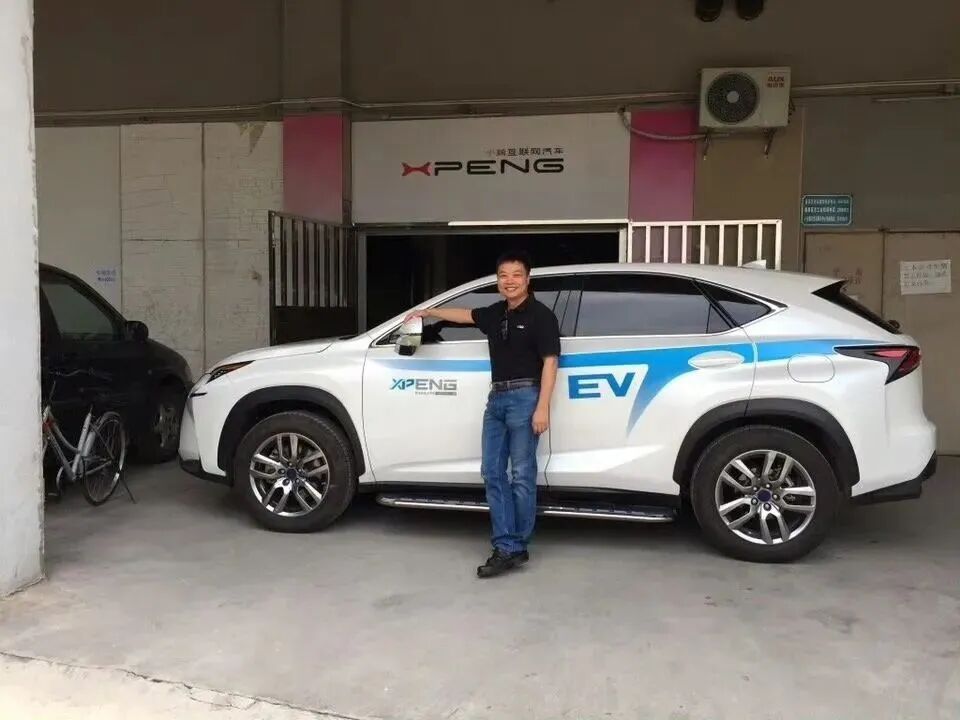
He Xiaopeng with Xpeng Motors' first prototype in 2015. He officially joined the company as chairman and CEO two years later.
LatePost: What else are you doing now that you wouldn't have done before?
He Xiaopeng: A lot of things. For example, "30 minutes of listening" — I spend 30 minutes chatting with frontline employees each time, two people per week, nearly 60 sessions so far. I ask them: what do you think the company does worst? What's the worst thing about your department? Who's the most incompetent person around you?
LatePost: What answers did you hear? What problems did you see?
He Xiaopeng: The silos between departments are much higher than I imagined.
The auto industry is a long chain. At the senior level, people can still push things through by cutting each other some slack. But the people below simply can't get anything done. I once called in the department specifically responsible for processes. They talked a good game. I said, don't give me that — doesn't the company have cloud docs? Show me the directory. They refused, saying they needed to prepare. I said no preparation allowed — open your computer right now, show me right now. I forced them to show me.
What I saw: a fairly large team had updated only two paragraphs in their process cloud docs over an entire year. I asked, what the hell is going on? The head of the process department explained that even though they were the process department, they were actually doing other work. That person is gone now, and I dismantled the department.
LatePost: Firing people seems like the easiest part.
He Xiaopeng: Later I started forcefully integrating horizontal business processes across the entire company — business, people, and finance horizontally, plus strategy both horizontally and vertically. The bigger the company, the more you need horizontal management, not vertical management. Horizontal management essentially means letting business flows, talent flows, and financial flows cut across different businesses and departments, making operations more efficient and controllable, then coordinating and balancing the whole.
Many silos can only be broken down by the number one person in the company, and you have to manage all the way to the front line. Whether it's employee experience or corporate processes and systems, I'm now directly managing all of it.
LatePost: So now you have a ton of people reporting to you.
He Xiaopeng: Otherwise you simply can't solve frontline problems. When we first restructured in 2023, I could hardly believe it — most of the company's requests weren't even entering any system. There wasn't even a real request template. Unblocking that was painful. Another example: I pushed to build a supply chain system. The system got built, but only one person was using it. Because of all sorts of private protections, the system was always "in testing," but the department head simply wouldn't let the team use it. That person got fired. But firing people is easy; finding the right replacement is hard.
In 2023 we tried to fix problems from 2021 and 2022, but didn't do it well, so in 2024 we rebuilt again to fix 2023's problems.
LatePost: This is what I find amazing. You've been around for ten years — in that same span, UC was sold to Alibaba. But in some ways Xpeng still acts like a beginner today.
He Xiaopeng: Small companies don't have systems, and don't need them. Most manufacturing companies don't really have systems either — they're mostly talent-driven, with some management rules and simple processes.
Systems are the advanced stage of an organization. Capable managers are the preliminary stage. Right now I'm moving from preliminary to intermediate. Our internal XPD (product development system) is only on version two — far from good enough. Going forward, our most important unit will be a quality operations center, ensuring that internal consensus gets implemented every quarter and checked every quarter.
LatePost: When you first became CEO, you'd write letters calling out leftover food in the cafeteria, computers left on, cars charging overnight — trying to instill principles, standards, even values. Have those things changed now?
He Xiaopeng: When the company is small, you can appeal to people. When it's big, you need methods to control things. What I think about more now is how to execute ideas — like how to improve meeting efficiency. The first time I saw the data I practically coughed up blood: a 30-person department spending 120 minutes on a weekly meeting. What's the point? There were quite a few departments like this, and I had to clamp down.
LatePost: How did you clamp down?
He Xiaopeng: I wrote an OKR to track meeting time. After tracking, HRBP talks to them. If that doesn't work, the business leader talks to them. And we send someone to sit in and observe — what exactly are you doing?
LatePost: Sending observers is pretty harsh, no?
He Xiaopeng: Later we didn't even need observers. All meetings are automatically recorded by AI, then analyzed in the backend cloud — what exactly are you doing.
LatePost: Do you find this kind of work enjoyable?
He Xiaopeng: No. But some people aren't doing their jobs well, and we need to turn the culture around.
LatePost: Ultimately, what kind of organization do you want to build? What standards are you aiming for?
He Xiaopeng: A group of 85-point people should keep the company's floor at 80 points, with ceilings in the hundreds of points — not dependent on one or two people determining the company's survival. Systems guarantee the floor; they can't control the ceiling.
By end of 2027, we'll roughly complete the new organizational build — full closed loop of horizontal, vertical, talent, process, and tool systems. I hope Xpeng can become a truly systematic global technology company.
Today I'm only dimly seeing the value of systems. I still don't know how to build the kind of system I just described. Maybe in three or four years, when my organizational building is in decent shape, I'll know how to make the system stronger.
The Honest Guy Who Always Got Fooled:
Because He Didn't Manage Personally, and Didn't Really Understand
LatePost: President Wang Fengying's joining was a critical moment for Xpeng. I heard you spent considerable effort persuading her. Was recruiting her decided before or after the September 2023 G9 controversy?
He Xiaopeng: After. At the time I felt I needed someone who understood cars better.
LatePost: What did she ask you at your first meeting?
He Xiaopeng: I don't remember. But I remember when she was preparing to join but hadn't officially started, she told me: Xiaopeng, there's a problem with your steel.
I said, we purchase directly, from the best steel companies. How could there be a problem? She said the cost is the problem — you're paying way more than others. It took me damn nine months to figure this out. The people below were constantly lying to you, and you can't see through it.
LatePost: So what was the problem with the steel?
He Xiaopeng: It was direct purchase, but only payment and logistics were direct. The pricing wasn't negotiated by the direct purchase people.
LatePost: Wait — Wang Fengying warned you about this before she even joined. She must have been onboarded by then. Why did it still take you nine months to fix?
He Xiaopeng: You have no idea how hard it is. You think it's one problem, you want to solve it, and the people below have 100 ways to say they've already solved it.
What stuck with me most was them telling me: given our specifications, this is already the cheapest in the country. Then they'd pull out stacks of data. What do you do? Eventually you discover you're using too many steel varieties, with all kinds of business detours in between, and everything they show you looks good. Later I started checking every two months — if I didn't see changes in the financials, I knew something was wrong in the process. I just didn't know where. Took me forever to investigate.
LatePost: You said "they" were lying to you, so it wasn't just one person.
He Xiaopeng: It was the entire chain of people colluding to fool me.
LatePost: I heard something — Xpeng once had a department put BYD's Han and the P7's costs side by side, saying the Han's cost was about the same as the P7's.
He Xiaopeng: I didn't believe it, but they insisted on proving you wrong. Or rather — you're the CEO, you don't believe it, you need to prove why you don't believe it.
LatePost: Did you prove it?
He Xiaopeng: How could I prove it?
LatePost: Could they prove it?
He Xiaopeng: They proved it. They gave endless documentation. I just felt from first principles or simple logic that our costs and BYD's couldn't possibly be the same, but I had no way to prove it. The lesson: you have to truly understand to identify traps.
Take a random example — cost, R&D expenses, tooling costs, logistics costs. These four get combined differently in different situations. I'm the P7, you're the Han. On the surface costs look the same, but the Han's cost has R&D fully waived, tooling not amortized, logistics bundled. Yours has R&D separate, tooling separate, logistics separate — then your BOM is meaningless. Four traps in there. If you're not a professional, you can't see them.
LatePost: How did you eventually figure it out? Someone tell you the tricks?
He Xiaopeng: Who's going to tell you? Nobody tells you! You can only learn yourself. I told William Li too — supply chain you have to manage personally, and you have to understand it. Not managing personally and not understanding — neither works.
LatePost: What kind of scams are you most susceptible to? Elaborately constructed ones, or crude and obvious ones?
He Xiaopeng: When I first graduated, countless people scammed me because I looked honest. My first part-time job was selling computers. Someone stole a computer and wanted to sell it to me. I could tell something was wrong — it was worth 100 yuan at most, but he insisted on 1,000. Yet all the inspection results showed it was a new computer. I ended up paying 600, took it back, and after 10 minutes discovered it really was only worth 100.
I used to get bullied for no reason all the time. A non-local, returning home from Guangzhou, getting off at the train station — an old lady blocks me, asks where I'm going. I don't speak. She says, young man, I won't harm you. I say I'm going to the bus. She follows me three steps, grabs my leg: young man, I walked with you three steps, give me 10 yuan. I was furious — I'd have walked to that bus stop whether she followed me or not. She says I showed you the way, don't be heartless. So I gave her 5 yuan.
LatePost: You were so angry. Why did you still give her money?
He Xiaopeng: Because she wouldn't let me leave.
LatePost: You've been an entrepreneur since 2004, battle-tested. Why are you still getting scammed today?
He Xiaopeng: Because scammers grow too.
LatePost: Why are there always scammers around you?
He Xiaopeng: Because I'm honest, I'm not smart.
LatePost: But everyone in the company calls you "Big Senior Brother" — Sun Wukong is very smart.
He Xiaopeng: Rush to the front when there's danger, get beaten by the master when you get back — that's Big Senior Brother.
LatePost: You're the CEO. The company's worth $16 billion. You used to chalk it up to looking honest, but that doesn't work anymore.
He Xiaopeng: I'm still not smart enough, not experienced enough. Later I often say, some people are actually lying with good intentions. Many people who left Xpeng gave me 100 reasons why, but actually there was only one — they didn't believe in me anymore, they wanted to switch to a better company.
LatePost: After being deceived so many times, does it become hard to trust people?
He Xiaopeng: I'll analyze why I was deceived, but I won't stop believing in people.
A lot of things weren't done deeply or thoroughly before because I wasn't holding myself to the standard of a large-scale, manufacturing-focused, technology-driven global company CEO.
Sometimes a CEO is the last person to know the truth. Because your understanding of the operational framework isn't comprehensive, accurate, or objective enough. Most CEOs hear only the extreme manifestations of a situation — in reality, there's bad within the good, and good within the bad.
LatePost: As an honest person, do you lie?
He Xiaopeng: Of course. Like when my mom asks, how's your company? I say, nothing's wrong, everything's great!
A CEO Can't Be a "Nice Guy": Replacing People, Reactivating People, Scrambling the Skill Tree
LatePost: After taking so many losses, do you ever think — to be a good CEO, do you have to be a "bad person"?
He Xiaopeng: You can't be too nice a person. A chairman can be a nice person, but a CEO can't.
LatePost: At UC you were president. Can a president be a nice person?
He Xiaopeng: So that wasn't successful either.
LatePost: People have already seen your transformation. In 2023 you removed 10 executives in one year. During that period, were you indiscriminately "killing" people? What was your goal?
He Xiaopeng: No way. Why would you think it was indiscriminate "killing"?
LatePost: Because it was too concentrated, too fast.
He Xiaopeng: It was too urgent. At the time I realized the core problem of the company lay with the executives, and the core problem with the executives lay with me. I had to make changes. Since I was already making such major changes, the speed had to be fast — don't wait. When a company is in a life-or-death phase, one moment of hesitation and the time is gone.
LatePost: You also did something pretty ruthless — having P9 employees do P10 work, then promoting the P9s.
He Xiaopeng: I promoted many people, replaced many people. Over the past year, across thirty first-level centers, I changed 85% of the heads — some left, some were transferred. Because you need to reactivate talent, identify who is suited to go from 1 to 10 with the company. Many people are excellent, but they're better suited for 0 to 1.
LatePost: Why not activate them with higher, bigger goals instead of switching them to positions they've never done before?
He Xiaopeng: So many people suffered. But I think people should be tossed around, should change themselves. Going too deep into one thing isn't good.
LatePost: Completely disregarding individual feelings?
He Xiaopeng: Absolutely disregarding them.
LatePost: The old He Xiaopeng wouldn't have spoken like this. Two years ago during the G9 crisis, many people blamed the product manager at the time, but you specifically kept the product manager.
He Xiaopeng: He had things he did wrong, but also things he did right. We didn't put him in the right position, didn't help and develop him well enough. He's good talent.
I think many people can be reactivated, so recently we've been reaching out to former employees who left, many P8s and P9s are coming back.
LatePost: You've rebuilt the executive team, but your personnel moves seem unpredictable. You had programmers manage HR, previously had HR manage marketing, had someone from a supplier background manage powertrain and automotive technology — people like Chen Yonghai and Gu Yuanqin have no experience in their current roles. Do you think the depth of these positions matches their individual capabilities?
He Xiaopeng: There are five angles to evaluate a person — expertise, business acumen, management, systems thinking, and fundamentals. Many people prioritize expertise first: he has experience, so he should do this. But he might be limited in vision precisely because of that experiential bias.
AI cars are a multi-dimensional capability combination. Why have someone from R&D manage HR? Traditional HR works within the box of recruiting, developing, deploying, and retaining talent. What I need now is HR that understands digitalization and informatization. Chen Yonghai has done product, just not automotive product. At the time I needed him to lead the product team in transforming from technology-driven product to user-driven product.
I believe the logic of talent is first, assemble talent without rigid conventions, and second, consider the combination of long-, medium-, and short-term logic. For example, last year I decided Shanghai needed to expand technical hiring because local talent wasn't deep enough. We rented two buildings in Shanghai, they're already full, and in 2025 we need to rent another.
LatePost: Auto companies need strength at both ends — procurement and sales. During turbulent times, how do you recruit better team leaders?
He Xiaopeng: I still hope most can be promoted internally, and should rely more on selection, minimize cultivation. But sometimes there's no choice — our current leadership depth isn't enough, and selection is quite painful.
LatePost: You want to find people willing to scramble their own skill trees for the cause, but this requires them to have enough security. How do you give them that security?
He Xiaopeng: I can't give it.
I often take someone who's been developing one skill tree, then after a year point their skill tree at a completely different tree. For example, there's someone at our company named Wang Tong — I just told him today, you should go develop a different skill tree.
I believe resilience is forged in adversity. The people who remain at Xpeng today aren't the leftovers — they're the selected. Why do I think we'll be better in 2025? Because your comprehensive capabilities are built up, then add courage and resilience, and everything falls into place.
The New Core Leadership: "Fengying is incredibly hardworking, she's amazing"
LatePost: Has Xpeng now formed a new core leadership team?
He Xiaopeng: Yes. Look, photographic evidence (pointing to a photo in his office of He Xiaopeng, Brian Gu, and Wang Fengying).
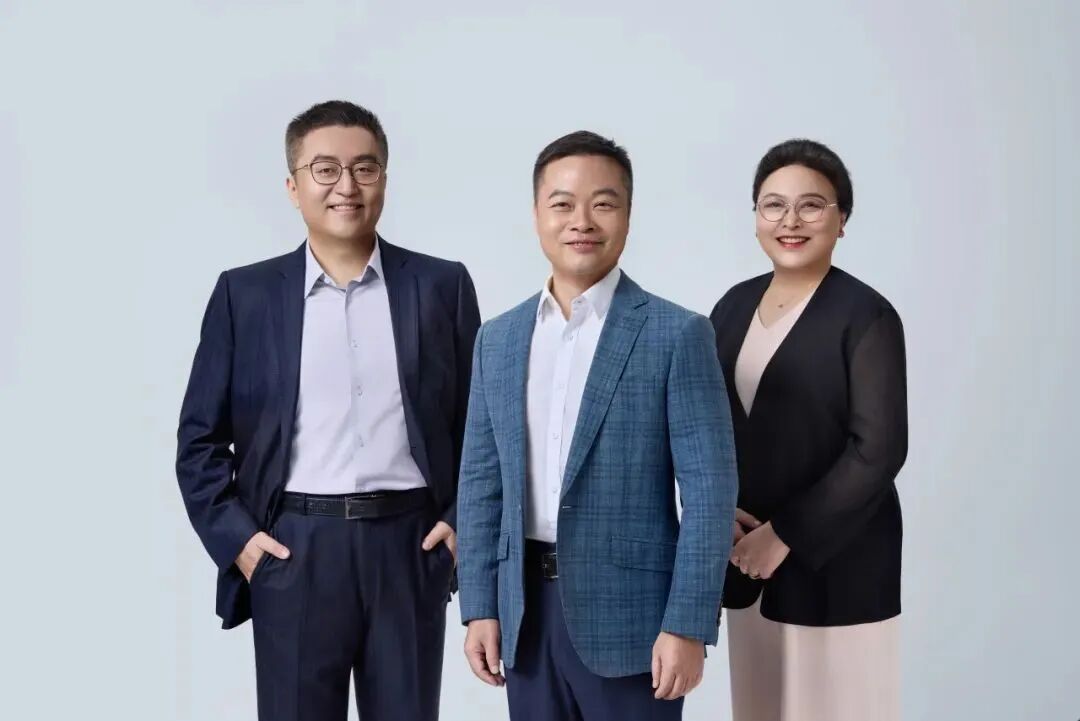
Xpeng Motors core executive team (from left: Brian Gu, He Xiaopeng, Wang Fengying)
LatePost: How do the three of you divide responsibilities?
He Xiaopeng: Fengying manages product and sales, Brian manages money and risk. The two of them jointly manage globalization. Everything else I manage.
LatePost: Do jurisdictions get adjusted?
He Xiaopeng: Every quarter. For example this quarter I handed corporate strategy over to her. We didn't have a strategy team before — before it was just the two of us, plus Brian, making decisions off the cuff.
LatePost: Wang Fengying has been at Xpeng for exactly two years. What's most surprised you about her?
He Xiaopeng: Incredibly hardworking, responsible, beyond imagination. She's amazing.
LatePost: It seems like every time we meet you, you're eating with her in the cafeteria. How many meals have the two of you had together?
He Xiaopeng: Let's see, two years, twice a day, probably 120-130 days accounting for business trips, so over 600 meals.
LatePost: Are there things that must be discussed over meals?
He Xiaopeng: No, it's just two people getting in sync. Without sufficient communication, it's easy to have different judgments on things, and we often tear things down and rebuild them. Talking over meals is more relaxed, not too intense.
LatePost: So the more intense the matter, the more it should be discussed over meals?
He Xiaopeng: Anyway, I've never argued with Fengying over a meal. We've argued plenty in one-on-one conversations.
LatePost: What was the most recent argument about?
He Xiaopeng: Management. Maybe not the most recent, but one that left an impression was management. I was telling Fengying something — I spent 45 minutes laying the groundwork very indirectly, when it was actually just one sentence — in the future when you need to chew someone out, can you do it in two minutes instead of 45, and teach them how to solve the problem? Don't just rant for 45 minutes while they still don't know what to do. And when criticizing people, keep it to as small a circle as possible.
LatePost: But that's not really an argument. You were discussing how to manage someone else.
He Xiaopeng: It was an argument. She didn't agree.
LatePost: Did you convince her?
He Xiaopeng: Barely.
LatePost: When did you learn about her temper?
He Xiaopeng: I knew as soon as she arrived, I knew even before she came, but didn't expect her to be this fierce — she'd get a table of 20 people and chew them out for an hour. Though she's already changed tremendously. At Great Wall Motor it was even worse.
LatePost: What's the harshest thing she's ever said to you?
He Xiaopeng: She rarely chews me out. But my core belief is that people need pressure, not despair. I chew people out too, and afterward I sometimes reflect, then go back and tell them, let's work together to get this done. Though I'm wondering, if you publish this, will she come after me?
New Product Philosophy: From Technology Product to User Product, Then Layering Customer Product and Commercial Product
LatePost: Xpeng previously had no single product leader. Now you do?
He Xiaopeng: Now the top of product is Fengying, below her is Chen Yonghai — matrix general manager, and below him are the product directors for each product platform.
LatePost: Now who has decision authority over a single vehicle model?
He Xiaopeng: Authority mainly lies with the matrix.
LatePost: At Xpeng, who is responsible for a product's commercial success?
He Xiaopeng: In principle everyone in the company should be, but the matrix's core mission is to be responsible for commercial success.
LatePost: The G9 crisis exposed unclear power structures as the essential problem. Now at Xpeng, is the power distribution clear?
He Xiaopeng: Still not clear enough, but moving from chaos toward clarity. By end of 2025, our organization will just be completing version 1.0. Remember, just 1.0.
LatePost: Your employees say one of the company's biggest changes in the past two years is that product went from being R&D-led to truly product manager-led. Is that accurate?
He Xiaopeng: Our previous products were technology-driven. In 2023 we changed product planning, product definition, and the capability for product to drive horizontally — what you just mentioned is the third change. But the transformation from technology product to user product is still insufficient. In 2025 we need to layer on customer product and commercial product.
What is customer orientation? It's not simply strong technology, but technology that delivers good user experience that users can perceive. Autonomous driving is hard to make a strong customer product, but making interior space interesting and differentiated — that's a customer product. Commercial product means competitive pricing and company profitability.
LatePost: You came from an internet entrepreneurship background. Why did it take until 2023 to make Xpeng a user-oriented auto company?
He Xiaopeng: Cars increasingly have multiplicative effects, so you should first address major weaknesses, then do the easiest value-adds. Major weaknesses like supply chain management, value-adds like exterior styling.
LatePost: Why not personally lead product?
He Xiaopeng: A CEO personally leading product creates many problems. Auto companies often treat the CEO's words as "imperial edict," but good product requires self-debate and team strength. Because the chain is too long — once you're wrong, everything's wrong.
LatePost: Then should a CEO personally lead R&D?
He Xiaopeng: It depends on the company. Because of Xpeng's restructuring last year, all R&D now reports to me — ten R&D teams in total. But from another angle, compared to many CEOs, I'm relatively strong on the technical side.
LatePost: You oversee technology, plus procurement and supply chain, plus all horizontal processes. Does managing at this level of detail leave you no time to think about longer-term matters?
He Xiaopeng: I keep evolving. When I take over a department, I start with very fine granularity, then expect it to get coarser at three months, six months, twelve months.
LatePost: What are you managing most tightly right now?
He Xiaopeng: Procurement.
LatePost: Do you set direction, or just requirements?
He Xiaopeng: Direction, requirements, and process — all of it.
LatePost: Xpeng has had many industry-leading designs. For example, Xiao P — the first to achieve full voice interaction. What's next for the cockpit? Is it still a competitive differentiator?
He Xiaopeng: In 2025, our cockpit AI will come to vehicles. I can't say more. Actually, what people consider innovation is often what tech people think is innovation, not what users see as innovation. For example, we made major changes to rear cargo space, including how the trunk connects with the second row — this has real value for users, but tech people would think it's nothing special.
LatePost: Aren't you a tech person?
He Xiaopeng: I was. Now I'm forcing myself to understand users and business better.
LatePost: Before, you'd get excited seeing a new idea. Now do you first ask whether users will actually pay for it?
He Xiaopeng: Not quite — it's how many users would be willing to spend how much money for this thing.
LatePost: Your product manager said that when finalizing the P7+ design, there were two options: the current styling, and a shooting brake version. The first team vote, you chose the shooting brake, and the vote went that way too. The product manager felt it wouldn't work and insisted on a second vote. But that time you said, no more voting — we'll go with your call. Why?
He Xiaopeng: I figured if I don't participate in the vote, it won't hit a floor. But if I participate, there might be no ceiling. For example, once I vote and make the call, when difficulties arise, they'll say "Xpeng decided this" — they'll shift responsibility.
LatePost: You said in a previous interview that you'll veto what you truly can't accept, and reluctantly accept the rest. What's something you recently reluctantly accepted?
He Xiaopeng: I can't think of anything.
Deep Reflections on Autonomous Driving: "Only I Can Make the Call, I'll Take the Bet, I'll Own the Mistake"
LatePost: Xpeng was China's first automaker to achieve city NOA — that was October 2022 in Guangzhou. By January 2024, you had the most cities opened among all automakers. But in the second half of 2024, "end-to-end" became the battleground, and your first-mover advantage was caught up. What happened?
He Xiaopeng: We first achieved highway NOA based on HD maps, then moved to city earlier than others — the first to complete city NOA deployment. By end of Q1 2023, I realized the HD map and rules-based approach to city NOA was a dead end. We needed to pivot.
At that time, GPT-4 based on the Transformer architecture had just been released. We quickly pulled together a small team, planning to first read through GPT's papers before setting direction. The papers alone took two months, while the team was also rapidly running validations.
Later we learned Tesla also started their project in February 2023. But we turned more slowly — they moved fast, and we took some detours. We made many bold hypotheses and careful verifications, because by 2023 we already had large numbers of users on our autonomous driving system.
LatePost: You realized you needed to pivot to end-to-end in Q1 2023? That early? Tesla didn't start pushing FSD V12 until late November 2023.
He Xiaopeng: I was leaning toward pivoting in the first half of 2023 — I just didn't know the optimal way. And the better your rules are written, the heavier your baggage, the harder to turn.
LatePost: When autonomous driving shifts from "rules" to the "end-to-end" era, you have to be decisive when the technology changes.
He Xiaopeng: An architecture change — choose wrong and it's a dead end. If you don't have the talent density or caliber, you don't dare to pivot. I was leaning toward pivoting, but with thousands of people, you can't just say "stop everything and pivot." They ask how, and you say "I don't know, I just feel the direction is right." You can't say that.
If we hadn't spent effort on two different models in 2023, we could have pivoted faster.
We first invested heavily in a small model deployed on-vehicle. Spent more than half a year, then found it couldn't handle large amounts of real-time data. The inference compute was already maxed out — use more and it became inefficient.
We quickly abandoned that approach and adopted a Foundation Model plus a dual cloud-and-vehicle processing solution, including distillation, pruning, and reinforcement learning. This meant no longer relying purely on local vehicle compute, but moving some compute tasks to the cloud, leveraging cloud's massive compute power, with the vehicle doing necessary local processing — the two working together. Cloud training takes enormous time because the infra is different from local; cloud trains first then deploys to vehicle, which also slowed us down.
LatePost: Why were you so convinced the cloud model approach was right?
He Xiaopeng: I wasn't convinced. How could I be convinced at end of 2023?
LatePost: When you weren't convinced, why still choose this slower path?
He Xiaopeng: It could go further. A cloud model lets the local model run larger data volumes, with greater efficiency and strength.
LatePost: What inspiration did DeepSeek give you? Will it change your training direction?
He Xiaopeng: DeepSeek's paper had two technical details that aligned with our judgment: 1) distillation is an effective way to preserve model capability, and 2) a huge model after distillation outperforms a small model with reinforcement learning. So Xpeng's reinforcement learning is deployed on our cloud model.
The rise and fall of large models benefits OEMs with self-developed large models: training compute consumption keeps declining, while large models' reasoning capability keeps rising. This brings the entire industry closer to AGI, pushing faster from LLM to embodied intelligence, physical AI, the real world.
DS showed us the power of China's private-sector innovation, but they're mainly exploring the digital world deeply. Applying this to the physical world is still very hard. There, Xpeng has opportunity.
LatePost: Why didn't you start Foundation Model earlier? Was it lack of money at the time?
He Xiaopeng: We only pivoted to Foundation Model at end of 2023 — something I was determined to do well. But everything had to be rebuilt. We built AI Infra, simulation systems, and model training all in-house. Every piece had challenges, had to come step by step. So it wasn't until 2024 that we applied large models to autonomous driving — one software suite transforming the autonomous driving product. No one in China had done this; we were the first to eat this crab. Reaching consensus always takes time.
LatePost: Some Xpeng employees say autonomous driving is like Xpeng's favored child — can't be criticized, can't be scolded, can only be described as "far ahead."
He Xiaopeng: That's not it. My own reflection is: at the time, I should have personally gotten into the technical details to directly set the technical architecture direction. Otherwise the team would spend at least two to three months on technical experiments before setting direction — massive time cost in between.
Only I dared to make the call, to bet on this direction, to own the mistake if wrong.
LatePost: But you have to truly understand technology, right?
He Xiaopeng: I consider myself to still understand some technology. So afterward I was often very decisive. I frequently say in internal meetings: three paths, pick one, even if that direction has only 40% success rate.
We're recently adjusting the number of model types on-vehicle. The team says there are three paths — current optimal, cheapest, most expensive — with different test results across paths. Even with extensive test logic, I decided to just pick one path. I'll judge which path best fits Xpeng's medium-to-long-term development.
LatePost: You've spent the past two years filling capability gaps, but a company's strengths also depreciate in various ways. How do you prevent autonomous driving — this first-mover advantage of Xpeng's — from depreciating, from being caught up? How do you convert relative advantage into absolute advantage?
He Xiaopeng: Ask me again in roughly two years, I'll answer clearly. I won't answer now. It will become one of our absolute advantages, but not everything.
This battle — without large models and AI's Scaling Law, automotive intelligence would have hit a ceiling hard to break through in 2024 or 2025. But today, I see autonomous driving's ceiling raised perhaps 100x because of large models. In 2025, MONA's high-end autonomous driving version will come to vehicles — no automaker has yet achieved autonomous driving's full power at that price level. Meanwhile across the entire system, we have at least three major upgrades, and after these three, capability might reach dozens of times what it is now.
Some say large models make small autonomous driving suppliers more able to deliver good autonomous driving experiences. I instead believe large models have substantially raised both the ceiling and floor in height and difficulty — more players will accelerate toward elimination in the coming two years.
Will Xpeng's Future Profit Come from AI or from Selling Cheaper Cars?
LatePost: Xpeng's total R&D investment in 2024 was roughly RMB 7 billion, less than 20% of Tesla's. How do you achieve technical leadership with far fewer resources?
He Xiaopeng: Subtract first. If others can do 3 things, can you do just 1, but do it best?
LatePost: Which two things did you give up?
He Xiaopeng: For example, if someone else is doing something, I won't: three automakers are making chips — one making SiC chips, one making LiDAR chips — I only made AI chips. We've also subtracted in many other technologies. My own judgment: to achieve technical leadership, an AI car company should spend RMB 50 billion annually on R&D.
LatePost: That's 7x your 2024 level. When will Xpeng have that kind of money?
He Xiaopeng: Don't know. A company has to earn money first, then spend it.
LatePost: You said this year's battleground is L3. Can we understand Xpeng's three autonomous driving upgrades in 2025 as all pointing toward L3? What do you need to fill in?
He Xiaopeng: For example, cloud compute — that's from 1 to 1000. Why I say you can't do this just by raising money without earning it, you have to earn it.
LatePost: Autonomous driving just cracked the top five in users' purchase decisions, can't break top three. When will users be willing to shift costs from range and comfort to autonomous driving?
He Xiaopeng: Right now, China doesn't have true L3 autonomous driving — it's all premium L2. Only L3-level autonomy can create strong user demand. My definition: the user takes over roughly once per 100 kilometers, maybe just once when pulling into their home parking lot; media tests should see one takeover per 2,000 km. Second, user mileage coverage — for every 10,000 km driven, 90% should be fully autonomous. I'm speaking from the user perspective, not the review perspective. That doesn't matter.
Some say users exposed to premium autonomous driving already account for 11%-12% of new users. I think it's currently 7%-8%. Only when it hits 10% will we see a major inflection point, shooting upward quickly.
L3 or L3+ will be the iPhone 4 moment for AI autonomous driving. The inflection point will come between 2025 and 2027. Automakers that can't keep up will fall behind.
LatePost: Nearly all delivered MONA M03s are versions without the Max autonomous driving package. What does that tell us?
He Xiaopeng: It tells us that if we launched Max, our sales could double.
LatePost: You're sure?
He Xiaopeng: Maybe not double immediately short-term, but add several tens of percent. Please look forward to the Max version we're launching after the Spring Festival, in Q2.
LatePost: You also made a key decision — making high-level autonomous driving hardware and software standard across all models. I heard you pushed this internally. What was the decision process?
He Xiaopeng: The team spent several months analyzing how to charge for it, then I killed it. Though actually, the proposal was mine to begin with. I had asked them — can we make more money on autonomous driving?
LatePost: They analyzed it and then you killed it?
He Xiaopeng: Because I realized that in the current market environment, there's simply no way to charge for it. Intelligent driving is a foundational capability, not a value-added service. Whether it's high-level AEB or end-to-end autonomous driving, it will become standard equipment in cars. This differs from traditional automotive "option" logic. It's more like the smartphone industry — certain features (cameras, fingerprint recognition) gradually went from premium configurations to standard across all models.
LatePost: Have you discussed whether Xpeng should make money from AI or from selling cheaper cars?
He Xiaopeng: AI has enormous value in automobiles because you can price the hardware-software integration as a whole, folding costs into the vehicle price rather than charging users separately for software.
LatePost: Why not follow the internet free model?
He Xiaopeng: Because "the wool comes from the pig's back" — and in automotive logic, there's no pig yet.
The automotive industry's business model is fundamentally different from the internet industry. Internet companies can offer free services and make money through other means (ads, data), but the auto industry must profit through bundling hardware and software.
When I first started in autos, I visited industry leaders everywhere. I met the head of Panasonic Battery. He said, Mr. He, there's a very famous entrepreneur who said he wanted to buy our batteries for his cars. I asked him how he'd make money. He said he'd give the cars away. Then this person asked me, Mr. He, after giving cars away, how do you earn the car money back through other means?
I was speechless. I said even in TVs that's impossible — at best you break even, then layer services on top. In autos, don't even think about it.
When intelligence is re-driven by AI,
Xpeng must break beyond traditional intelligence to achieve "full-power AI"
LatePost: What do you think of Xiang Li saying Li Auto wants to become an AI company?
He Xiaopeng: Many people can say they're an AI company. But for me, you have to have cars.
LatePost: Xpeng was the earliest automaker to make intelligence its core. Why didn't you propose "we want to be an AI company" first?
He Xiaopeng: I won't just be an AI company. This goes back to my pain during the UC era — suppose UC had 500 million monthly actives, WeChat had 1 billion, but my depth of engagement was only a few tenths of WeChat's. In the physical world, with that many users, the depth of change could be dozens of times greater than WeChat.
AI's greatest value lies in changing the physical world (atoms), not just the digital world (bits). Digital world changes fast but with shallow impact; physical world changes slow but with deep impact. I want to use AI to change the physical world (cars, robots), so we want to be an AI car company.
LatePost: AI companies can certainly also make robots, changing human life in the physical world.
He Xiaopeng: Yes, but for ordinary users, AI is usually understood as something digital. Xpeng wants to do AI + large hardware, or AI + robots — both in parallel. AI must combine with large hardware to maximize its value.
LatePost: So do you want to go all in on AI or all in on cars?
He Xiaopeng: At this stage, cars are of course the priority.
LatePost: You used to talk about smart cars. When the P7+ launched in 2024, you started promoting AI cars. What's the deeper shift in thinking behind this change in terminology?
He Xiaopeng: I believe that with large models pushing it forward, AI has evolved from "visual, narrow-scope, generalized AI" to "cerebellar AI, cerebral AI, even global AI." AI is no longer limited to single functions but has gained more complex cognition and decision-making capabilities.
When intelligence is re-driven by AI, Xpeng must jump out of traditional intelligence (like autonomous driving, voice interaction) and enter the "full AI" logic, achieving "full-power AI."
LatePost: Is the development of "cerebellum" and "brain" sequential? Are smart EVs and robots sequential?
He Xiaopeng: Autonomous driving development (L2 to L4) is gradual, not a leap. Autonomous driving solves the "cerebellum" problem (movement, balance, instinct), while "brain" capabilities (higher-level cognition, reasoning, decision-making — that is, general AGI) also grow stronger through this process.
Smart EVs are the precursor to robots. Current robots add a simple agent on top of the "cerebellum" foundation. This agent still has a large gap from a true "brain" and needs many more years of technical accumulation.
I believe the technology development path is gradual, so we don't pursue short-term breakthroughs. Google started in 2009 to solve a "cerebellum" autonomous driving problem — 16 years, and they still haven't made it work in the United States. Why do people think a "brain" problem can be solved by throwing a model at it, training it a bit, and it's done? There's no logic to that.
LatePost: In the future AI universe, where do you think Xpeng will be positioned? Through what?
He Xiaopeng: We definitely hope to be number one in the physical world. The "cerebellum" has small generalization scope and lower difficulty; the "brain" has large generalization scope and higher difficulty. So autonomous driving (cerebellum) will develop faster than AGI (brain). We need to first do well on the "cerebellum" while continuously advancing the "brain."
From local to global, from simple to complex. The "brain" can't emerge within a few years — no possibility.
LatePost: Can I understand this as Xpeng choosing a more conservative, gradual development path? Xiaomi, Huawei, Li Auto all want to do L4, and may all want to do robots eventually. Do you think your technical judgments align?
He Xiaopeng: They're different. In my technical judgment, many technologies not related to AI also matter — materials, craftsmanship, powertrain, comfort, space, safety.
We've heard too many times that technology will change the world. Windows 95 would change the world in 5 years; mobile internet would change the world in 5 years; Web3 would change the world in 5 years. In the end, they each only affected part of the world. AGI won't change the world that fast.
LatePost: You said using smartphones plus mobile internet as a reference for AGI doesn't work. What's a better reference?
He Xiaopeng: Internet logic is: use one technology or product to hone one capability, keep raising funding, and suddenly one day you hit the singularity and change the world. But for a mass-production company, you need to do well on the ceiling and the floor — cost, users, scale are all floor. In the past, people didn't consider the floor, only the technology.
Today I still see many in the industry saying, even with real large models you can't achieve L3, L4. They're still thinking with internet logic — no combination of ceiling and floor, no thinking about how to balance each node commercially, in product, and technically.
LatePost: What's your year-end summary of AI in 2024?
He Xiaopeng: One sentence: our AI still isn't good enough. I did extensive summarizing last month, looking back at what I did worst in 2024. In the end, I think I delayed most on AI-driven thinking. Xpeng has 30 centers; only a few relatively actively embraced AI. On internal informatization, we just released an AI employee yesterday called Iron — same name as our robot.
LatePost: How unified will AI become in the future? Xpeng makes cars, chips, robots, flying cars, operating systems. Can one unified model cover them all?
He Xiaopeng: In my system, the model behind each agent is different, because we can't find one powerful model that can fully accommodate them all. Our most foundational layer is chips and operating systems. I believe the future operating system is the large model. It starts as several models; long-term they'll merge. Short-term, for efficiency, effectiveness, and capability, keeping them separate is most effective.
LatePost: How is Xpeng's intelligent robot progress?
He Xiaopeng: Not that fast. Unitree has done very well, but they're at a very basic level doing a good integration. Put it in factories, in homes — impossible. And it's fully remote-controlled. You could consider it an even earlier form than the automotive mule car.
LatePost: Resources are so limited. Why not just give up?
He Xiaopeng: I know there are too many companies in China that just want to disassemble, copy, then add their own capabilities to achieve "first copy, then surpass." But robots contain massive amounts of technology requiring years of R&D and accumulation. I hope Xpeng can have more original innovation.
LatePost: Li Auto hasn't even started, and you have the least money, yet you want to do it earlier. Why?
He Xiaopeng: Many things aren't built by piling up money. They're built through long-term exploration, accumulation, and iteration.
LatePost: For Xpeng, what is the value of flying cars?
He Xiaopeng: This is our vision — changing future mobility.
LatePost: How does making flying cars help sell cars well?
He Xiaopeng: Currently speaking, not much help.
LatePost: So it's your personal passion.
He Xiaopeng: Of course not. Deli Zhao has passion too (laughs).
LatePost: How opposed is Xpeng's board to this?
He Xiaopeng: They never approved, from start to finish — including our robotics work. I was the one person forcefully saying I believed in it, but nobody supported me. I said this would have enormous strategic value in the future, that it was suitable for any smart car company to pursue, but it required long-term R&D and a lot of money.
LatePost: What did the board say?
He Xiaopeng: Just like you — why invest money? Why spend the effort? Why would policy open up? Why would the technology break through? What are the use cases? Why would users want this? You can't solve any of these.
LatePost: With so many questions, how do you answer them?
He Xiaopeng: I said it might take many years before I can answer those questions for you.
I simply believe technology can do a lot of cool things, and let ordinary people feel it. And I'm not at all worried about competition in aircraft — making planes is grueling. It's not just money; time is a huge constraint. Competitors think, I have to work on this for seven years? Then I'm out.
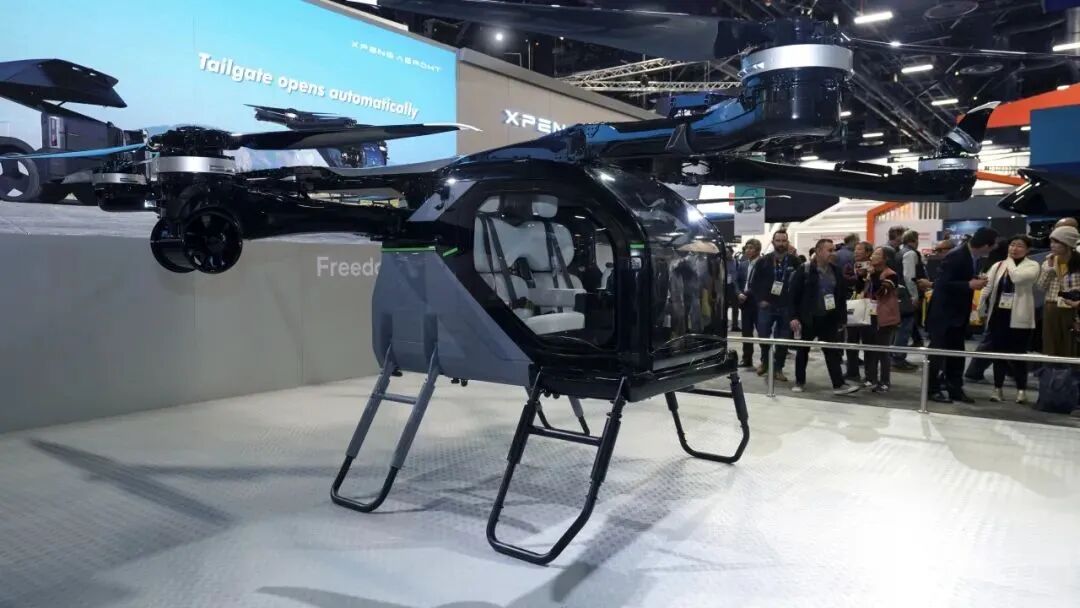
In January 2025, Xpeng Aeroht's "Land Aircraft Carrier" flying vehicle on static display at CES in the United States.
LatePost: A couple years ago Xpeng was in the ICU. Did you think about what would happen to flying cars?
He Xiaopeng: No time to think about it — I was thinking about Xpeng. At the hardest moments, I didn't think about flying cars at all.
I've been thinking recently that because of the AI-plus-car combination, making robots and making aircraft have both become significantly less difficult. But you have to spend time learning how to do it. If you just wait for others to figure it out, then reverse-engineer, benchmark, and poach people — that might be faster, but you'll still have plenty of problems. So in 2025, I want to deeply reflect on how AI can drive our entire system, not just one technology within it.
LatePost: It's only just started, and you're already doing deep reflection?
He Xiaopeng: I didn't do well in 2024.
In 2025 I also want to change the company culture. I wanted to add a phrase, but then they said someone already uses it — "Tech for Good."
LatePost: China's largest internet company — Tencent — uses that. You didn't know?
He Xiaopeng: I didn't notice... I feel like we're doing high-tech things, and that means equalizing access for ordinary users. So I proposed we could use "Tech for Good" as company culture. One director immediately reacted and said, "Isn't 'Tech for Good' Tencent's?"
LatePost: How do you understand this "good"?
He Xiaopeng: From one perspective, AI might bring things to the world that aren't necessarily good, but maybe if we do it, it can be a little better.
LatePost: Do you think you have a technology faith?
He Xiaopeng: I have technology sentiment, but technology faith — I don't know. Faith sometimes means absolute belief or fanatical belief in something. If that's what you mean, then no.
LatePost: With only sentiment, how can you infect the whole company — make them believe technology is Xpeng's future?
He Xiaopeng: The vast majority of people probably won't think this way. Most people look at the present or the recent past to judge something.
Technology sentiment means I believe good technology brings good change, so I look forward to it. Even if it means being a slow company, even if the road might be a bit painful, as long as in the end this technology becomes a good user product that serves ordinary people well.
Death or Struggle:
"Even if it ultimately fails, I'll accept it"
LatePost: What values do you want Xpeng the company to have?
He Xiaopeng: We're reorganizing them. Two are most important: simplicity, and for me personally, another one would be like-mindedness and sharing success.
LatePost: Which is harder — shared vision or shared path?
He Xiaopeng: Both are hard. Many people find sharing failure easy; sharing success is hard — just look at China's private enterprises. Many people say sharing success means I win once, then win 99 more times. That's what's truly hard.
LatePost: Every generation of entrepreneurs has their limitations. In your self-assessment of your DNA and capabilities, what are you best suited for?
He Xiaopeng: Best suited for entrepreneurship. I later realized there aren't really capabilities I lack — just no energy or no time to learn. Most of the past was not spending the effort, just not wanting to work that hard.
LatePost: Looking back over 20-plus years of entrepreneurship, from the PC era to mobile internet to now, what summaries and insights can you share?
He Xiaopeng: Someone asked me this yesterday. One: When I was in university, I thought TCL, Skyworth Group, and Konka had already taken all the entrepreneurial opportunities — what were we sophomores supposed to do? But you have to always believe there are even bigger opportunities ahead. That's important. Two: I told myself, because I'm not smart, I have no shortcut.
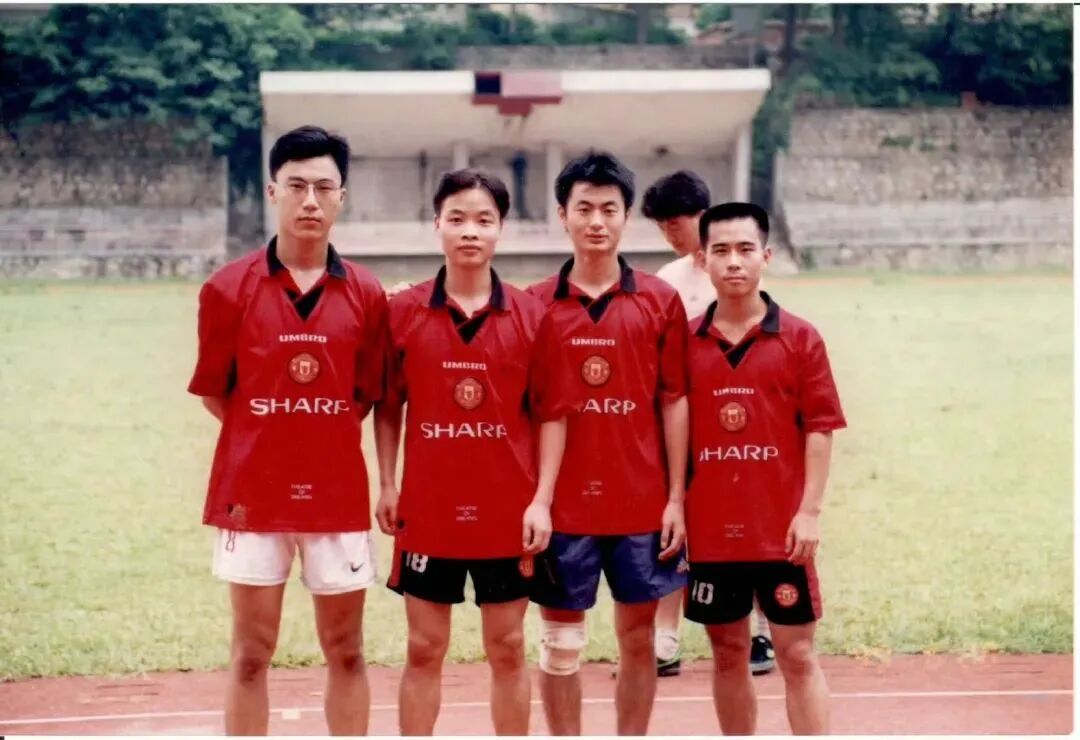
1990s: He Xiaopeng with undergraduate classmates on the South China University of Technology campus
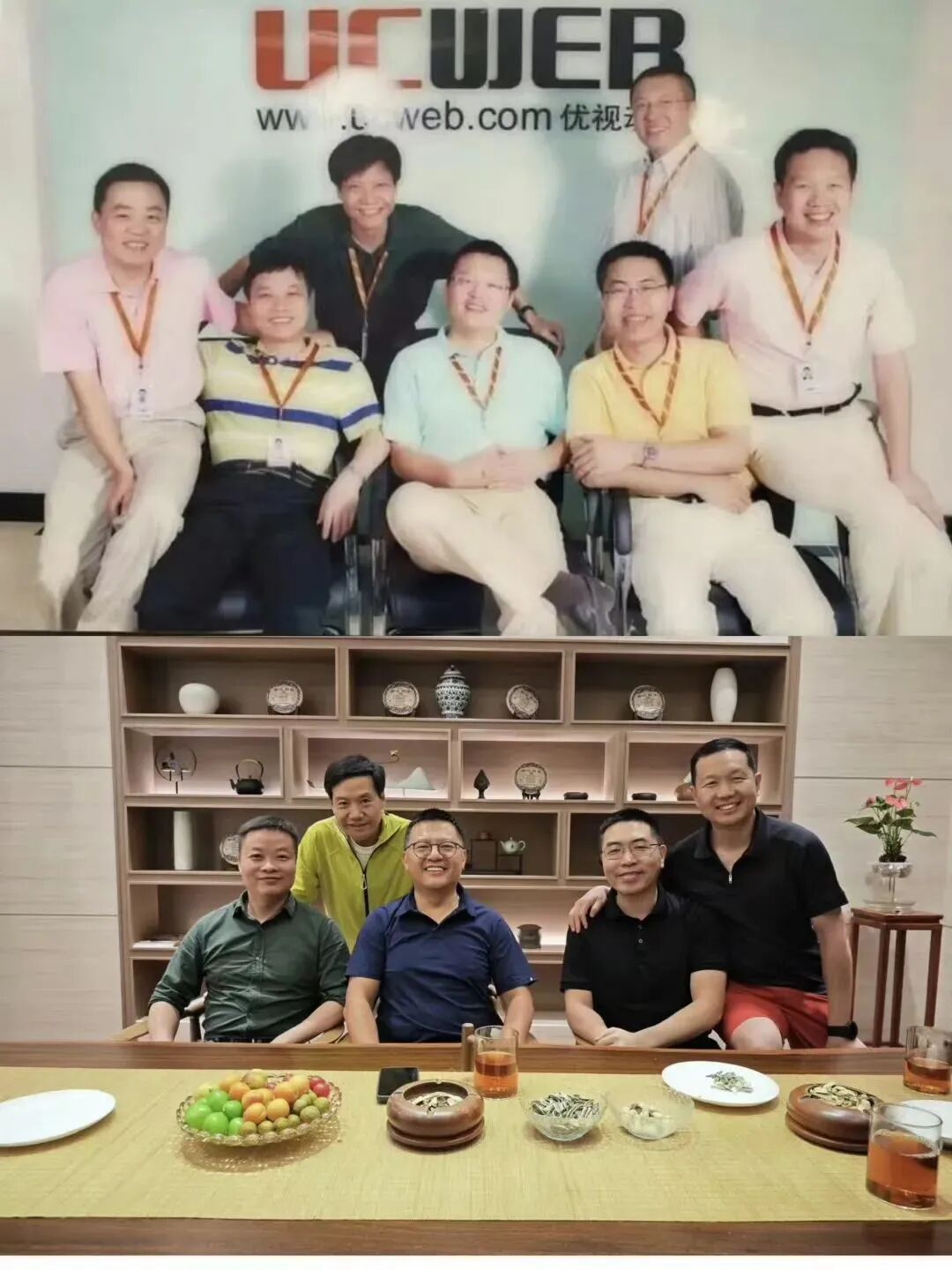
August 2024: Lei Jun reunites with the "UC Four Musketeers" (front row, left to right: He Xiaopeng, Yongfu Yu, Jie Liang, Shunyan Zhu; back row: Lei Jun)
Several people have said that whatever I do, it's always slow business, slow company. I once said this to Tao Zhang of Dianping, but he didn't agree.
LatePost: Why say that to Tao Zhang?
He Xiaopeng: This was around 2013. I went to ask his advice — how could you build a company even slower than mine and still do it well? He got worked up and said, how do you think we're slow? We're running pretty fast.
LatePost: Mm, later Dianping was merged into Meituan. Many entrepreneurs say they want to change the world. What about you?
He Xiaopeng: I only want to change myself. When I first started my business, I just wanted a monthly salary of a few tens of thousands. Later when things improved, I wanted to make life better for myself and my family, and for the brothers who started the company with me. After that, when you start another company, it's nothing more than letting your friends and users have better lives because of what you built.
Isn't that just influencing yourself and the small circle around you?
LatePost: Then who can change the world?
He Xiaopeng: Not me, anyway.
LatePost: The shorthand "Wei Xiaoli" is rarely used now. Do you feel the three of you ultimately went down different paths?
He Xiaopeng: It's fine. I think none of the three of us are bad.
LatePost: There's a classic theory: assertion, repetition, contagion. To influence a group of people, the simplest way is assertion, repetition, contagion — lead everyone forward together. But you don't seem like that assertion-contagion type of entrepreneur.
He Xiaopeng: No ability, no strength, no capability.
LatePost: What's the last thing that excited you?
He Xiaopeng: You've really stumped me with this one. AI excites me, but to say very excited — no. It's too hard for anything to make me very excited now.
LatePost: The previous He Xiaopeng loved exploring new things. You even wrote Moments posts like "my greatest passion is exploring things in uncharted territory." What about now?
He Xiaopeng: Stopped writing. If users don't curse you, PR will.
LatePost: No more deep-sea fishing?
He Xiaopeng: Less now. I've become much more boring.
LatePost: What new explorations are you doing?
He Xiaopeng: Can't say. Not the right time.
LatePost: You can only talk about hard things?
He Xiaopeng: In your personal life, first, it's really more boring than before because all time goes to work; second, you can't play up that you love having fun; third, some of the company's long-term strategic things you can't talk about because that's product planning secrets.
LatePost: Yongfu Yu previously said you're very playful, love tinkering, can't sit still. But now you keep emphasizing filling gaps, becoming an all-around player. Is this the internet spirit bowing to manufacturing? From doing whatever's fun, living however's enjoyable, to pursuing procedural justice, pursuing competence and excellence.
He Xiaopeng: It's still pursuing a life of tinkering. I think life is about messing with yourself, about being splendid. And being an all-around player means the enterprise needs to be all-around to compete in autos — it doesn't mean you personally need to be all-around. You need to make the enterprise all-around.
The internet spirit is technology equalization. Xpeng is a technology company making balanced hardware-software products. That hasn't changed.
LatePost: Is the former He Xiaopeng drifting away from himself?
He Xiaopeng: No, still a young man! Though my biggest shock this year was suddenly discovering I have to hold my phone farther away to read. I sat in an optical shop asking the optician for a long time, and he kept coming back to ask how old I actually was. Finally he told me: I'm presbyopic.
LatePost: Not surprising. Old colleagues who followed you from UC to Xpeng say your current work state is — playing with your life.
He Xiaopeng: (Laughs) Good thing I'm not playing with his life.
LatePost: In your early 2023 interview you said you couldn't become Lei Jun because he's too hardworking. But now you're also fully devoted to work. From a web novel enthusiast who still had time to read A Record of a Mortal's Journey to Immortality at work to "996," what happened?
He Xiaopeng: Because there's too much I don't understand, and competition is too brutal. I rarely read web novels now. Just one — Xuanjian Xianzu.
LatePost: Your colleagues say your work hours might now be longer than Wang Fengying's.
He Xiaopeng: About the same — roughly six and a half days a week. But yesterday you hit me with something: people shouldn't live this tired. And it does seem like I'm living more and more tired.
LatePost: When a CEO is this tired, it means the company has problems.
He Xiaopeng: China's giant factories are equally tired — tough on people, tough on the industry. All this grinding isn't good for the whole social ecosystem.
LatePost: You recognize this and still personally lead the grinding?
He Xiaopeng: Because first I have to ensure survival, and survival requires struggle.
LatePost: In recent years, having been deceived, having batches of people leave — have you had moments of insecurity?
He Xiaopeng: No insecurity. That's human nature struggle, just a battle of wits and courage. From another angle, I once gave myself a few phrases: one, accept the bet and accept the loss; two, refuse to accept defeat.
LatePost: Is there a difference between those two "losses"?
He Xiaopeng: "Accept the bet and accept the loss" means if I fail and the company goes under, I own that. "Refuse to accept defeat" means expecting to turn the bad into the good — resolutely going from chairman to CEO, switching from the old 0-to-1 approach to thinking about 1-to-10 and 10-to-100, then going all in.
These two together changed my mindset. First, they gave me the courage to transform. Second, even if my transformation fails, I'll own that too.

Founded in 2022, Heart Capital is an early-stage venture capital fund focused on technology and digitalization in China. The team is led by Yan Han, formerly a founding partner at Lightspeed, alongside core investors, a CFO, and seasoned investors from industry backgrounds. The team's past investments include Series A investments in Xpeng Motors (NYSE: XPEV, 09868.HK) and Full Truck Alliance (NYSE: YMM), as well as FinVolution (NYSE: FINV), RoboSense (02498.HK), Baichuan, Manbang Cold Chain, Fan Deng Reading, World Logistics, Micro-nano Starry Sky, LandSpace, Lanhu, Starfield, and others. Rooted in China with a global outlook, Heart Capital is committed to finding true value in non-consensus. The firm respects the value of "people" and champions the potential of "heart," aspiring to accompany more young Chinese entrepreneurs in strengthening China and expanding onto the world stage.