A Deep-Dive Observation of FLAME's First Discharge: A Conversation with Starlight Fusion | PORTFOLIO

Another path to igniting fusion energy.
Recently, Xingneng Xuanguang, a Heart Capital portfolio company, has been featured in numerous interviews, including coverage by CCTV and in-depth analysis from several industry media outlets. On the evening of the 3rd, CCTV-2's flagship program Economic 30 Minutes aired a special segment titled "New Momentum for Sci-Tech Innovation in Anhui." The program reported on Xingneng Xuanguang's independently developed next-generation Xingneng No. 1 "FLAME" advanced field-reversed mirror device and its plasma discharge. This report follows the December 29, 2025 Focus Report coverage, marking another significant report by a national authoritative financial media outlet on Xingneng Xuanguang's technical approach and engineering progress.
Additionally, following the company's recent successful first plasma discharge of the FLAME device, Xingneng Xuanguang gave an in-depth interview to the "Commercial Fusion" platform, revealing how the FLAME device will deliver on its megawatt-level power output through a "four-step" evolution blueprint, and how the "FLAME" device will ignite another possible path for fusion energy. Here is the original interview:
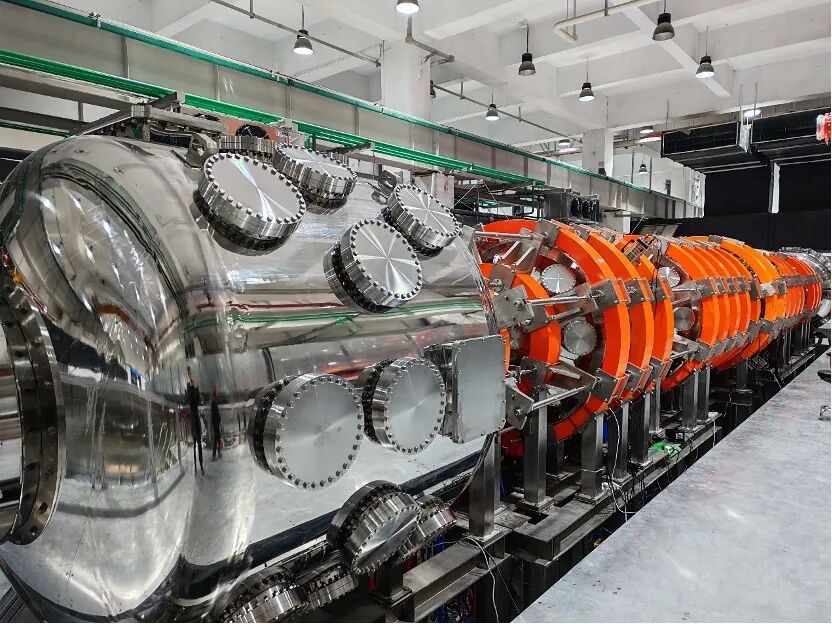
Image source: Xingneng Xuanguang
The Elegant Straight Line
💬 A Conversation with Xingneng Xuanguang About Another Path for Fusion Energy
In humanity's grand pursuit of an "artificial sun," tokamak devices have long held dominant sway. We've grown accustomed to thinking that fusion reactors should take the shape of a giant "doughnut."
Yet when I walked into Xingneng Xuanguang's experimental hall and engaged in deep discussion with the technical team, an entirely different technical aesthetic presented itself: the straight line.
As global appetite for commercial fusion energy grows ever stronger, demands for device economics, compactness, and modularity have risen accordingly. That structurally simple straight-line configuration — which not only greatly simplifies engineering complexity but also holds potential for extremely high beta values (meaning higher energy density) — is experiencing its "Renaissance," driven by new breakthroughs in physics and advanced control theory.
Just recently, Xingneng Xuanguang, a leading force in China's commercial fusion sector, announced an exciting milestone: its independently developed FLAME (Field-Reversed Mirror Long-Lived Axisymmetric Mirror Experiment) successfully achieved its first plasma discharge (First Plasma).
Below: The moment FLAME's "first light" was born
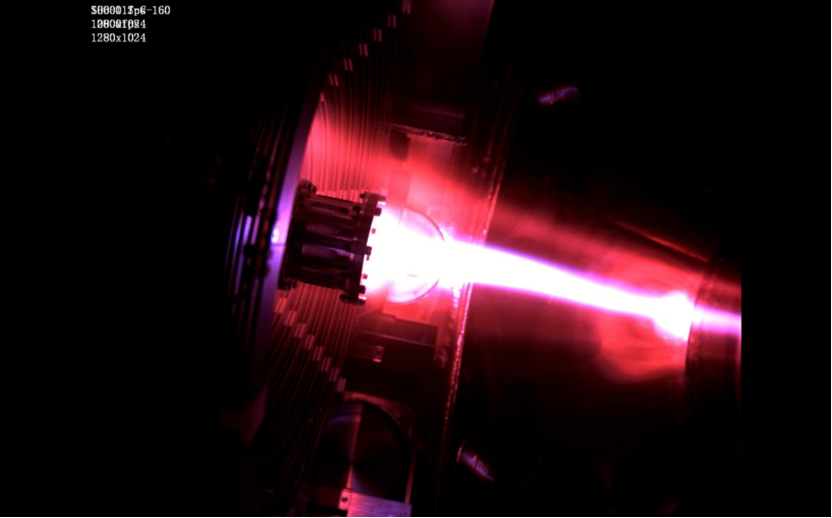
Image source: Xingneng Xuanguang

Why FLAME?
During the interview, Xingneng Xuanguang CTO Ming Liu pointed to the approximately 18-meter-long device before us, showing us its design philosophy that sets it apart from other technical approaches. FLAME no longer relies on a single magnetic confinement method, but instead deploys a sophisticated "physical combination punch."
If controlling high-temperature plasma is like trying to grab a slippery blob of jelly with your bare hands, the biggest pain point for traditional straight-line devices has always been "leaking at both ends." To solve this problem, FLAME validates an entirely new paradigm of coupled multiple physical mechanisms.
Below: Schematic of FLAME's "triple confinement" mechanism: at the core is a self-organizing rotating FRC plasma, surrounded by a funnel-shaped magnetic mirror field, with electrostatic barriers at both ends responsible for plugging the leaks
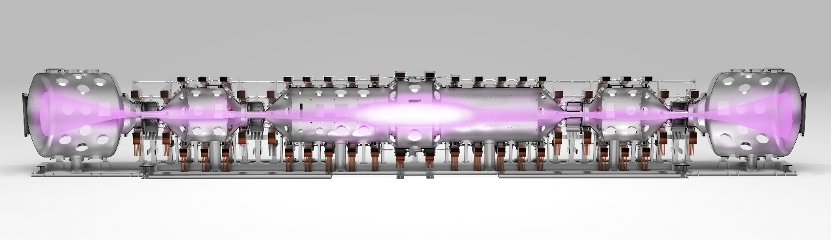
Image source: Xingneng Xuanguang
From KMAX to FLAME: Inheritance and Evolution
In conversation with the team, we learned that FLAME did not emerge from nowhere. Its technical DNA is deeply rooted in years of accumulated research from the University of Science and Technology of China's KMAX laboratory.
From early explorations of foundational physical phenomena such as ion cyclotron resonance and wave-driven electrostatic barriers in the laboratory, to now integrating these principles into a large-scale engineering device like FLAME — this represents not merely a technical upgrade, but a rapid march from "principle validation" toward "commercial energy." Xingneng Xuanguang hopes that through this coupled paradigm of "strong magnetic mirror + FRC core + electrostatic plug," it can forge a path that is more efficient and closer to commercial viability than its predecessors.
In the following article, I will draw on firsthand materials from this in-depth interview to peel back FLAME's metal shell, interpreting the technical architecture and development path behind this "elegant straight line" from the dimensions of system composition, the deep logic of physical mechanisms, and future experimental blueprints.
Interview Transcript

I. Deconstructing FLAME: The Beauty of the Straight Line
Standing before the FLAME (FRC Long-Lived Axisymmetric Mirror Experiment) device, the most immediate impression is: it's so long.
Below: A wide-angle shot of FLAME. Its 18.5-meter body stretches across the field of view, with 30 precisely arranged magnet coils encircling it like vertebrae, radiating industrial sci-fi aesthetics.
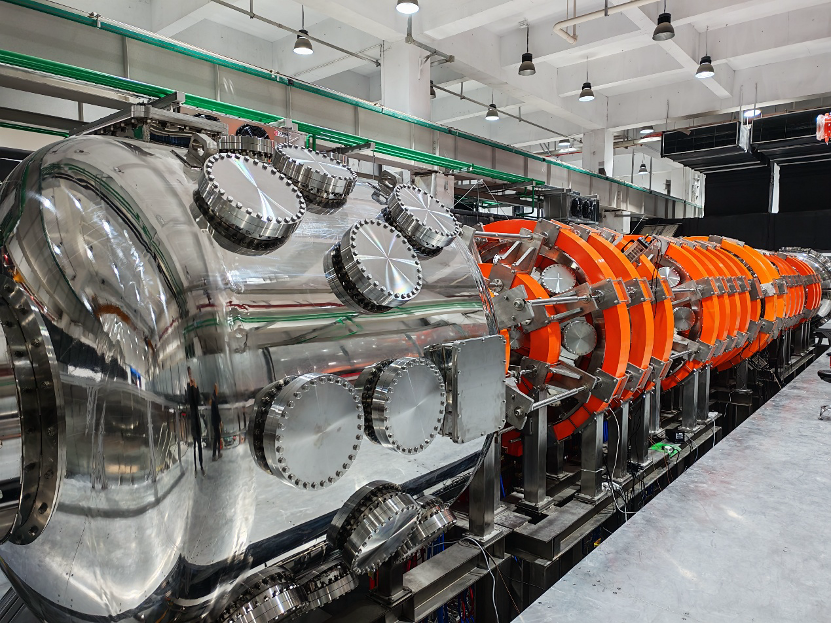
Image source: Xingneng Xuanguang
The 18.5-meter-long vacuum chamber lies like a spear across the center of the experimental hall. Unlike those complex devices that twist themselves into "pretzels" or "doughnuts," FLAME displays a minimalist straight-line aesthetic.
Xingneng Xuanguang CEO Zhida Yang told us: "This axisymmetric straight-line topology isn't purely for aesthetics — it's about using the most direct engineering means within a controlled volume to challenge the highest plasma physical parameters."
Here, based on my on-site interview, are the five core systems of FLAME I've compiled for you.
1.1 Minimalist Frame: Modular Vacuum System
Q: Why build it so long?
A: CTO Ming Liu explains that length equals stability. For straight-line devices, sufficient axial space serves not only to accommodate high-energy particles, but more importantly to elongate the plasma column, thereby physically reducing the growth rate of magnetohydrodynamic instabilities.
FLAME's vacuum chamber is designed with a five-segment series structure resembling Lego bricks:
- Central cell: the core battlefield for confining high-temperature plasma.
- Sub-mirrors: control checkpoints at both ends of the central cell.
- Expanders: at the outermost ends, responsible for final energy exhaust.
This modular design with a total volume of 26 cubic meters means they can swap out any segment for upgrades in the future without having to start from scratch. Combined with the ultra-pure vacuum environment maintained by high-performance vacuum pump sets, this effectively prevents impurities from "contaminating" the plasma and reduces unnecessary energy losses.
Below: Internal deconstruction of FLAME. The red area in the center is the central cell, blue represents the sub-mirrors, and the gray areas at both ends are the expanders.
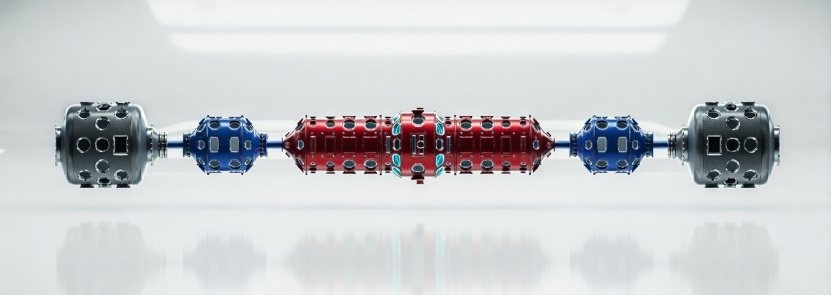
Image source: Xingneng Xuanguang
1.2 Magnet System: The Bottleneck of Building the "Magnetic Bottle"
If the vacuum chamber is the container, then the magnets are the container's "walls." Out of pragmatic considerations for iteration speed and cost, Xingneng Xuanguang has chosen high-current copper conductor coils paired with capacitor energy storage for the current phase.
In the experimental hall, we can see the orange-yellow coils visibly constricting at both ends of the device. This is precisely to construct the "high magnetic mirror ratio" topology. Imagine a bottle that's narrow at both ends and wide in the middle. FLAME uses strong magnetic fields to create extremely narrow "magnetic throats" at both ends. This design is like corking the bottle, compressing the plasma's escape window (loss cone) to the extreme and forcibly "bouncing" particles that try to slip away back toward the central region.
Below: FLAME magnetic field strength distribution curve. The "magnetic peaks" formed by the steeply rising curve at both ends vividly explain why charged particles are locked inside the bottle.
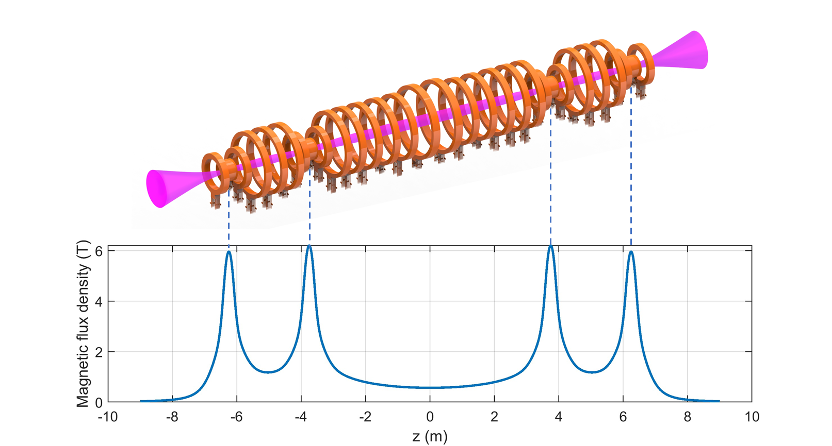
Image source: Xingneng Xuanguang
1.3 Energy Heart: Hundred-Megajoule-Class Pulsed Power Supply
In the adjacent power hall, I was awestruck by rows of supercapacitor cabinets. This is FLAME's energy heart. To maintain that delicate "magnetic bottle," the power system doesn't just need brute force — it needs precision.
- Massive capacity: FLAME is equipped with hundred-megajoule-class pulsed power modules, providing ample energy reserves for high-intensity discharge.
- Zero ripple: The engineers at Xingneng Xuanguang made a point of emphasizing how ruthlessly FLAME demands current smoothness down to the millisecond level. The core FRC plasma is exquisitely sensitive; even the tiniest current jitter (ripple) could shatter its fragile internal magnetic topology.
Below: A photo of FLAME's supercapacitor power room. Every joule of energy stored here will, in the instant of discharge, be transformed into the magnetic force that cages the "artificial sun."
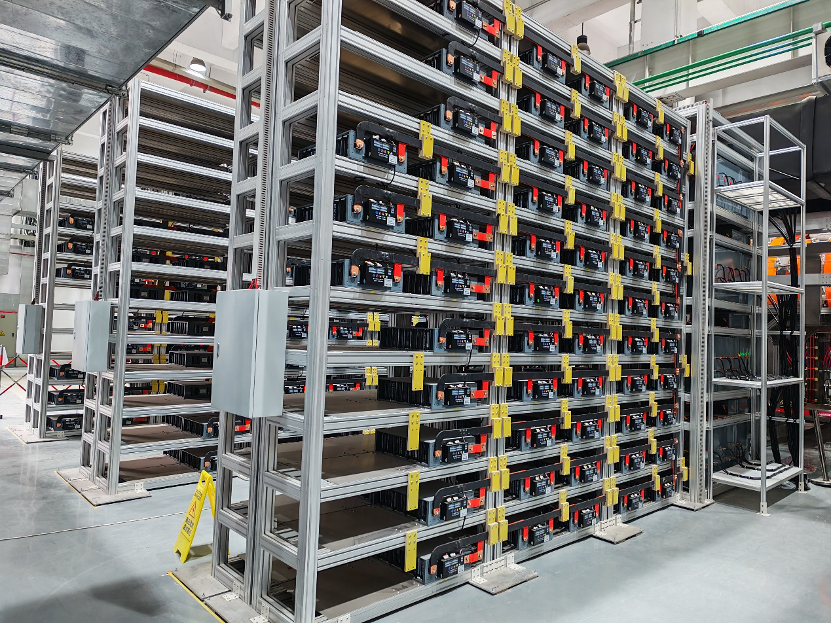
Image source: Xingneng Xuanguang
1.4 Three Fires: Multi-Dimensional Heating and Drive
How do you burn gas into a 100-million-degree plasma?
FLAME readies three "fires" that work in concert:
Main force: Neutral Beam Injection (NBI)
This is the heavy hitter. FLAME is outfitted with eight high-flux neutral beams. They're not just heaters — they're "stirring rods." Through off-axis injection, they drive plasma rotation, forming and sustaining that critical FRC closed magnetic ring.
The blocker: Electron Cyclotron Resonance Heating (ECRH)
Uses microwaves to heat electrons. Its clever trick is inducing an electrostatic barrier that, paired with the magnetic mirror, creates a "double lock."
The assist: Ion Cyclotron Resonance Heating (ICRH)
Delivers energy directly to ions via high-frequency waves, boosting core temperature.
1.5 Taming Instability: The Art of Startup and Control
Linear devices fear "crashing" (instabilities) above all. FLAME has invested heavily on the control side:
- Seed source: A coaxial plasma gun fires the first "bullet," producing an initial high-density seed plasma so the subsequent neutral beams have a target to hit.
- Rotational stabilization: This is an elegant physical mechanism. Bias electrodes at the edge apply an electric field, inducing sheared flow in the plasma. Think of it like spinning a top — the gyroscopic effect of high-speed rotation keeps the otherwise restless plasma column in dynamic equilibrium inside the straight tube.
Below: The coaxial gun and bias electrodes at the device end. These precision metal components are the "steering wheel" for controlling the plasma's macroscopic behavior.
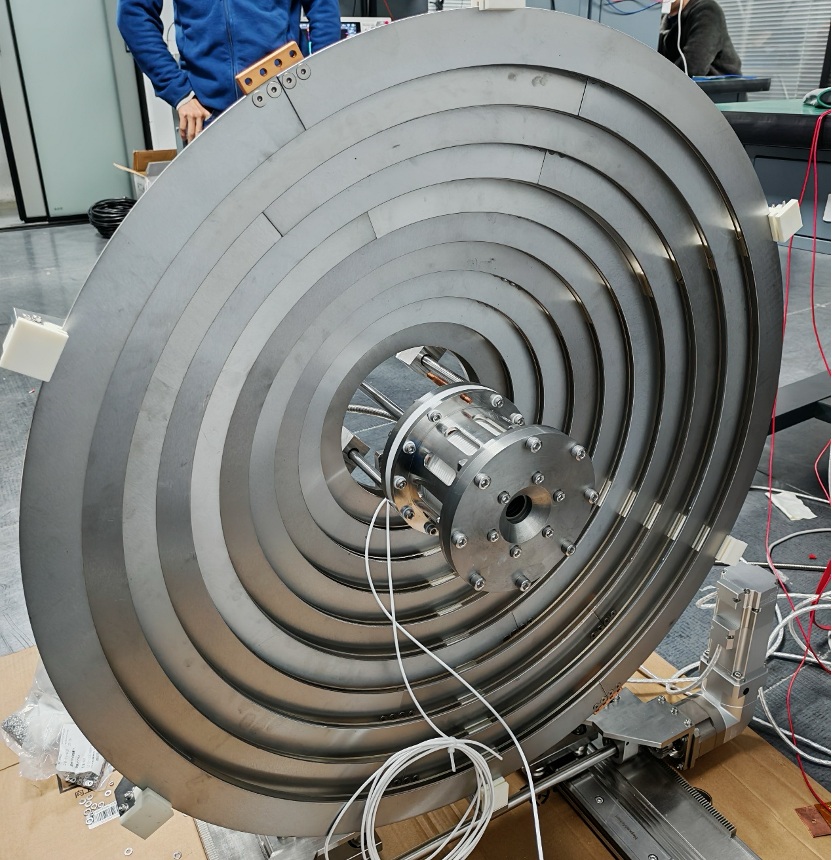
Image source: Xingneng Xuanguang
Editor's Observation
After walking through FLAME's experimental hall, my strongest impression was: pragmatism.
Xingneng Xuanguang didn't chase the "perfect configuration" of fully superconducting magnets from the start. Instead, they chose mature engineering approaches (copper coils, capacitor power supplies) to trade for maximum speed in physical validation. FLAME is no longer a scientific concept lying on paper; it's an engineering prototype born from precise calculation and deliberate trade-offs in service of commercialization. Its purpose is to push the physical limits of linear devices as far as possible while ensuring engineering feasibility.
II. Physical Core: How to Weave a "Leak-Proof" Magnetic Cage?
In the world of magnetic confinement fusion, the core challenge is always the same: how do you keep a ball of 100-million-degree plasma — trying to explode in every direction — pinned obediently in place?
In discussions with Xingneng Xuanguang's physics team, I found that FLAME's design philosophy isn't about any single technology going it alone. It's a "joint air-sea-land operation." They've constructed what they call a "triple confinement" integrated system, attempting to simultaneously seal off every escape route for the plasma across three dimensions: macroscopic stability, micro-kinetics, and topological structure.
Below: The soul of FLAME's physics — a schematic of the "triple confinement" mechanism: at the core is a self-organized rotating FRC plasma, surrounded by a funnel-shaped magnetic mirror field, with electrostatic barriers at both ends responsible for the final seal.
Image source: Xingneng Xuanguang
First Layer: Return to "Elegance" and the Spinning Top
Axisymmetric magnetic mirror + sheared flow
"Why not stick with the traditional baseball-coil magnetic mirror?"
That was my question when I saw FLAME's straight, unadorned exterior.
The team explained that while the traditional "baseball coil" is stable, its shape is too twisted — like a winding mountain road. Ions running inside easily get thrown out by the "complicated road conditions" (neoclassical transport losses).
Below: The "baseball coil" designed by the United States' LLNL
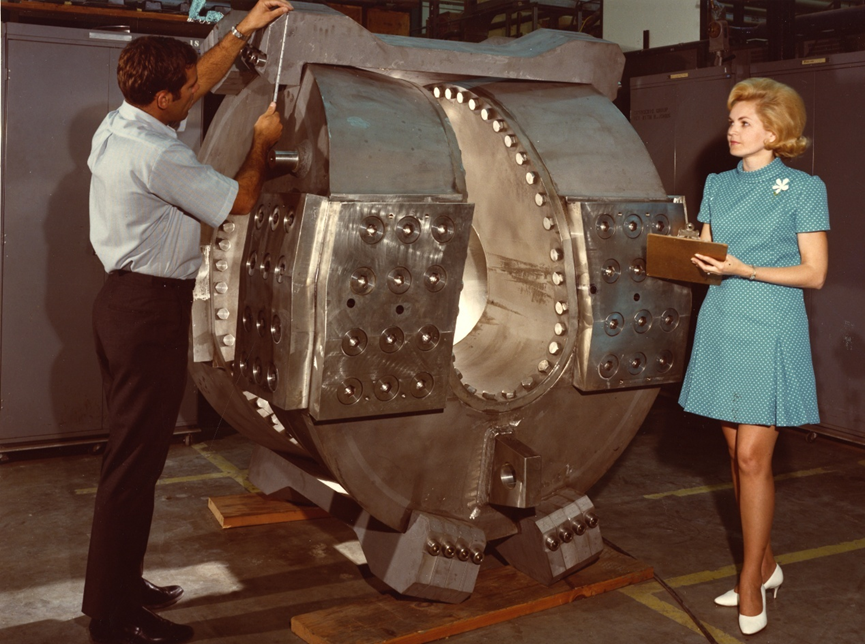
Image source: LLNL public materials
FLAME chose to return to an axisymmetric design — a straight pipe. This eliminates orbital complexity. Using extremely high magnetic fields at both ends, it reflects most particles back like a funnel.
But straight pipes have a fatal weakness: the plasma tends to wobble like jelly (MHD instabilities). FLAME's solution is full of mechanical beauty — make it spin. Using bias electrodes at the ends, the device creates an electric field at the edge that drives the plasma to rotate at high speed. Imagine a top that can't stand upright — once it spins fast, it's steady as a rock. This "sheared flow," where different layers rotate at different speeds, is like wrapping a wall of high-speed streaming air around the plasma, forcibly suppressing the internal turbulence.
Below: A schematic of the sheared flow principle, like the inner and outer lanes of a highway moving at different speeds. The diagram shows a cross-section of the plasma column; the differential rotation between inner and outer layers creates "shear force" — an invisible shield maintaining macroscopic stability.

Image source: Public materials
Second Layer: The Invisible "High-Voltage Grid"
Ambipolar potential barrier + kinetic blocking
Though the magnetic mirror can stop most particles, there are always some "hard-headed fast runners" that slip away along the field lines. What to do? FLAME's strategy: set up a checkpoint at the exit.
- Electrostatic dam: By injecting high-power microwaves (ECRH) into the subsidiary mirror region, electrons there are heated to extremely high temperatures. Physics tells us this establishes an ambipolar potential barrier. For positively charged ions, it's like a "mountain of static electricity" rising from flat ground at the exit. Even if an ion makes it through the magnetic funnel, it will slam into this invisible wall and be bounced back to the center.
- Special forces (sloshing ions): To further quell microscopic internal disturbances, the team also injects a batch of special "sloshing ions" via neutral beams. They're like patrol special forces, oscillating along specific orbits, specifically plugging holes in velocity space and fundamentally suppressing the seeds of microscopic turbulence (such as DCLC instability) before they can sprout.
Below: Axial ambipolar potential distribution. The horizontal axis is device length, the vertical axis is potential energy. Note the steeply rising "peaks" at both ends — these are the "electrostatic gates" blocking ion escape.

Image source: Xingneng Xuanguang
Third Layer: From "Tunnel" to "Smoke Ring" — The Ultimate Transformation
FRC core self-organization
If the first two layers are defense, then the third is FLAME's offense — the Field-Reversed Configuration (FRC). This is FLAME's most captivating physical goal: changing the shape of the magnetic field itself.
When eight high-flux neutral beams (NBI) lash the plasma like whips, driving it to generate a powerful toroidal current, a miracle occurs: the magnetic field lines in the central region are canceled, torn apart by the current-generated magnetic field, then reconnect. The originally open "tunnel" running straight through both ends spontaneously self-organizes into a closed "smoke ring" in the core region.
This is the FRC. It possesses an extremely high beta value (plasma pressure to magnetic pressure ratio approaching 1).
What does this mean? It means Xingneng Xuanguang doesn't need large quantities of expensive ultra-high-field magnets. With only modest magnets, they can confine plasma of extremely high density and pressure. This is the shortest path to low-cost fusion.
Editor's Observation
The most captivating aspect of FLAME's physical mechanism is its "self-consistency." It is not a simple stacking of functions, but rather an organic ecosystem: the axisymmetric structure paves a straight road, the shear flow keeps the vehicle steady, the electrostatic barrier guards the exit, and the FRC core pushes energy density to the extreme at the center. Under this architecture of "inner closed-ring flow, outer magnetic-mirror wrapping, and axial electrostatic plugging," multi-dimensional physical controls combine their forces to deeply exploit the self-organizing nature of the plasma.
III. Decoding the First Discharge Data: The "First Report Card" on the Path to Fusion Ignition
For any large-scale fusion device, the first discharge is a rite of passage.
In conversations with Xingneng Xuanguang's engineers, you can sense the relief that comes after walking on eggshells. The first discharge isn't just about catching a glimpse of that flash — more importantly, it's about using the signals fed back from diagnostic equipment to verify whether that 18.5-meter "physics black box" actually works as expected.
In the words of CTO Ming Liu, this is "the first report card on the path to fusion ignition."
Below: The control room monitoring the first discharge data. As waveforms leap across the screen, FLAME officially exits pure hardware debugging and begins its physics exploration career.
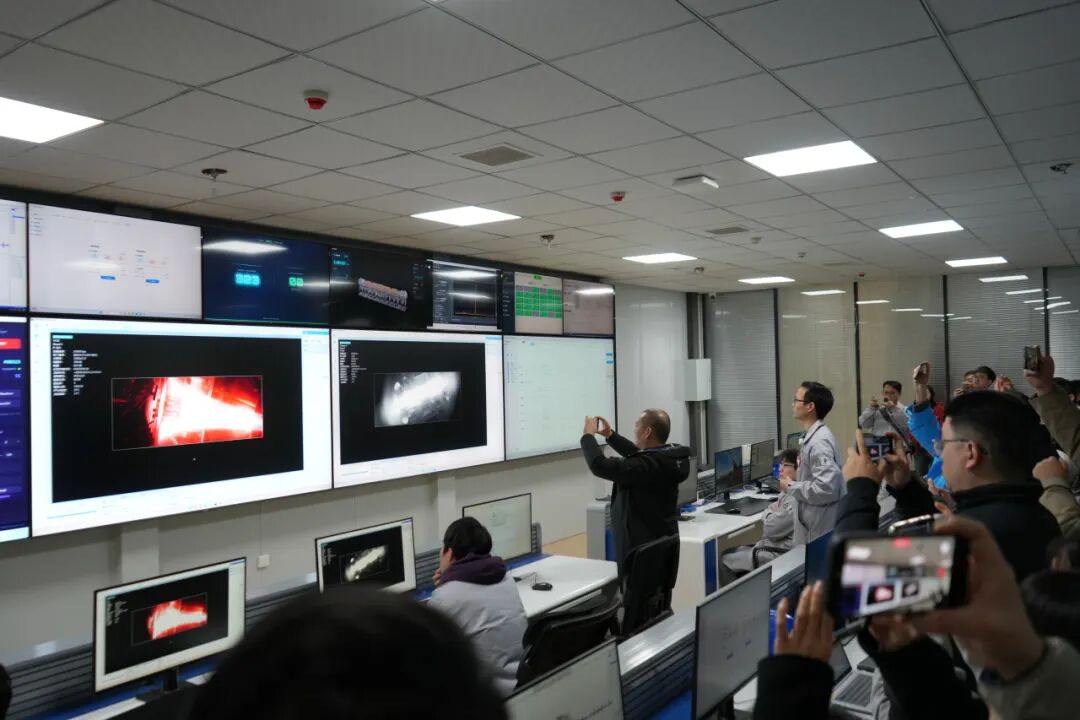
Image source: Xingneng Xuanguang
3.1
The "Target" Holds Steady: An Order-of-Magnitude Breakthrough in Density
In the first discharge experiment, monitoring instruments captured a critical signal: the average plasma density in the central chamber reached the order of 10^19 m^-3.
Why does this number matter?
If the subsequent high-power neutral beam injection (NBI) is the "bullet," then the plasma in the central chamber is the "target." If the target density is too low, the bullet will pass straight through the device — failing to heat the plasma and potentially burning through the opposite inner wall. This establishment of a high-density target proves that the plasma guns at the ends are highly efficient. It shows FLAME has prepared sufficient "optical depth," laying a solid physical foundation for the upcoming NBI heating experiments.
3.2
Transport Validation: Magnetic Field Collimation Across Ten-Meter Distances
FLAME is an 18-meter linear device. Plasma generated from guns at both ends must traverse ten meters to converge in the central chamber.
Along the way, the plasma undergoes a dramatic transition from extremely strong "magnetic throats" to relatively weak "central regions." According to physical laws, it will expand like a fluid.
In interviews, engineers excitedly noted: The evolution characteristics recorded by the diagnostic system match kinetic predictions with high precision. This doesn't just mean our magnetic field lines are "pulled extremely straight" — it also proves that the current ratios among the 30 magnet coils achieved exquisite synchronization. The plasma didn't "hit a wall" halfway, but obediently completed its long-distance march along the predetermined trajectory.
3.3
Vacuum Environment and Impurity Control
Plasma is extremely "delicate." If there's even a trace of heavy metal impurity in the vacuum chamber, it triggers "radiation collapse," instantly extinguishing the discharge.
In the first discharge, FLAME maintained stable millisecond-level operation.
- Vacuum resilience: The device has not yet fully activated its ultimate cryogenic system. Sustained discharge was achieved relying solely on molecular pumps, demonstrating excellent inner wall cleaning treatment and outgassing rate control.
- Smooth signals: Preliminary radiation diagnostics (AXUV) show very smooth waveforms. This means we successfully avoided energy loss from heavy impurities during startup, creating a clean "delivery room" for the plasma.
Let's revisit FLAME's first discharge through high-speed camera footage.
Video source: Xingneng Xuanguang
Editor's Observation
The success of the first discharge means FLAME's fusion experimental platform has fully run through its operational workflow. While the current plasma remains in a low-temperature, low-energy-confinement state, it proves that Xingneng Xuanguang's engineering logic is sound. A stable platform has been built. What comes next is the moment of true burning — activating high-power heating to challenge the physical limits of the field-reversed configuration (FRC).
IV. Evolution Blueprint: The "Four-Step" Strategy Toward Megawatt-Scale Power
FLAME's successful first discharge only validates the reliability of foundational engineering designs — overall system integration, vacuum sealing, and magnetic field construction. How to cross from today's "cold" plasma to the hundred-million-degree "artificial sun" state?
In discussions with the Xingneng Xuanguang team, they showed me a rigorous physics roadmap. This isn't about luck — it's about "cashing in" on physical predictions through precise engineering control, step by step.
Below: The "four-step" strategic roadmap, FLAME's "advancement ladder." From basic heating to ultimate high-energy output, each step corresponds to a core physics pain point that must be solved.

Image source: Xingneng Xuanguang

Level One: Breaking "Electron Drag," Freeing the Ions
In fusion reactions, our core goal is to heat ions (positively charged atomic nuclei), because they are the "protagonists" of fusion reactions. But plasma must maintain electrical neutrality, so inevitably, large numbers of lightweight, energetic electrons (negatively charged) swarm around the ions.
From a physics perspective, ions are like heavy "semi-trucks," while electrons are nimble "scooters." This vast mass difference determines their special energy exchange pattern: When we use neutral beam injection (NBI) to fire high-energy ions into the device, these ions are like heavy trucks flying down a highway. However, if the background electron temperature is low (low energy), these dense "cold electrons" act like viscous mud, creating enormous drag on the high-speed ions, continuously consuming and stealing their kinetic energy.
This phenomenon is called the "electron drag effect." If electrons are too cold, no matter how fast the ions run, they will quickly be "dragged down," preventing ion temperature from rising.
- Strategy: FLAME will prioritize activating electron cyclotron resonance heating (ECRH) and ion cyclotron resonance heating (ICRH) systems.
- Goal: First raise electron temperature above 500 eV (about 5.8 million degrees Celsius).
Intuitive understanding: FLAME's strategy is like using a blowtorch to heat and liquefy the "viscous lubricant" in the environment before firing up the engine. Only when electrons are hot enough to stop dragging their feet can the energy from subsequent NBI injection truly stay with the ions, allowing them to collide and trigger fusion.
Level Two: Strong Injection, Strong Exhaust, Capturing "Fast Ions"
Once the background environment warms up, the core weapon — eight high-current neutral beam (NBI) sources — will officially enter the stage. The enemy at this point is the background neutral gas, which acts like "spies" that steal the charge from high-energy ions through "charge exchange," causing them to escape magnetic confinement.
- Strategy: FLAME will activate ultra-high-pumping-speed cryogenic condensation pumps.
- Goal: Create extreme vacuum purity, achieving "strong injection, strong exhaust." Allow NBI-injected high-energy particles to accumulate energy before being lost, truly getting the plasma to "burn."
Level Three: Closing the "Electrostatic Gate," Locking Down the Exit
As energy density climbs, the pressure of axial particle escape will increase dramatically. At this point, the aforementioned "ambipolar electrostatic barrier" will face its ultimate test.
- Strategy: Precise, "surgical" injection via microwave systems at the magnetic throat.
- Goal: Establish an invisible electrostatic wall.
Intuitive understanding: If the FLAME magnetic mirror structure is the door being closed, then the electrostatic barrier is the high-voltage lock added to it. This gate keeps low-energy ions firmly trapped inside the central chamber, creating an absolutely quiet environment for the "self-organization" of the core region.
Level Four: Ultimate Transformation, the Birth of the Field-Reversed Configuration (FRC)
This is FLAME's ultimate mission, and the most exhilarating vision of the entire interview.
- Strategy: When FLAME's eight NBI beams "fire" at precise tangential angles, driving a massive toroidal current.
- The miracle moment: The magnetic field generated by this current reverses the external magnetic field; magnetic field lines break and reconnect instantaneously.
- The physical picture: At the center of the 18.5-meter device, a closed, high-pressure FRC plasma core will emerge from its cocoon. In this state, FLAME will truly possess megawatt (MW)-scale energy output potential, validating the ultimate feasibility of linear devices as commercial fusion reactors.
Editor's observation
In Star Fusion's experimental hall, what we saw was not merely flickering screens and crisscrossing pipelines, but rather a reverence for scientific principles and a spirit of pragmatism.
This roadmap demonstrates the qualities of a top-tier commercial fusion company: rather than pinning hopes on "lottery ticket" technological leaps, it breaks down a grand vision into executable, observable engineering milestones. Starting from the "elegant straight line," FLAME is using these four steady steps to measure humanity's distance to ultimate energy.
Conclusion: On a Straight Line, Igniting the "Flame" of the Future
As we concluded our interview with Star Fusion and stepped out of the experimental hall, looking back at that 18.5-meter silver device wrapped in orange rings, what welled up within us was a new understanding of "technological aesthetics."
From a technical perspective, FLAME validates a bold hypothesis: Can we lock down狂暴的能量 through the "multiple concerto" of magnetic mirrors, electrostatic barriers, and shear flows within an axisymmetric, elegantly simple structure? The first-discharge data offers a promising preliminary answer. This design avoids the extremely complex geometry of traditional toroidal devices, attempting to find the "golden ratio" that supports commercial viability between physical confinement efficiency and engineering feasibility.
In Star Fusion's engineering strategy, I read a rare and valuable "spirit of pragmatism." Rather than getting bogged down early on in high-cost, long-cycle fully superconducting solutions, the team decisively chose mature copper coils and pulsed power systems. This "small steps, fast iterations" model has allowed Professor Sun Xuan's team to transform over a decade of academic work at the KMAX lab into large-scale engineering experimentation at unprecedented speed. This is perhaps the core logic of commercial fusion development: letting physical expectations guide engineering design, and real data feed back into theoretical models.
The warmth behind the name: FLAME. It means fire — both an intuitive description of high-temperature plasma and a portrait of these fusion dreamers' inner selves. First discharge is only a starting point. In the journey ahead, as all eight neutral beam injectors come online at full power and the FRC core emerges from its cocoon, FLAME will continue charging toward one physical limit after another: ion temperature, confinement time, and beyond.
The operation of the FLAME device not only fills an important piece of the puzzle in China's magnetic confinement fusion research landscape, but also presents another possibility to the world. On the racetrack toward ultimate energy, this "elegant straight line" is accelerating with solid engineering practice and physical innovation, carving out its own path.
Below: Beneath the dense web of pipelines and the massive magnets are the core researchers, with an average age under 40. It is precisely this interweaving of "scientific rigor" and "entrepreneurial passion" that has ignited this flame leading toward the future.
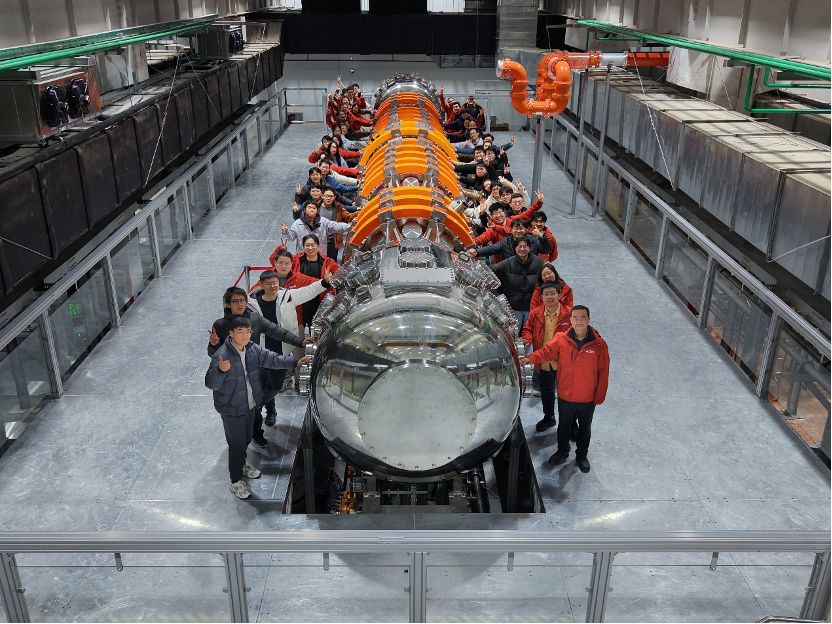
Image source: Star Fusion

Founded in 2022, Heart Capital is an early-stage venture capital fund focused on technology and digitalization in China. The Heart Capital team is primarily composed of Yan Han, founding partner of Lightspeed China, core investors, a chief financial officer, and seasoned investors from industry. The team's past investments include Series A investments in Xpeng Motors (NYSE: XPEV, 09868.HK) and Full Truck Alliance (NYSE: YMM), Pre-Series A investment in MetaX (688802.SH), as well as RoboSense (02498.HK), FinVolution Group (NYSE: FINV), LandSpace, Micro-nano Star Sky, Huitian, Xi Wang, Polestones, Sunmi, World Logistics, Baichuan, Manbang Cold Chain, Fan Deng Reading, Lanhu, Starfield, and others. Rooted in China with a global outlook, Heart Capital is committed to finding true value in non-consensus. Heart Capital respects the value of "people" and advocates for the potential of the "heart," looking forward to accompanying more young Chinese entrepreneurs in strengthening China and going global.