Xi Wang Sunrise Xu Bing: Where Is AI's Biggest Opportunity in the Next Decade? | Xinxing PORTFOLIO

Building houses and rules for AI Agents.
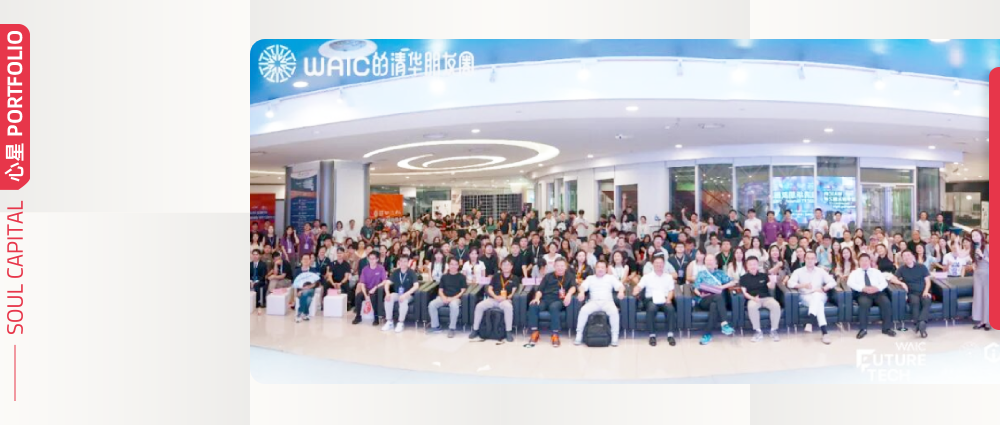
Xi Wang, Sunrise: "The biggest opportunity of the next decade is building houses for AI Agents." On the evening of July 17, as WAIC 2026 opened, Xi Wang, Chairman of Sunrise, was invited to "WAIC's Tsinghua Circle Night" to join Turing Award winner Richard Sutton and guests from the AI, entrepreneurship, and investment communities in a discussion about the intelligent future. He delivered a keynote speech titled "Coexisting with Agents, Building with Fellow Travelers — Inference Infrastructure and the Entrepreneurial Map in the Agent Era."
If Sutton's focus is on how robots learn to understand environments and complete actions through learning, Xi Wang pushed the discussion further: when machine intelligence moves beyond the lab into enterprises and daily life, how will humans work alongside it, and what must we prepare for this new relationship? How machines learn to act is the starting point of intelligent development; how humans and machines form new social and production systems is the question the next phase must answer.
The first thing to be reshaped is the human-machine relationship. Xi Wang believes that Agents can serve as collaborators that jointly judge and create with humans, or as "digital employees" that receive tasks and execute autonomously. No longer constrained by human availability, they can work continuously and complete tasks in batches, thereby transforming organizational structures and production methods. Future companies may no longer be merely collections of people, but new organizations composed of both employees and Agents.
This new organization requires new infrastructure. In Xi Wang's view, for Agents to run long-term, they need not only more abundant computing power, but also software scheduling, memory management, chip configuration, and more rational coordination between cloud and edge. Around token costs, data privacy, model deployment, and hardware-software joint optimization, new product forms and entrepreneurial opportunities are emerging.
And when Agents truly become actors in society and enterprises, a supporting system and operating rules will emerge around them. Xi Wang thus raised a series of new practical questions: how to account for the cost and output of each digital employee, how to track their authority, actions, and accountability, how to insure against potential losses, and how to mobilize scattered, idle computing resources. New fields like Token FinOps, Agent insurance, and utilization management are attempting to answer these questions. They represent not only new roles and businesses, but may also constitute the foundational institutions of a future human-machine collaborative society.
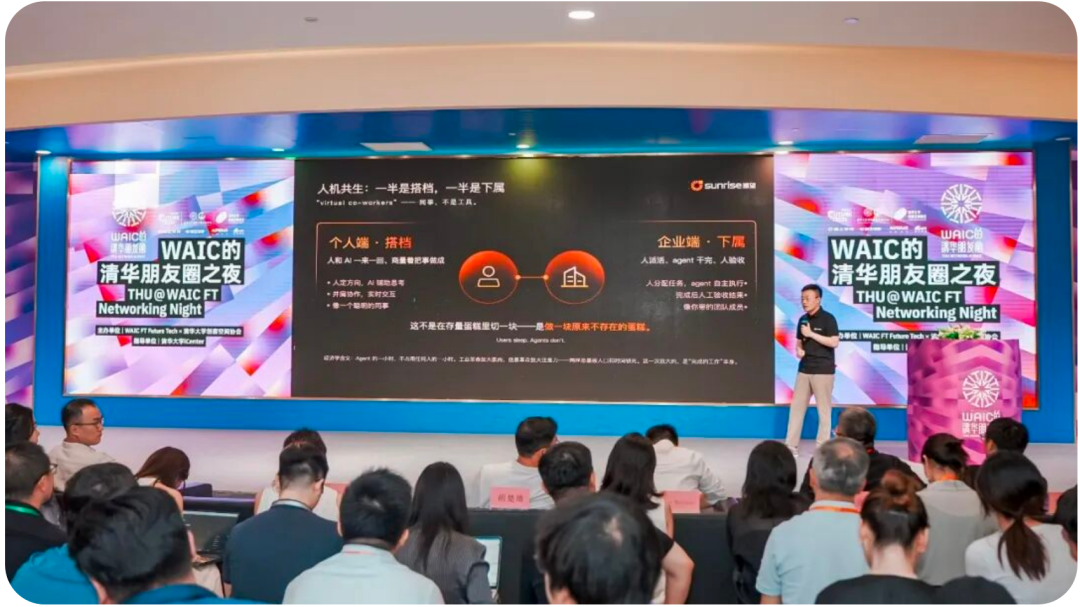
From how machines learn, to how humans and machines live and work together — a new world is being opened.
Below is the transcript of Xi Wang's speech:
In 2014, I co-founded SenseTime with several Tsinghua classmates at Tsinghua Science Park. I completed my undergraduate studies at The Chinese University of Hong Kong, majoring in both Mathematics and Information Engineering, and later became a doctoral student of Professor Tang Xiaoou.
The Multimedia Laboratory founded by Professor Tang Xiaoou at The Chinese University of Hong Kong was one of the earliest pioneers in deep learning in China. Around 2012, in the early days of deep learning, our laboratory was the most prolific institution in this field in China in terms of paper output.
In the early days of our startup, we built a basic computing environment and trained small neural networks using dozens of consumer-grade GPUs, focusing on computer vision. In 2014, we formally established SenseTime at the south gate of Tsinghua.
Looking back at more than a decade of entrepreneurship, I have distilled one profound lesson: there will always be people more diligent, more intelligent, and more talented than you in any industry. Entrepreneurs must guard against complacency — never assume that your achievements cannot be surpassed. A steady stream of outstanding young people will eventually break through what their predecessors have built.
The successive waves of young entrepreneurs constantly pushing industry boundaries and refreshing innovation outcomes — this is the core motivation behind my commitment in recent years to investing in and supporting young entrepreneurs.
In 2014, the concept of "AI" barely existed in the industry. What we delivered externally was core computer vision technology, turning facial recognition and smart city visual solutions into普惠化, standardized general products, making artificial intelligence as accessible as water and electricity — low-cost infrastructure available to all. This has been the shared original aspiration and vision of generations of AI entrepreneurs.
Based on this vision, I embarked on my second entrepreneurial journey, going deep into the GPU and AI inference chip track. Sunrise starts from underlying computing power, continuously reducing the cost of using artificial intelligence to achieve computing power普惠.
Industry Inflection Point: Intelligence Becomes a Procurable Infrastructure
Looking back at industry development over the past decade, model scales have continued to expand and computing resources have kept growing. For the past ten years, training capacity determined the ceiling of AI development; now that ceiling has been raised to an extremely high level. And 2026 is the industry's critical turning point: the market has begun paying at scale for top-tier large models, with many users spending over a thousand yuan monthly on models and frequently exhausting their token quotas. Such market demand simply did not exist a year ago; this year marks the true first year of token commercial value recognized by the general public.
Numerous powerful trillion-parameter large models have emerged domestically and internationally, and users are willing to pay for them. Enterprises and individuals have begun paying attention to token usage costs, behind which lies a fundamental transformation in the logic of intelligence supply.
For a long time, top-tier intelligence was a scarce resource, dependent on the long-term cultivation of specialized talent by universities. The cultivation cycle for top talent was lengthy and supply limited; high-end intelligence was like a luxury good. But a brand new era has arrived: top-tier intelligence has become a standardized commodity available on demand. Such procurable commodities are priced at over a thousand yuan monthly, with massive numbers of users willing to pay, directly driving exponential revenue growth for global leading large model companies.
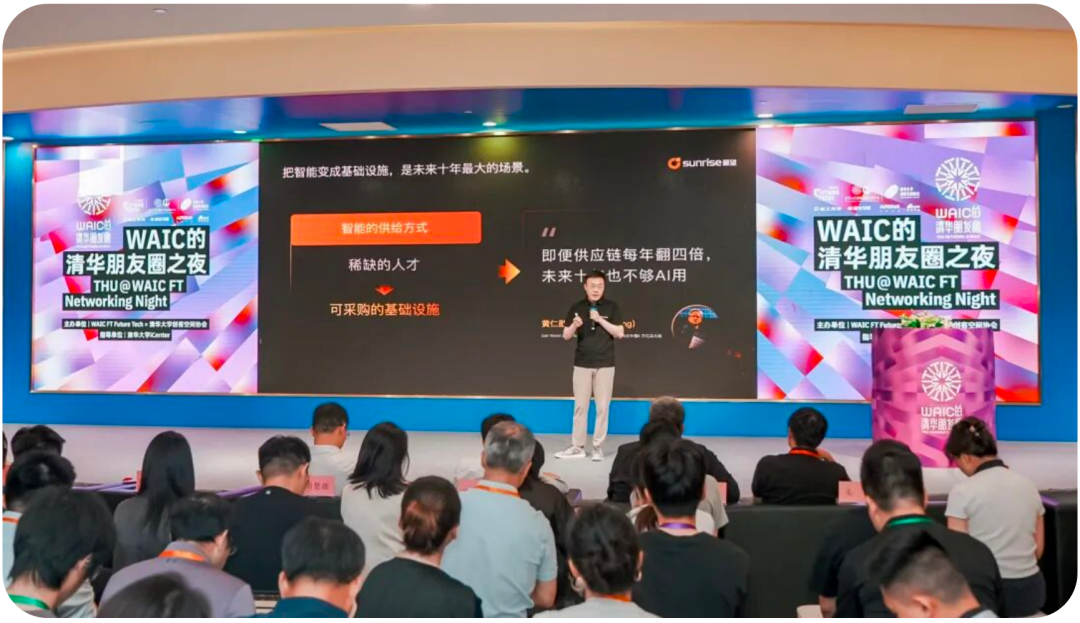
Intelligence has formally transformed into a procurable digital infrastructure. There is a judgment in the industry worth everyone's deep consideration: even if computing hardware capacity expands fourfold annually, it still won't satisfy AI's needs over the next decade.
The core reason is the birth of an entirely new species: the Agent. Agents will continuously consume massive computing power, burning through tokens to complete various tasks. They achieve complete decoupling of intelligent tasks from human time, and the total number of future Agents may far exceed that of humans. The global population is about 8 billion, while the number of Agents could reach hundreds of billions in the future. Humans have built physical infrastructure like office buildings and residences, but massive numbers of Agents still lack suitable operating carriers and computing environments.
The Agent Era: Human-Machine Symbiosis and a Productivity Revolution
From the present to the next decade, we will formally enter the era of human-machine symbiosis. Agents have two core positioning:
The first is as collaborators in personal assistance scenarios. With the user as the primary actor, we communicate back and forth with the model to collaboratively advance tasks. Humans control the overall direction, while Agents assist with thinking, real-time interaction, side-by-side collaboration, Q&A, and implementing various tasks.
The second is as subordinate executors in enterprise work scenarios. Humans issue complete task instructions, and Agents autonomously break down workflows and complete repetitive, standardized tasks in batches, taking on substantial execution work and unleashing human creativity.
We are seeing enterprises begin purchasing tokens at scale, introducing AI Agents as "digital employees" to work alongside human employees. Humans assign tasks, Agents execute them, and humans then review the results — similar to how junior programmers are managed day-to-day. Agents don't need rest; they can run 7×24 without interruption, their time completely decoupled from human time, no longer limited by humans' seven or eight hours of daily availability. Agents don't carve up existing pies; they create incremental markets that never existed in history.
Looking back at history, humanity has experienced three major productivity revolutions. The Industrial Revolution amplified human muscle and physical strength; the Information Revolution amplified human attention and information dissemination efficiency; and with the arrival of the Agent era, human time is finally being completely liberated — something never before experienced in history.
To achieve large-scale proliferation and long-term operation of Agents, several key technical problems must be systematically solved: software scheduling to coordinate task allocation and execution for large numbers of Agents; memory management to support the memory storage needed for Agents' long-term operation; and chip configuration to match optimal computing and memory solutions for different scenarios. In my view, the biggest opportunity of the next decade is building houses for AI Agents — constructing the infrastructure that Agents need. This is the industry's most urgent task at present.
High Bandwidth Memory (HBM), as a core component for AI training and inference, faces severe supply bottlenecks. HBM uses multi-layer stacking processes, is complex to produce, and difficult to expand capacity. The explosive demand from Agent infrastructure construction has directly driven memory manufacturers' performance to soar.
With HBM capacity expansion proving difficult, the entire industry has turned to a new solution — LPDDR (Low Power DDR), or consumer-grade memory. It has simpler production methods, abundant supply chains, and is easy to scale; mass production costs are several times better than HBM; it can accommodate larger-parameter models; and it supports the memory accumulated during long-term Agent-user interactions. Chip manufacturers including Qualcomm, Intel, NVIDIA, and Apple all use hundreds of GB of LPDDR in their inference chips to expand video memory capacity.
In Agent systems, memory isn't just a configuration parameter for graphics cards — it's the digital employee's workstation. The larger the workstation, the more Agents a single machine can support, and the longer each Agent can remember things. Extremely high-bandwidth scenarios and training workloads remain more suitable for HBM. Sunrise's third-generation GPUs use large-capacity LPDDR, achieving lower real task costs on capacity-sensitive Agent workloads with long contexts and high concurrency.
The Edge Inflection Point Has Arrived, Driving Explosive Growth in Inference Demand
Cloud AI is transitioning from "wild growth" to a "high-cost steady state." Global cloud providers have invested trillions of dollars in capex to build AI data centers. Cloud model parameters have reached trillion scale, and API fees have been widely accepted by the market. However, token bills have become the cost item enterprises most need to pay attention to. With token prices continuously rising due to power shortages and the emergence of rate-limiting measures, token bill amounts have even exceeded phone and electricity bills, and enterprises must strengthen control over such costs. Meanwhile, the edge side is welcoming three key inflection points.
First, a leap in computing power. Edge chip computing power is advancing from the historical 100-200 TOPS toward 1000 TOPS-class.
Second, memory expansion. Edge storage is approaching 200 GB, and with large-capacity LPDDR solutions, can accommodate larger-parameter models.
Third, increased intelligence density. Tsinghua University's "density law" reveals that large model capability density doubles every 3.5 months, and is still accelerating, indicating that 200-300B models may rival current cloud flagships within one to two years.
In other words, the cloud model capabilities that currently cost users over a thousand yuan monthly to subscribe to could in the future be directly deployed on terminal devices, achieving permanent token-free usage. Killer application scenarios for edge AI will concentrate on needs where data doesn't leave the device, especially privacy-sensitive tasks. The real ceiling for these applications is determined by memory capacity and memory prices, and with the promotion of LPDDR solutions, this ceiling is being continuously raised. If inference costs drop by 90%, many historically unprofitable application scenarios will transform into profitable business models, thereby driving explosive growth in inference demand and computing demand.
Imagine what future edge devices might look like? I believe the edge may give birth to products at the level of the iPhone or DJI drones.
First vision: 24-hour portable computing power.
Imagine a computer that can run 24/7 for seven days straight. You buy it for tens of thousands of yuan, and it's like hiring a junior engineer. After you write code during the day, it can help you check for problems, fix bugs, and iterate — without stopping all day.
The edge has two advantages that cloud can't replace. First, no cloud token billing fees. Second, data, code, and privacy security remain in your own hands, never uploaded to the cloud.
Its annual token consumption might be worth a hundred or two hundred thousand yuan. So on the edge, this computer you can think of as a token factory that pays for itself in half a year.
Second vision: a phone doppelgänger.
Phones are also worth making a doppelgänger for. Phones have physical space constraints; it's hard to fit a 200B model inside one. But what you can do is something like a power bank — the phone is just the interface. This power-bank-like thing communicates with your phone, containing a sufficiently powerful privatized large model to handle your WeChat, photos, and all those private things that are inconvenient to put on the cloud or share externally. It becomes the entity that understands you best, because it will follow you for many, many years, growing up with you, watching you study, accompanying you through work.
Agent Era Entrepreneurial Map: Systemic Opportunities to Reshape Digital Infrastructure
The Agent era presents numerous entrepreneurial opportunities. I'd like to share and co-create with you across four layers: the computing layer, the edge layer, the application layer, and the co-design service layer.
At the application layer, the core of entrepreneurship is no longer developing another chatbot, but reconstructing business logic. Here are five specific opportunities.
First, outcome-based vertical industry Agents. The best application entrepreneurship in the Agent era isn't adding a chat box to existing software, but finding a unit that customers are willing to pay for by results — a work unit, standardized, then scalable and replicable, becoming a digital production line.
Second, Token FinOps. Cloud-era FinOps answered one question: how much did each business unit spend on the cloud? In the AI era, the new FinOps must answer: for every digital employee we hire, how much did they cost? What tasks did they complete? Were the results good? Are they still worth paying for?
Third, joint optimization of models and hardware. During WAIC, newly released chips already number in the hundreds. We have an excellent chip innovation ecosystem. What we lack are people who can push a given model to its limit on a particular hardware chip. In the future, a batch of "inference adaptation foundries" may emerge — they don't produce chips, they don't make models, but they process both into mass-producible, deliverable inference products.
Fourth, Agent insurance. Humans need insurance; the same is true in the Agent era. The more digital employees we have, the more we need to know which Agent did what, why they did it, whether problems can be replayed, and who bears the losses. Future Agents will need to be accountable for their results; important Agents may need their own IDs, their own authority levels, behavior records, and risk ratings.
Fifth, utilization banks. Some data centers, as well as enterprise-built intelligent computing clusters, have low utilization rates. These resources are existing inventory, computing power that hasn't been put to use. But which parts can actually be utilized? Whether it can be migrated, billed, and adapted — these are gold mines very close to cash flow, that can be mined in a timely manner. The entrepreneurial opportunity isn't to build a scheduler, but to build an "ore refinery" that processes scattered, heterogeneous cards into products that customers can stably run and purchase.
There are tremendous entrepreneurial opportunities across these four layers. At the computing layer, making every kilowatt-hour, every GB of memory, every card efficiently convert into tokens. At the edge layer, once a 200-300 billion parameter model can fit in a device in your pocket, the opportunity to create iPhone-level new products emerges. At the application layer, transforming customers' "one cent per million tokens" billing into pricing by task completion — how much to get something done. Finally, at the co-design service layer, joint optimization of models and hardware is the key to realizing technical value, which is also the value that DeepSeek has validated.
Finally, I'd like to share the rare era opportunities and advantages belonging to Chinese AI entrepreneurs today.
We often say China's AI industry has three trump cards: first-tier open-source large model capabilities, scalable memory supply chains, and ample, stable power resources. The combination of these three gives us the world's most advantageous foundation for token mass production, and gives "building houses for Agents" the confidence to land first in China.
What we deliver is never a single chip or a single server, but a complete inference infrastructure that is "affordable, ownable, and deployable" — laying a sufficiently stable, sufficiently cheap foundation for all entrepreneurs doing applications, edge devices, and services. Sunrise is willing to be this stage-builder rooted at the bottom layer, doing inference chips thoroughly, solidifying the base of the token factory, and equipping Agents with native computing power engines.
Among those present today are investors and entrepreneurs who have traveled this road with us — we are all fellow travelers in the Agent era. Over the next decade, the boundaries of intelligence will continuously expand, and entrepreneurial opportunities will flow endlessly. May we coexist with Agents, build with fellow travelers, and together transform the vision of computing power普惠 into tangible industrial reality.
Thank you all!

Heart Capital was founded in 2022 and is a venture capital fund focused on investing in early-stage technology startups in China.
Heart Capital's team is mainly composed of founding partners and core investors from Lightspeed China, as well as senior investors from industry. The team's past investments include MetaX (688802.SH), Xpeng Motors (NYSE: XPEV, 09868.HK), Full Truck Alliance (NYSE: YMM), SUNMI (06810.HK), RoboSense (02948.HK), Ambiq Micro (NYSE: AMBQ), Hanshow Technology Co., Ltd. (301275.SZ), FinVolution (NYSE: FINV), HERE (NASDAQ: HERE), as well as LandSpace, MicroNano Space, Baichuan, Yunmanman Cold Chain Logistics, World Logistics, FanDeng Reading, and Lanhu.
Rooted in China with a global perspective, Heart Capital is committed to early-stage陪伴 and supporting entrepreneurial teams with the potential to become world-class companies in China's technology sector. Heart Capital advocates the value of "heart," believing that technology can become a bridge linking hearts. Heart Capital looks forward to accompanying more young Chinese entrepreneurs onto the world stage.