From Red Ocean to Blue Ocean: Xpeng Motors Redefines Autonomous Driving with Second-Generation VLA | Xinxing PORTFOLIO

THE FUTURE is now within reach.
On March 2, Xpeng Motors officially unveiled its second-generation VLA (Vision-Language-Action) model, declaring that intelligent driving has moved from "geek early adoption" to "mass-market everyday use," with Volkswagen as its launch customer. Behind this technological leap lies He Xiaopeng's arduous two-month decision-making process and over 2 billion yuan in R&D investment.
We have compiled an in-depth conversation between China Entrepreneur and He Xiaopeng from several months ago, reconstructing how a hard-tech company doubled down on physical AI amid cutthroat competition — from autonomous driving architecture to globalization to embodied intelligence — to carve out its own blue ocean path. Recommended reading.
The following is an edited transcript of China Entrepreneur's interview with He Xiaopeng:
Interviewers | China Entrepreneur reporters Yifan He and Yafei Ren
Writer | China Entrepreneur reporter Yuexin Kong
Editor | Jiying Ma
Photography | Guisen She
From "Bloody Ocean" to Blue Ocean
China Entrepreneur: Xpeng Motors' Q3 2025 results were quite strong — revenue and profits both growing. You mentioned a concept: from "bloody ocean" to blue ocean. What do you mean by "bloody ocean"?
He Xiaopeng: I see the bloody ocean as extreme uncertainty within brutal competition. The auto market shifts dramatically every year. In 2024, even some well-performing Chinese automakers faced challenges, while others achieved massive success. With the right strategy plus a bit of luck, outcomes can be vastly different.
Today, we can at least see where the blue ocean is, where the light is coming from. The key is finding the right rhythm, matching resources, and building capabilities to reach it.
But my expectations for the blue ocean may differ from many founders — mine are quite high. In China's internet industry, many sectors end up with just two or three survivors. And those two or three achieve stable, comfortable development where they can do different things — that's what I consider true blue ocean status.
So throughout these years of building cars, I've kept pondering: How can we avoid the "bottom-right effect" and achieve more sustainable, stable success? The so-called bottom-right effect is when everyone believes bigger and cheaper cars equal success, so they all crowd toward the bottom-right of the product matrix. But in some ways, that's not really a sound approach. There are many reasons a company ultimately succeeds, but one essential factor is using technology to change many people's lives and winning their affection through technology.
China Entrepreneur: So the bottom-right is the "bloody ocean."
He Xiaopeng: The further you go toward the bottom-right, the bloodier it gets.
China Entrepreneur: Where in this quadrant do you envision the blue ocean?
He Xiaopeng: I think it's in the middle of the quadrant. It's a balanced system — it can't all be in the top-left, nor can you think purely in manufacturing logic.
Recently we've been talking about physical AI. The physical world is quite like technology and manufacturing; the AI world is quite like what we used to call the internet. These two are fundamentally very different. If we have the capability to combine them, we can create entirely new forms — that's the blue ocean we hope to find.
China Entrepreneur: To reach the blue ocean you describe, you first need to escape the bloody ocean. You said the auto industry competes on different things every year. So what were the main battlegrounds in 2024 and 2025? And what do you predict for 2026?
He Xiaopeng: I think it's hard to imagine from the perspective of China's past internet ecosystem. First, in the internet world, you often had "hundred-company wars," but these usually ended within three years. In autos, they never end.
Second, in autos, one auto show can launch over a hundred new models; a year might see hundreds of completely new or facelifted products. That's something the internet industry never encountered.
Third, nearly all internet products were free for users — it was hard to create a 2x effect or half-price effect. In autos, if someone said they'd give all their cars away for free, they'd probably sell very fast — though they'd also go bankrupt very fast.
So much of internet logic doesn't apply to autos. I can't answer what the auto industry was competing on in 2024 and 2025 — that means there's enormous strategic possibility space in this market.
People often say that coming from internet battlefields to auto battlefields, the internet seems incredibly harmonious by comparison. Only in autos do you realize how completely different it is.
The "Painful" Choice of Autonomous Driving Strategy
China Entrepreneur: You mentioned on WeChat Moments that you're quite satisfied with Xpeng's autonomous driving (VLA) system, but I understand the entire R&D process was actually very difficult. What were the main challenges?
He Xiaopeng: I think most companies today are still thinking in the old software programming paradigm — how to use software to change the world, how to use software to define cars. In a way, in the software world we pursue determinism. For example, if I write a program today saying "turning right was wrong, should go straight," a few lines of code fixes it, then you test. But in the AI large model world, if you say "turning right was wrong," it might not listen — it might not go straight either, but some other direction.
So you see entirely new capability requirements and challenges, including changes in team requirements, resources, and infrastructure.
Over the past year-plus, we've been painfully going through this process — how to get more and more people, especially the top leader, to change their original way of thinking. So the past year has been agonizing. With software plus algorithms, we had determinism: the ceiling wasn't high, but the floor was. But with large models, it's indeterministic — the ceiling might be very high, but the floor might also be very low.
Looking at our second-generation VLA these past few months, what makes me very happy is that it broke through many of our previous ceilings. I believe in 2026 and 2027, it can solve many more problems that were previously unsolvable. For example, when you're driving and there's a pothole or sinkhole in the road — how does the autonomous driving system handle sudden incidents? With old software rules, there might be countless combinations of scenarios. But with models, this problem might just be one set of reinforcement learning. That's what makes me very happy.
But there are also many things that make me unhappy. For instance, when the light ahead is red — with rules and algorithmic optimization, the autonomous driving system simply stops at red, slows for yellow. But actually, yellow light regulations differ by country: in China you slow down for yellow, while in some countries you maintain speed through yellow. How do you balance this and achieve good generalization?
Our previous logic was that we could build a good L2, or an L2 infinitely close to L3. But now I see the possibility of reaching L4 in terms of ceiling. Given three to five more years, we might reach L5.
China Entrepreneur: You just mentioned the floor and ceiling issue. What determines each?
He Xiaopeng: The greatest strength of large models is their ability to integrate all kinds of long-tail data. I often give this example: someone driving across a bridge around 5 a.m. happens to face the rising sun on the opposite side, and their vision instantly shifts from dark to bright. Most people won't encounter or rarely encounter this scenario. Long-tail data like encountering sunrise during morning commute or sunset during evening commute — combining and analyzing all of these is exactly where large models excel, while rules struggle.
Rules excel at simple instructions: no one on either side of this road, no lights ahead, so go straight. But when large models execute, they might make baffling behaviors like changing lanes due to too many stacked logical combinations. From a programming perspective, it might be just three or four logic rules, but the complex reasoning of large models creates floor instability. You think it shouldn't change lanes, yet it can list multiple scenario combinations to justify the lane change — that's very frustrating.
Because of this, we incorporate VLA and human-machine co-driving combination modes into our large models. After all, some people don't want to drive in the leftmost lane, feeling it's too dangerous at night, preferring the middle lane. Others avoid the right lane, worried about bicycles and motorcycles. Some simply dislike the middle lane for no clear reason, preferring left or right. This requires VLA to understand people's habits and preferences, communicating through dialogue and memory, gradually achieving "I get you." How to enable VLA large models to make these "getting you" adjustments is the challenge we currently face.
China Entrepreneur: From VLA first generation to second generation, what kind of painful R&D process did you personally experience? I heard that sometimes internal meetings couldn't even continue, because you needed to build consensus and solve specific difficult problems.
He Xiaopeng: Essentially, it's about whether to make a choice when facing very uncertain goals and processes, plus massive R&D investment. I thought about this for a long time, and finally made up my mind to bet on this path.
China Entrepreneur: When did you truly make up your mind?
He Xiaopeng: Roughly between late Q2 and early Q3 this year.
We had been running multiple solutions in parallel before, but each had strengths and weaknesses, each requiring significant resources. I felt this was when someone needed to have the courage to make a decisive choice.
I think Xpeng is a startup. When a startup has a reasonable probability, it needs to place its bet. Because once you bet, you become more resolute, invest more people and more money, and success becomes more likely.
China Entrepreneur: Why did you choose this timing? What was your decision logic?
He Xiaopeng: I think this comes from multiple capabilities. I may not be able to answer this — it's the convergence of various internal technical developments that ultimately led to my judgment.
China Entrepreneur: Did you need to do persuasion and communication internally? Because this adjustment required your colleagues to make many changes.
He Xiaopeng: Very difficult (to communicate). What they most wanted to ask was: Xiaopeng, with such a large team, how do you prove (you're right). I couldn't say it was intuition, so it was extremely painful.
Sometimes you really do have to rely on your intuition after comprehensive judgment of technology, business, resources, and trends. In the end it became a painful answer: intuition.
My intuition tells me this is a path to L4 and eventually L5, so we must go all-in.
I believe that even if China's L2 becomes perfectly complete, it's hard to make it globally universal. For example, when we drive in Europe — many European countries have roads from decades or even a century ago, very narrow, difficult even for human drivers. That's why China prefers large cars while Europe prefers small cars — you simply can't drive large cars in Europe.
On narrow roads where even humans struggle to drive, like Beijing's hutongs, current Chinese L2 companies including Xpeng would have very high takeover rates if specifically tested there. If we're truly moving toward unmanned driving, Beijing's hutongs are among the problems that must be solved.
Why am I betting so heavily on our new-generation VLA? I believe only when all four scenarios — highways, main roads, small roads (hutongs being small roads), and off-road — can be driven well, will we have ultimate unmanned driving.
China Entrepreneur: You just said the biggest communication difficulty was self-proof. Sometimes for an entrepreneur, after making a judgment by intuition, the hardest part is the "translation" work — translating your intuition into language colleagues can understand. How did you prove yourself? Did you use "if you can't convince them, overpower them," or some other method?
He Xiaopeng: I think it ultimately becomes a combination — extensive communication throughout, plus hoping technology would give me more evidence. Many times you need to adjust their OKRs, proactively tell them we'll bear this responsibility together, help them persuade their peers and subordinates. It was a painful process that took months to execute.
I think many Chinese AI companies combining software and hardware will encounter this difficulty in the future, because you don't know if this path is 100% viable. With software, things are relatively clear, but with models it's a chaotic state. Yet chaos has another benefit: it may emergently produce new things you hadn't thought of or imagined.
You may not have encountered it, but others may have. Large models combine different long-tail scenarios in certain environments, and it becomes an "emergence."
China Entrepreneur: What technical paths did you abandon for this?
He Xiaopeng: This represents our move from the original end-to-end small model domain into the end-to-end large model domain. It represents different possibilities of capability. I'm talking about long poles, medium poles, and short poles. What excites us now is that our long pole is very high, and we're working hard to solve countless medium-pole problems.
China Entrepreneur: Can you give a specific example of a medium pole?
He Xiaopeng: For example, how to judge traffic lights, how to stably guarantee traffic lights are 100% problem-free — that's a medium pole. In the digital world (large models), people often say solving 98% is already impressive. Sorry, but in the physical AI world, with 2% unsolved, you might run red lights, or fail to go when red turns green. That 2% is outrageous — can we make it 99.99%? It looks like just moving the decimal two places, but the difficulty is enormous.
China Entrepreneur: You also developed your own chips, successfully taping out last year — a very important link in this chain.
He Xiaopeng: The original autonomous driving logic didn't need high computing power. HD maps solved the "God's eye view" challenge, lidar handled anomalous scenarios — both greatly reducing programming difficulty and central computing requirements.
Large models' demand for computing power is nearly limitless, with no clear ceiling in sight. So to truly succeed in this domain, you must self-develop computing power, self-develop the entire compilation environment, and do quantization well. For autonomous driving companies with software attributes in the physical AI domain, this is a massive challenge — if you want to go big, you can't avoid it.
In the future, there won't be a hodgepodge of chips and different levels of assisted driving. There will likely be two main categories: simple assistive types, and powerful high-end types.
Robot Mass Production by End of 2026
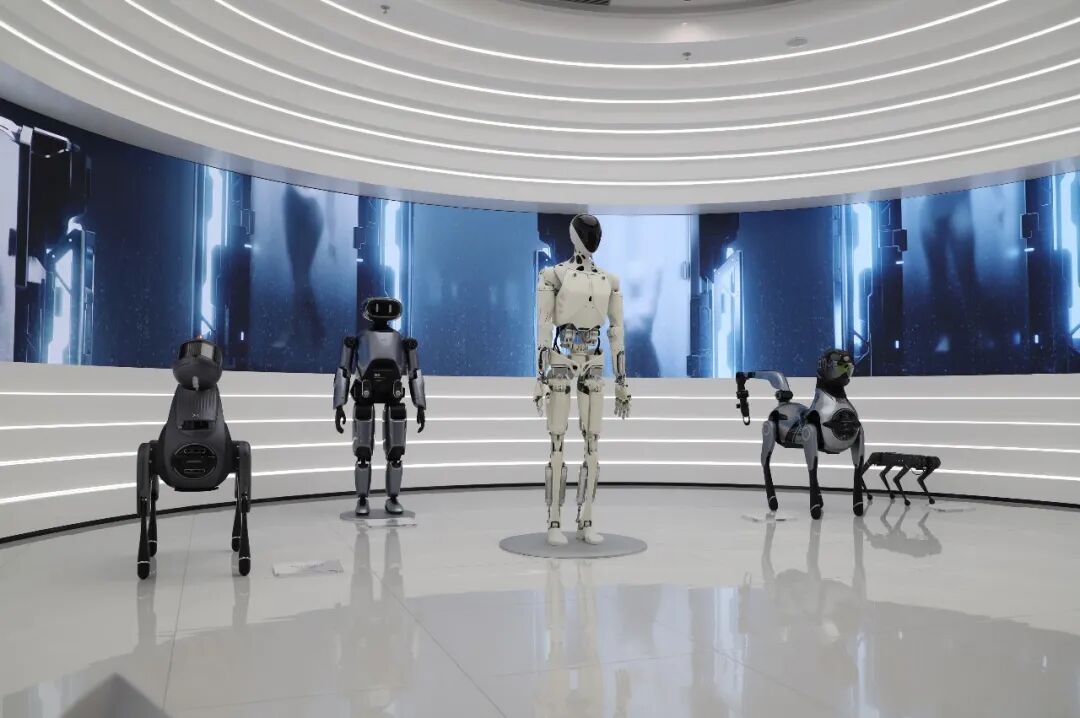
China Entrepreneur: After releasing your latest robot, you did something — you cut open its skin in public, and you actually choked up. I found that strange watching the video, because there should be many things more worthy of getting choked up about. Why were you so emotional at that moment?
He Xiaopeng: When you've been in close contact with something for a long time, it feels like your companion. The robot was built by our own team. Many people didn't understand: why prove anything to others by cutting open your own machine? We even felt that cutting open our own incubated product was like wronging a child we carefully nurtured. Some on our team also felt it was unnecessary: if outsiders don't understand, so be it; if they don't believe, that's fine too.
At that moment, I truly treated it as a companion and felt it was being wronged. We were especially unwilling and reluctant in our hearts. But ultimately we also saw that more and more people moved from doubt to belief, which will push the robotics industry forward. So I firmly believe it was worth doing. If it had thoughts, it might also feel pain and grievance.
China Entrepreneur: You invested emotion in it, right?
He Xiaopeng: Yes.
China Entrepreneur: Share the current state of robotics industry development.
He Xiaopeng: I think robotics is somewhat similar to the VLA autonomous driving I just discussed. In the past it was written with software, so it was deterministic but its ceiling wasn't high enough — generalization was very poor. We're trying to rethink robotics with large models.
Because a car has only one joint or one motor, it can only move forward, backward, left, right. But a robot now has over eighty joints, over eighty motors — impossible to control with rules. In this situation, the entire industry is exploring or choosing future robot forms. For example, specialized custom robots for specific industries that can be more deterministic, like traditional robotic arms, sweeping robots, logistics robots, etc.
But I think there are other forms. First, comprehensive humanoid generalization robots, which more easily solve super long-tail problems. Second, today we see changes in the physical AI world — changes that have only amplified in recent years. I strongly believe that very soon in this world, there will appear general-purpose robots with some generalization capability, some intelligence. As long as there are massive funds and technology like China's new energy vehicles, I believe in 10 to 20 years, (robots) will definitely change everyone's life.
China Entrepreneur: Compared to others, what are Xpeng Motors' advantages in building robots?
He Xiaopeng: First, we're a company that builds unmanned or AI cars, which solves many AI and sales problems. We have deeper understanding of mass production, quality, and safety.
Second, compared to many car companies, we started considering how to combine software and hardware, how to use AI to drive enterprise and products, how to do full-stack self-development, how to do cross-domain fusion innovation — we started on this slightly earlier than many car companies. So I think whether against robotics companies or most robot-oriented car companies, we have better advantages on these two points.
At this tech day, our robot only demonstrated "walking" capability. I believe in half a year, everyone will see its capabilities possibly improve 50 to 100x in combination, then it can truly help people a little. At this iteration speed, in one or two years, three to five years, its capabilities will definitely change enormously. I very much look forward to this kind of robot truly helping more people in the coming decades.
China Entrepreneur: Your goal is mass production by 2026?
He Xiaopeng: End of 2026.
China Entrepreneur: What's your concept of mass production?
He Xiaopeng: It's the next form beyond current controlled robots. Can be managed through interaction, like natural language. Has better safety coefficients, better generalization, truly sold to consumers.
China Entrepreneur: Actually still C-end scenarios. You're currently using it in factories, mainly for data collection?
He Xiaopeng: Actually current mass production is overwhelmingly for research purposes, demonstration purposes, industrial purposes. But personally I think in industrial applications, humanoid robots face many challenges — the same ones our own robots encounter in factories.
China Entrepreneur: Specifically, what challenges in your factories?
He Xiaopeng: Chinese humanoid robots entering Chinese factories face three challenges: First, robot hand cost and durability are poor, lacking cost-effectiveness; second, China's manufacturing costs are still somewhat lower than Europe and America's; third, Chinese manufacturing has higher requirements for functional complexity than Europe and America.
We've recently seen a very strong difference: many European and American factories have very clear operation manuals — for situation A do these three things, for situation B do these four things. China never had such rules; it's random, dynamic, super-generalized behavioral combinations.
China Entrepreneur: So in Chinese factories, the foreman role is especially important.
He Xiaopeng: I think robots entering factories will definitely happen eventually, but perhaps not as the first step. But a good humanoid robot entering European and American factories might be a good choice.
Organizational Transformation: Control the Ceiling, Raise the Floor
China Entrepreneur: I recall in early 2025, you said your organizational construction goals were just beginning, and by end of 2025 you wanted to reach another higher level. It's nearly year-end now — how do you view organizational changes?
He Xiaopeng: I think we've done organizational upgrades, mostly completed at the middle-to-senior level. Unlike many companies that started from the grassroots, we went top-down — from head, neck, to shoulders, then finally to waist. I've always believed that if there are real problems, they're management problems; the vast majority of grassroots have no problems.
We've also done considerable optimization of processes, systems, and tools, and are advancing various infrastructure construction to improve overall system efficiency and effectiveness. But even so, at Xpeng's current scale of 28,000 people, our management is still in early stages, having only achieved stability in basic management.
Next we have a three-year plan to "advance steadily and go far" from the previous three years toward the new 2026–2028 three years.
Sometimes you admire companies with good management and want to learn from them, but actually their development paths differ enormously — sometimes not even "south slope" versus "north slope" of the same mountain, but entirely different mountains. Ultimately you have to find your own suitable path.
I've always felt management is a practical science, so in the next three years, I hope to lead the company from basic management to relatively advanced management.
But even good management doesn't mean a strong enough system. System refinement may be a ten-year, twenty-year endeavor — also what we find painful.
China Entrepreneur: "Good management doesn't mean strong systems" — there's a lot of blood and tears behind that statement. What's your experience? What's the difference between good management and strong systems?
He Xiaopeng: Many small companies are actually very small teams where strong combat effectiveness is enough. But as your team grows larger, you may need large-scale group fighting capability.
I feel there are two system capabilities we haven't remotely achieved: First, how to enable 80-point people in a system to have 120-point capability, combining many individual strengths into organizational strength through the system. While it can't guarantee this is a 200-point direction, it can maintain a sufficiently high floor.
Second, a better system can adapt to different founders. If the original founder or original management retires, how do you ensure a particularly poor successor won't drive the company into a ditch? That's also what the system needs to solve.
I think one is raising the floor, one is controlling the ceiling.
China Entrepreneur: You've been doing this kind of systematic transformation these past two years?
He Xiaopeng: I think today we're only doing management transformation. I hope in coming years to reach the edge of systems.
China Entrepreneur: There's a "10,000-person trap" for companies — when a company reaches 10,000 people, management capability and organizational system capability face huge challenges. Xpeng Motors is now over 20,000 people. When did you experience this trap? Because managing a manufacturing company is different from an internet company — you're actually managing a manufacturing company with internet company elements, so your difficulty is doubled.
He Xiaopeng: Many 10,000-person companies are manageable because they're divided into many business groups, each maybe only 1,000–2,000 people — actually still a thousand-person management logic.
Auto business is more complex than internet, with two main additional variables: first, many dependency relationships, such as supply chain; second, massive brand-sales-related relationships.
There are also latent challenges: first, quality and safety; second, policy and regulations; plus globalization issues. So I believe the complexity of auto (management) at 10,000 people far exceeds internet companies' single BU at 10,000 people — perhaps 5 to 10 times the difficulty.
The most important thing for an enterprise is adversity. Most people think adversity is at the bottom, but actually for enterprises, the more dangerous time is at the peak.
China Entrepreneur: The peak is actually the greatest adversity — you just haven't realized it.
He Xiaopeng: If adversity appears at the peak, the resulting changes in values often cause more damage to the enterprise than at the bottom. For enterprises, you need confidence, but even more self-awareness, to move forward steadily. So the most important word I use to define Xpeng Motors' last three years and next three years is "steady."
I hope to walk moderately slower, moderately control my emotions and desires, ultimately making success more likely.
China Entrepreneur: The problems you encountered before weren't actually at the peak, but at the bottom, right?
He Xiaopeng: No, I believe the problems encountered at the bottom come from seeds planted at the peak. So when you're at the bottom and rethinking, you go from surface to bottom layer to find the thread, trying to unravel it. I think the hardest thing at the bottom is withstanding enormous pressure to do things many people consider insufficiently important.
This is extremely painful, and the vast majority don't agree. This is what we encountered in previous years. Now with slightly better organizational capability, sales capability, operational capability, and momentum, why are we still trembling with fear? Neither set high goals for ourselves — we don't expect high goals for next year — nor set low goals, but how to walk steadily while going further.
China Entrepreneur: Actually for Xpeng Motors, there are challenges different from general manufacturing. Other manufacturing may have relatively stable processes, but you change very fast — for example, after changing the autonomous driving solution to VLA, suppliers or supply chain may change. You don't need as many sensors, but need to increase investment in chips and other areas. That's also a challenge.
He Xiaopeng: Absolutely. So in autos it's best to think further ahead and not change casually. Every change is massive (loss) — could be cost, could be trust, could be various kinds of losses.
China Entrepreneur: In early 2025 you mentioned that during 2024's transformation, you adjusted many people, let go of many people, and hired many people. Were there still many personnel changes in 2025?
He Xiaopeng: Much better in 2025. During the most painful time in 2024, I had dozens of meals, asking everyone to have confidence in the company, and ultimately lost over 30% of personnel. In 2025, everyone's confidence in the company gradually recovered; our employee turnover rate dropped significantly this year — I'm quite happy about that.
Meanwhile we're focusing more on internal cultivation and incubation — I believe many talents will emerge internally. In the next three years, our hiring will shift from social recruitment to graduates as the main source. We believe many excellent graduates will become future experts and management talent.
China Entrepreneur: Looking back at 2025, what were several of your most difficult decisions?
He Xiaopeng: I think every day brings important decisions. If I had to name a difficult one, VLA was among them — I thought about it for roughly two months. But next year's strategy, how manufacturing companies can be less cutthroat and live well — I've thought about these longer.
I think after entrepreneurship, especially at this scale, you don't have long, very painful decisions. You just think fast, decide fast, dynamically adjust, and self-iterate.
China Entrepreneur: From internet company entrepreneur to manufacturing company leader, respect for manufacturing was gradually established. What were the hardest hurdles in between? Is your respect fully established now?
He Xiaopeng: First, being told by others or learning from books is never as real as personal experience. Second, you need extremely strong lateral learning ability to re-examine business, industrial logic, and how to properly build startups.
The larger the enterprise scale, the more supply chain enterprises affected, the deeper the impact on more families' well-being — this forces you to shoulder stronger responsibility, to make your results benefit more people. This is the responsibility of our manufacturing-type, physical-type enterprises.
I often tell friends: for first-time entrepreneurship wanting to go big, digital domain entrepreneurship has higher happiness index than physical world entrepreneurship. Neither is easy, but the difficulty level and persistence are completely different, and the resulting cognition differs vastly.
At the end of the day, I just want to be someone who uses technology to change the world. To truly change the world and make it better through products, you must not only do software well but also execute well in the physical world — doing both soft and hard is necessary to possibly achieve it.
Heart Capital was founded in 2022 as a China-based early-stage venture capital fund focused on technology and digitalization. The Heart Capital team is primarily composed of Yan Han, founding partner of Lightspeed China, core investors, the CFO, and seasoned investors from industry. The team's past investments include Series A investments in Xpeng Motors (NYSE: XPEV, 09868.HK) and Full Truck Alliance (NYSE: YMM), Pre-Series A investment in MetaX (688802.SH), as well as RoboSense (02498.HK), FinVolution (NYSE: FINV), LandSpace, Micro-nano Starry Sky, Aerofugia, Xi Wang, Polestones, Sunmi, World Logistics, Baichuan, Yunmanman Cold Chain, Fan Deng Reading, Lanhu, Starfield, and others. Rooted in China with a global perspective, Heart Capital is committed to finding true value in non-consensus. Heart Capital respects the value of "people" and advocates the potential of "heart," looking forward to accompanying more young Chinese entrepreneurs to strengthen China and go global.