The Hidden Secret of China's Spring Festival Tables: How Seven "Treasure Provinces" in the South Guard Northern China's New Year Through "South-to-North Vegetable Transport" | VOICE

The Great Annual Migration of Fruits and Vegetables.

With Chinese New Year approaching, northern China is already deep in winter's grip, yet vegetable shipments from the south are in full swing. According to data from Yunmanman, a digital freight platform, the annual peak of "south-to-north vegetable transport" logistics is underway. Fruits and vegetables from seven southern provinces — Guangxi, Sichuan, Guizhou, Yunnan, Guangdong, Fujian, and Hainan — are flowing steadily northward, adding a splash of green to northern dinner tables for the holiday.
China's pronounced north-south climate divide makes southern provinces the primary winter source of fruits and vegetables for the north. These seven provinces in particular serve as the backbone of this seasonal supply chain, providing northerners with abundant vitamins and dietary fiber.
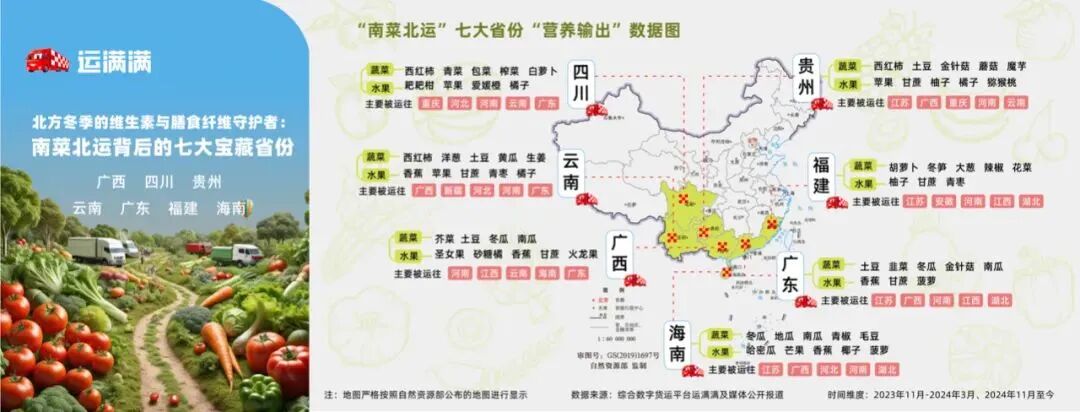
Recently, Yunmanman released a data visualization tracking the "nutritional output" of these seven provinces. The dataset covers two critical shipping windows — November 2023 to March 2024, and November 2024 to present — mapping vegetable and fruit flows across the country and making the scale of this migration tangible.
Guangxi
Guangxi's location in the southern subtropical and northern tropical zones gives it warm, thermally rich conditions. Annual temperatures range from 16.8°C to 23.3°C, with abundant rainfall and distinct wet-dry seasons — making it one of China's wettest regions. This climate enables year-round vegetable cultivation, and the autumn-winter months provide ideal growing conditions for cool-weather crops that struggle in heat.
Public data shows Guangxi's vegetable industry has grown into a 100-billion-yuan specialty agriculture sector, with annual output exceeding 44 million tons and over 10 million tons shipped out of province. It ranks as China's largest autumn-winter vegetable production base and a critical "south-to-north vegetable transport" hub. Currently, Guangxi ships more than 30 vegetable varieties through this program.
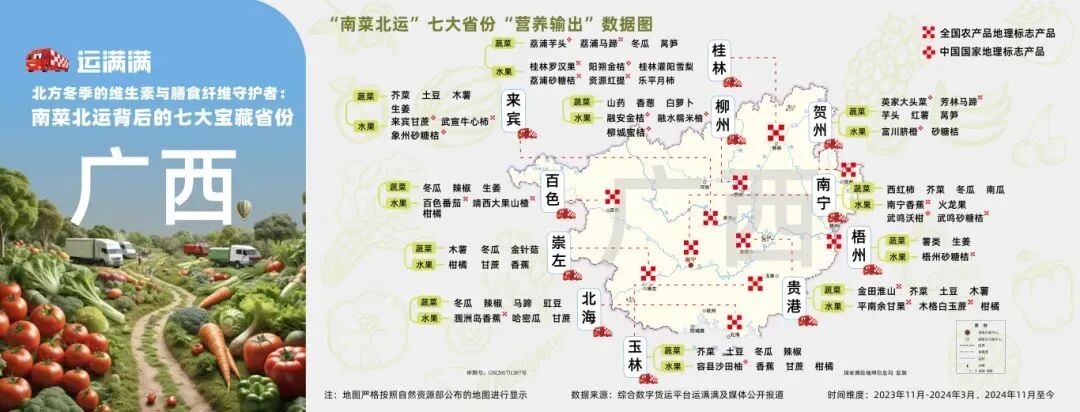
Yunmanman data shows Guangxi's highest-volume vegetable shipments include mustard greens, cherry tomatoes, potatoes, winter melons, and pumpkins. The province is also celebrated as China's "fruit bowl" for its diverse, high-yield, premium-quality produce. Citrus dominates winter fruit output, with Guangxi leading the nation in both planted area and total production. During recent peak seasons, the most shipped fruits from Guangxi were cherry tomatoes, sugar oranges, bananas, sugarcane, dragon fruit, and jackfruit. These fruits and vegetables primarily head to Henan, Jiangxi, Yunnan, Hainan, and Guangdong.
Sichuan
Sichuan sits in southwestern China within a humid subtropical monsoon zone, with four distinct seasons — mild winters and moderate summers. Its complex topography creates diverse microclimates that accommodate a wide range of fruit and vegetable cultivation.
As one of China's most botanically diverse provinces, Sichuan covers all 13 major vegetable categories, 105 species or variants, and thousands of cultivars. It serves as both a key "winter-spring vegetable" production base and a major contributor to south-to-north shipments. Per the Sichuan Vegetable Industry Development Report, the province regularly exports over 6 million tons to balance national supply, feeding its 80-million-plus population while still shipping substantial volumes elsewhere.
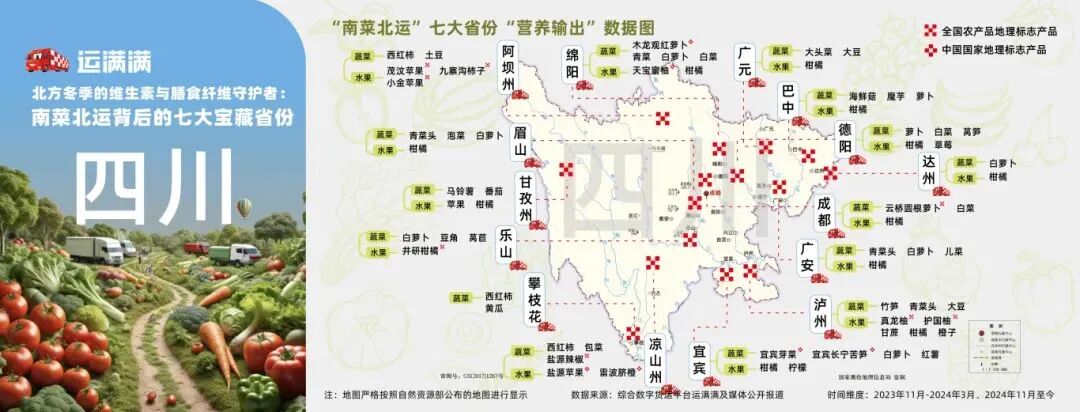
Yunmanman data shows Sichuan's highest-volume vegetable exports during recent peak seasons were tomatoes, leafy greens, cabbage, pickled mustard tubers, and white radishes. Winter fruit diversity is equally notable, with citrus and apple varieties particularly prominent. Sichuan is known as China's top province for late-ripening citrus. Peak-season fruit shipments were led by papa mandarins, apples, Ehime oranges, and tangerines. Most of these products travel to Chongqing, Hebei, Henan, Yunnan, and Guangdong during winter and spring. By destination city, the top recipients are Jiangmen, Chongqing, Linyi, Lanzhou, and Guiyang. Within Sichuan, the heaviest shipping origins are Deyang, Yibin, Meishan, Luzhou, and Mianyang.
Guizhou
Guizhou lies on the eastern Yunnan-Guizhou Plateau in a humid subtropical monsoon zone with distinctive vertical climate patterns. Relatively mild winters with wide diurnal temperature ranges create favorable natural conditions for off-season produce.
The province also boasts a 61.5% forest coverage rate, with air and water quality ranking among China's best. This ecological environment helps minimize pest pressure and ensures clean, healthy vegetable output.
Once known for small-scale "basket peddling," Guizhou has transformed into a province capable of producing millions of tons of vegetables annually.
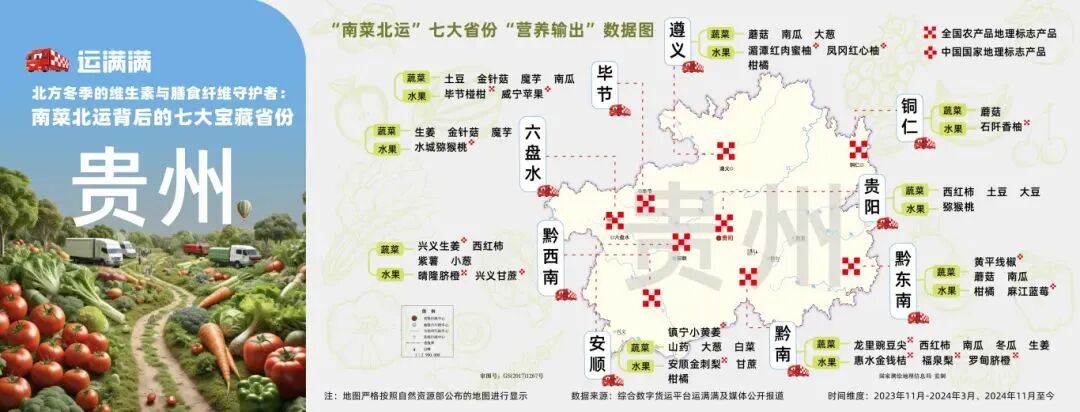
Yunmanman data shows Guizhou's top vegetable exports during recent peak seasons were tomatoes, potatoes, mushrooms, and konjac. Winter fruit diversity is considerable — apples, sugarcane, pomelos, tangerines, and kiwifruit led shipments. These products reach Jiangsu, Guangxi, Chongqing, Henan, Yunnan, and other provinces.
Yunnan
Yunnan borders China's far southwest with unique geography and climatic diversity. Warm, humid conditions with ample sunshine and thermal resources allow year-round cultivation of varied fruits and vegetables.
Winter vegetable varieties span from common solanaceous crops to distinctive local specialties. Records indicate Yunnan produces ecologically premium vegetables throughout the year across more than 200 cultivated species.
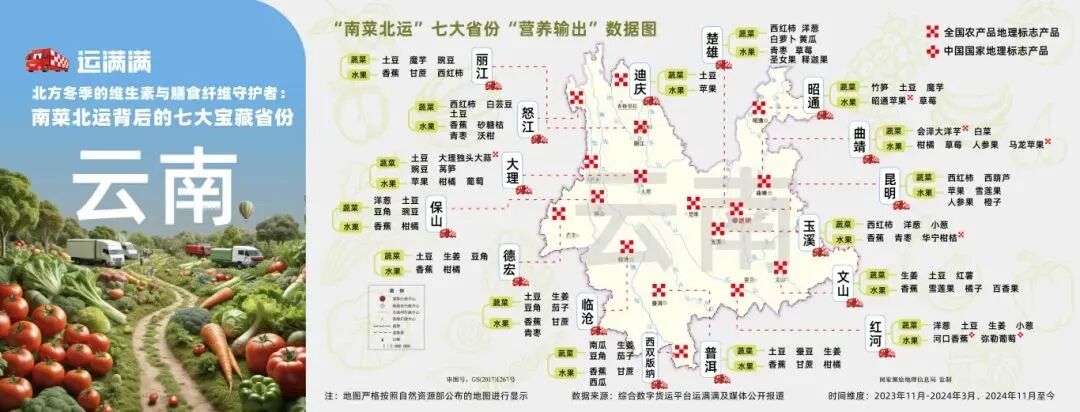
Yunmanman data shows Yunnan's highest-volume northern-bound vegetables during peak season were tomatoes, onions, potatoes, cucumbers, and ginger. The province also holds China's richest fruit germplasm resources, covering 287 species across 118 genera and 49 families. Platform data indicates bananas, apples, sugarcane, jujubes, and tangerines dominated Yunnan's fruit shipments. Destination analysis shows most products heading to Guangxi, Xinjiang, Hebei, Henan, and Guangdong. Within Yunnan, the top shipping origins are Chuxiong, Qujing, Xishuangbanna, Honghe, and Dali.
Hainan
Hainan's tropical maritime climate brings year-round warmth, humidity, and abundant sunshine. These natural advantages make it one of China's key winter "vegetable basket" production bases. Winter melon and vegetable crops also serve as pillar industries for farmer income growth and tropical specialty agriculture.
In recent years, the provincial government has optimized winter crop structure through policies emphasizing "stable melons, increased beans, reduced peppers, and expanded aquatic vegetables" — aiming for rational structure, scientific layout, distinctive features, and smooth sales.
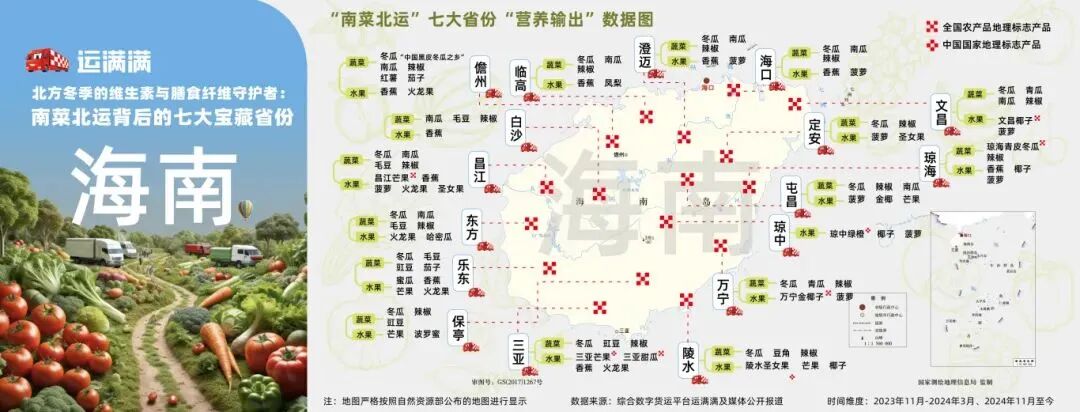
Yunmanman data shows Hainan's highest-volume fruit exports during recent peak seasons were hami melons, mangoes, bananas, coconuts, and pineapples; top vegetables were winter melons, sweet potatoes, pumpkins, green peppers, and edamame. Most shipments go to Jiangsu, Guangxi, Hebei, Henan, and Hubei. The province's top five shipping origins are Wenchang, Sanya, Haikou, Ledong, and Wanning.
Guangdong
Beyond its economic prominence, Guangdong is a major fruit and vegetable producer. The western coastal region remains frost-free year-round with mild winters and wide diurnal temperature ranges — effectively a natural greenhouse ideal for crop development. Winter vegetable cultivation provides crucial income for rural households, often accounting for nearly half of annual earnings. These conditions suit cold-tolerant and cool-weather vegetables, while winter fruit diversity is substantial and the mushroom industry continues expanding across multiple regions.
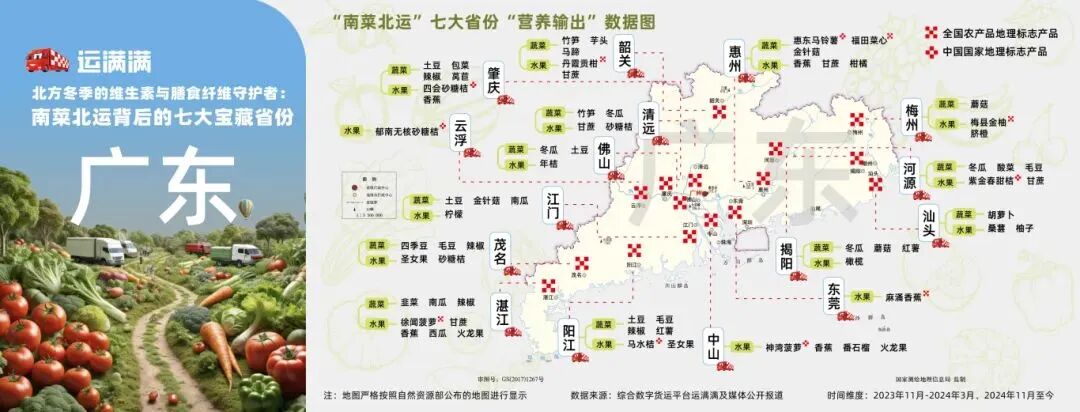
Yunmanman data shows Guangdong's top fruit exports during peak season were bananas, sugarcane, and pineapples; vegetables were potatoes, Chinese chives, winter melons, enoki mushrooms, and pumpkins. Notably, imported cherries surpassed all locally grown fruits to become the province's highest-volume fruit shipment in recent years. The top five shipping cities are Huizhou, Zhanjiang, Zhaoqing, Dongguan, and Foshan. Primary destination provinces are Jiangsu, Guangxi, Henan, Jiangxi, and Hubei, with Nanning, Chongqing, Changsha, Wuhan, and Haikou leading among cities.
Fujian
Fujian sits on China's southeastern coast in a subtropical monsoon zone with relatively warm, humid winters. These conditions support diverse fruit and vegetable cultivation, particularly excelling in cold-tolerant leafy greens, root vegetables, and brassicas.
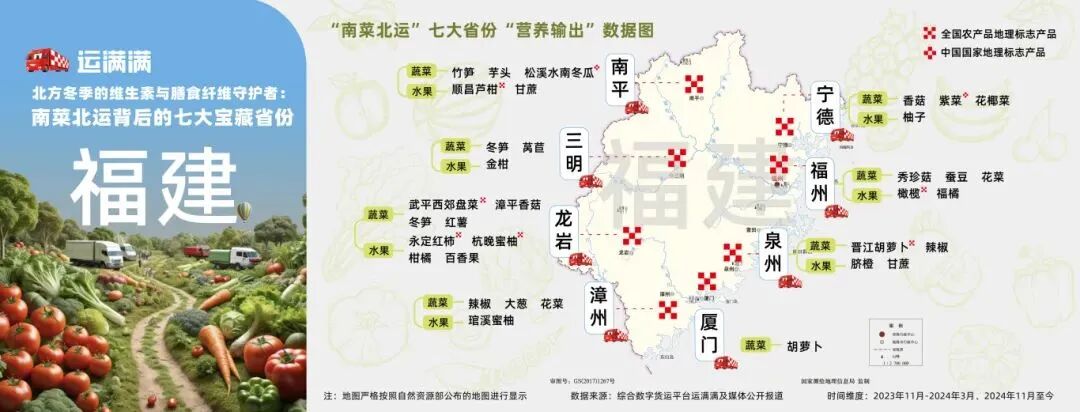
Yunmanman data shows Fujian's top vegetable exports were carrots, winter bamboo shoots, scallions, peppers, and cauliflower. The province is China's leading pomelo producer, accounting for over half of national output. Guanxi honey pomelos, Duwei wendan pomelos, Jianyang mandarin pomelos, and Pinghe red pomelos — in varying sizes and colors — relieve northern dryness and warm southern chill alike. Platform data indicates pomelos, sugarcane, and jujubes were Fujian's top fruit shipments. These products primarily reach Jiangsu, Anhui, Henan, Jiangxi, and Hubei. Notably, Yunmanman data shows citrus and pomelo shipments originating from nearly every region of Fujian.
Source: Full Truck Alliance — "The Seven Treasure Provinces Behind South-to-North Vegetable Transport: Guardians of Vitamins and Dietary Fiber for Northern Winters"

Founded in 2022, Heart Capital is an early-stage Chinese venture capital fund focused on technology and digitalization. The team is led by Yan Han, founding partner of Lightspeed China, alongside core investors, a CFO, and seasoned industry veterans. Past investments include Series A stakes in Xpeng Motors (NYSE: XPEV, 09868.HK) and Full Truck Alliance (NYSE: YMM), as well as FinVolution (NYSE: FINV), RoboSense (02498.HK), Baichuan, Yunmanman Cold Chain, Fan Deng Reading, World Logistics, Micro-Nano Star, LandSpace, Lanhu, and Starfield. Rooted in China with a global outlook, Heart Capital seeks genuine value in non-consensus spaces. The firm honors human potential and champions the power of conviction, aspiring to support young Chinese entrepreneurs in strengthening China and expanding worldwide.