Heart Capital's Bingjian Wu: "YES or NO" — The Two Sides of the AI Coin | VOICE

We're in the very earliest days of the AI industry right now.

Since John McCarthy first proposed the concept of artificial intelligence at the Dartmouth Conference in 1956, it has been a source of endless debate. As AI technology now gradually permeates every industry, public skepticism about its downsides has only grown. Ethics, law, regulation — these complex and multifaceted issues constantly shape how people think critically about AI.
Recently, Bingjian Wu, a partner at Heart Capital, participated in a "Debate About the Future" hosted by Jazzyear. The discussion required simple "YES/NO" answers to subjective questions covering open-source models, embodied intelligence, ethics and regulation, technological development, and more.
In the current AI wave, the Heart Capital team continues to focus on AI-led digital industries. Beyond investing in large model companies like Baichuan, it has also deployed capital in AI applications and AI infrastructure. In this discussion, Bingjian Wu offered an investor's perspective on these questions.
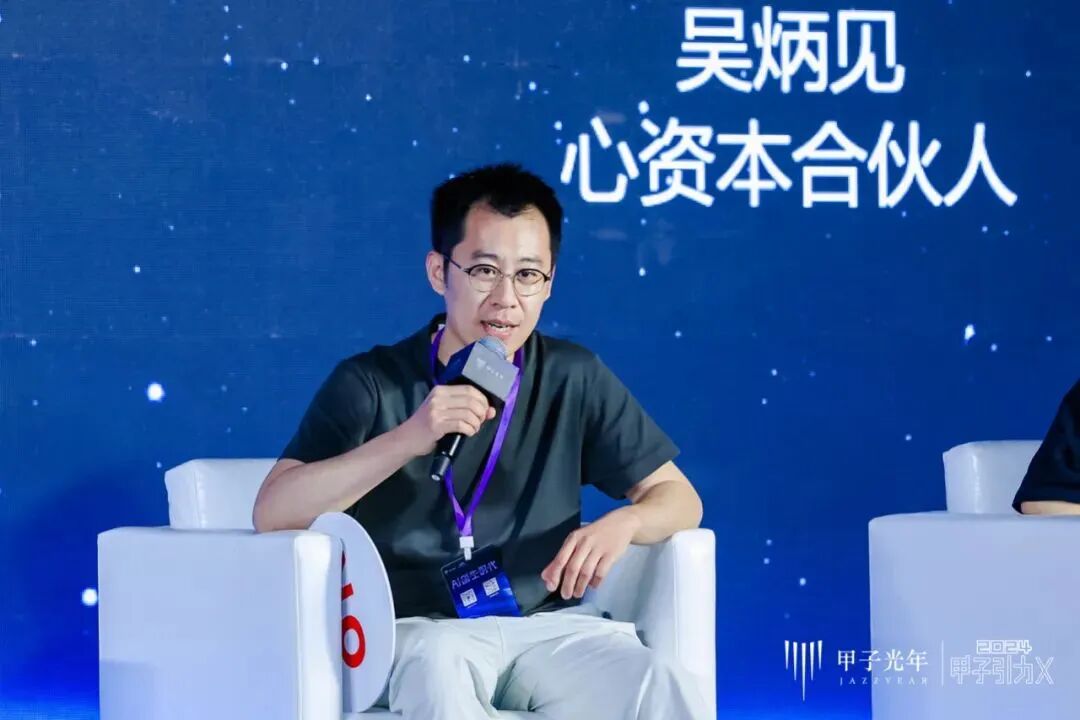
We see AI as a marathon of more than ten years. As model capabilities improve, different applications will be unlocked. Right now, we're at the very earliest stage of the industry.
1. Will open-source models fall increasingly behind?
Bingjian Wu: NO
As an investor, I've noticed some entrepreneurs initially tried building products entirely on prompt engineering using OpenAI's API and other closed-source models, with underwhelming results. Mainly because the models were too heavily aligned — sometimes they sounded like robots. So they switched to open-source models, fine-tuning them on user interaction data, and saw much better outcomes. We believe open-source models may reach perhaps 80% of closed-source performance, but will capture a larger market share. Also, we need to look at who is making open-source models. Every model vendor holds multiple versions — new ones stay closed, older ones go open. That will be the norm. Some other model makers, realizing they can't make the first tier, simply go open-source from the start, like Llama. This makes open source a continuously replenishing force.
2. Is embodied intelligence the ultimate form of AI?
Bingjian Wu: NO
In my view, AI's ultimate form should reflect humanity's diverse capabilities — language, thought, action. Today's large language models are simulating our language and cognitive functions. If embodied intelligence can accurately predict the next sequence of actions, then it works, enabling interaction with the physical world. In the future, there may be protein large models that predict protein sequences to accelerate drug discovery. There may also be slow-thinking models that help us make decisions. So embodied intelligence is just one possible form among many.
3. Is the humanoid form the optimal choice for embodied intelligence?
Bingjian Wu: NO
When discussing embodied intelligence, our goal is to develop general-purpose robots that can complete 99% of tasks, not specifically humanoid robots. Since human society has designed all tools around the human body, starting from a humanoid form may be the best path to developing general-purpose robots. But once robots can perform most tasks, whether they maintain human form becomes less important. For example, the smartphone is already part of our body, yet humans didn't evolve a phone mount — so should future robots have one?
4. Will the "AI Genesis Era" arrive within three years?
Bingjian Wu: NO
A key signal to watch: when first-tier model vendors like OpenAI release their first true Agent — one with the ability to understand tasks, plan, and take action — that will indicate model reasoning capabilities have crossed a critical threshold. That would be a major step toward the "AI Genesis Era." AI's development resembles the semiconductor industry: as model capabilities improve, different applications are gradually unlocked. It's a marathon, not a sprint.
The growth trajectory of large models differs significantly from the internet; it's better understood by looking at the chip industry. In the 1950s, after Fairchild invented the semiconductor, the improving capabilities of chips successively enabled calculators, PCs, gaming consoles, mobile phones, MP3 players, smartphones — mass-market electronic products that emerged across decades, driven by Moore's Law. These products spanned decades, unlocking sequentially. When semiconductors first appeared, their capabilities could only support calculators; only as computing power improved could PCs be built.
If last year was Year One of large models, this is Year Two. Applications built on large models will also emerge in a specific order. When it's time for calculators and Walkmans, don't force-build a PC. When it's time for Talking Tom, don't force-build Douyin — you can't. History cannot be skipped, only lived through.
5. Do AI-generated images and videos enjoy copyright protection?
Bingjian Wu: YES
A person picks up a brush and paints a picture — they hold copyright. Later came the camera; they take a photo, whether a work of artistic value or a casual snapshot — they still hold copyright. Now the creative tool has evolved to AI; this person uses AI to generate images and video — copyright obviously applies. Times change, and the tools in hand change with them.
On the other side, intelligence is presented in the form of tokens. Behind each token lie contributions from training data and the base model; the model itself participated in creation. Whether proceeds from a work should be shared with model and data owners — that's another interesting question.
6. Can you accept the idea of "digital immortality"?
Bingjian Wu: YES
I accept it. Just add a password, set access levels — shoot the breeze with close friends, keep it restrained with acquaintances.

Founded in 2022, Heart Capital is an early-stage venture capital fund focused on technology and digitalization in China. The team is led by Yan Han, founding partner of Lightspeed China, alongside core investors, a CFO, and seasoned investors from industry backgrounds. The team's past investments include Series A stakes in Xpeng Motors (NYSE: XPEV, 09868.HK) and Full Truck Alliance (NYSE: YMM), as well as FinVolution (NYSE: FINV), RoboSense (02948.HK), Baichuan, Manman Cold Chain, Fan Deng Reading, World Logistics, Micro-Nano Star, LandSpace, Lanhu, Starfield, and others.
Rooted in China with a global outlook, Heart Capital seeks true value in non-consensus. It respects the value of "people" and champions the potential of the "heart," looking forward to accompanying more young Chinese entrepreneurs in strengthening China and going global.