Code Brain | From Zero to One Billion: The Sales System Development Path

A great product is table stakes; selling well is what really matters.

Every year, the enterprise services sector sees a flood of startups, each running tirelessly toward their own definition of success. A startup has two jobs: build a great product, and sell it well. A great product is the prerequisite, but selling well is what really matters. That's why building a sales organization is mission-critical for B2B companies — it directly impacts profitability and growth velocity.
So how exactly do you build a sales organization, and what landmines lurk along the way? We invited Zhao Lei, VP of Sales at a soonicorn and former General Manager of Oracle's North China region, to break down the distinct developmental stages of a sales organization as enterprise revenue grows from zero to one billion RMB, the problems to solve at each stage, and the challenges you'll encounter.

Here's the full article:

From zero to one billion RMB in revenue, based on scale and organizational development requirements, we can roughly divide the journey into four stages:
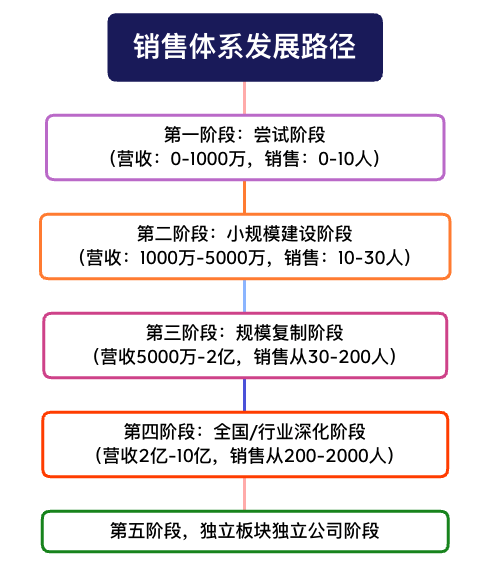
Stage One: Experimentation
(Revenue: 0–10 million RMB; Sales headcount: 0–10)
In stage one, the product has barely reached a deliverable state, and you're tentatively testing the waters with sales. The most important thing is selecting customers with relatively high odds of success for these early attempts. During the selling process, revenue isn't the priority — the priority is discovering: where the friction points in closing deals lie; what customers actually care about; what scenarios and talking points customers respond to most readily; and from this, distilling our ideal customer profile at this stage.
There's often no sales leader yet at this point. Typically, the founder should be the first salesperson. But here's the trap: while the founder is the top seller, you can't evaluate salespeople and sales work through the founder's lens. So you still need to hire 3–5 sales reps for early experimentation. Use strong performance-based incentives to encourage more attempts, and meticulously record and analyze sales behaviors and processes to answer the questions above. At this stage, build a spending and revenue model, and try to find what we call the "sweet spot" — this is critical for subsequent budgeting and planning.
Also experiment with pricing models and price architecture. This pricing structure must leave room for future channel and distribution costs that you can already anticipate. Try to determine what pricing model and price points customers will accept while maximizing company interests. Another important task is exploring what role channels can play in our deal logic — what they can do for us. You won't have answers to all these questions immediately; they require continuous experimentation and reflection, with detailed process documentation and analysis.
Common mistakes at this stage:
- The founder is the top seller, evaluating sales work through the founder's perspective and results, and drawing corresponding conclusions.
- Customer outreach is completely undirected, with attempts made without any plan.
- The closing process isn't recorded or analyzed in detail, making it impossible to properly summarize real friction points and best practices.
- Front-end spending and revenue data isn't properly analyzed, and this data isn't used to guide subsequent work.
At this stage, there are few people and not many rules — it's almost entirely personal management. But direction and purpose must be strong. Motivation, communication, and retrospectives are the most important work. If possible, do these daily and weekly, using retrospectives to pool collective wisdom, spark insights, and summarize good practices.
Stage Two: Small-Scale Construction
(Revenue: 10–50 million RMB; Sales headcount: 10–30)
Stage two brings the company's first wave of scalable replication. Building on stage one, we now have a fuzzy customer profile and a rough best practice from initial outreach to closed deal. Stage two is about optimizing and replicating along this path. First, you need to find an experienced sales leader. This leader must help the company formulate business and organizational development plans for at least the next three years, and have strong execution ability to turn plans into reality. From this stage onward, the sales organization must carry company strategy, derive sales strategy from it, clarify growth points, target industries/customers, and competitive strategy, and implement this strategy down to each team.
Sales teams begin to stratify, adding new functions like business development, SDRs, and inside sales. At this stage, the company should begin establishing industry focus — sales can't run around aimlessly anymore. The number of accounts each rep follows should be capped (generally no more than 50 initially, with the number decreasing over time) to force greater focus. As sales headcount grows from a handful to several dozen, pure personal management becomes impossible. You need to establish systems and approval processes, plus cross-team collaboration mechanisms. Systems aren't built in a day, but compliance with systems must become habit immediately. During this period, continuously gather feedback and iteratively improve the systems.
Sales system rule implementation depends heavily on CRM, so at this stage you need to establish a CRM system for customer-facing staff. Developing a CRM in-house isn't easy at this point, so you'll basically be buying off-the-shelf products. Selection criteria largely depend on whether the CRM fits your business characteristics and whether it's flexible enough to support growth for the foreseeable future. The CRM should enable customer grading, tiering, and ownership assignment; set end-to-end business stages and milestones for each stage; close the loop on marketing-generated leads and self-sourced leads; and record every customer touchpoint.
Beyond data entry, you need to deeply mine and organize bottleneck data and statistical analysis data from the CRM to guide process management and risk control, gradually building a digital process control system for sales.
At this stage, pressure around sales hiring and development immediately surfaces. We need to summarize the characteristics and profile of successful salespeople based on our business traits, and identify target companies and the fastest sources for new sales hires. We often demand that salespeople be all-arounders: connected, experienced, capable, eager to learn, hardworking, optimistic — a long list of requirements that narrows the candidate pool and drives up per-salesperson cost. Truly all-around salespeople are exceedingly rare. So to hire suitable people quickly, you must analyze and summarize the key sales characteristics based on business specifics. Keep these characteristics to five or fewer, ideally three, and they must be clearly defined, not vague. Anyone who fits these characteristics can be recruited for a trial — this significantly lowers the hiring bar.
Also, once salespeople join, they absolutely cannot be left to figure things out on their own. You must build a sales training system tightly aligned with real-world selling, with clear stage goals and path guidance from day one through week one, month one, and month three. This ensures previously summarized best practices take root in new hires, and lets you identify misfits earlier rather than waiting until the end of a probation period. The sales development system should continuously update itself, constantly summarizing best practices and empowering salespeople, ensuring ramp-up time keeps shrinking and sales efficiency keeps improving. A company's best salespeople are generally homegrown, so building precise hiring and sales development systems is essential.
As sales headcount grows and teams form, this is also when you begin building company sales team organization and culture. This stage should encourage salespeople to charge boldly into battle, stimulating their initiative. The principle should be more motivation than control, more empowerment than restriction. Work from goal-setting, incentive structures, revive mechanisms, weekly/monthly/quarterly/annual meeting cadences, and process incentives to build a culture of salespeople who dare to fight and compete.
Many B2B companies start with relatively low deal sizes, and salespeople's self-sourcing ability is limited — they're mostly following up on marketing-generated leads. At this stage, the entire closed-loop handling process for these leads is critically important; flow efficiency directly impacts revenue. So from inside sales to SDR to salesperson to delivery, you need detailed closed-loop tracking, constantly monitoring blockages and bottlenecks in between, addressing them promptly, calculating per-lead cost and time cycle, watching for data changes, and guiding subsequent marketing spend.
Also, for large volumes of leads, you need clear tiered handling based on characteristics — partly for efficiency (large and small deals require different sales approaches and resources), and partly to prepare for industry specialization. Only by finding common industry scenarios and pain points can we guide salespeople to replicate industry case studies. At this stage, sales self-sourcing ability is still insufficient, so marketing needs to both generate leads and use community/networking approaches to help salespeople reach more customers and dig deeper into industries.
Common mistakes at this stage:
- No clear strategy-to-tactics decomposition; still making decisions by gut feel, with sales fighting disorderly battles.
- No system for managing people; still managing people through people, making decisions by feel.
- No good mechanisms or methods for summarizing and accumulating best practices; sales still operating independently, unable to replicate case studies.
- No long-term planning for the sales organization; treating symptoms rather than root causes.
- No full-process closed-loop management and conversion improvement mechanism from lead to closed deal.
Stage Three: Scalable Replication
(Revenue: 50 million–200 million RMB; Sales headcount: 30–200)
Stage three brings the company's second wave of scalable replication. This stage severely tests sales organization maturity. The company must invest heavily in sales organization building, and needs to see rapid results in customer acquisition and revenue. Headcount is growing rapidly, management span instantly widens, so filling gaps and systematic problem-solving become imperative.
In the previous stage we began strategy-to-tactics decomposition down to the team level; in this stage, strategy-to-tactics decomposition must go finer. From strategy to tactics, we need clear customer categorization and tiering; clear competitive strategies for different industries and regions; defined sales win paths and customized sales battle maps; growth strategies decomposed not just to the team level but to every individual; with each person's win path and key actions defined. Only then can we achieve complete alignment from company strategy to tactics to action, and complete consistency of goals and actions across company, team, and individual levels — ultimately ensuring our targets are achieved on schedule.
As headcount surges and company revenue scales up, process management becomes mandatory internal capability and the most important test of sales organization maturity. Process management isn't just deal progress management — it's about maximizing efficiency, optimizing resource allocation, and minimizing business risk. This includes sales forecasting, account management, pipeline management, daily activity management, early warning and response, decision management, and front-back office resource coordination. These components aren't isolated; they can't be considered and ruled on separately, but must be strung together in one system that makes them reinforce each other. How to verify this? Important indicators: forecast-to-actual variance within plus or minus 10%, efficiency-related metrics steadily improving, and clear optimization of front-back office resource allocation.
In practice, I've seen good results from establishing a sales forecast (FCST) management system — starting with the end in mind, continuously measuring process actions against targets, using precise forecasts to coordinate and allocate resources, aligning everyone's process goals, and ultimately holding people accountable for results. This system is used in most multinationals; with slight adaptation for domestic startup characteristics, it's already been implemented at many startups with good results.
At this stage, you need to continuously improve per-capita productivity. There's a law in B2B business: 20% of customers bring 80% of revenue. Without this model, rapid business growth is very difficult. To achieve this, industry specialization is essential — especially penetrating "rich" industries and replicating within them. So organizational design should facilitate industry-region collaboration; establish single-industry national coordination mechanisms so that within an industry, the entire country uses unified tactics and unified pace, enabling the most efficient penetration and coverage.
On hiring and development: with previous accumulation and continuous system improvement, the sales hiring bar should be lowered further — ideally hire younger salespeople and develop them in-house. This requires a training system that doesn't just improve understanding, but also holds each salesperson accountable for strategy implementation and specific actions post-training. Training content should be extremely close to real-world selling — the optimal path for customer acquisition and winning deals, with clear, executable sales action maps, and defined daily, weekly, and monthly action plans. These actions and implementations need CRM integration, ultimately making training effects evaluable and measurable. This significantly shortens new salesperson ramp-up time and improves success rates, and also has visible effects on improving existing salespeople's efficiency.
Channel system building is also a priority at this stage. B2B business fundamentally can't rely entirely on our own sales force for coverage — the cost is too high, and it's nearly impossible. So using channels to solve coverage is a good way out. Channel partners work with vendors to make money; without money, there are no lasting channels. But how do you get channels to target the markets we want and move quickly? How do you get channels and direct sales to form synergies? How do you activate channels and exercise process control? These are the hard parts of channel building. This requires targeted design based on business characteristics, working from pricing models, customer/industry tiering, channel enablement, and incentive and考核 structures, with continuous refinement. Good channel output should approach 50% of revenue, but this definitely isn't achieved overnight, and higher isn't always better — it depends on business specifics and requires case-by-case analysis.
Finally, a key point: as the sales organization expands and business forms multiply, sales operations becomes increasingly important. I recommend establishing a sales operations team at the beginning of this stage or the end of the previous one. This team's function isn't just ensuring all related systems land and operate smoothly; more importantly, it's about achieving early warning monitoring, auditing, and business insights, and serving as the connective tissue between sales and finance, legal, HR, and other functions.
Common mistakes at this stage:
- No clear actions and methods for strategy-to-tactics decomposition; unable to decompose strategy to teams and individuals. This often manifests as: numerical breakdown without paths to achieve those numbers; telling sales they're going the wrong way without giving them a map.
- Forever gaps between forecasts and reality, making optimal decisions and resource allocation impossible.
- Direct sales and channels fighting each other; channels fighting each other; unable to form synergies.
- No unified planning for the sales organization; policy whipsawing; unstable morale.
- Blind expansion: adding headcount without adding efficiency.
Stage Four: Industry/National Deepening
(Revenue: 200 million–1 billion RMB; Sales headcount: 200–2,000)
Getting through stage three is a major milestone in sales organization building. It's hard to attract good talent, and almost every system needs to be built from scratch — yet you still need to achieve rapid revenue growth. Crossing this hurdle means even harder problems lie ahead, but you've already built a very competitive foundation for the company. Stage four is about solving moat-building and national deepening.
At this stage, to deepen industry/national penetration, you'll move toward BU-ization and clustering by industry/segment. Each BU is separately assessed and accounted for. You'll also increase investment in and lead industry/product standard-setting — attacking the market from a position of strength, using resource advantages to influence industry development direction, and using standard-setting as a moat for deeper industry penetration. You'll also increase brand building, using brand to pull channel building and market coverage, establishing a national market coverage system that makes channel functions more prominent.
This stage especially needs to strengthen sales organizational capability building and culture building — culture must sink deep into people's hearts, using culture to regulate behavior and organizational capability to manage teams. Sales should be entirely homegrown; middle managers should be promoted from within, giving the system the ability and space to select and promote more talented people, continuously feeding the rapidly expanding sales organization. Establish talent mobility mechanisms across regions and between group and regional levels; incentives should tilt more toward long-term rewards.
As the organization grows and hierarchy proliferates, you'll inevitably need to build supporting audit and risk control systems. Forming good ethos and values is important insurance for keeping the entire team developing positively.
Fundamentally, sales organization building is pathway building. Once a good pathway is established, you need to run more products through it. So at this stage, the company badly needs a second growth curve. Launching new products/services becomes inevitable. This severely tests the sales organization's front-end market feedback and secondary product selling capability. On one hand, you need mechanisms to continuously summarize and mine new needs and growth points while solving customer pain points; on the other hand, use the previous training system and process management system to rapidly build secondary product selling capability.
Common mistakes at this stage:
- Incomplete systems, insufficient management precision, major lapses occurring.
- Insufficient organizational capability, unable to support rapid business development.
- Insufficient team culture building, unable to support rapid business development.
- Incomplete audit systems, lapses occurring.
- Tendency to neglect frontline salespeople.
- Weak anti-corruption efforts.
As business develops further (1 billion RMB and beyond), the sales organization will move from centralized to decentralized, and business will enter a stage of independent segments operating as independent companies. Each separated part will then embark on a new round of building.
The above is a rough description of sales organization development and evolution. Depending on business characteristics, external environment, and industry attributes, each company's building pace will differ. The purpose of summarizing is to see clearly and respond better. Sales organization building is a science, with its own laws, methodologies, and best practices. Chinese people have innovated little in sales organization building — it's mostly repackaging plus folk experience. I hope we can all keep learning, summarizing, finding good methods to practice in wave after wave of rapid growth, and continuously innovate!
Clear hope beats vague hope!
Let's encourage each other.