Liang Rubo: How Does a 100,000-Person Organization Stay Agile? | 2021 Ma Hui Entrepreneurs' Annual Meeting

The management system avoids a one-size-fits-all approach, staying flexible and adaptable rather than rigid.


Liang Rubo, Co-founder and CEO of ByteDance
"Managers have strong incentives to push for more and more explicit rules. This force is like gravity, constantly pulling the company toward greater rule-making. In this process, we must resist organizational gravity — it keeps us in a state of continuous stretch."
Recently, Liang Rubo, co-founder and CEO of ByteDance, was invited to deliver a keynote speech titled Stay Stretched, Avoid Rigidity at Source Code Capital's "2021 Ma Hui Annual Entrepreneurs Conference," sharing ByteDance's explorations and practices in maintaining organizational vitality and improving management efficiency.
ByteDance now has 100,000 employees spread across more than 200 cities worldwide. How to implement scalable and effective management within a large-scale, multi-business, rapidly growing global organization is undoubtedly a challenge.
Liang said ByteDance's approach includes: first, establishing basic management systems to ensure efficiency; second, emphasizing cultural development and alignment of values, increasing consensus rather than refining rules; third, using tool systems to ensure management actions are implemented, and leveraging data to support better decision-making; fourth, ultimately holding managers accountable for their management decisions to ensure effectiveness.
The full speech follows:
Hello everyone, I'm Liang Rubo.
Yiming previously shared at the Ma Hui annual conference the management philosophy of "Context, not Control," and also discussed how as organizational complexity increases, we should avoid excessive chaos by improving talent density and providing ample context rather than adding rules and processes. These ideas come from Netflix's Freedom and Responsibility. Today, I'd like to share some of ByteDance's specific practices and insights.
More Rules Can Lead to Organizational Rigidity
ByteDance is now a fairly complex organization. We have 100,000 employees across more than 200 cities globally. These colleagues work on different businesses — content platforms like Toutiao, Douyin, and TikTok; vertical businesses like Dongchedi that span online and offline; enterprise-facing services like Lark and Volcano Engine; and education business Dali Education, among others. All these businesses are complex and require large-scale team support, and they demand very different things from their teams. Beyond this, our organization is still growing at nearly double the rate every year. ByteDance has become a large-scale, multi-business, rapidly growing global organization.
Yiming previously shared at Ma Hui that if an organization doesn't choose to stay small and focused, it must confront the chaos that rising organizational complexity can bring. A typical response is to increase rules and processes to keep the organization orderly, but this leads to rigidity. From the perspective of the department making rules, to minimize problems, they will naturally make processes and rules as detailed as possible — but this weakens the possibility of exploring optimal solutions.
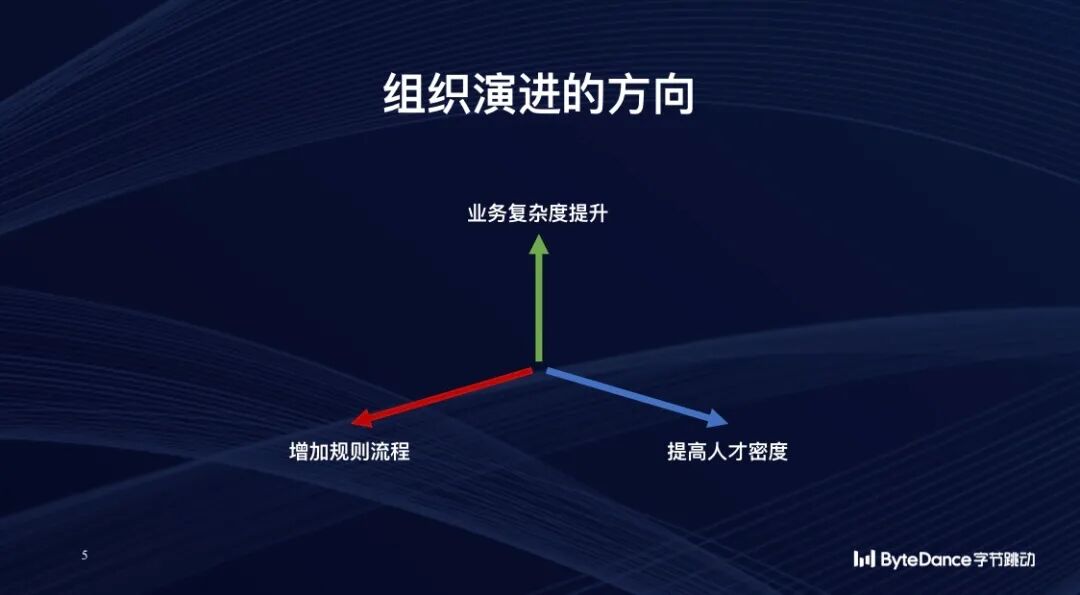
We're in an innovative industry, and the situations we face are elastic and flexible. With many constraints, employees become reluctant to seek optimal solutions. First, when facing rules, people naturally tend to comply with them rather than break them, and rules also dull sensitivity to new opportunities. Second, various rules effectively raise the cost of innovation, increasing the barrier for trial and error and breaking conventions — over time, this damages enthusiasm for innovation. Especially when major industry changes occur, when the company can't rely on inertia to move forward, accumulated rules, processes, and systems become particularly large obstacles that create serious problems.
For us, on one hand, the organization is very large, so we need to focus on management efficiency and ensure management can scale without excessive chaos. On the other hand, we also need to focus on management effectiveness, ensuring the organization doesn't become rigid, maintains elasticity, and can always seek optimal solutions.
No One-Size-Fits-All Management Mechanisms
How do we do this?
First, we emphasize cultural development. We believe that through cultural development, we can build more consensus within the company. Using culture and values to guide people means that in many situations, we don't need to rely on very detailed rules — everyone can work in reasonable directions with similar standards.
I remember at one meeting, someone raised that our decision-making mechanism wasn't clear enough, and proposed we should establish some rules: for example, if a decision isn't reached or consensus can't be achieved within two days, it should be escalated to a higher level for decision. After discussion, we concluded that we shouldn't set such detailed rules. If we did, there would be many similar rules, and they would effectively become useless. We should instead emphasize in our culture taking ownership, being pragmatic and bold, and proactively pushing things forward. Emphasizing these more fundamental points is more effective than establishing detailed rules.
At ByteDance, we have basic management mechanisms — budget management, goal management, job levels and ladders, compensation standards, performance reviews, and so on — but none of these mechanisms are one-size-fits-all. They are all guiding and directional, and relevant people have the space and responsibility to make reasonable decisions based on actual circumstances.
Because there are no blanket rules, much of the company's management work is quite demanding, and many people aren't used to it. The decision-making process often requires extensive discussion and alignment, so efficiency isn't particularly high. Managers need to make many decisions themselves and can't shift management pressure onto rules. We believe that shifting management pressure onto rules may distort management signals.
For example, with forced performance distribution, when a manager communicates with an underperforming employee, they might say: "Actually you've done quite well, but there's nothing we can do — the company has distribution requirements, so you'll have to take the hit this time." Situations like this show that the manager isn't truly taking on management responsibility but shifting pressure onto rules. This completes a management action but doesn't achieve management effectiveness. Our approach is to have managers take responsibility for their management decisions, even though this often puts managers in a somewhat stretched, uncomfortable state.
These management mechanisms would be difficult to implement quickly without tool support, especially in a very large organization. Tools can ensure we generally align with the direction of management mechanisms, help us identify anomalies, and enable efficient alignment. They can also accumulate valuable data.
For example, through data transparency, we make managers more aware of their management responsibilities and more accountable. Because data is transparent, management behaviors are conveniently surfaced — whether teams are promoting people quickly, whether they're making timely cuts, whether evaluations have sufficient differentiation. By observing data, we can continuously improve and iterate management processes or tools to make them more efficient. We can also find trends in accumulated data to discover more information points that assist managerial judgment.
Some of ByteDance's Management Practices
How does this approach translate into practice? Let me elaborate on a few common management actions.
The first I want to discuss is job levels and ladders. We have ladders and levels — a ladder refers to a category of roles, for example engineering is one ladder, product is another, and so on, with each ladder having its own levels. But we don't have written level standards, nor do we have dedicated promotion committees. We only broadly align on reference conditions and processes for promotion, with company-wide cross-review above certain levels.
Compared to standards, we focus more on the person and their capabilities themselves. We set levels through sample comparisons and align standards through discussion. When we look at what level someone should be, we often discuss whether this person is similar to so-and-so, what the similarities are, and why they should be at the same level. At the same time, our teams allow "skip-level promotions" and "fast promotions" — in this process, we don't rigidly enforce ratios or obsess over standards; overall flexibility is quite high.
Additionally, in compensation management, first, for specific ladder-level combinations, we determine a compensation range based on market conditions, but this range is also reference-based and can be broken — it just requires approval with reasons listed. At the same time, we also track premium cases in management, observing the subsequent performance of employees who received premiums, using this approach to assess the reasonableness of premiums.
We have corresponding models for salary adjustments and year-end bonuses. For a specific employee and specific case, the system recommends a range for compensation and year-end bonus based on certain logic, but these ranges are all reference-based and can be broken. We review overall situations through reports, comparing horizontally and vertically with history, and also examine cases that broke the model.
We have two types of performance reviews: one for individual employees, and another for teams and organizations. There's no forced distribution, no bottom elimination, but we have calibration meetings where people align together and review whether performance situations are reasonable according to certain rules. We look at performance distribution and compare it with history and other organizations. We also focus on cases that need attention — for example, consistently high performers, consistently low performers, employees with large performance fluctuations, and the premium cases mentioned above. We also look at performance distribution among people at the same level in the same ladder. Through various views, we can visually see performance distribution, avoiding situations where one person's actual performance is better than another's but the performance result is reversed. Through calibration and alignment, we make performance reviews generally trend toward reasonableness.
For organizational performance, we've established some directional consensus, such as not determining performance based on absolute output. If a business has good numbers, does that mean the organization has good performance? Not necessarily. We look at whether performance exceeds inertia. Some businesses have good data because they're riding previous momentum, because a strong foundation was laid before. We particularly value whether momentum can be created — creating momentum on top of inertia. For organizational performance, this is basically the only consensus. As for how the whole process works, it's mainly through discussion and alignment along the way: "What's a reasonable situation for organizational performance," "Why do we say we created extra momentum," or "Why is this good data only due to inertia." We discuss these topics and then form conclusions.
How do we apply organizational performance results? We've determined whether an organization's performance is good or average — what impact does this have? In fact, we don't currently have particularly explicit rules for applying organizational performance results, only directional guidance. If an organization has good performance, it can have some emphasis in bonuses. As for how to emphasize — whether to heavily incentivize only key personnel in that organization, or to broadly increase incentives for better-performing people in the organization — this is all up to managers.
The system can see the final bonus situations of employees in organizations with different performance levels. If there are anomalies, we discuss why these anomalies exist during calibration and alignment. As long as there's reasonable explanation, it's acceptable. We've previously discussed that if you make the logic and rules very explicit, people's focus may shift to fighting for maximum benefits for their own teams. This would make it difficult later to have objective discussions about business momentum based on facts.
Resisting Organizational Gravity, Staying Stretched
Of course, our current management approach also encounters some challenges.
I was chatting with an engineering colleague the other day. He mentioned that his team had a very outstanding new graduate hire who performed very well and grew very quickly. But after working with us for two years, this person was poached by another company with nearly double the salary, which he found very regrettable. I asked him: You have such high regard for this person and such confidence in their value, how did you not keep up on incentives and just watch them get poached? He told me that the system's recommended range was limited, and he gave the maximum recommended amount every time, but still couldn't keep up — the increases weren't fast enough.
I was quite surprised at the time. This manager had been at the company for several years and should have been very familiar with it, yet still didn't sufficiently understand the company's philosophy of flexible breakthroughs, and couldn't keep up in practice. This also made me realize that in a large organization, achieving unity of knowledge and action in management is extremely difficult. Although we have philosophy and tools, in concrete implementation we still encounter all kinds of problems. In my understanding, this is a challenge between ideal and reality. How to make philosophy land better in reality is a major problem we face.
Another challenge is that because there are few rules, especially explicit rules, people have to do a lot of thinking when making decisions, making decisions based on specific circumstances. People need to be responsible for these decisions, often requiring discussion and meetings to align across larger scopes — this not only creates high decision-making pressure but also low efficiency. This also keeps many people in an uncomfortable state in management activities. Managers have strong incentives to push for more and more explicit rules. This force is like gravity, constantly pulling the company toward greater rule-making.
But on the other hand, the management problems we encounter in the real world are highly complex, and we can't control, characterize, or respond to this management complexity through a set of rules. We need to maintain elasticity so managers can make reasonable management decisions. Striking this balance is very difficult, especially during rapid organizational growth — we need to ensure management effectiveness while preventing the company from being paralyzed by management inefficiency. I think this is also a challenge we've been continuously facing.
Finally, I'd like to summarize. The problem we face is: in a large-scale, multi-business, rapidly growing global organization, how do we achieve scalable and effective management.
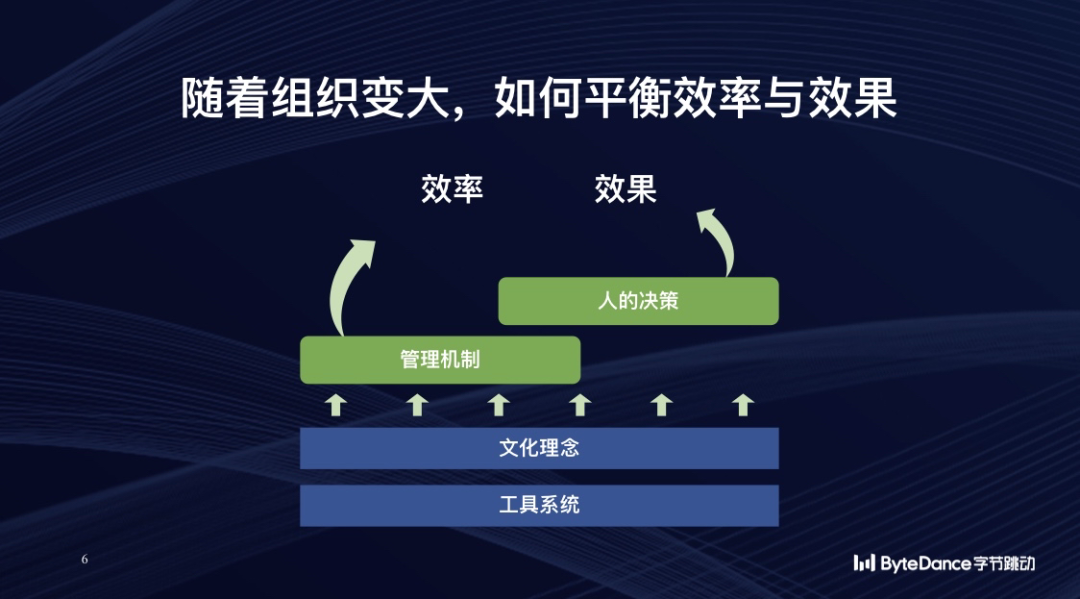
Our current approach is: increasing consensus through culture and reducing rules; achieving management efficiency through basic management mechanisms; ensuring management effectiveness by having managers take on management responsibility; achieving management feedback and iteration through data accumulation and transparency; and supporting all of this through tool systems. In this process, we must resist organizational gravity and stay in a stretched state. We still have many challenges, and we are still exploring solutions.
That's my sharing for today, thank you all!