"2016 Source Code Capital Summit" — Yiming Zhang: Why I Don't Agree With Controlling Headcount Costs

From April 21 to 23, 2016, the Source Code Capital "Ma Hui" community gathered at Gubei Water Town — a "Jiangnan-style waterside town" at the foot of the Great Wall. At the event, ByteDance CEO Yiming Zhang shared his insights on the talent challenges facing growing companies, covering recruitment and human capital management in comprehensive detail.
Not everyone is cut out to be an entrepreneur. Starting a business seems inseparable from high risk and long odds. To break through the pack, founders need conviction, perseverance — and also guidance from those who came before, plus a solid support system. Source Code Capital wants to be that: fast, helpful, and precisely responsive to what entrepreneurs need.
On April 21, 2016, the "Ma Hui" community — Source Code Capital's extended family — gathered at Gubei Water Town, a "Jiangnan-style" village at the foot of the Great Wall, for a three-day, two-night annual meeting. This year's event drew all of Source Code's LPs and portfolio companies, with a packed lineup of activities that kept the energy high throughout.
A Glimpse of Ma Hui

Ma Hui's signature event: Texas Hold'em. Watch the pros keep their Poker Face.

This year's Ma Hui brought together a formidable crowd: Source Code Capital LPs, portfolio companies, and industry heavyweights. Yiming Zhang, CEO of Toutiao; Xing Wang, CEO of Xinmeida; Zhitao He, CEO of Lianluo Hudong; Min Luo, CEO of Qufenqi, a pioneer in internet finance; Lixin An, CEO of GESAFE; and Xiang Li, serial entrepreneur and founder of CHJ Automotive, all delivered keynote speeches.
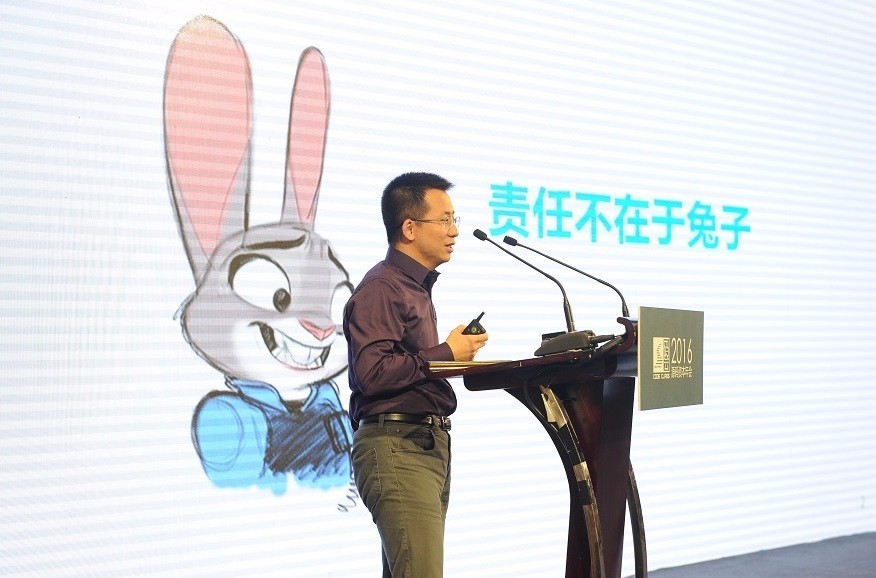
On April 22, Toutiao CEO Yiming Zhang speaks at Ma Hui.
Yiming Zhang's Ma Hui Speech
The operational advice that startups need varies by stage and industry, so I want to share something more universal and longer-term. After thinking it through, only one thing fits: talent. Because the role talent plays in a company never changes.
A recent article about wolves and rabbits has been circulating everywhere. At first glance it made sense — everyone wants a team of wolves, working incredibly hard. But think harder and problems emerge. Where do the rabbits come from? Is this generation just full of rabbits? Can wolves and rabbits transform into each other? If you have too many rabbits and too few wolves, can you replace them? Can you even tell them apart? So it's not about venting emotions or setting expectations, but about examining the underlying issues. A company's talent mechanism is what matters most.
On company growth and talent challenges, Netflix has a famous Culture & Values deck with an analysis that I'd like to adapt with my own perspective. Early-stage companies usually have simple operations — just product and engineering, no marketing, PR, or media partnerships. But as companies grow, operations become more complex, requiring more hires, which dilutes the talent pool. Chaos follows. What to do? The conventional response: establish processes, write rules, create systems. But heavy processes slow everything down — this is how many big companies operate, and it's how they lose their innovative edge and get eliminated. So what then?
Here's a framework. The vertical axis is operational complexity — the diversity of your business and the degree of coordination required across functions. The red line represents talent density, specifically the concentration of exceptional people. The black line in the lower left represents processes and rules.
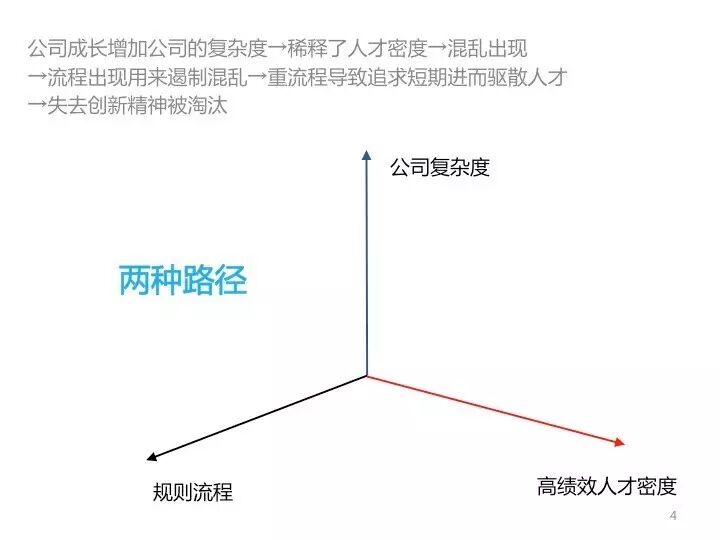
This produces four possible outcomes:
-
Keep the company simple with a small, lean team. But this doesn't really work. A platform company or any company with serious ambitions needs to absorb as many productive factors as possible and become a powerful system. Only high-throughput systems are good systems; only they create massive value. So keeping complexity low and headcount small isn't the answer for anyone who wants to build something significant.
-
The common approach: as complexity rises, increase rules and processes to prevent chaos and mistakes. This solves immediate problems but at great cost. From the perspective of the rule-making departments, finer-grained rules mean fewer problems. But this weakens the possibility of optimal solutions, because real situations are often elastic and fluid. With too many constraints, employees stop looking for the best answer. This is especially damaging when major industry shifts occur and a company can no longer rely on momentum — accumulated rules, processes, and systems become a massive burden.
-
A worse scenario: no processes at all, leading to pure chaos. Companies with processes may be slow and rigid, but they're not chaotic.
-
The alternative approach: raise talent density. Bring in people with strong strategic vision, solid values, and comprehensive abilities. I see the bottom two dimensions as fundamentally in balance. If you hire people with poor comprehension, your systems must be extremely detailed. But with a high-quality talent pool, rules can stay simple — reduced to a handful of principles. People coordinate based on principles rather than step-by-step instructions, or even just by knowing the "goal" and applying common sense.
Of these three dimensions, rules are the easiest to add, since there's always some company to copy. When an industry is relatively stable with fixed models, adding rules works fine — they solidify how colleagues coordinate. But in a dynamic industry, rules create problems by constraining flexibility. This is why many companies falter: they grow, establish rules, then coast on momentum. But when the industry suddenly shifts and major internal adjustments become necessary, those rules become shackles.
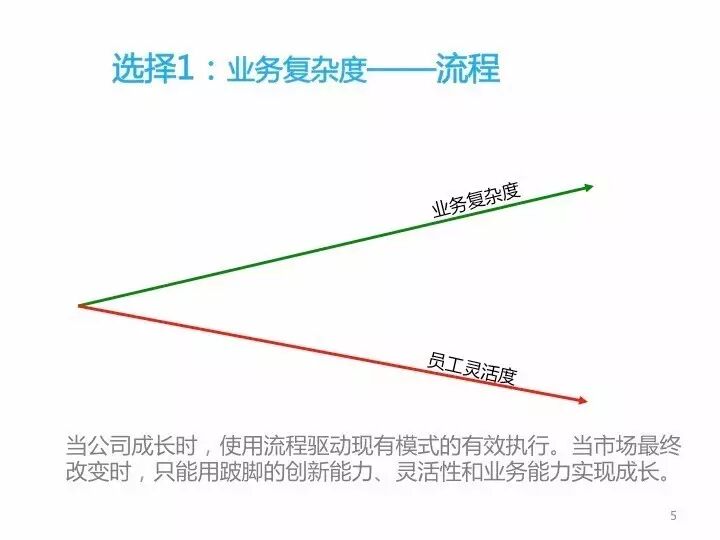
We believe Toutiao operates in an innovative industry that will face constant challenges and changes in the coming years. So we should reduce rules and maintain organizational flexibility to adapt to business evolution.
Our conclusion: as a company grows and its business expands, the key is ensuring that the density of exceptional talent outpaces the increase in operational complexity. We've summarized this internally as "do challenging things with exceptional people." Challenging things are by definition increasingly complex — and you need exceptional people to tackle them.
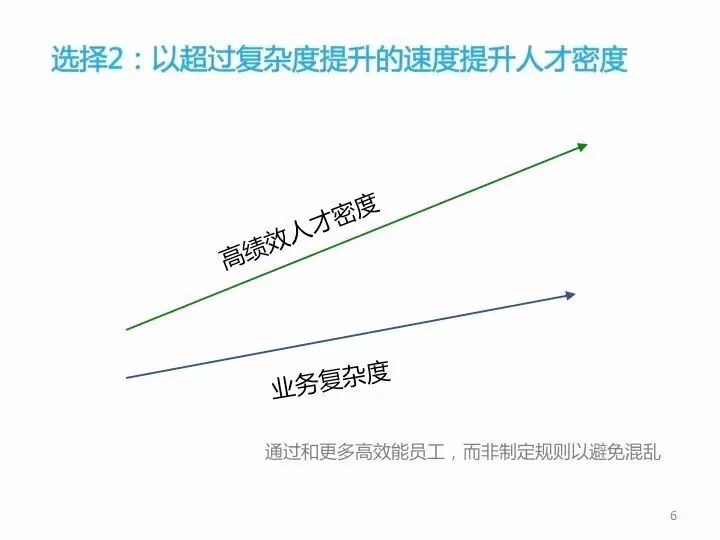
How do you make talent density exceed operational complexity? The talent mechanism has three core components. First, compensation — both short-term and long-term. Second, growth — what they can learn and become at this company. Third, quality of life — they find their work meaningful and enjoyable.
How do you attract the best people? What gives you the right to recruit such talent? Today I'll focus mainly on the first point: beyond meaning and growth, I believe the core is an effective incentive strategy.
First, provide the best ROI. We often see the term "human capital cost." Many companies treat talent as a drain on resources. Especially cost-conscious CEOs think, "I found this person cheap — great." But compare with the United States: labor costs there are extremely high, and Chinese talent moving there typically sees two to three times the compensation. China, India, and Cambodia all have lower labor costs, yet the United States still leads in development. The core reason is that the United States achieves better returns by deploying exceptional talent. So the key metric isn't cost — it's return and output.
A company's core mission is to build the right configuration of productive factors for maximum ROI, and to provide strong ROI for every individual. Thus a company's core competitiveness is its ROI level, not its cost level. As with investing, higher compensation with good ROI means better returns. So we've consistently told our HR team: we want to pay top of market. We actively require HR to benchmark market compensation at least annually and maintain industry-leading pay. Of course, high labor costs in turn demand that we deploy and leverage these people effectively — but this is precisely an aggressive posture.
Second, maintain a high enough ceiling on returns to attract top talent capable of creating extraordinary value at any time. Over the past year or two, I've often heard candidates say in interviews, "Toutiao has already grown so much — the best time to join has passed." We find this frustrating (though I used the same persuasion tactic when recruiting early on). If larger companies can't attract good talent because they all choose startups instead, future competitiveness becomes limited. Early-stage companies typically use stock option plans with high proportions for engineers, but you can't maintain high relative proportions as you scale — there are too many people. How to solve this?
I don't think options are the key. Options are merely one path to potentially outsized returns, potentially financial freedom. The core question is whether you're providing outsized returns, whether you're offering rewards that let people level up. So we believe the focus should shift to increasing year-end bonus proportions. We've told our team internally that we want exceptional performers to have the chance to receive 100 months of year-end bonus. We need them to know that joining Toutiao at any time can yield extraordinarily high returns, with excellent platform resources — more competitive than joining a startup.
I've noticed a problem with front-loaded stock options: they primarily reward investment acumen, not business capability. An individual's returns depend largely on when they joined which company, and whether they chose cash or stock. Someone with outstanding business performance might have had poor personal finances when joining and requested more cash — even if they subsequently perform brilliantly, their returns fall far short. Given the option, I strongly encourage moving more incentives to the back end, to year-end, and making them tied to individual contribution rather than investment foresight.
Third, determine compensation fairly and rationally based on role level and performance evaluation. We've run analyses showing that compensation versus performance often carries various premiums — familiarity premium, new-hire premium, seniority premium, and others. So at Toutiao, monthly salary is set by role level, which represents stable output in a given professional domain. Business leaders don't set compensation — they only define roles. They don't reference historical compensation either; whatever someone earned previously shouldn't influence or distort role-level assessment. HR sets offers based on role level, current supply-demand dynamics, and competitive intensity.
Our annual review should function as a re-interview. If this person were joining today, what offer would you make, at what compensation? If you'd offer a significantly higher level, consider a substantial raise — they've grown rapidly. Benchmark this against the startup market: if they could handle a startup CEO role in the industry, their compensation should look completely different.
Similarly, if someone is underperforming, would you still offer them a role? Demote or let them go? Because internal relationships extend beyond business — personal bonds create familiarity premiums — we want leaders to evaluate this coldly. We even ask managers to imagine: if your direct report told you they had a better opportunity and were leaving, would you feel relieved or genuinely regretful?
A CEO should be an excellent HR leader. If you view the company as a product, there are three primary inputs. First, capital — financial input. Second, opportunity input — information input, what's happening in the industry, what needs to change; this tests the CEO's judgment. Third, talent input. The company's outputs are profit, service, product. Between inputs and outputs lies configuration quality — how effectively you deploy capital, how effectively you deploy talent. This is management. Inputs and management determine outputs. Once business direction is set, talent input deserves the most attention.
Finally, beyond the CEO doing HR well, HR must do HR well. The current state of the industry is that HR has low barriers to entry. I believe HR extends far beyond recruiting — it's participating in organizational management, assisting the CEO and business leaders with hiring and talent deployment. It requires deep thinking about the company and organizational capability. I'd go so far as to say that human resources fundamentally means understanding human resources. If you accurately grasp your business objectives, derive precise understanding of roles from them, and deeply understand talent in the market, then all that market talent is effectively yours — because talent flows. If a company fails to properly understand talent, that talent isn't truly theirs. We often see cases where someone underperforms at one company, then achieves great success elsewhere or in entrepreneurship — showing they weren't that company's talent, because the company failed to understand and deploy them correctly. If I were to set a high bar for HR, it would be the ability to write a book like How Google Works. If HR lacks understanding of how to organize and mobilize for efficiency, and merely handles transactional work like recruiting, they're still far from being excellent HR.
These are my current thoughts. Our company is still learning and striving. I hope to exchange ideas and progress together with all of you. Thank you.