Yi Cao Named "Investor of the Year 2016" by iBlack Horse

The 2016 Chuangye Heima Community Conference was held today in Beijing, where Yi Cao, founding partner of Source Code Capital, was named "Investor of the Year 2016."
The 2016 Chuangye Heima (iBlackHorse) Community Conference was held today in Beijing, where Yi Cao, founding partner of Source Code Capital, was named "Investor of the Year 2016."
The Chuangye Heima Conference is an annual heavyweight event in China's venture capital industry. Niu Wenwen, chairman of Chuangye Heima, said at the conference: "Entrepreneurs are children of winter. These founders who grow up during winter have a natural advantage—they have the optimistic mindset of the internet generation, yet can also integrate deeply with China's industries."
Yi Cao, founding partner of Source Code Capital, presented his core thesis at the conference: invest in major transformations.
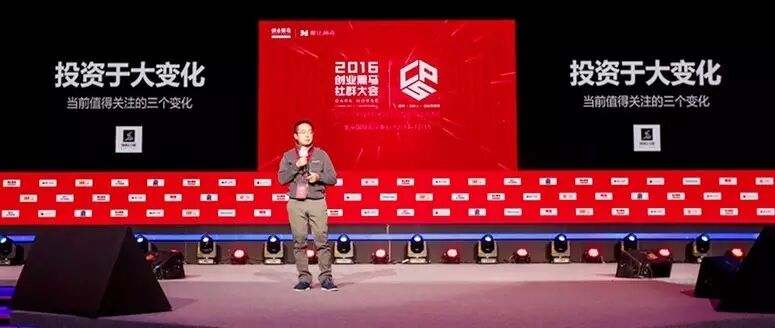
"The biggest problem facing the investment world right now isn't a capital winter—it's an asset winter. Capital isn't scarce; there's plenty of it. The question is where to invest? Where will the next big thing emerge?"
"Opportunity comes from change. Big opportunities come from big changes. And there are still several massive waves of opportunity ahead." Cao believes that future investment opportunities lie in three major transformations: computing platforms, new technology, and globalization.
Full transcript of the speech:
Just now, both Mr. Chen (Hong) and Mr. Zhou (Yahui) mentioned two crucial keywords for investors: first, the capital winter; second, how to capture outsized opportunities worth a billion or even ten billion dollars.
Today I'd like to briefly build on their points and share some of my own observations. How should we invest during a winter? Where might we find opportunities worth ten billion, or even a hundred billion dollars?
First, the capital winter. I remember at one conference, someone asked me about it. I told them that the biggest problem in the investment world right now isn't a capital winter—it's an asset winter.
Capital is actually abundant. Over the past 15 years, China's VC and PE industry has developed. Initially it was money from the United States, Japan, and Singapore. But in the past five years, three enormous forces have entered:
First, domestic A-share listed companies, including Mr. Zhou Yahui here with us today. With 3,000 listed companies, there's strong demand and supply pouring into equity investment markets.
Second, roughly fifteen core internet companies worth tens or hundreds of billions of dollars, investing heavily in VC and PE.
Third, institutional capital—central government, local governments, state-owned enterprises, and traditional financial institutions.
So capital truly isn't scarce; there's plenty of it.
But the big question now is how should we invest? Where will the next big thing emerge? The asset winter is the biggest problem. I do think it exists, but I believe it's temporary—a brief transitional period.

There are still several massive waves of opportunity ahead. I believe we need to spend the next three to five years studying and preparing for them.
First, opportunity comes from change. Big opportunities come from big changes. More broadly, as many of you have read in Harari's Sapiens, human history is essentially a history of massive transformations. Several enormous changes define humanity's major stages: the Agricultural Revolution, the Industrial Revolution, the Age of Exploration and global trade, the Electrical Revolution, the Information Revolution, and the Biological Revolution. The Agricultural Revolution transformed humans from hunter-gatherers to settled communities organized around villages. The Industrial Revolution created social division of labor. The Age of Exploration enabled trade—especially global trade—after specialization, which was crucial. We'll return to the Age of Exploration and stages of globalization later. Then came the Electrical Revolution.
What we've experienced over the past forty to fifty years, and what will continue for the next twenty to thirty years—perhaps a full century—is the Information Revolution, alongside the life sciences revolution where information and biology converge.
So Sapiens is really a history of massive transformations. These great changes drive human evolution across spans of centuries and millennia.
Focusing now on the information and technology industries: what changes are occurring? Which changes will create which big opportunities? Changes come in large and small varieties, like waves—long waves, medium waves, short waves. Different magnitudes of vibration, extending from the underlying layers to application layers, create different magnitudes of change. So we need to study where the big changes are happening, and devote more time, energy, and capital to them.
01
Transformation One: Computing Platforms
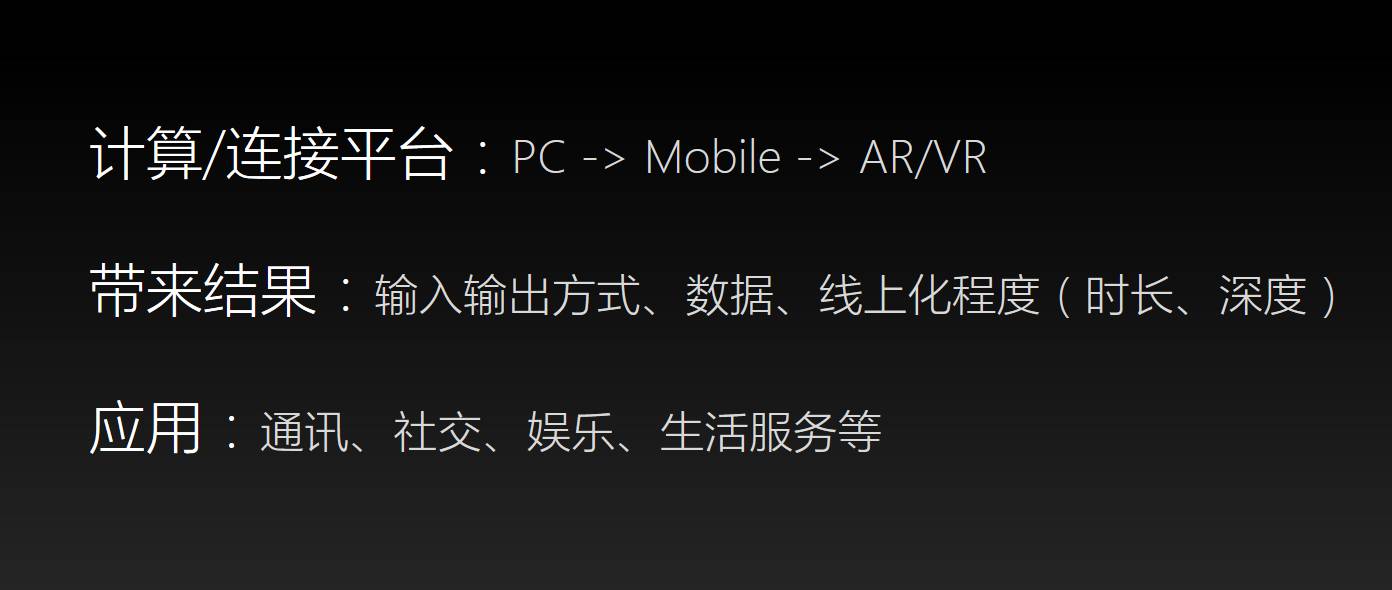
Declining computing costs continuously amplify the information revolution, driving ever-higher penetration. Driven by Moore's Law, computing, transmission, and storage costs keep falling. This foundational change at the core layer continuously propagates upward, creating IT-driven transformations across every industry. As costs drop, both enterprises and individuals can leverage information tools to solve problems and improve efficiency at very low cost. Every 10-15 years, major computing platform opportunities emerge.
PC internet gave birth to the three major portals and BAT. When mobile internet arrived, some companies successfully migrated from the southern to the northern hemisphere—BAT and certain e-commerce companies, for instance. But others failed to make the transition, enabling new startups to capture fresh industry positions on new platforms and new starting lines.
Looking at the next major computing platform: when it arrives, where are the incremental opportunities? Where are the existing players that succeeded in mobile but may not grasp the new platform? AR platforms, for example, will create enormous opportunities for startups.
Therefore, the result of this underlying transformation is what we call "Three Horizontals, Nine Verticals"—applications and opportunities across nine vertical sectors will undergo dramatic change. Some companies will successfully migrate from mobile, such as in IM, where Tencent might launch a new AR product and continue dominating communications. But it's also possible that a new company will seize the new platform, new user needs, and new opportunities under changed conditions—including in entertainment and comprehensive services.
The extension of computing platforms changes input and output, bringing them closer to people. Phones brought us closer than PCs did. New platforms like AR could keep us online except when sleeping—perhaps even while sleeping—completing massive data input and output. And the display quality, input dimensions can multiply. So I believe this deserves attention over the next 5-10 years.
On one hand, we should watch who can build the AR/VR platform—who will be the Apple, Android, or Xiaomi of AR/VR. But more importantly, as AR/VR begins rapid growth, we should watch the major applications within it: communications, social, entertainment, e-commerce for daily necessities.
We divide "internet plus" into three stages: PC internet, mobile internet, and AR/VR. To analyze the changes AR/VR will bring, we should look back at what the previous two stages accomplished. PC and mobile internet created enormous value in two ways:
1. Making existing industries more efficient. By extending management reach, service radius, and capital radius, large traditional industries became more concentrated. What might have been one or two thousand companies eventually consolidated into one or two covering the entire industry's services. In other words, large companies in existing markets could grow larger, absorbing fragmented market participants through extended service, management, and capital reach, turning them into their own territory and creating even larger companies. This is the existing market.
2. Activating incremental markets. When resources are used more efficiently and better products emerge, incremental markets are stimulated as well. These are the changes PC and mobile internet, as computing platforms, brought to the business world. The same will happen on AR platforms—because of higher user engagement, longer user time, and greater information input and output, the impact will exceed what mobile internet achieved.
02
Transformation Two: Declining Population, Rising AR

Globally, except in developing countries like those in Africa, populations are declining and aging. Meanwhile, ARPU per person is rising. A very practical question: where will the supply of these products and services come from? New solutions are essential—artificial intelligence must meet this supply.
And economically, this supply transfer is highly efficient, because AI-driven supply is cheaper than traditional supply. So this scissors gap inevitably creates enormous room for AI-generated value.
When populations were large, productivity relatively low, and supply demands modest, the need for AI was less intense. Now AI faces both strong demand and strong supply—GPU and other infrastructure have matured.
So in the next step, many professions will be replaced. The coming 10 to 15 years are ones we should devote significant time to studying.
Today, internet and TMT investors, myself included, who previously invested in internet, are now investing in more technologically intensive companies—AI-driven ones, new VR/AR platforms. This presents many challenges. It requires substantial time, focused and patient learning, while waiting for the next big opportunity.
03
Transformation Three: Globalization
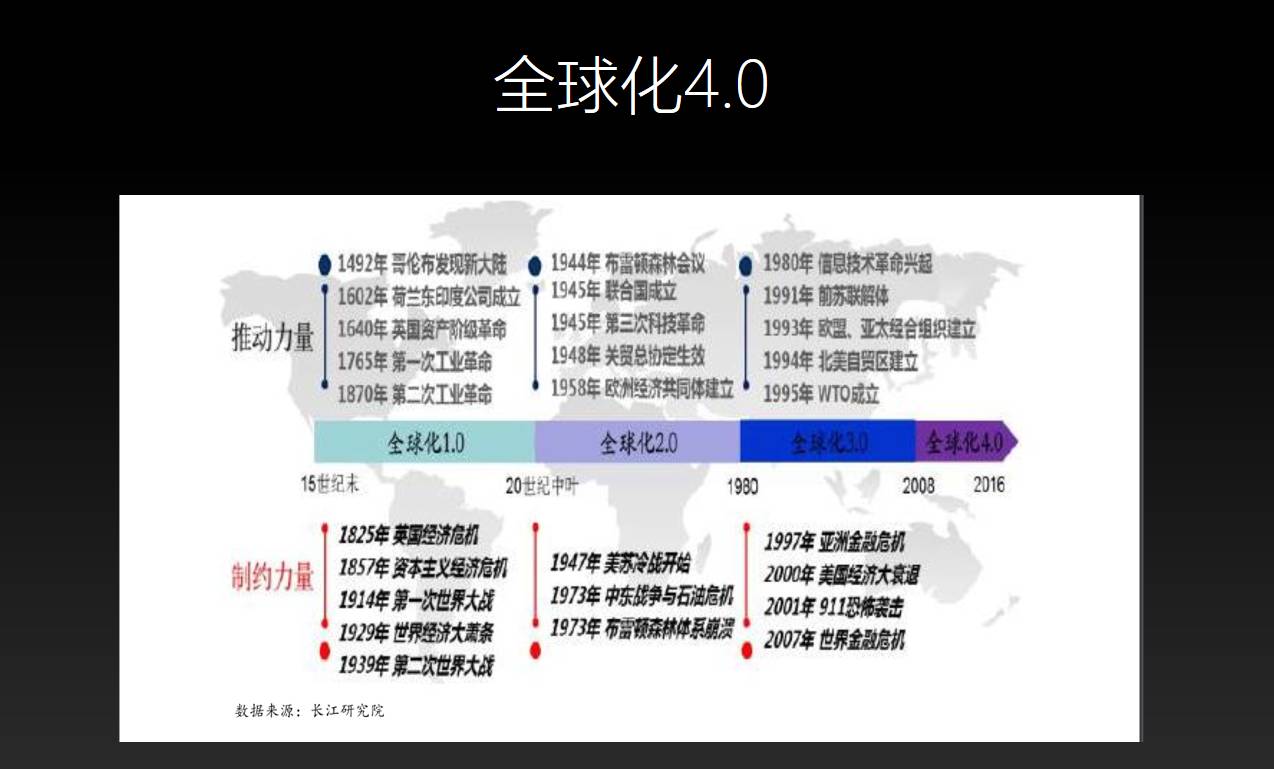
Globalization began in Europe. The Netherlands initiated it, seizing global markets. Later Britain became the empire on which the sun never set, then after World Wars I and II, the United States came to dominate.
Past globalization did create many problems—uneven distribution, competition between lower classes in developing nations and middle classes in developed countries, with the latter suffering greatly.
Now, with Trump's rise in the United States promoting populism and anti-globalization, this creates excellent timing for China and Chinese companies. Of course, Chinese companies' globalization will also take considerable time; each stage spans decades or even centuries. In this Globalization 4.0 process, we need a long-term perspective: first, underlying supply—China has excellent entrepreneurs, excellent resources, and a massive home market. Second, favorable external macro conditions—the United States is retreating, creating opportunity for China to advance. Going forward, Chinese companies will certainly occupy important positions in the global digital and technology-driven sector, able to stand as equals with the United States, even surpass it in some areas.
These major transformations represent incremental opportunities we should examine. Each major change creates very real value, and these changes will persist for extended periods. It may take decades before the next great transformation supersedes these. This is the source of our returns.
Finally, value comes from new resource development and more efficient resource allocation: first, new things can be produced at lower cost—electrical appliances, PCs, phones, general merchandise. Second, these resources can be better allocated—smoother trade, more symmetric information, more efficient overall resource allocation. Both generate enormous value.
The current venture capital environment does present significant challenges for every VC and PE investor. These three major transformations all diverge from our previous experience; they require tremendous effort to expand our boundaries. AR/VR, artificial intelligence, and other new technologies have many underlying elements to grasp and learn; globalization involves vast amounts of information unfolding.
These three transformations present major challenges for investors. To embrace them, we must devote substantial time and patience to relearning. As long as we invest heavily in learning, spending our time where it matters most, we should have the opportunity to capture the big opportunities these three major transformations bring.
Thank you all!