Yi Cao of Source Code Capital Named Cyzone's 2016 China Angel Investor of the Year

Yi Cao emphasized that great companies and outstanding investors succeed by capturing the convergence of three peaks: "the right timing, the right place, and the right people."
The "Cyzone 100 Future Leaders Summit & 2016 Cyzone Annual Conference" concluded today in Beijing, with Yi Cao, founding partner of Source Code Capital, named "2016 China Angel Investor of the Year."

▲ Yi Cao (left), founding partner of Source Code Capital, named 2016 Angel Investor of the Year
Cyzone's citation:
He entered the venture capital field 12 years ago and has focused on the TMT industry for many years, participating in investments spanning multiple sub-sectors: financial internet, industrial internet, service internet, and internet companies going global.
In 2014, he struck out on his own to establish a new investment institution, managing $500 million and 1.5 billion RMB. In its two years of operation, it has invested in representative "Internet+" and "Intelligence+" companies including Qufenqi, Yongqianbao, Yijiupi, CHJ Automotive, and Toutiao, making him a standout among early-stage investors born in the 1980s.
Therefore, we award the 2016 Cyzone Investor of the Year to Yi Cao, founding partner of Source Code Capital.
Cyzone has presented the "China Angel Investor of the Year" award since 2008, with only one recipient selected annually. Lei Jun, Zeng Liqing, He Boquan, Bob Xu, Cai Wensheng, Lin Dongliang, Wu Jiong, and Wang Gang have previously been named "China Angel Investor of the Year." Over the years, the selection and presentation of this award has become an annual highlight of China's angel investment community. In his subsequent keynote speech, Yi Cao shared three insights from his 12 years in venture capital.

▲ Yi Cao shares his insights on venture capital
The following is a transcript of Yi Cao's speech:
Thank you, Cyzone. Finding out that Wang Gang would be presenting the award to me — the pressure was immense. Speaking after Wang Gang — even more pressure. Receiving this award truly makes me tremble with caution. We've done reasonably well these past two years, but there are many predecessors and peers who are exceptional. Later I found a rationale for myself: Cyzone is encouraging the third generation of China's venture capital community, and I'm here to accept this award on behalf of that group.
I'm something of a veteran in the venture investment industry. Though not old in years, I stumbled into this line of work in 2004. Wang Gang just spoke about many of this industry's problems — we didn't coordinate beforehand today. I hope my reflections and thoughts on this industry can help restore some of everyone's passion and confidence in it.
01: Equity Investment Is Moving From Alternative to Mainstream
First point: the equity investment industry is moving from alternative to mainstream. When I first entered the industry in 2004, there were just over 10 active funds, mostly fly-in VCs from the United States, Singapore, Japan, and Europe, with a small number of domestic ones, investing no more than $1 billion annually. But by 2015, there were over 2,000 venture capital institutions in the market, investing more than $50 billion each year. So in 10 years, more than 50x growth.
Beyond enterprises, both government and the general public are participating in the "Internet+" wave. When I first started, VC was a very small financial category. Today it has become increasingly mainstream — the core zone of innovation, entrepreneurship, and finance. When I graduated, my computer science classmates going to Baidu, Tencent, and Alibaba were getting 15,000 to 20,000 RMB salaries; I made only 7,000 doing VC. This is what I personally experienced. I stumbled into the venture capital industry by accident, never expecting that over the past 10 years it would become a mainstream financial category, even a mainstream social activity and behavior. Understanding how and why this happened — I see it at two levels, macro and meso:
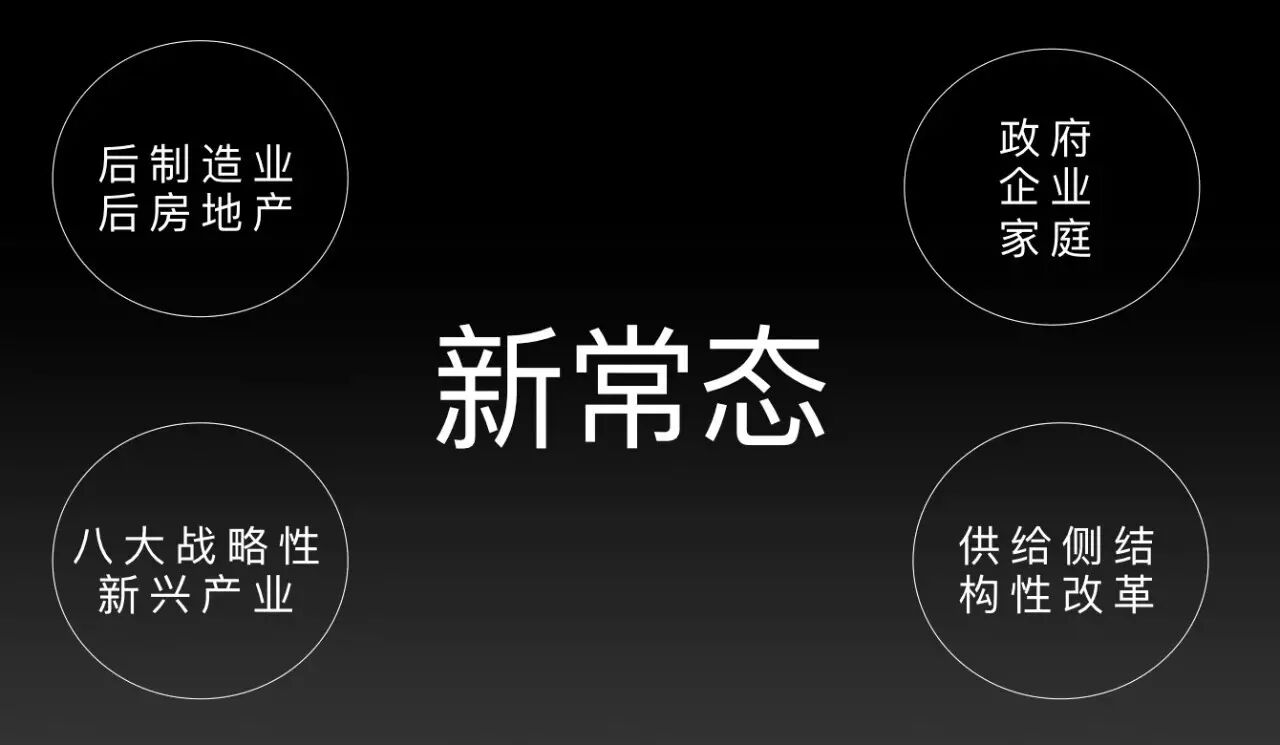
At the macro level, everyone knows the term "new normal," proposed by General Secretary Xi in 2014. The economy has entered a period of overlapping challenges, a post-manufacturing, post-real estate phase, with growth entering a relatively stable rather than exceptionally high-speed development stage. Against this backdrop, what are the main participants in the economy doing?
For government, it is promoting support for the eight strategic emerging industries. For enterprises, we see both state-owned and private companies shifting from growth models based on investment and demand to ones driven by technology and higher-quality supply. For households, China's growing population of high-net-worth individuals, accumulated over 30-plus years of reform and opening up, are reconfiguring their wealth — from manufacturing, real estate, and mining toward the new economy. In this macro context, massive funds from government, enterprises, and households all seek new destinations. After real estate and manufacturing, what is the next pillar? Macro-level, we have the "eight strategic emerging industries" and "supply-side structural reform."
At the meso level, I focus more concretely on the information industry. As a crucial component of the "eight strategic emerging industries," this is an industry I have consistently participated in. The information industry's penetration into every sector of the national economy represents an enormous extension capable of addressing inventory reduction, deleveraging, and overcapacity across industries. Because it is inherently a process of optimizing resource allocation. Once information technology penetrates an industry, it can bring resource allocation optimization, overcapacity reduction, inventory reduction, and deleveraging benefits.
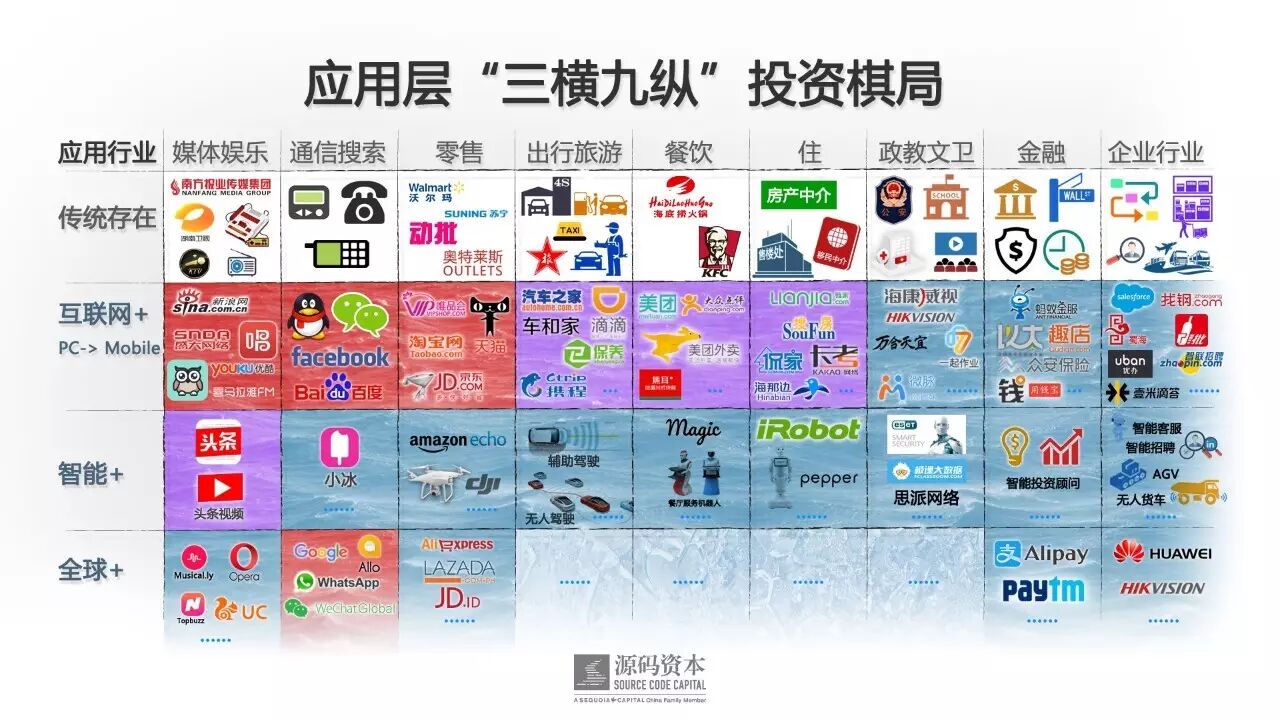
When I first entered the investment industry, I started from the top-left corner: "PC Internet + Entertainment Media" and "PC Internet + Information & Communications." From 2004 to now, all nine boxes in the first row have been filled, and the second and third rows are gradually penetrating from left to right. This is the meso perspective.
We ourselves analogize "Internet+" as "Market Economy 2.0." The 1.0 version is intuitively manifested in numerous marketplaces — 2C convenience stores, grocery shops, department stores, large commercial complexes; 2B various wholesale markets for clothing, electronics, fabrics, fast-moving consumer goods, and so on. These offline presences will gradually move online, with fewer and fewer offline marketplaces remaining. So it is offline resource allocation moving online, and after going online, resource allocation efficiency improves significantly.
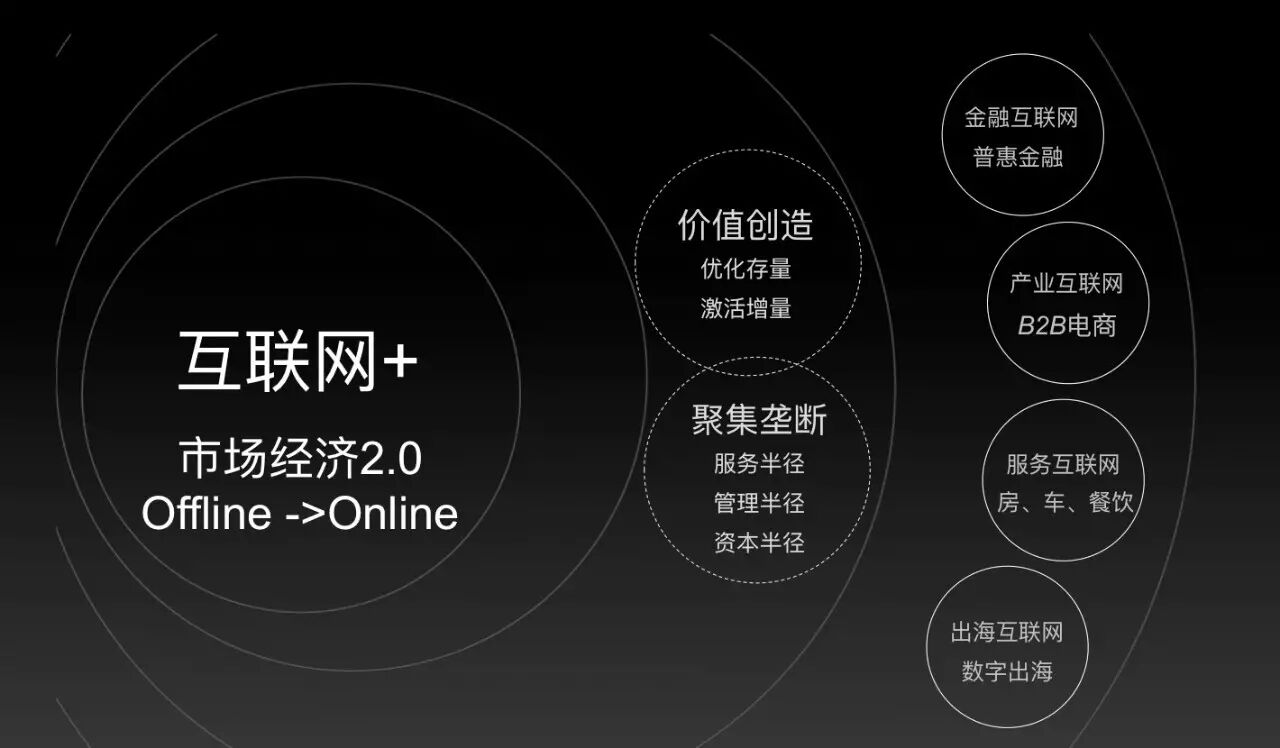
How does this allocation efficiency improvement occur? How do large companies emerge from this efficiency improvement? Three elements:
First, service radius. For example, a travel agency serving several hundred or a thousand clients was already quite good. Serving customers required answering phones, executing various processes. But starting with Trip.com Group, it used information products for front-end customer acquisition, effectively handling customer needs; back-end, it used information systems to integrate service capabilities at scale. It made the service radius enormous — large enough to cover the entire industry. Originally, small service providers offered travel intermediary services, but with information technology tools, the service radius could become massive. This is the first element that allows winner-take-all large enterprises to emerge in an industry.
Second, management radius. Through various information systems, a company's management capacity also expands. More people can be managed, and more importantly, employee efficiency improves dramatically — each employee creates greater value through information systems.
Third, capital radius. Originally, financial markets were bank-dominated, with banks mainly offering collateralized loans. But with venture capital and equity investment, leading companies can access equity financing. Companies like JD.com, Meituan, and DiDi have raised billions or tens of billions of dollars, then used that to consolidate smaller players in their industries.
These three elements allow companies to become larger after going online, and industry concentration to become very high. What value creation does this bring? Summarized in two aspects: first, optimizing existing stock — making original economic activities more efficient, lower-cost, and higher-quality. Second, activating incremental growth. After optimizing costs, because costs are lower, service is better, and service radius is larger, more previously unmet demand can be better, more cheaply, and more readily served anytime, anywhere. So it is a process of activating incremental demand. These two elements are where "Market Economy 2.0" most improves upon 1.0: making existing economic activities more effective, stimulating incremental unmet markets, and making resource allocation more efficient.
02: Investing in Big Changes
Second insight: invest in big changes.
Changes appear in massive quantities every day. Using the body as an analogy, some changes appear at the nerve endings — like a small bump on the skin somewhere, a bit itchy, scratch it and it passes. Some changes come from inside the body, like your body getting healthier, your respiratory system improving. The most fundamental is when the brain changes, when cognition changes. Depth, breadth, and height change. Industrial changes are more dramatic than bodily ones. Some changes are so large you must devote your maximum time to them, rather than allocating too much time to small changes.
Consider several major changes in human history: first the Cognitive Revolution, then the Agricultural Revolution, then the Industrial Revolution, then the Great Voyages and geographical discovery, then the Electrical Revolution, the Information Revolution, the Biological Revolution — over five thousand years of human history, each revolution lasting hundreds or even thousands of years. We are now in the Information Revolution. Where should we devote significant time? At what point in time do certain major elements have enormous impact, perceptible earlier in their infancy?
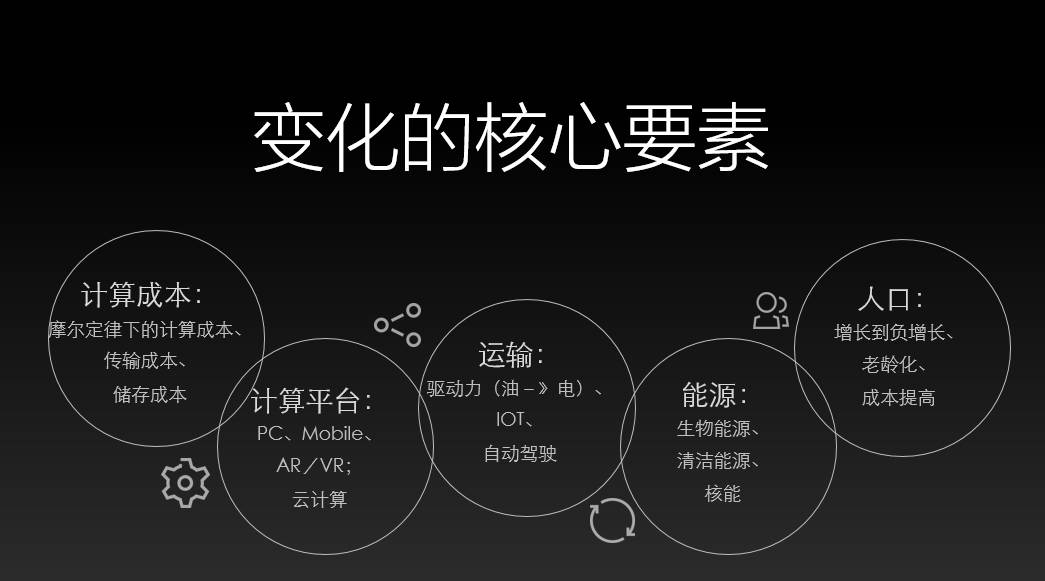
Several core elements of change:
First, computing cost. CPUs, GPUs, memory, disk drives and so on, driven by Moore's Law — computing costs halve every 18 months, with transmission and storage costs following suit.
Second, computing platforms. Computing platforms divide into two ends: client-side and server-side. Client-side is well understood: earliest Apple computers and IBM PCs; then in 2007, smartphones represented by iPhone became the new computing platform, surpassing PCs over the past 8-9 years to occupy the mainstream computing platform position. Over the next 10-20 years, new computing platforms are gestating, with AR platforms being the most likely significant possibility. This is client-side change — pay attention to when AR's water temperature rises and gradually matures. Server-side has also changed significantly: originally each company built its own network servers, rented virtual hosts. Now cloud computing普及 represents a more efficient server-side approach, maximizing a company's ability to acquire computing resources without boundaries — a very important computing platform shift.
Third, transportation. Why is transportation so important? It corresponds to electronic computing power. The increase in electronic computing platforms and computing power represents the evolution of light-speed transmission media like electrons and photons. Transportation is the evolution of atomic movement — the process of moving an aggregate of atoms, like an apple or a cup of water, from point A to point B. Several major changes: first, power drive shifting from oil to electricity; second, IoT — transportation equipment being connected to networks, such as passenger vehicles with DiDi connecting through mobile phones, and now freight vehicles also being connected online, laying good groundwork for autonomous driving. This is the goal of technological evolution in transportation: reducing the cost of moving something from A to B, increasing transportation speed, and gradually approaching 100% accessibility.
Fourth, energy. Evolving from biological energy to renewable clean energy, now breaking through controllable nuclear fusion energy.
Fifth, population. This element has also reached a turning point at this stage. For thousands of years it trended consistently upward; China's internet economy has been driven by demographic dividends. But now this dividend is entering a turning point, beginning to change: from growth to negative growth, aging population. The changes this brings: shrinking working-age population, rising labor costs, reduced innovation density; shrinking demand as well.
These are core elements of change, and they will bring enormous opportunities. If we focus on big changes, we have the opportunity to seize big opportunities; if we focus on small peripheral changes, we may only capture small opportunities — this is roughly how it divides. Excess returns come from persistent, genuine value creation. Short-term, insubstantial value creation may cause some companies to spike for a year or two then fall back down. Internet value creation mainly comes from developing new resources and optimizing allocation of existing resources. Investing in big changes, allocating time to big opportunities gestated by big changes — this is the task and goal we investors must contemplate, practice, and optimize daily. This is my second insight.
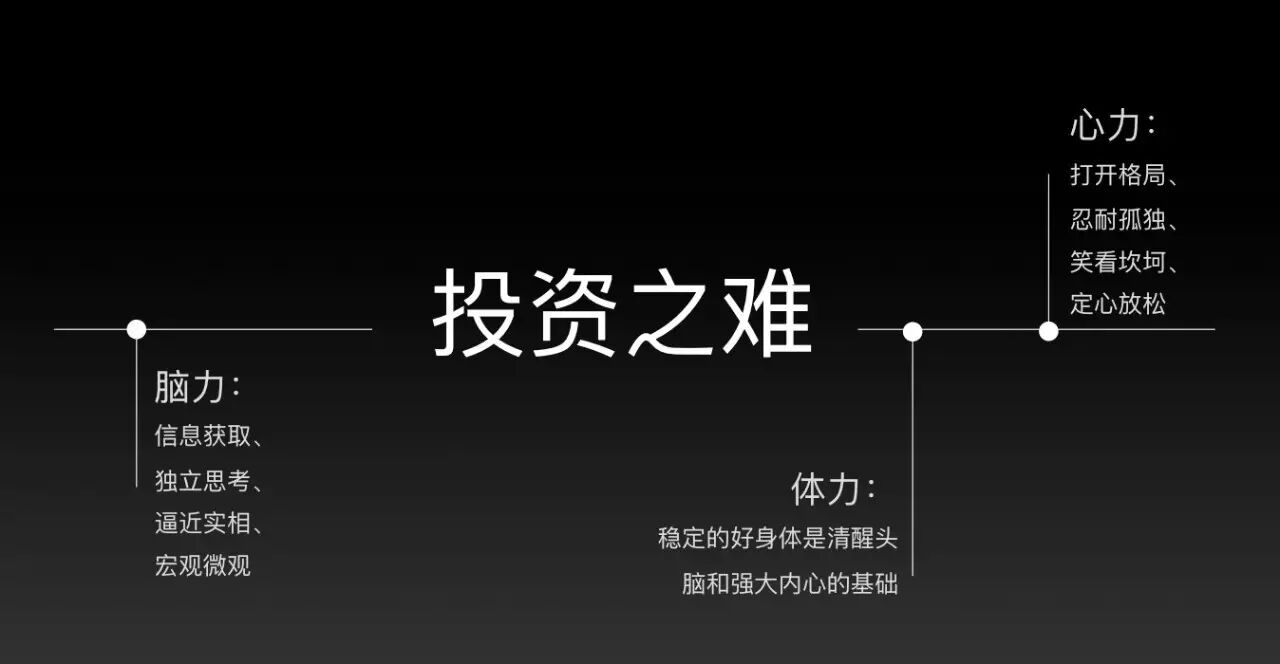
03: The Difficulty of Investing
Third insight: the difficulty of investing.
Seizing big opportunities is genuinely difficult. This difficulty comes from three aspects: mental capacity, physical stamina, and inner strength. This came from an entrepreneur. Building a $100 million, $1 billion, $10 billion, or $100 billion company requires different levels of mental capacity, physical stamina, and inner strength. We are entrepreneurs behind many entrepreneurs, so to some extent how large an investor can become also depends on how much energy your mental capacity, physical stamina, and inner strength can store.
1. Mental Capacity
Investing is about making decisions, a process of continuously improving cognition. This cognition must first come from good information acquisition methods, establishing high-quality primary and secondary information sources.
At the same time, independent thinking. After acquiring information, you must have the ability to think independently about problems. The external noise is enormous — it can pull you north today, south tomorrow.
Approaching reality is a painful process. You often feel that last month you had reached great heights in understanding something, thought it was a period. But two months, three months, half a year later, that cognition is backward or completely wrong — a hard slap to your own face. The path to approaching reality is arduous, with many pitfalls, ups and downs.
The span from macro to micro is also difficult. Deeply immersing in an industry, your cognition focuses very narrowly. But if you only have depth, you neglect macro changes, climate changes,赛道 changes, and cannot comprehensively view a thing's development. So you need cognitive ability and perspective across macro, meso, and micro dimensions — also a great challenge. Some people excel at micro, others at macro; a good investor needs thinking and cognitive capabilities at all three levels.
2. Inner Strength
Inner strength is about how large your heart is, how strong your heart is. How large your heart is determines whether you can identify and embrace enormous things. Even when they are still early, you can identify them, and have great patience and tremendous passion to accompany this big change, growing with it from seedling stage.
This process requires enduring much loneliness, because your judgment differs from 99% of the market, and this period may be very long. For example, Warren Buffett from the internet bubble's recovery through the 2008 financial crisis did not generate excess returns like most hedge funds, and faced much criticism. But he endured this loneliness, and in the 2008 financial crisis became the big winner — others went down, he went up. Enduring the loneliness of the process.
Smiling at setbacks. Smiling at ups and downs — invested companies are like children to investors. Every child has ups and downs, let alone having 20 or 30 children. So many setbacks to accommodate and accept.
Finally, settling the mind and relaxing. To seize big opportunities you must settle the mind and relax. If your mind is drifting, restless, short-term, rash; if body and spirit are tense and rigid — then some small yet significant sounds from afar cannot reach your eyes, your ears, and you cannot achieve the process of "eyes arriving, heart arriving, hands arriving."
3. Physical Stamina
Physical stamina is the foundation of mental capacity and inner strength — when the skin is gone, where can the hair attach? Physical stamina supports clear mind and strong heart; you must carve out time to exercise, maintaining a positive state.
The great enterprises of today and the outstanding investors they have produced have all seized the superposition of three wave peaks — the convergence of favorable timing, advantageous terrain, and harmonious people. If misaligned — one at a peak, another in a trough — you certainly cannot reach the greatest heights. A person is only 1.7 or 1.8 meters tall, with limited energy, limited work possible in a day. But what you do at what time, in what position — this relative height creates enormous differences between you and others. The intensity of these three factors differs by orders of magnitude: the amplitude of harmonious people is 1 kilometer, the amplitude of advantageous terrain is as long as the equatorial radius, the amplitude of favorable timing is enormous — 1 light-year. So if you can superimpose these "three waves," your height is a $100 billion or $1 trillion company. But if you do the wrong thing at the right time, or the right thing at the wrong time, no amount of effort can achieve great heights.
Here I have shared my three insights. These insights come from my practice over the past 12 years, and bit-by-bit reflection. In today's overall domestic and international environment, we are extraordinarily fortunate. I am also firmly optimistic about China — I believe China can achieve the great rejuvenation of the Chinese nation in our generation. In this great era, resonating with our times and our country, utilizing technology and capital's power to transform every major industry, to create persistent, genuine value. I am filled with unlimited passion for my industry and my work.
Thank you!